1.1.1 - Static Field Hazards
Static Field Hazards
What you’ll learn
- DOMAIN: Safety and Screening -> Static magnetic field risk recognition — Identify the major hazards created by the always-on main magnet.
- DOMAIN: Safety and Screening -> Ferromagnetic control — Distinguish projectile risk from torque and translational attraction.
- DOMAIN: Patient Care -> Screening workflow — Choose the safest technologist response when patient, visitor, or equipment screening is incomplete.
- DOMAIN: Workflow and Professional Decision-Making -> Scope-based escalation — Recognize when to stop, clarify, consult, or deny access rather than proceed.
- DOMAIN: Image Production and Safety -> Environment awareness — Relate field strength, fringe field, shielding, and zone control to daily MRI practice.
Blueprint mapping
- Safety and Screening → MR environment risks → static field hazards
- Safety and Screening → access control → ferromagnetic object prevention
- Patient Care → pre-exam screening → discrepancy recognition and escalation
- Workflow/Professional Judgment → scope limits → consult MR safety leadership when needed
Why it matters
- The static magnetic field is always present; unlike gradient or RF exposure, the risk exists even when no sequence is running.
- Many exam stems test the safest next technologist action, not physics trivia: stop, clarify, remove, restrict entry, or consult.
- Projectile events are among the most dangerous MRI accidents because they can injure patients and staff within seconds.
- Static field hazards commonly appear with screening errors, incomplete documentation, visitor access problems, and mislabeled equipment.
Key Terms & Must-Know Facts
1.1.1.1 Key terms
- Static magnetic field (B0): The constant main magnetic field produced by the MRI magnet.
- Fringe field: Magnetic field extending outside the bore and magnet housing.
- Ferromagnetic: Material strongly attracted to a magnetic field.
- Projectile effect: Rapid acceleration of a ferromagnetic object toward the magnet.
- Translational attraction: Pulling force drawing an object into a region of stronger field.
- Torque: Rotational force attempting to align an object with the magnetic field.
- Isocenter: Central point of the magnet where the field is most uniform.
- Gauss line: Boundary line representing a specific magnetic field strength in space.
- 5-gauss line: Common controlled boundary used in safety planning for public exposure control.
- MR Safe: Item poses no known hazards in all MRI environments.
- MR Conditional: Safe only under specified conditions.
- MR Unsafe: Item known to pose hazards in MRI.
- Zone control: Restricted access model used to control entry into MRI areas.
- Screening discrepancy: Any mismatch between history, documentation, device label, or observed equipment.
1.1.1.2 Must-know facts
- The magnet is always on in normal operation.
- Static field risk begins before imaging starts.
- Projectile risk is greatest with ferromagnetic loose objects.
- Large equipment is not the only danger; small items can become high-speed projectiles.
- Torque matters most for certain implants and elongated ferromagnetic objects.
- The technologist should not independently clear uncertain implants outside policy.
- If screening is incomplete, the safest action is usually do not proceed until clarified.
- Visitors, staff, and non-patient equipment require screening too.
- Field strength and proximity both influence hazard severity.
- Local protocols vary; confirm with your institution.
| Term | What exam stems are really asking | Technologist action |
|---|---|---|
| B0 static field | Is the hazard present even when not scanning? | Yes; maintain control at all times. |
| Projectile effect | Could this item fly into the bore? | Keep ferromagnetic items out of controlled areas. |
| Torque | Could the field rotate this item or implant? | Verify device conditions or escalate. |
| Fringe field | Can danger exist outside the scanner room center? | Respect marked boundaries and zones. |
| MR Conditional | Can it enter under every circumstance? | No; confirm exact conditions first. |
| Screening discrepancy | May I continue if one part of history conflicts? | No; stop and clarify. |
Core content
Exam takeaway: Separate always-on field risk, projectile risk, and implant uncertainty before choosing the next step.
flowchart TD
A[Static magnetic field is always on] --> B[Loose ferromagnetic object]
A --> C[Implant or device]
A --> D[Unscreeened person or equipment]
B --> E[Projectile / translational attraction]
C --> F[Torque / displacement concern]
D --> G[Stop entry and screen]
E --> H[Remove item before approach]
F --> I[Verify MR label or escalate]
G --> J[Restrict access until cleared]
Exam takeaway: When screening information is incomplete, the safest technologist action is to stop entry and clarify rather than proceed.
flowchart TD
A[Person or equipment approaches MRI area] --> B{Screened and documented?}
B -- Yes --> C{MR Safe or approved MR Conditional?}
B -- No --> D[Do not allow access]
C -- Yes --> E[Proceed per policy]
C -- No or uncertain --> F[Remove item or consult MR safety leadership]
D --> G[Clarify before entry]
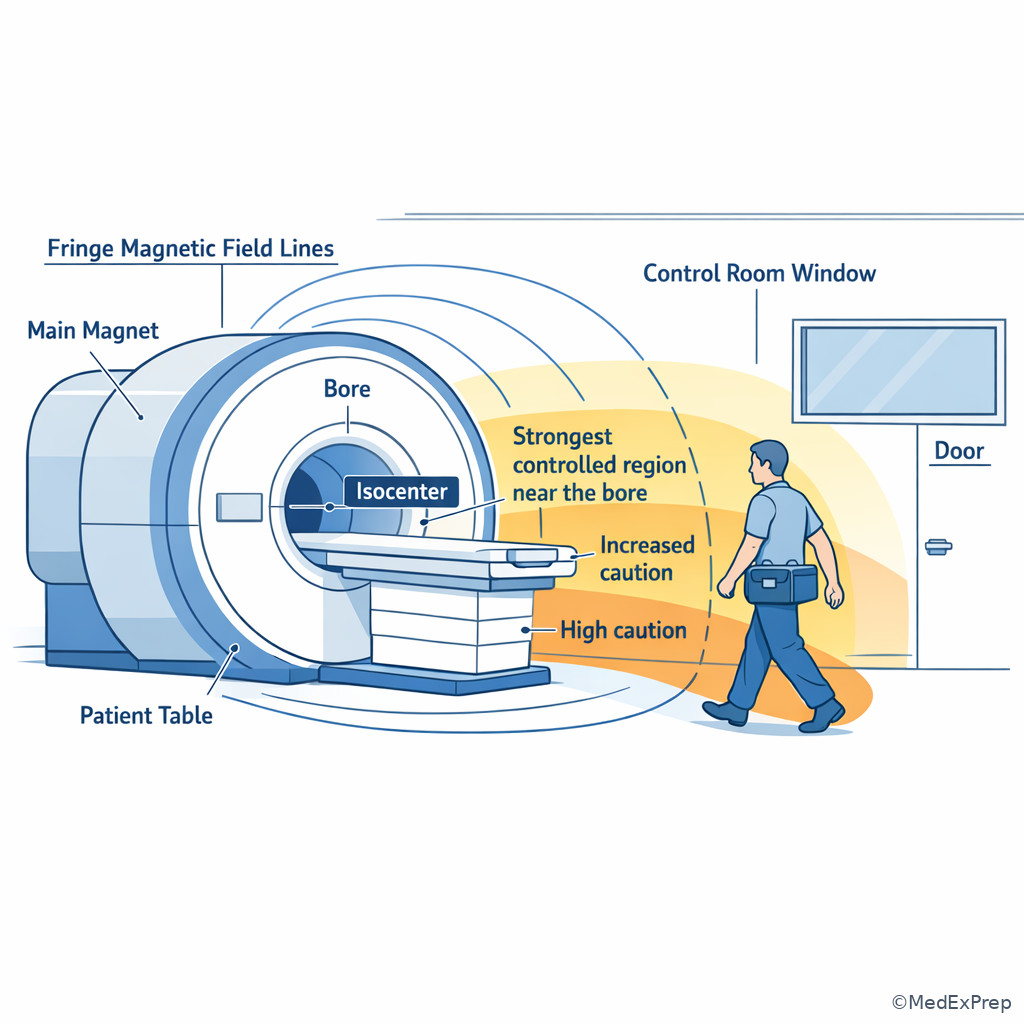
F --> G Exam takeaway: Visualizing the field outside the bore helps prevent the mistake of assuming danger exists only during active scanning.
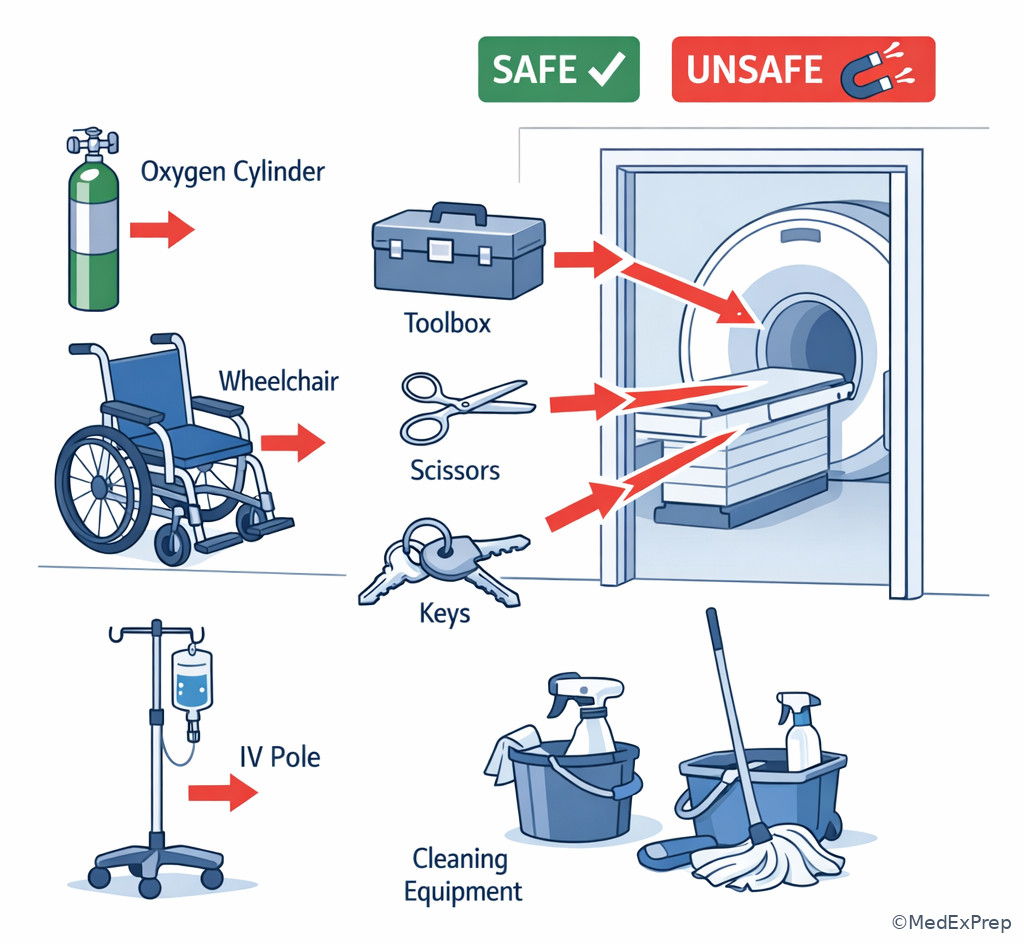
Exam takeaway: Everyday items such as oxygen cylinders, floor buffers, and tools can become life-threatening projectiles in the MRI environment.
1.1.1.3 Foundational hazard: the magnet is always on
A Explanation
The first decision conflict on exam stems is usually simple but heavily tested: Do you act as if risk starts only when the scan begins, or do you act as if risk exists whenever the magnet is energized? The correct rule is that the main magnetic field is continuously present in normal operation. That means a patient being positioned, a visitor stepping near the door, or a cleaner bringing equipment toward the room may already be in danger before a single pulse sequence is selected. The single finding that resolves the decision is the presence of the always-on static field.
WHY THIS IS TESTED: candidates often overfocus on RF heating and gradient noise, but the earliest safety error in real workflow is uncontrolled entry into the static field environment. When the stem asks for the most appropriate next step, choose the action that recognizes the field is active now, not later.
Choose restrict, screen, and remove hazards when any person or object approaches the magnet environment. Reject “just start the scan and monitor” when the risk is a static field issue rather than a sequence-dependent one. If the issue involves uncertain device status or an item with no verified MRI labeling, the technologist’s role is to stop and verify or escalate, not to improvise clearance. See Fig 1.
B Worked example
A 62-year-old man presents for routine brain MRI. He has hypertension, diabetes, and chronic knee pain. He is anxious but cooperative. While he is being positioned, his spouse opens the scanner-room door carrying a handbag, keys, and a cane with an unknown metal shaft. A distracting detail in the stem is that the patient says he already had “many CT scans without problems.” The tempting but wrong clue is that imaging has not started yet, so some learners assume there is no immediate risk.
Reasoning chain: identify task — safety action before imaging. Extract key facts — live MRI environment, unscreened visitor, unknown metal items, active positioning phase. Apply rule — static field risk exists before image acquisition. Eliminate distractors — do not continue setup, do not merely tell the spouse to stand still, do not assume the cane is acceptable because it looks like assistive equipment. Verify — the safest next step is to stop access immediately, remove the visitor and belongings from the restricted area, and screen before any re-entry.
C Exam trap
Common wrong answer: Proceed with patient setup because the scan has not begun.
Why it is tempting: Learners associate MRI risk with gradients, RF pulses, or image acquisition rather than the ever-present main field.
Single clue that eliminates it: The person or object is already near the magnet environment; static field hazards are present without scanning.
D Checkpoint
Question: A technologist is preparing a patient for MRI when an unscreened respiratory therapist enters carrying a standard oxygen cylinder because the patient “might get short of breath.” What is the most appropriate next step?
- A. Continue setup and ask the therapist to keep the cylinder near the wall.
- B. Stop room access immediately and remove the cylinder from the MRI area until MR-safe or MR-conditional equipment is confirmed.
- C. Begin the localizer first, then reassess whether the cylinder interferes with imaging.
- D. Allow the cylinder if the patient has no implant history.
Answer: B
- A: Tempting because it seems to preserve workflow, but location in the room does not eliminate projectile risk from a ferromagnetic cylinder.
- B: Correct because the unresolved static field hazard takes priority over exam progress and must be addressed before scanning.
- C: Tempting because it sounds like a quick practical compromise, but the danger exists before and during any imaging.
- D: Tempting because it shifts focus to implant screening, but patient implant history does not make unsafe equipment safe.
1.1.1.4 Projectile effect, translational attraction, and torque
A Explanation
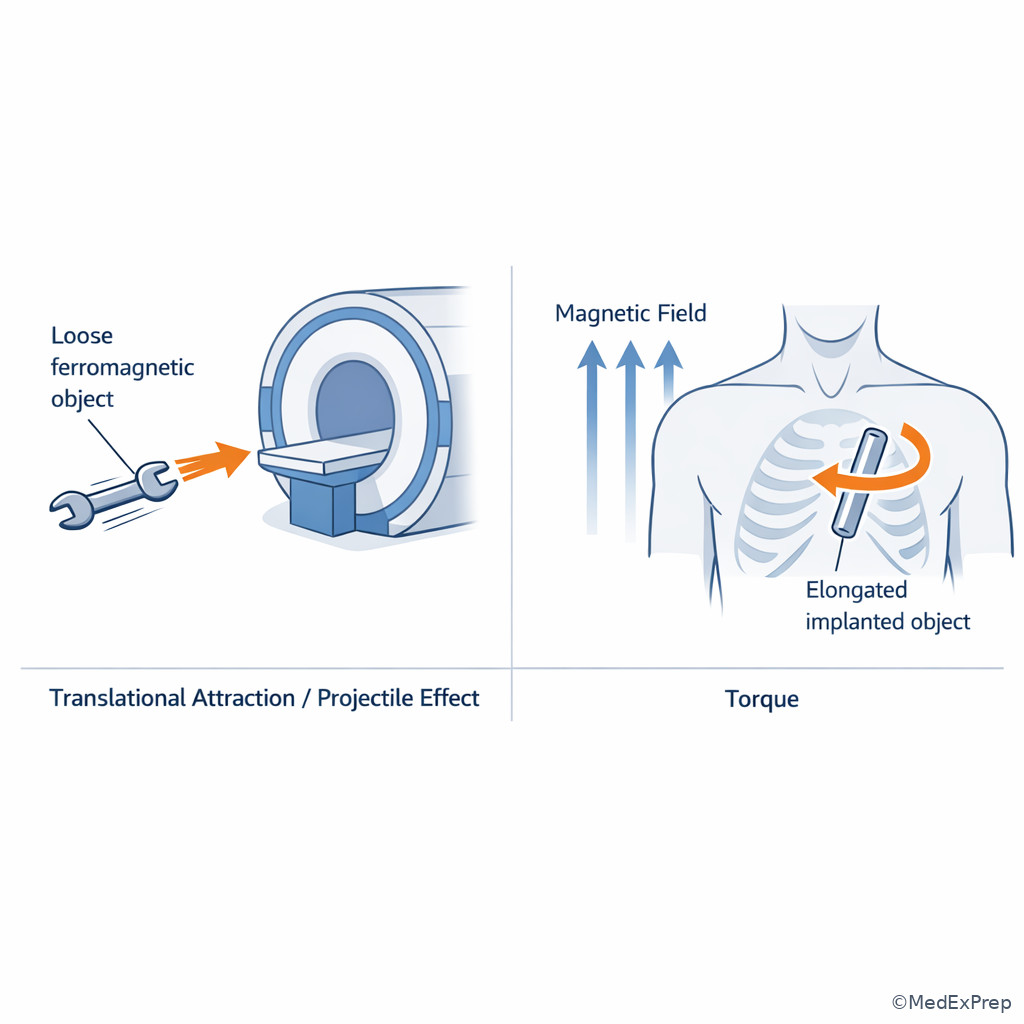
The next exam-level decision is which static field hazard best explains the scenario. If the stem describes a loose ferromagnetic item being pulled into the magnet, think projectile effect driven by translational attraction. If the stem describes an implanted or elongated object trying to twist into alignment, think torque. The single rule that resolves the choice is: movement into the magnet = translational attraction; rotation to align = torque.
Projectile events usually involve equipment or accessories: oxygen cylinders, wheelchairs, IV poles, scissors, tools, floor buffers, or personal items. Torque is more often discussed with implants, clips, or other devices where rotational force matters. On exams, these ideas are paired to test whether you can choose the right preventive action. For a loose ferromagnetic object, the answer is to keep it out of the controlled environment entirely. For an uncertain implant, the answer is not “watch carefully” — it is verify conditions or escalate. See Fig 2.
WHY THIS IS TESTED: many distractors blur all magnetic risks together. The exam rewards the candidate who matches the mechanism to the action: remove the object, verify the device, or do not proceed.
B Worked example
A 47-year-old woman is scheduled for a cervical spine MRI. She has rheumatoid arthritis, asthma, and prior abdominal surgery. A distracting detail is mild tachycardia from anxiety. During setup, the technologist notices a detachable metal hair barrette hidden under the patient’s hair covering and also learns she had a prior vascular clip “years ago,” but she has no documentation. The wrong-answer temptation is to treat both issues as the same level of risk and simply remove the barrette, then proceed.
Reasoning chain: identify task — safest next step for two distinct hazards. Extract key facts — one loose external metallic object, one undocumented internal device. Apply rule — external loose ferromagnetic items create projectile risk and are removed; undocumented implant/device concerns require verification, not assumption. Eliminate distractors — do not proceed just because one visible item was removed; do not independently clear the clip based on patient memory; do not reduce the field strength as a substitute for proper screening. Verify — remove the barrette and then stop the exam until implant documentation or approved clearance is obtained per policy.
C Exam trap
Common wrong answer: If the external metal is removed, proceed because the major hazard has been addressed.
Why it is tempting: The visible hazard captures attention and creates false reassurance once corrected.
Single clue that eliminates it: The implant or clip history remains undocumented; an uncertain internal device is not cleared by fixing an unrelated external object.
D Checkpoint
Question: Which scenario most specifically points to torque rather than projectile effect?
- A. A ferromagnetic wrench accelerates toward the bore when left on the table.
- B. A standard oxygen cylinder is pulled inward as it nears the scanner room door.
- C. An implanted metallic device is at risk of rotational force attempting to align with the magnetic field.
- D. A set of keys slips from a technologist’s pocket and moves toward the magnet.
Answer: C
- A: Tempting because it clearly involves magnetic force, but inward acceleration of a loose object is translational attraction/projectile risk, not torque.
- B: Tempting because cylinders are classic MRI hazards, but again the primary issue is projectile effect.
- C: Correct because the key clue is rotational alignment of an implanted metallic object within the field.
- D: Tempting because small loose items are common in exam stems, but motion toward the magnet is not the same as rotational torque.
- The most common mechanism behind a flying loose object in MRI is translational attraction.
- True or False: Static field hazards begin only after the first sequence starts. False.
- Name the 2 key mechanical static-field forces commonly separated on exams: translational attraction and torque.
1.1.1.5 Screening people, visitors, and equipment for static field risk
A Explanation
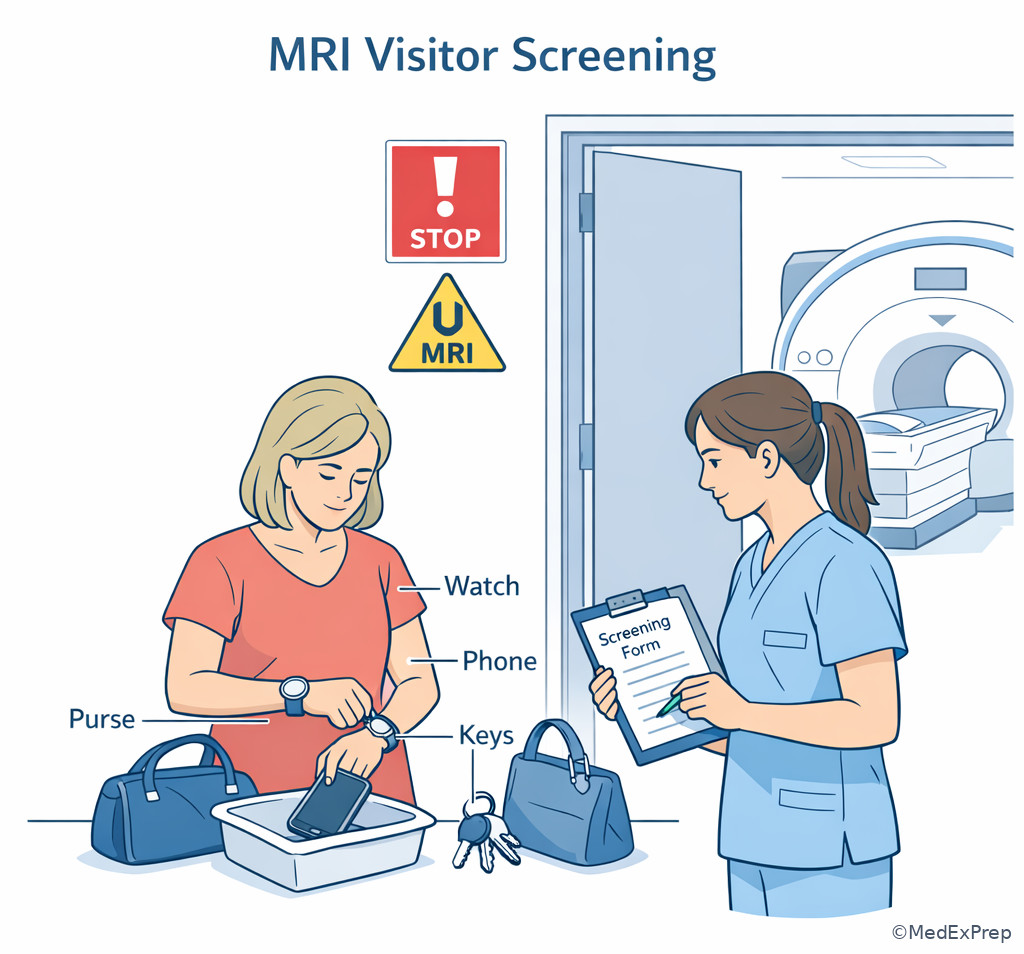
The major workflow conflict here is speed versus certainty. In real practice and on the ARRT MRI exam, the right answer favors certainty when a static field hazard is unresolved. Patients are not the only screening target. Visitors, transport staff, anesthesia staff, environmental services, and equipment entering the MRI environment all require control. The rule that resolves the conflict is: no unrestricted access without screening and appropriate labeling verification.
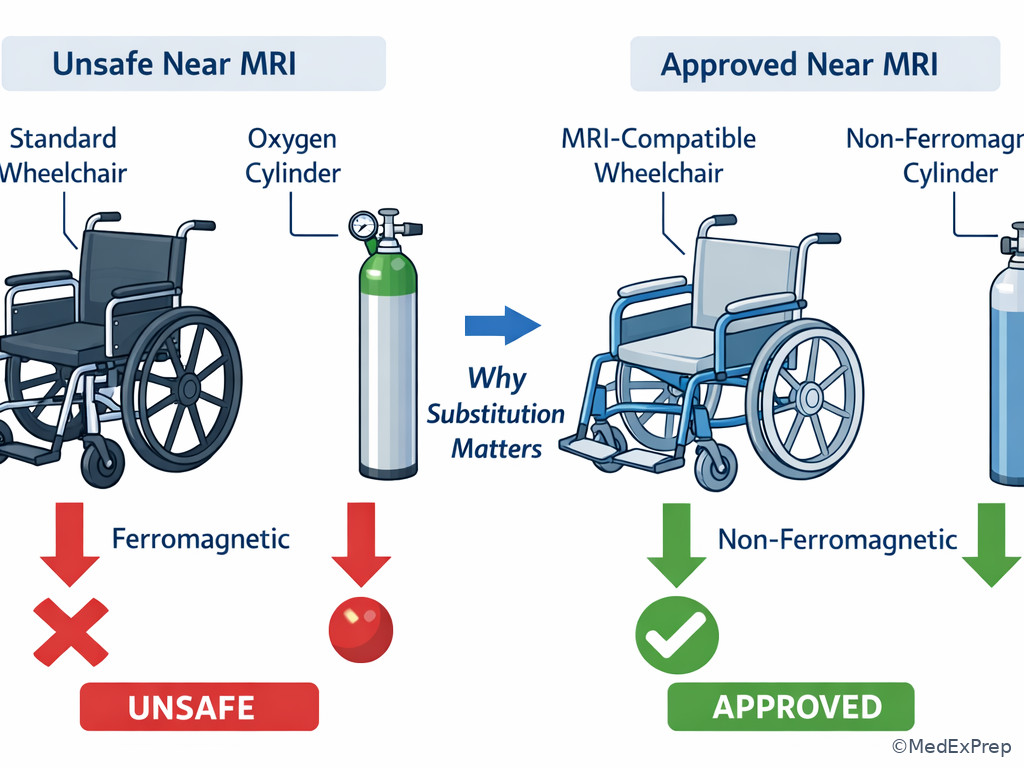
Exam stems often include a seemingly helpful staff member with standard hospital equipment. That is deliberate. A device can be appropriate in general patient care and still be unsafe in MRI. Similarly, a patient may deny metal but arrive with a transdermal patch, hearing aid, insulin pump, jewelry, or personal monitoring device. Choose the answer that pauses workflow long enough to verify. Reject the answer that assumes “hospital equipment” means MRI-compatible. See Fig 2.
WHY THIS IS TESTED: the exam assesses whether you control the MRI environment, not merely whether you remember definitions. Static field hazard prevention is a screening and access-control problem as much as a physics problem.
B Worked example
A 71-year-old inpatient with stroke symptoms arrives for MRI with a nurse and transporter. Comorbidities include atrial fibrillation and chronic kidney disease. A distracting detail is that the patient’s blood pressure is mildly elevated, creating urgency. The transporter brings a standard wheelchair, and the nurse has a medication pump that “should be fine because we use it everywhere.” The tempting but wrong clue is the acute clinical indication, which may push a learner to prioritize speed over access control.
Reasoning chain: identify task — best technologist-level next step under time pressure. Extract key facts — unscreened support staff equipment, standard wheelchair, unverified pump, urgent but not excuse-for-bypass scenario. Apply rule — urgency does not override static field safety control. Eliminate distractors — do not allow equipment based on familiarity, do not assume the nurse already checked, do not move the patient closer first and decide later. Verify — keep the patient outside the restricted hazard area until MRI-appropriate transport and equipment are confirmed or substituted.
C Exam trap
Common wrong answer: Accept equipment because it comes from a hospital unit and is being managed by another licensed professional.
Why it is tempting: Learners confuse clinical authority on the floor with MRI safety clearance in the magnet environment.
Single clue that eliminates it: The item is described as standard or unverified rather than MR Safe or appropriately MR Conditional.
D Checkpoint
Question: A patient’s daughter asks to remain in the room for comfort during MRI. She has not been screened and is carrying a phone and smart watch. What is the most appropriate response?
- A. Allow her to stay if she stands behind the technologist and remains quiet.
- B. Ask her to power off the phone and stay in the room.
- C. Screen her fully and remove or verify all items before any allowed entry per policy.
- D. Permit entry because visitors are lower risk than patients.
Answer: C
- A: Tempting because it sounds controlled, but unscreened presence and retained electronic/metal items remain unresolved hazards.
- B: Tempting because powering off seems practical, but magnetic hazard is not solved by switching a device off.
- C: Correct because visitors require screening and item control just like anyone else entering restricted MRI space.
- D: Tempting because visitors are not being imaged, but static field hazards do not depend on patient status.
1.1.1.6 Field strength, fringe field, and where danger exists
A Explanation
Another common decision point is where the hazard begins. Learners may think only the bore is dangerous. The better rule is that the field extends beyond the bore as a fringe field, and hazard increases as ferromagnetic objects move into stronger regions. The single clue that resolves the choice is mention of a marked magnetic boundary, approach toward the scanner, or field lines outside the bore. That means the correct action may happen before the patient or equipment reaches the table. See Fig 1.
Board-style questions may mention the 5-gauss line, controlled access area, or fringe field around the room. You do not need vendor-specific map memorization. You do need the concept that the MRI suite must be controlled because magnetic effects extend beyond what looks visually dangerous. Choose answers that respect posted boundaries, access restrictions, and room control. Reject answers that treat the hazard as a “bore-only” problem.
WHY THIS IS TESTED: this concept explains why zone models, access restrictions, and equipment screening exist at all. If you misunderstand fringe field, you will make unsafe workflow decisions later in the course.
B Worked example
A 35-year-old outpatient with migraine history and obesity arrives for lumbar MRI. She has no implant history. A maintenance worker opens the MRI suite door to ask a question while carrying a large toolbox and wearing a belt with multiple tools. A distracting detail is that the worker remains several feet from the bore, making the wrong answer “he is not close enough to matter” seem appealing.
Reasoning chain: identify task — control of environmental static field risk. Extract key facts — unscreened worker, multiple ferromagnetic tools, inside controlled MRI area, not yet at the bore. Apply rule — fringe field risk is not limited to the bore; controlled access exists because field extends outward. Eliminate distractors — do not allow him to stand by the door, do not quickly ask what he needs before acting, do not assume distance alone is sufficient without policy-defined control. Verify — remove him and the toolbox from the restricted area immediately and address the question from a safe location.
C Exam trap
Common wrong answer: The object is not at the bore yet, so the risk is minimal and can wait.
Why it is tempting: Learners visualize danger only at the scanner opening.
Single clue that eliminates it: The person has already entered a controlled MRI area with ferromagnetic tools.
D Checkpoint
Question: Which statement best explains why MRI suites use controlled access areas beyond the scanner bore itself?
- A. Because RF heating is highest in the control room.
- B. Because the static magnetic field extends outside the bore as a fringe field and can affect people or objects before they reach the magnet center.
- C. Because image quality decreases if visitors stand too close to the wall.
- D. Because gradient coils are active whenever the room door opens.
Answer: B
- A: Tempting because RF is a familiar MRI hazard, but this question is specifically about static field spatial control.
- B: Correct because it directly states the rationale for access control around a live main magnet.
- C: Tempting because image quality concerns are real, but controlled access exists first for safety, not visitor-related wall proximity artifacts.
- D: Tempting because gradients are another MRI risk source, but they are not the reason for constant room-access control.
- True or False: A loose ferromagnetic item is harmless if it is not yet touching the table. False.
- The field outside the bore is called the fringe field.
- The common controlled boundary often referenced in safety planning is the 5-gauss line.
1.1.1.7 Scope-based response when static field risk is uncertain
A Explanation
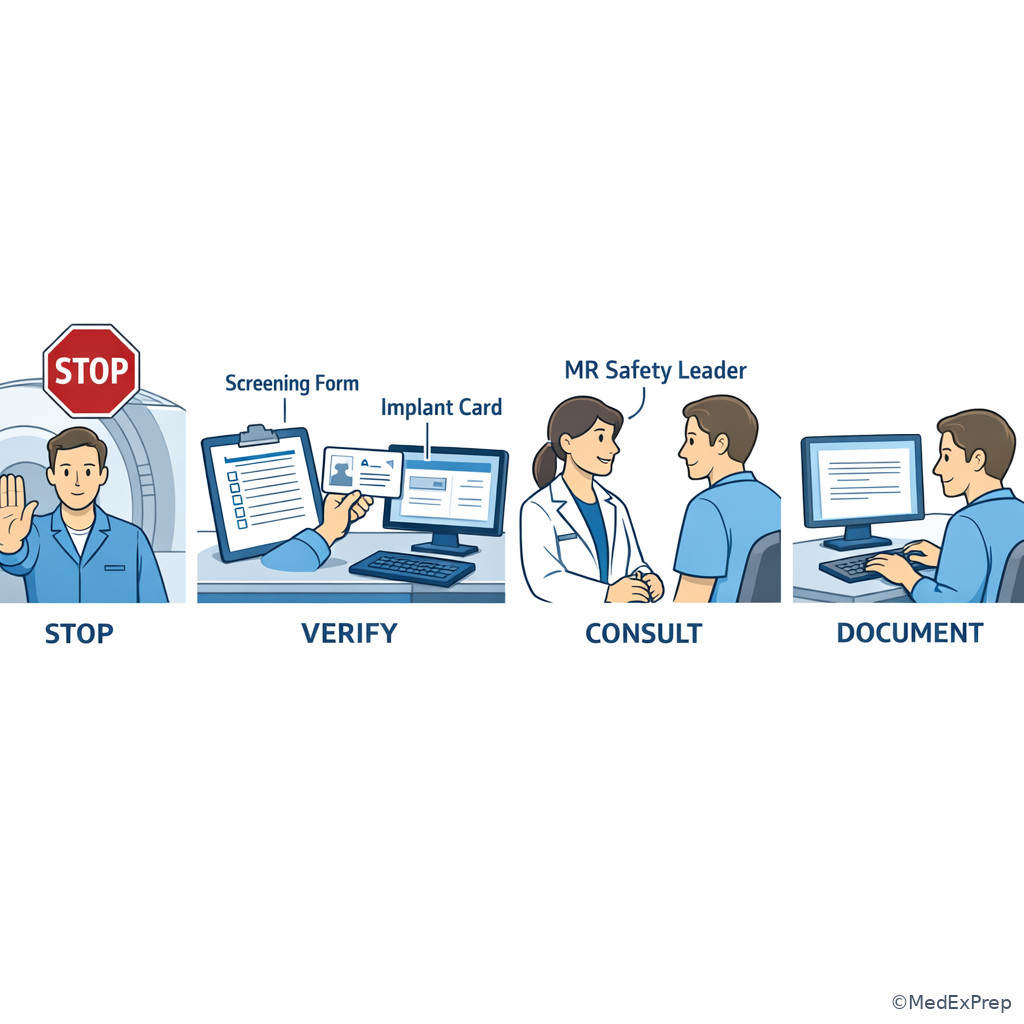
The most exam-relevant integration skill is knowing what to do when you are not sure. The conflict is between keeping throughput moving and practicing within scope. The rule is straightforward: an entry-level MRI technologist does not override MR safety restrictions or independently clear high-risk uncertainty outside established policy. If a device label is unclear, the history is inconsistent, or an item’s MRI status is not verified, stop and consult according to site workflow. Local protocols vary; confirm with your institution.
This is where MRI safety becomes a professional judgment topic. The exam may offer options that sound proactive but exceed scope: “clear the device based on similar implants,” “lower the field strength and proceed,” or “scan first and stop if symptoms occur.” Those answers are attractive because they appear problem-solving-oriented. They are wrong when policy-required verification is missing. The technologist’s correct action is to identify the unresolved hazard and escalate appropriately. See Fig 1.
WHY THIS IS TESTED: ARRT-style safety questions frequently turn on role boundaries. The best answer is often the one that protects the patient and respects scope, even if it delays imaging.
B Worked example
A 58-year-old man presents for shoulder MRI. He has coronary artery disease, sleep apnea, and prior back surgery. He reports a “nerve stimulator that was removed,” but the chest scar suggests there may still be retained hardware. A distracting detail is that he had a prior MRI at another hospital “without any trouble.” The tempting wrong answer is to rely on that prior MRI history and proceed.
Reasoning chain: identify task — determine the safest technologist-level response to uncertain implant history. Extract key facts — inconsistent history, possible retained hardware, no documentation, prior outside MRI of unknown conditions. Apply rule — prior uneventful MRI does not independently clear current uncertainty. Eliminate distractors — do not accept the patient’s recollection as final proof, do not choose a shorter protocol as a workaround, do not attempt physician-level clearance. Verify — stop the exam, seek formal documentation or approved consultation, and proceed only if established policy supports it.
C Exam trap
Common wrong answer: Proceed because the patient had a previous MRI with no reported complication.
Why it is tempting: Prior tolerance feels like informal evidence of safety.
Single clue that eliminates it: The present device history is still inconsistent and undocumented; prior experience does not replace current verified clearance.
D Checkpoint
Question: A patient reports an implanted device but cannot provide the card, and the chart contains no verified MRI conditions. The patient says, “Just use the same settings you use for everyone else.” What is the most appropriate technologist response?
- A. Proceed with the shortest protocol to minimize exposure.
- B. Continue if the patient signs a consent acknowledging risk.
- C. Stop and obtain required documentation or formal consultation before proceeding per policy.
- D. Choose a lower-sounding field strength scanner if available and proceed without further review.
Answer: C
- A: Tempting because it sounds safer, but protocol length does not solve unresolved implant status.
- B: Tempting because consent sounds protective, but consent does not replace MRI safety verification requirements.
- C: Correct because unresolved device conditions require documentation or formal consultation before access or scanning.
- D: Tempting because lower field strength may seem less risky, but independent clearance without conditions remains outside scope.
Exam Traps & Differentiators
Exam takeaway: Match the clue to the mechanism so you choose remove, restrict, or escalate instead of using the wrong safety framework.
flowchart TD
A[Stem clue] --> B{Loose external object?}
B -- Yes --> C[Projectile / translational attraction]
B -- No --> D{Implant or device uncertainty?}
D -- Yes --> E[Verify MR status or escalate]
D -- No --> F{Unscreened person or visitor?}
F -- Yes --> G[Stop access and screen]
F -- No --> H[Consider other MRI risk topics such as RF, gradient, or noise] - Most common wrong answer and why: “Proceed because the scan has not started.” This is tempting because candidates confuse static-field hazards with sequence-dependent hazards. The differentiator is the phrase always-on magnet.
- Second common wrong answer and why: “Proceed because the patient tolerated MRI before.” This is tempting because prior exposure sounds reassuring. The differentiator is current verified documentation, not memory or anecdote.
- Third common wrong answer and why: “Hospital equipment is acceptable.” This is tempting because the item is medically necessary in other departments. The differentiator is MR-specific approval.
| Looks similar | Actually think | Single discriminating clue | Best technologist action |
|---|---|---|---|
| Projectile event | Loose ferromagnetic object in static field | Object pulled inward toward magnet | Remove item; restrict access immediately |
| Torque concern | Rotational force on implant/device | Twisting/alignment risk | Verify conditions or escalate |
| RF heating concern | Sequence-dependent energy deposition | Discussion of SAR, heating, conductive loops | Apply RF safety controls; not a pure static-field question |
| Gradient effect | Time-varying magnetic fields | PNS or induced stimulation clue | Adjust or stop per gradient safety issue |
| Noise exposure | Acoustic hazard | Hearing protection/communication clue | Use hearing protection and communication plan |
If the stem says “the patient is only being positioned,” think static field hazard may already be active.
If the stem says “standard oxygen cylinder” or “regular wheelchair,” think probable MR Unsafe until verified otherwise.
If the stem says “the patient had MRI before,” think previous tolerance does not replace current documentation.
If the stem says “visitor wants to stay for comfort,” think visitors also require screening and item control.
If the stem says “unknown clip/device/history discrepancy,” think stop and consult rather than improvise.
If the stem says “toolbox not near the bore,” think fringe field and controlled access still matter.
Tables
| Static field hazard type | What the stem may say | Main risk | Immediate action |
|---|---|---|---|
| Projectile effect | Loose cylinder, keys, scissors, tool, wheelchair | Rapid attraction toward magnet | Remove from MRI area and secure access |
| Translational attraction | Object pulled inward | Movement into stronger field | Prevent approach; use approved substitutes |
| Torque | Twist, rotate, align, clip/device concern | Rotational force on object/device | Verify conditions or escalate |
| Fringe field exposure | Person/equipment near controlled boundary | Hazard outside bore | Apply access control before closer entry |
| Screening discrepancy | Conflicting history or missing label | Unknown risk | Stop and clarify before proceeding |
| Item status | Meaning | Can you proceed? | Exam note |
|---|---|---|---|
| MR Safe | No known MRI hazard in all MRI environments | Yes, within policy | Still follow local workflow and identity checks |
| MR Conditional | Safe only under specified conditions | Only if conditions are verified | Do not guess missing conditions |
| MR Unsafe | Known MRI hazard | No | Keep out of restricted MRI environment |
| Unknown / unverified | Status not established | No, not until clarified | “Unknown” behaves like “stop” on exams |
| Differential question type | Static field clue | Closest confounder | How to tell them apart |
|---|---|---|---|
| Mechanical force | Loose object pulled toward magnet | RF heating | Movement toward magnet, not temperature complaint |
| Implant motion concern | Twisting/alignment wording | Gradient stimulation | Static orientation force versus tingling/PNS symptoms |
| Access control | Unscreened visitor or staff | Patient consent issue | Safety screening comes before comfort or preference |
| Equipment problem | Standard hospital device entering MRI room | Image artifact issue | Immediate safety risk precedes image quality considerations |
| Prior MRI history | “Had MRI before without issue” | Formal clearance | Past tolerance is not current verified documentation |
Algorithm / Approach
Exam takeaway: The safest MRI technologist workflow is screen first, verify status, stop on uncertainty, and escalate rather than improvise clearance.
Exam takeaway: When documentation is incomplete, the correct answer is usually to pause and escalate rather than modify technique and proceed.
flowchart TD
A[Implant or device reported] --> B{Verified MR status and conditions available?}
B -- Yes --> C[Follow documented conditions and local policy]
B -- No --> D[Do not proceed]
D --> E[Consult MR safety resource / radiologist / supervising provider per policy]
E --> F{Cleared by policy and documentation?}
F -- Yes --> C
F -- No --> G[Reschedule or choose alternative plan outside technologist authority]
Use this approach on board-style stems:
- Identify the risk source: person, loose object, equipment, implant, or screening discrepancy.
- Name the mechanism: static field, projectile/translational attraction, torque, or unresolved MRI status.
- Choose the action: remove, restrict access, verify conditions, or escalate.
- Reject common distractors: proceeding because time is short, because the patient had prior MRI, or because another staff member says the item is fine.
- Verify and document: only continue once policy-supported clearance exists.
Rapid Review
- Always-on magnet → static field risk exists before sequence start.
- Projectile effect → loose ferromagnetic object pulled toward magnet.
- Torque → rotational alignment force, classically implant/device related.
- Fringe field → danger extends beyond the bore.
- Standard hospital equipment → not automatically MRI-safe.
- MR Conditional → safe only when exact conditions are verified.
- Unknown device status → stop, clarify, escalate.
- Prior uneventful MRI → not equivalent to current clearance.
- Visitors → also require screening and item control.
- Urgent clinical indication → does not override MRI safety policy.
- External loose metal removed → does not clear unresolved implant history.
- Control areas → exist because fringe field matters, not just bore proximity.
- Scope boundary → technologist identifies and escalates rather than independently clearing high-risk uncertainty.
Self-check quiz
1.1.1.8 Question 1
A patient has not yet been moved into the bore. The technologist notices a loose set of keys on the patient table. What is the most appropriate next step?
- A. Start the scan because static field effects matter only during image acquisition.
- B. Remove the keys before further positioning or scanning.
- C. Tape the keys in place so they do not move.
- D. Continue if the patient confirms the keys are lightweight.
1.1.1.9 Question 2
A visitor wants to remain in the MRI room for reassurance. She has a smart watch, phone, and purse, and has not been screened. What action is most appropriate?
- A. Let her stay because she is not the patient being scanned.
- B. Let her stay if she powers off her phone.
- C. Screen her fully and control all carried items before any permitted entry.
- D. Permit entry if she stands beyond the foot of the table.
1.1.1.10 Question 3
A 66-year-old man presents for knee MRI with hypertension and chronic obstructive pulmonary disease. He arrives with a standard oxygen cylinder from the floor because he uses intermittent supplemental oxygen. A distracting detail is that he is comfortable on room air at the moment. Which finding most strongly requires immediate correction before he enters further into the MRI environment?
- A. The patient’s blood pressure is mildly elevated from anxiety.
- B. The standard oxygen cylinder has not been verified as MRI-safe or MRI-conditional for the planned environment.
- C. The patient reports a prior CT scan with contrast.
- D. The patient forgot his reading glasses in the waiting room.
1.1.1.11 Question 4
A 54-year-old woman with diabetes and prior aneurysm treatment reports a “clip or coil” placed years ago, but she does not know the type. She also wears removable earrings, which are taken off. A tempting wrong move is to proceed once the visible jewelry is gone. What is the most appropriate next step?
- A. Proceed because the most obvious metallic hazard has been removed.
- B. Proceed on a shorter protocol to reduce magnetic exposure time.
- C. Stop and obtain verified implant documentation or approved consultation before proceeding.
- D. Ask the patient to sign consent and continue if she accepts the risk.
1.1.1.12 Question 5
A 39-year-old outpatient with migraines, obesity, and claustrophobia is being positioned for brain MRI. A maintenance worker steps into the controlled MRI area carrying a toolbox but remains several feet from the bore. Which principle best explains why this is still a safety problem?
- A. Gradient fields are continuously active whenever the room door is open.
- B. RF heating is greatest near the room entrance.
- C. The fringe field extends beyond the bore, so static-field hazards can exist before reaching the magnet center.
- D. Image quality will be degraded if metal is present anywhere in the suite.
1.1.1.13 Question 6
A 58-year-old man with coronary artery disease, sleep apnea, and prior spine surgery presents for shoulder MRI. He reports a prior implanted neurostimulator that was “removed,” but the chart is incomplete and a chest scar is visible. He says he had MRI once before at another hospital without any issue. What is the most appropriate technologist action?
- A. Proceed because prior uneventful MRI strongly suggests the device situation is safe.
- B. Proceed on a lower-field-strength system if available without waiting for records.
- C. Pause the exam and obtain documentation or formal MR safety consultation before proceeding.
- D. Continue after asking the patient to report any unusual sensation immediately.
1.1.1.14 Question 7
A 72-year-old inpatient with heart failure and chronic kidney disease arrives for brain MRI with a nurse and transporter. He is in a standard wheelchair, and an infusion pump from the unit is attached. The nurse states that both have been used during other imaging tests and that the study is urgent. Which is the best initial technologist response?
- A. Move the patient into the MRI room first, then decide which items must be swapped out.
- B. Keep the patient outside the restricted MRI area until MRI-appropriate transport and equipment are verified or substituted.
- C. Proceed because the nurse is responsible for the pump, not the MRI technologist.
- D. Disconnect the pump independently and continue with the standard wheelchair.
1.1.1.15 Question 8
A technologist is asked to classify the primary hazard in three situations: a wrench pulled toward the magnet, an undocumented implanted clip that may rotate, and a patient complaint of heating during a high-SAR sequence. Which pairing is most accurate?
- A. \(Wrench = torque\); \(clip = projectile effect\); \(heating = static field\)
- B. \(Wrench = translational attraction/projectile risk\); \(clip = torque concern\); \(heating = RF-related risk\)
- C. \(Wrench = gradient stimulation\); \(clip = fringe field only\); \(heating = translational attraction\)
- D. \(Wrench = acoustic risk\); \(clip = RF risk\); \(heating = only a patient comfort issue\)
Answer key
1.1.1.16 Question 1 — Answer: B
A: Tempting because some learners associate hazard onset with active scanning; incorrect because the static field is present before image acquisition. The discriminating clue is that the keys are already on the table in the MRI environment. Source support: ACR MRI safety guidance emphasizes the always-on magnetic field and ferromagnetic control.
B: Correct because a loose metallic item must be removed before further positioning or scanning. The discriminating clue is the unsecured external object near the magnet.
C: Tempting because securing an item sounds practical; incorrect because taping does not convert an unsafe loose item into an MRI-approved object. The clue is that the issue is ferromagnetic hazard, not simple motion prevention.
D: Tempting because lightweight objects may seem less dangerous; incorrect because even small items can become projectiles or interfere with safety control. The clue is unresolved external metal in the MRI area.
1.1.1.17 Question 2 — Answer: C
A: Tempting because the visitor is not undergoing imaging; incorrect because static field hazards apply to anyone entering the controlled area. The discriminating clue is unscreened visitor status.
B: Tempting because turning off electronics feels like sufficient mitigation; incorrect because magnetic and access hazards remain even if a device is powered down. The clue is retained items plus no screening.
C: Correct because visitors require screening and carried-item control before permitted entry. The clue is the combination of unscreened status and multiple items.
D: Tempting because location-based limits sound protective; incorrect because standing position does not replace screening and item verification. The clue is unresolved entry screening.
1.1.1.18 Question 3 — Answer: B
A: Tempting because anxiety-related blood pressure changes are common in MRI patients; incorrect because mild anxiety hypertension is not the immediate static-field hazard here. The clue is the presence of standard equipment.
B: Correct because an unverified standard oxygen cylinder is a classic projectile risk and must be addressed before further approach. The discriminating clue is “standard oxygen cylinder.”
C: Tempting because prior contrast history may matter in other contexts; incorrect because it does not determine static-field safety. The clue is unrelated to the present hazard source.
D: Tempting because forgotten personal items can delay workflow; incorrect because missing reading glasses are not the urgent magnetic danger described. The key clue is unverified equipment entering the MRI environment.
1.1.1.19 Question 4 — Answer: C
A: Tempting because removing visible earrings gives a sense that the metallic risk is solved; incorrect because the unresolved aneurysm-treatment implant history remains. The discriminating clue is the unknown “clip or coil.”
B: Tempting because shorter protocols sound safer; incorrect because scan duration does not substitute for implant verification. The clue is missing device information, not protocol length.
C: Correct because documented implant status or approved consultation is needed before proceeding when device details are uncertain. The discriminating clue is unclear prior aneurysm hardware type.
D: Tempting because informed consent appears protective; incorrect because consent does not authorize bypassing MRI safety policy. The clue is unresolved implant uncertainty beyond technologist self-clearance scope.
1.1.1.20 Question 5 — Answer: C
A: Tempting because gradients are a known MRI hazard; incorrect because the stem asks about a toolbox entering the area before scan execution, which is a static-field access problem. The clue is “several feet from the bore” with ferromagnetic tools.
B: Tempting because RF exposure is also tested in MRI safety; incorrect because the question turns on location and approach to the magnet, not energy deposition. The clue is toolbox entry into a controlled area.
C: Correct because the fringe field extends beyond the bore, so uncontrolled ferromagnetic objects are a danger before reaching magnet center. The discriminating clue is presence in the controlled MRI area rather than bore contact.
D: Tempting because metal can affect image quality in some situations; incorrect because immediate safety control is the issue here, not artifact alone. The clue is environmental hazard rather than acquisition quality.
1.1.1.21 Question 6 — Answer: C
A: Tempting because prior uneventful MRI suggests possible compatibility; incorrect because prior tolerance is not current documented clearance. The discriminating clue is incomplete chart plus visible scar and uncertain retained hardware history.
B: Tempting because lower field strength may sound safer; incorrect because changing systems does not remove the need for verified device conditions. The clue is unresolved documentation, not merely degree of exposure.
C: Correct because the technologist must pause and obtain documentation or formal MR safety consultation rather than independently clear the situation. The clue is inconsistent device history within scope-limited decision-making.
D: Tempting because symptom monitoring sounds cautious; incorrect because waiting for symptoms is not an acceptable substitute for pre-scan implant verification. The clue is pre-existing uncertainty requiring resolution before scanning.
1.1.1.22 Question 7 — Answer: B
A: Tempting because it preserves urgency and seems efficient; incorrect because unverified wheelchair and pump should not be brought farther into restricted MRI space. The discriminating clue is standard unit equipment plus urgency pressure.
B: Correct because the safest first action is to keep the patient outside the restricted area until MRI-appropriate transport and equipment are verified or substituted. The clue is multiple unverified items approaching the MRI environment.
C: Tempting because the nurse manages the infusion clinically; incorrect because MRI environment control remains the technologist’s responsibility within the suite. The clue is MRI-specific safety responsibility, not floor ownership of equipment.
D: Tempting because removing one hazard seems proactive; incorrect because independently disconnecting equipment may exceed immediate role or policy, and the standard wheelchair remains a hazard. The clue is that more than one item is unresolved.
1.1.1.23 Question 8 — Answer: B
A: Tempting because it includes familiar MRI terms; incorrect because the wrench being pulled inward is not torque, the clip concern is not projectile effect, and heating during high-SAR imaging is not a pure static-field issue. The clue is mechanism mismatch.
B: Correct because a loose wrench being drawn inward reflects translational attraction/projectile risk, an undocumented clip that may rotate suggests torque concern, and patient heating during a high-SAR sequence points to RF-related risk. The discriminating clue is exact wording for each mechanism.
C: Tempting because it uses other true MRI hazard categories; incorrect because none match the described mechanisms. The clue is the pull-in, rotation, and heating trio.
D: Tempting only if one ignores mechanism detail; incorrect because acoustic risk and generic comfort explanations do not fit the stem. The clue is explicit mechanical and thermal hazard language.
Exam takeaway: Exams often test whether you can distinguish standard hospital transport tools from MRI-approved transport equipment.
Exam takeaway: When a device history is uncertain, documentation and formal consultation outrank speed or patient reassurance.
Exam takeaway: Visitor comfort requests do not bypass MRI screening or item removal requirements.
Exam takeaway: Distinguishing inward pull from rotational alignment helps eliminate close distractors on exam questions.
Keep going with the full ARRT Magnetic Resonance Imaging Prep Course (ARRT MRI)
You just studied the way members do, in the same lesson interface. Full access unlocks every lesson, the question bank and flashcards for a full year.
One payment · 1 year of access · No auto-renewal