1.1.1 - AGACNP Practice Boundaries
Why it matters
- Board questions often look clinical, but the real test is whether you stay within the AGACNP role while still acting decisively for an unstable adult or older adult.
- The most common misses happen when a learner chooses a technically correct medical action that is the wrong professional action for the NP role, privilege level, or care setting.
- On exam day, unsafe autonomy is a trap: when a patient is deteriorating, the correct answer is often to stabilize, monitor, and escalate rather than to “do everything yourself.”
- Practice-boundary questions are also hidden inside ethics, transfer, procedures, medications, and disposition stems, so this lesson supports many later topics.
Exam takeaway: Use this map to decide whether to treat, collaborate, or escalate when the stem tests role boundaries.
flowchart TD
A[Adult or older adult acute problem] --> B{Is patient unstable or deteriorating?}
B -->|Yes| C[Stabilize ABCs and activate higher level support]
B -->|No| D{Within AGACNP scope and privileges?}
D -->|Yes| E[Assess order interpret manage monitor]
D -->|No| F[Consult supervising clinician or specialty team]
C --> G{Setting capable of ongoing care?}
G -->|Yes| H[Continue acute management with collaboration]
G -->|No| I[Arrange transfer to higher level of care] Exam takeaway: Visualize acute care settings, adult patient population, and escalation points to avoid out-of-role answers.
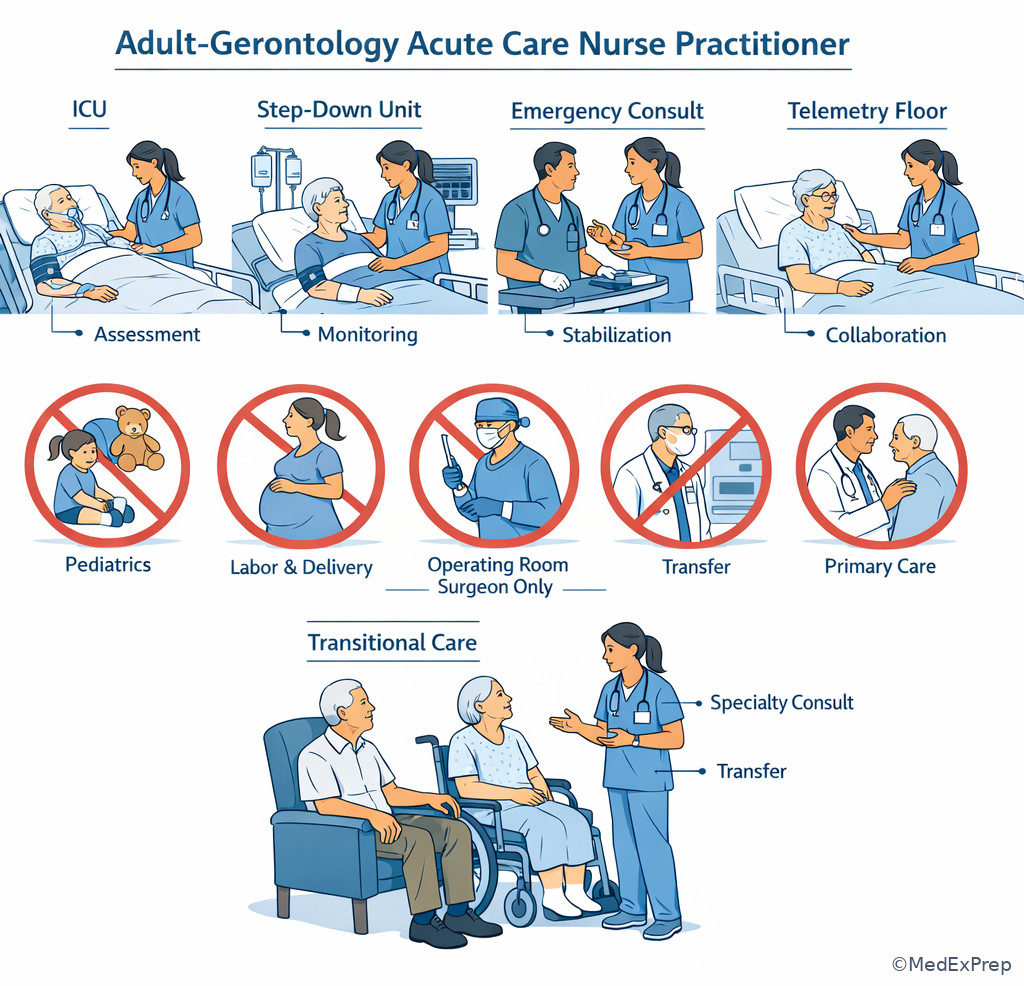
Key Terms & Must-Know Facts
1.1.1.1 Key terms
- Scope of practice: What the AGACNP role is educated, licensed, and population-focused to do
- Privileges: Institution-specific permissions that further limit what an NP may perform
- Population focus: Adult-gerontology, not pediatrics, neonates, or obstetrics
- Acuity: Degree of instability or time sensitivity
- Escalation: Notifying supervising clinician, specialty team, rapid response, or higher level care
- Stabilize first: Immediate support of airway, breathing, circulation before transfer or consultation delays
- Setting capability: Whether the current unit can safely deliver required monitoring/interventions
- Collaboration: Shared acute management with physicians or specialty teams when complexity or policy requires it
- Consultation: Requesting expert input for issues outside NP privilege or specialty depth
- Disposition: Appropriate level of care after assessment and stabilization
- Out-of-role signal: Clue that an answer exceeds AGACNP exam role expectations
- Institution-dependent protocol: Process that varies locally and should be framed generally on exams
1.1.1.2 Must-know facts
- The AGACNP exam tests adult and older adult acute/critical care judgment, not pediatric or obstetric management.
- Correct answers stay inside NP scope and institutional privilege limits.
- If the patient is unstable, stabilization outranks paperwork, routine consultation, and low-yield diagnostics.
- If acuity exceeds setting capability, arrange a higher level of care after immediate stabilization.
- Do not choose surgeon-only, anesthesiologist-only, or unrestricted physician-autonomy answers.
- When local protocol could change a detail, the best exam answer is the safest generally accepted action.
- A right intervention at the wrong priority is still wrong on boards.
- Older adults may present atypically, but the role boundary rules do not change.
| Domain | What the question is really testing | Best exam mindset |
|---|---|---|
| Scope | Can you recognize what belongs to the AGACNP role? | Choose actions consistent with acute care NP practice |
| Safety | Can you identify when independent action becomes unsafe? | Stabilize, monitor, escalate |
| Collaboration | Can you identify when specialty help is required? | Use consultation early when privilege/specialty limits are crossed |
| Disposition | Can you match patient needs to care setting? | Transfer if the unit cannot support ongoing risk |
| Professional judgment | Can you reject tempting physician-only answers? | Stay in role while still acting decisively |
Core content
1.1.1.3 Foundational boundary: who the AGACNP treats, where, and under what limits
A Explanation
The decision conflict in many introductory board items is not “Do you know the disease?” but “Are you acting as an adult-gerontology acute care NP in the right setting for the right patient population?” The AGACNP candidate manages acutely ill, critically ill, and medically complex adult and older adult patients in hospital-based and similar acute care environments. The single rule that resolves many stems is this: if the scenario drifts into pediatric, neonatal, obstetric, surgeon-only, or routine primary care continuity management, reject it. Choose the option that keeps the NP in a hospital-based acute care role, focused on stabilization, diagnostic reasoning, evidence-informed management, monitoring, and collaboration.
WHY THIS IS TESTED: Test writers know candidates overgeneralize “NP” into unrestricted practice. They build distractors that sound medically sophisticated but violate population focus, setting, or privilege assumptions. See Fig 1.
Key rule: Scope is defined by population + setting + role authority + institutional privileges. A correct clinical action can still be the wrong exam answer if it assumes a different professional role.
Memory anchor: Think A-C-U-T-E for AGACNP boundaries: Adults, Critical/acute illness, Unit-based care, Team-based decisions, Escalate when needed.
B Worked example
A 67-year-old man with COPD, CKD stage 3, and coronary artery disease is evaluated on a step-down unit for worsening dyspnea. He is anxious, has wheezing, oxygen saturation 88% on nasal cannula, and a mild chronic anemia on labs. The stem asks for the most appropriate next step. One answer choice recommends adjusting oxygen delivery, reassessing work of breathing, ordering a blood gas per unit protocol, and notifying the supervising acute care team if he worsens. Another recommends “assuming care for his 7-year-old grandson in the adjacent pediatric observation bed because the unit is short-staffed.” A third recommends “providing long-term outpatient COPD medication reconciliation and annual smoking-cessation follow-up planning only.” A fourth recommends “performing independent bronchoscopic intervention.”
Reasoning chain: Identify the task: choose the safest in-role action. Extract key facts: adult patient, acute setting, respiratory deterioration. Apply the role rule: AGACNP manages acutely ill adults in hospital-based settings. Eliminate distractors: pediatric coverage is outside population focus; routine continuity planning alone ignores acute instability; bronchoscopy exceeds usual exam-role expectations. Verify: the correct choice combines acute assessment, treatment, monitoring, and escalation within role.
C Exam trap
Common wrong answer: Selecting the most “advanced” technical procedure.
Why it is tempting: Learners equate higher clinical sophistication with higher test value.
Single clue that eliminates it: The stem asks you to function as an AGACNP candidate, not as a surgeon, anesthesiologist, or proceduralist with unrestricted privileges.
D Checkpoint
Question: A 73-year-old patient on a telemetry unit develops new hypotension after diuresis. Which action is most consistent with the AGACNP practice boundary?
- Independently perform a procedure requiring privileges not described in the stem
- Reassess volume status, review hemodynamics and medications, initiate in-role stabilization, and escalate if instability persists
- Transfer responsibility to the pediatric service because the unit is busy
- Schedule outpatient chronic disease follow-up without addressing the current hypotension
Answer: B
- A: Tempting because invasive action sounds decisive; wrong because privilege-dependent procedures are not assumed without stem support.
- B: Tempting because it may feel less dramatic; right because it matches adult acute care NP scope, immediate assessment, stabilization, and escalation logic.
- C: Tempting only if the learner ignores population focus; wrong because pediatrics is outside AGACNP role.
- D: Tempting because follow-up matters; wrong because current instability outranks continuity planning.
- Assess first: ABCs, hemodynamic stability, mental status, and whether the patient remains appropriate for the current unit.
- Intervene: Start in-role stabilization and targeted reassessment.
- Delegate: Routine vital sign acquisition or transport preparation may be delegated per policy; advanced assessment and escalation decisions stay with the NP/RN team.
- Escalate: Notify supervising clinician or rapid response immediately if deterioration exceeds current setting capability.
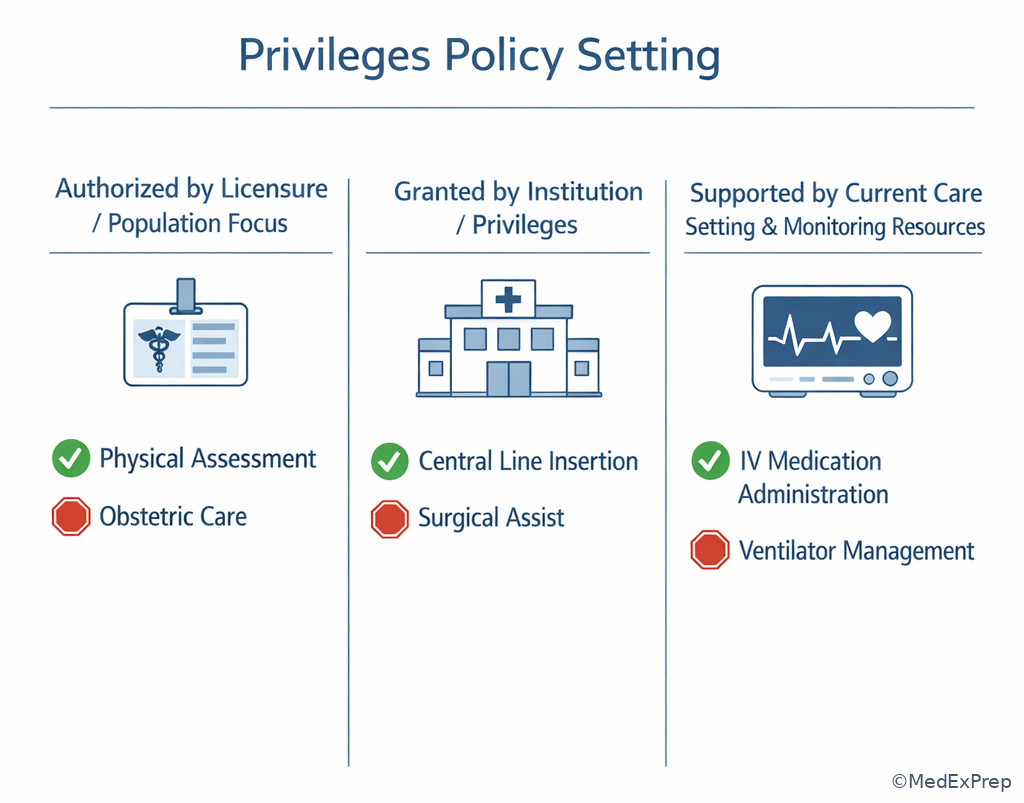
1.1.1.4 Privileges, policy, and setting capability: when “can do” is still not “should do”
A Explanation
A second foundational conflict is the gap between broad educational scope and local privilege or setting reality. A stem may describe an action that an NP could perform in some institutions, but unless the question confirms privileges, local capability, and support, the safest board answer is usually the one that works within known authority and escalates appropriately. The single rule: never assume unrestricted autonomy or universal privileges. Even if the management idea is clinically sound, reject it if it skips consultation, ignores policy, or fails to account for unit limitations.
WHY THIS IS TESTED: This mirrors real practice. A safe AGACNP knows the difference between medical possibility and role-authorized action. See Fig 2.
Recall: This is the first topic in the course, so there is no prior lesson to reference backward. Here, we establish the framework that upcoming lessons on Privileges Consultation And Transfer and Unsafe Out-Of-Role Actions will expand.
High-Yield Connection: This concept is tested alongside Task Acuity And Setting. Know both role authority and unit capability for exam day — they are frequently paired in stems.
Exam takeaway: Separate what may be clinically indicated from what is authorized and supportable in the current setting.
flowchart LR
A[Clinical need identified] --> B{Within NP privileges?}
B -->|Yes| C{Current unit can support monitoring?}
B -->|No| D[Consult and arrange appropriate clinician involvement]
C -->|Yes| E[Proceed within protocol and reassess]
C -->|No| F[Stabilize and transfer or upgrade level of care]
D --> G[Shared management]
F --> G
B Worked example
A 79-year-old woman with severe aortic stenosis, atrial fibrillation, and frailty is on a step-down unit after treatment for decompensated heart failure. She now has increasing work of breathing and intermittent confusion. Chest radiograph is delayed because transport is backed up, and a mildly elevated BNP from admission remains in the chart as noise. One answer choice says to continue monitoring on the current unit because she is already admitted. Another says to immediately perform a high-risk procedure not mentioned in institutional protocol. A third says to reassess, begin in-role stabilization, call the supervising clinician, and arrange ICU transfer because the unit cannot provide the needed intensity of monitoring. A fourth says to wait for all imaging before acting.
Reasoning chain: Identify the task: safest next step in a deteriorating older adult. Extract key facts: worsening respiratory status, confusion, high-risk cardiac disease, frailty, likely need for closer monitoring. Apply the rule: do not assume the current unit is enough; setting capability matters. Eliminate distractors: routine monitoring is wrong priority; unsupported procedure is privilege creep; waiting for imaging delays stabilization. Verify: stabilization plus escalation and transfer is correct.
C Exam trap
Common wrong answer: “Keep the patient here and finish the workup first.”
Why it is tempting: It sounds orderly and avoids overreacting.
Single clue that eliminates it: The patient’s worsening work of breathing and confusion signal current setting inadequacy, not a simple workup delay.
D Checkpoint
Question: An adult patient on a floor unit develops rapidly rising oxygen needs and repeated suctioning requirements. Which is the most appropriate action?
- Continue current floor care until all pending tests result
- Arrange reassessment, initiate immediate supportive care within role, and escalate to a higher level of care if unit capability is insufficient
- Assume independent authority for any airway procedure regardless of privileges
- Focus on discharge planning because the patient has many chronic conditions
Answer: B
- A: Tempting because more data may clarify the diagnosis; wrong because rising oxygen need is a capability and safety issue now.
- B: Tempting because it uses a conservative systems approach; right because it prioritizes support, reassessment, and appropriate escalation.
- C: Tempting because airway problems feel urgent; wrong because urgency does not erase privilege and training limits.
- D: Tempting because disposition always matters; wrong because it ignores immediate instability.
- Assess first: Airway protection, oxygenation trend, mental status, and whether bedside resources match acuity.
- Intervene: Begin authorized supportive measures and targeted monitoring immediately.
- Delegate: Basic support tasks and repeat vitals may be delegated per policy; disposition and escalation decisions cannot.
- Escalate: Move early when the unit cannot safely monitor the likely trajectory.
- The most common cause of a wrong boundary answer is assuming ___ autonomy. Answer: unrestricted
- True or False: A clinically reasonable procedure is always the best answer even if the stem does not establish privileges. Answer: False.
- Name the 3 key filters before acting: population, privileges, setting capability.
1.1.1.5 Application: recognizing in-role versus out-of-role answer choices in board stems
A Explanation
Once you know the boundaries, the next challenge is recognizing how board questions hide them. Out-of-role answers often share one of several features: they shift to another population, assume independent physician-level authority, skip necessary consultation, choose a procedure beyond stated privileges, or ignore the need to transfer. The decision conflict is usually between an answer that sounds assertive and one that sounds disciplined. The single finding that resolves it is the presence of an out-of-role signal in the wording. Phrases like “perform the operation,” “manage this newborn,” “independent anesthesia plan,” or “routine long-term primary care follow-up” should trigger immediate rejection.
WHY THIS IS TESTED: These items reward disciplined reading, not just content recall. See Fig 3.
Common distractor pattern: The wrong answer is often the “most aggressive” one. On this exam, aggressive is only correct when it is also in role, safe, and supported by the setting.
Memory anchor: Use R-O-L-E when screening options: Right population, Ordered action within scope, Limits/privileges respected, Escalation when needed.
Exam takeaway: Spot wording that signals a wrong population, wrong setting, or unsupported autonomy before choosing an answer.
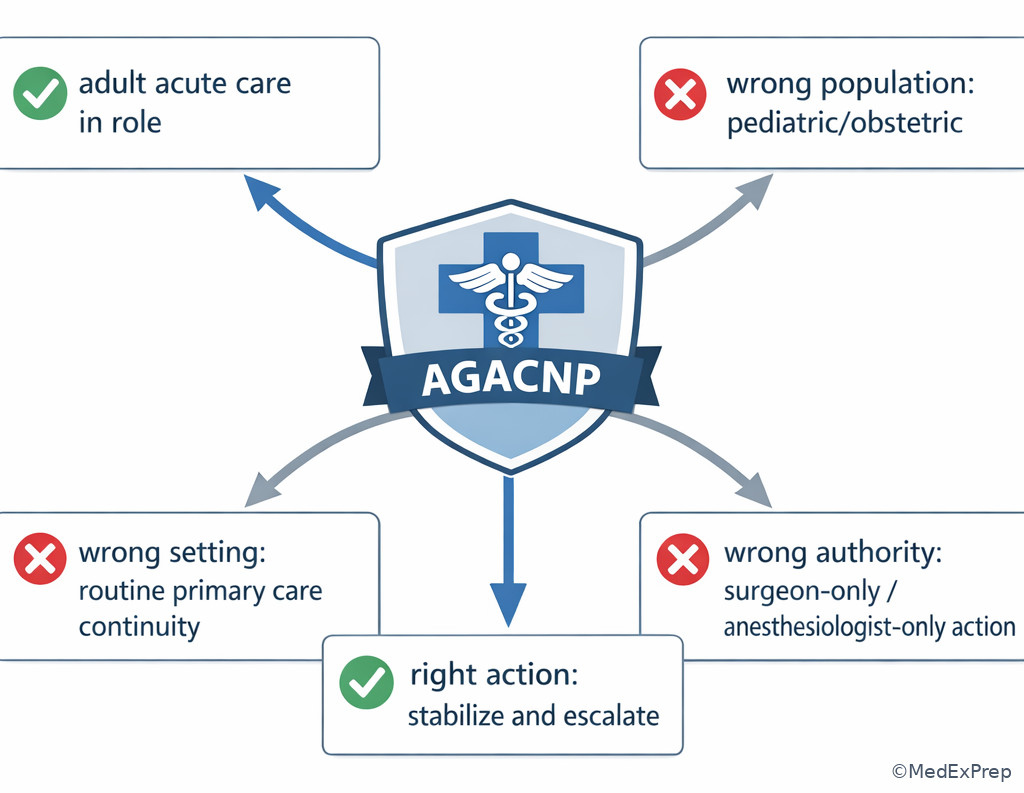
B Worked example
A 58-year-old man with cirrhosis, type 2 diabetes, and obstructive sleep apnea is admitted for GI bleeding evaluation and becomes progressively somnolent. He has mild hyperammonemia, but the stem also notes a recent sedative dose as distracting noise. Options include: initiate bedside reassessment and airway support while notifying the collaborating team; independently perform endoscopy; discharge with outpatient hepatology follow-up if mental status improves briefly; or manage his adolescent daughter’s fainting episode in the waiting room because you are “the provider on site.”
Reasoning chain: Identify the task: most appropriate next action for acute change in mental status. Extract key facts: adult inpatient, unstable trajectory, need for acute assessment. Apply the rule: stay with the adult acute-care patient, use in-role stabilization, do not assume proceduralist role, do not cross to pediatric care. Eliminate distractors: endoscopy is not the NP’s assumed exam-role action; discharge is unsafe; pediatric crossover is outside population focus. Verify: reassessment, support, and team escalation is best.
C Exam trap
Common wrong answer: Picking the answer that targets the likely diagnosis most directly.
Why it is tempting: It feels disease-specific and efficient.
Single clue that eliminates it: The question tests the AGACNP role, so direct procedural correction may belong to another credentialed clinician while your priority is stabilization and escalation.
D Checkpoint
Question: Which answer choice is the strongest out-of-role signal for an AGACNP board item?
- Reassess an older adult with acute dyspnea and consult respiratory therapy
- Trend labs and hemodynamics in a patient on a monitored hospital unit
- Provide routine well-child management for a 6-year-old with otitis symptoms
- Coordinate step-down disposition for an improving adult after sepsis treatment
Answer: C
- A: Tempting because consultation may look deferential; wrong to reject because adult acute dyspnea management is in role.
- B: Tempting because trending data feels less dramatic; wrong to reject because this is classic AGACNP work.
- C: Tempting if the learner focuses only on “provider” language; right because pediatric routine care is outside adult-gerontology acute care population and setting focus.
- D: Tempting because disposition may feel administrative; wrong to reject because transition planning for acute-care adults is in role.
- Assess first: Whether the question is testing a current unstable adult patient or trying to lure you into another population/setting.
- Intervene: Keep the focus on acute assessment, monitoring, and stabilization for the adult patient in front of you.
- Delegate: Noncritical logistics may be assigned per policy; the role-screening judgment remains the NP’s responsibility.
- Escalate: If the needed action lies beyond credentials or setting, obtain the right team immediately.
1.1.1.6 Application to instability: when the safest boundary answer is stabilization plus escalation
A Explanation
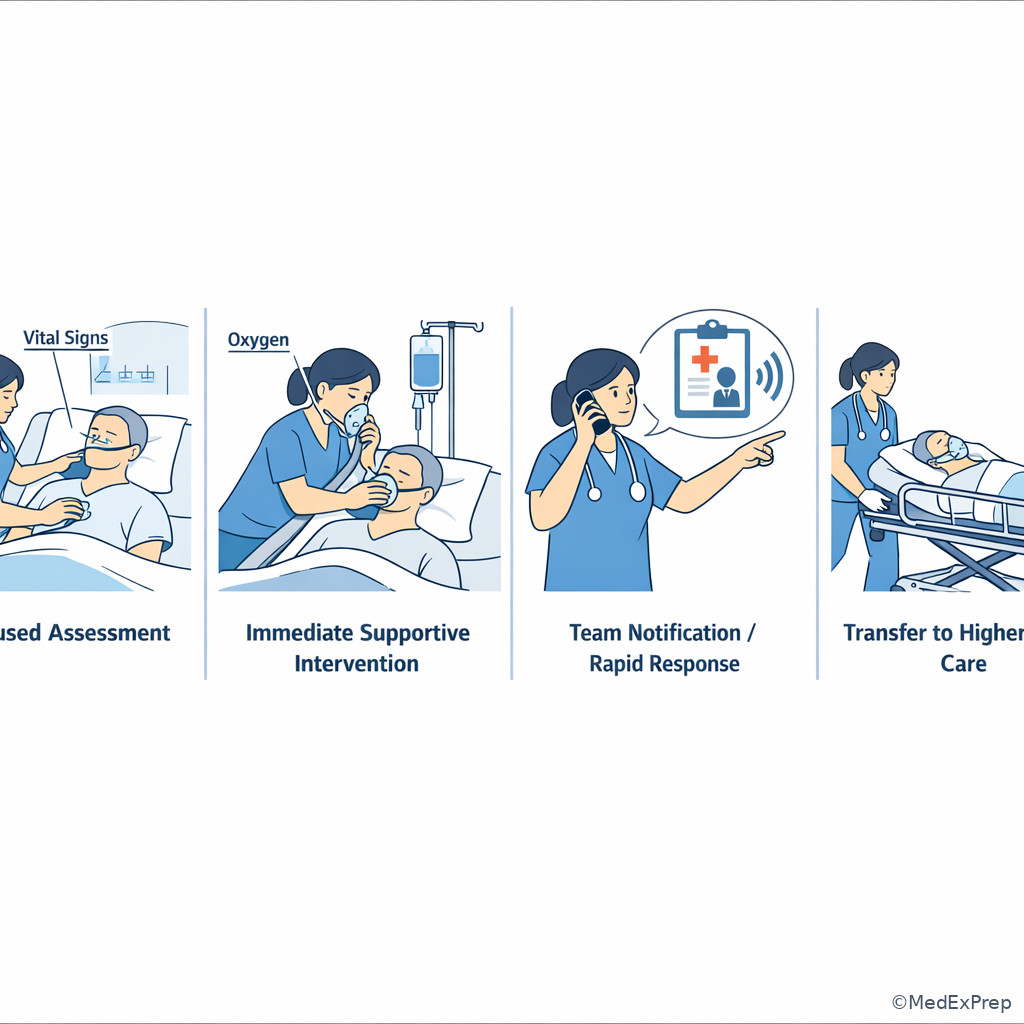
Many test-takers assume “scope question” means passive caution. In fact, the correct answer is often highly active: assess, stabilize, order urgent tests within role, initiate evidence-informed treatment, and escalate. The decision conflict is between unsafe passivity and unsafe autonomy. The single rule that resolves it: when acuity exceeds role, privileges, or setting capability, do not delay stabilization while waiting for perfect authority clarification; instead, perform the urgent measures that are clearly within role and simultaneously escalate. This is the professional middle ground the exam wants.
WHY THIS IS TESTED: Acute care board items punish both extremes. Candidates either overreach or underreact. The best answer preserves patient safety first. See Fig 4.
High-Yield Connection: This concept overlaps with Safest Next Step Logic and later emergency topics such as sepsis, respiratory failure, stroke, and shock. Know both clinical deterioration recognition and role-appropriate escalation — they are frequently paired in stems.
Exam takeaway: In unstable patients, the best answer is usually immediate in-role stabilization plus escalation, not delay or unsupported autonomy.
flowchart TD
A[Acute deterioration] --> B{Immediate threat to airway breathing circulation?}
B -->|Yes| C[Start supportive interventions within role]
B -->|No| D[Rapid focused reassessment and trending]
C --> E[Notify supervising clinician or rapid response]
D --> E
E --> F{Need higher capability or specialty procedure?}
F -->|Yes| G[Transfer/consult]
F -->|No| H[Continue acute management and reassess]
B Worked example
A 71-year-old woman with metastatic lung cancer, HFpEF, and chronic kidney disease becomes acutely hypotensive and confused on a medical floor. Temperature is 39.1°C, heart rate 124/min, blood pressure 82/48 mm Hg, and lactate is pending. She also has a chronic sacral wound documented earlier, which is tempting but not yet actionable noise. Options include: wait for all culture results before giving support; immediately review allergies, obtain cultures and labs per protocol, initiate fluid resuscitation and antimicrobial pathway within role, and escalate to rapid response/ICU; independently place all invasive monitoring regardless of privileges; or delay action while arranging outpatient palliative follow-up.
Reasoning chain: Identify task: most appropriate next step in presumed sepsis with shock. Extract key facts: hypotension, fever, confusion, cancer, likely instability. Apply the rule: act now within role and escalate simultaneously. Eliminate distractors: waiting for cultures delays treatment; unsupported invasive procedure assumes privileges; outpatient planning ignores acute shock. Verify: stabilization + urgent escalation is correct.
C Exam trap
Common wrong answer: “Wait until the consultant arrives before starting anything.”
Why it is tempting: Learners fear acting outside scope.
Single clue that eliminates it: The patient is unstable now, and supportive interventions within role should not be delayed while escalation is underway.
D Checkpoint
Question: A patient on a monitored unit develops acute chest pain, diaphoresis, and new hypotension. Which action best reflects AGACNP practice boundaries?
- Obtain focused assessment data, start immediate in-role stabilization, activate urgent team response, and prepare for higher-level management
- Wait for cardiology to evaluate before initiating any urgent measures
- Assume unrestricted authority for any invasive rescue procedure not described in the stem
- Defer evaluation because the patient is already on telemetry
Answer: A
- A: Tempting because it seems broad; right because it balances action with appropriate escalation in an unstable adult.
- B: Tempting because consultation is appropriate; wrong because waiting alone ignores immediate circulation threat.
- C: Tempting because urgency feels like permission; wrong because instability does not create privileges.
- D: Tempting if monitoring is mistaken for treatment; wrong because telemetry does not address shock.
- Assess first: ABCs and signs of immediate deterioration.
- Intervene: Start authorized resuscitative/supportive actions and urgent diagnostics without delay.
- Delegate: Team members may gather equipment or repeat vitals; the NP must retain prioritization and escalation decisions.
- Escalate: Activate rapid response, specialty consultation, or ICU transfer when instability exceeds current support.
- The best answer when acuity exceeds role is usually ___ plus ___. Answer: stabilization; escalation
- True or False: Concern about scope means you should avoid all urgent intervention until the supervising clinician arrives. Answer: False.
- Name 3 instability clues that should change priority immediately: hypoxia, hypotension, altered mental status.
1.1.1.7 Integration: choosing among collaboration, consultation, transfer, and refusal of unsafe actions
A Explanation
The final level is synthesis. Some stems are not just about recognizing a wrong action; they ask what to do instead. The key decision conflict is between several reasonable-seeming system actions: collaborate, consult, transfer, or decline an unsafe request. The rule is to match the response to the limiting factor. If the issue is specialty expertise, consult. If the issue is patient instability, stabilize and escalate immediately. If the issue is setting insufficiency, transfer or upgrade level of care. If the issue is requested action outside role/privilege, decline the unsafe action and obtain the appropriate clinician. This is where professional accountability appears most clearly on the exam.
WHY THIS IS TESTED: The exam does not reward reflexive deference; it rewards accurate matching of the problem to the right system response. See Fig 5.
Recall: The upcoming topic Privileges Consultation And Transfer will expand the differences among consultation, co-management, and transfer. Here, the core idea is that the limiting factor determines the next action.
Exam takeaway: Match expertise gaps to consultation, capability gaps to transfer, and privilege gaps to declining unsafe actions with escalation.
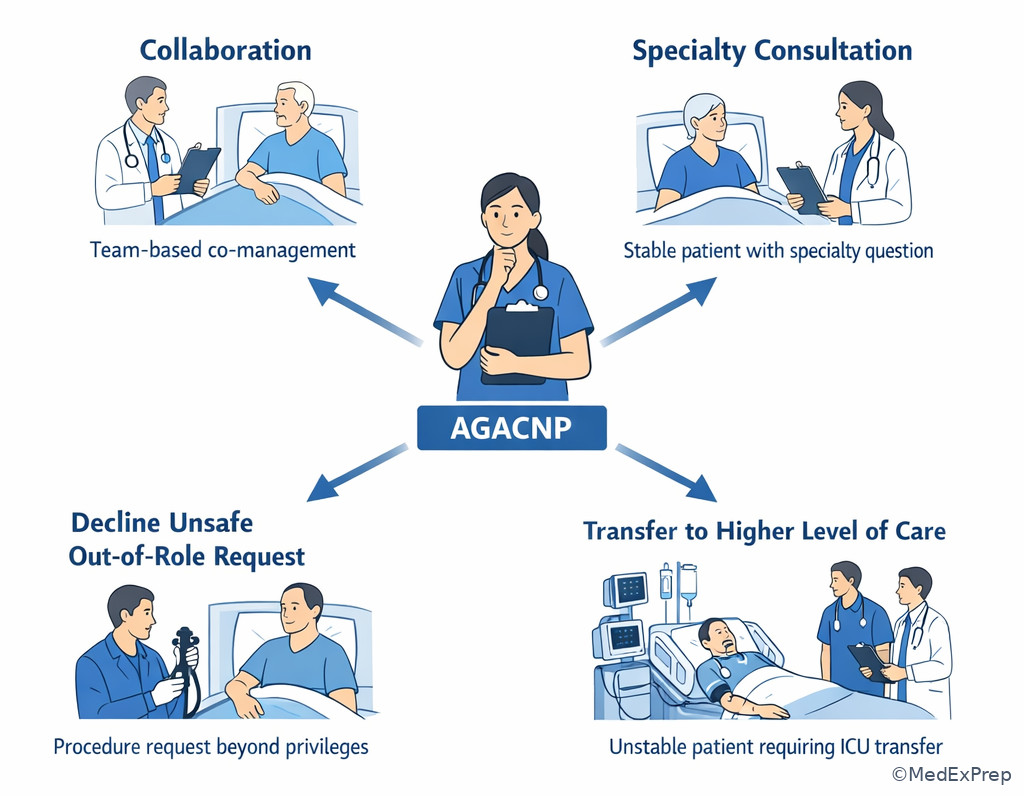
B Worked example
An 83-year-old man with severe COPD, dementia, atrial fibrillation on anticoagulation, and recent aspiration pneumonia is on a small community hospital unit. He develops worsening hypercapnia, increasing somnolence, and repeated desaturations despite escalating oxygen. A colleague asks the AGACNP candidate to “just manage him here overnight” because transfer paperwork is time-consuming. Another team member suggests a procedure outside documented local NP privileges. The stem asks for the most appropriate next step.
Reasoning chain: Identify the task: choose among several system responses. Extract key facts: older adult, acute respiratory decline, likely need for higher monitoring/ventilatory support, small facility limitations. Apply the rule: the limiting factor is setting capability, not merely diagnosis uncertainty. Eliminate distractors: keeping him overnight ignores capability gap; unsupported procedure ignores privilege gap. Verify: stabilize, escalate, and arrange transfer or ICU-level care as appropriate.
C Exam trap
Common wrong answer: Agreeing to “temporarily” continue unsafe local management because transfer is inconvenient.
Why it is tempting: It sounds practical and team-oriented.
Single clue that eliminates it: Repeated desaturations and somnolence show the patient has already outgrown the setting’s safe capability.
D Checkpoint
Question: Which pairing is most accurate?
- Privilege gap → continue independently to avoid delay
- Specialty expertise gap in a stable patient → targeted consultation
- Setting capability gap → routine outpatient referral after discharge
- Acute instability → postpone action until diagnosis is fully confirmed
Answer: B
- A: Tempting because delays can be harmful; wrong because privilege gaps require proper clinician involvement, not workaround independence.
- B: Tempting because it may seem less urgent; right because consultation is the correct response when the problem is specialty depth, not instability.
- C: Tempting because disposition planning matters; wrong because capability gaps require immediate level-of-care action, not later referral.
- D: Tempting because diagnostic certainty is reassuring; wrong because instability must be addressed before full confirmation.
- Assess first: Whether the core problem is instability, expertise need, privilege limit, or setting mismatch.
- Intervene: Choose the in-role action that immediately reduces risk.
- Delegate: Administrative transfer steps may be shared; final clinical judgment about unsafe continuation cannot be delegated away.
- Escalate: Refuse unsafe requests and notify the appropriate supervising or specialty team promptly.
Exam takeaway: In frail older adults, subtle deterioration plus limited unit capability should push you toward early escalation and safer disposition.
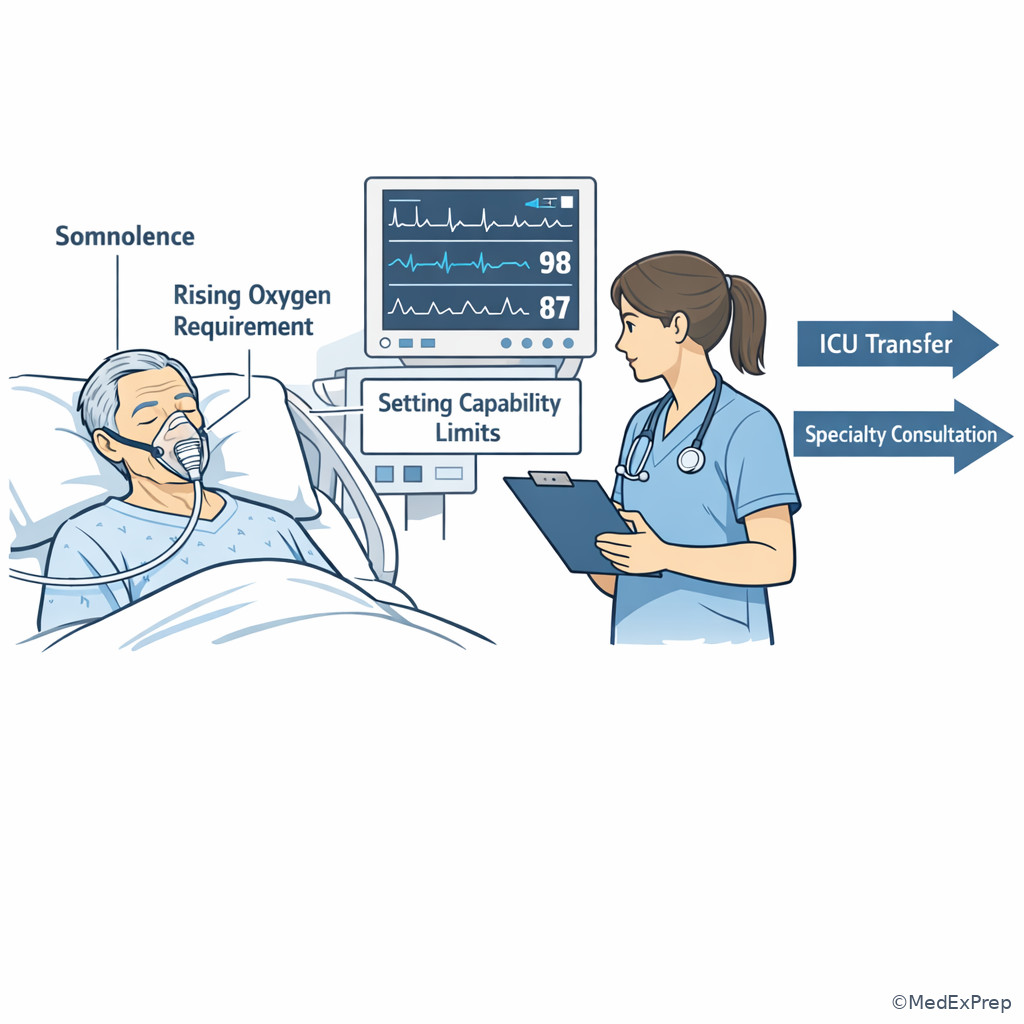
Exam takeaway: Use a quick privilege-policy-setting checklist before selecting any answer that implies procedural independence.
Exam takeaway: Visualize the order of priority in unstable adult patients so you do not choose either delay or unsupported autonomy.
Exam Traps & Differentiators
Common traps & distractors: These questions rarely ask, “Do you know the definition of scope?” They ask whether you can reject a tempting answer that is either too passive, too autonomous, wrong-population, or wrong-setting.
- Most common wrong answer and why: Choosing the most invasive or independent action because it sounds decisive. It is tempting because board learners associate urgency with procedural autonomy. Eliminate it when privileges, setting support, or role authority are not established.
- Looks similar but isn’t: Consultation is not the same as transfer. Consultation solves an expertise gap; transfer solves a capability gap.
- Looks similar but isn’t: Caution is not the same as delay. Safe practice means acting within role while escalation occurs, not waiting idly.
- Looks similar but isn’t: Chronic care planning is not the same as acute management. If the patient is unstable, follow-up tasks move down the priority list.
- If the stem says new hypoxia, hypotension, or altered mentation, think immediate stabilization and escalation.
- If the stem says pediatric, newborn, prenatal, or well-child, think outside AGACNP population focus.
- If the stem says perform the operation, independent anesthesia plan, or unsupported invasive procedure, think out-of-role autonomy trap.
- If the stem says small facility, floor unit, no ICU capability, repeated escalation needs, think setting mismatch and transfer.
- If the stem says local protocol varies, think choose the safest general action rather than a rigid institutional detail.
| Confusable pair | Why learners mix them up | Discriminator |
|---|---|---|
| Consultation vs transfer | Both involve getting help | Consult for expertise gap; transfer for capability gap |
| Stabilize vs wait for specialist | Fear of acting outside scope | Urgent supportive care within role should not wait |
| Assertive management vs unsupported autonomy | Both sound decisive | Autonomy without privilege/policy support is wrong |
| Chronic planning vs acute management | Both are legitimate NP work | Instability always reorders priorities |
| Adult-gerontology scope vs general NP identity | “NP” feels broad | Population focus remains adult/older adult acute care |
Exam takeaway: Use this tree to separate delay, overreach, and proper escalation when several options sound reasonable.
flowchart TD
A[Board answer choice] --> B{Wrong population or setting?}
B -->|Yes| C[Reject]
B -->|No| D{Requires unsupported autonomy or procedure?}
D -->|Yes| C
D -->|No| E{Patient unstable or unit inadequate?}
E -->|Yes| F[Stabilize and escalate/transfer]
E -->|No| G[Manage within role or consult for expertise] | Stem clue | Think | Avoid |
|---|---|---|
| Rapid desaturation on floor unit | Higher level of care may be needed | Finishing low-priority diagnostics first |
| Procedure not tied to stated privileges | Consult/collaborate | Assuming universal authority |
| Question mentions newborn or child | Outside population focus | Generalizing AGACNP to all ages |
| Patient unstable while consultant is pending | Start in-role urgent support now | Passive waiting |
| Community hospital with limited resources | Assess transfer need early | Trying to “make do” unsafely |
Algorithm / Approach
| Limiting factor | Best immediate response | Board-style wording you may see |
|---|---|---|
| Instability | Immediate in-role stabilization + escalation | “most appropriate next step,” “priority action,” “requires immediate clarification” |
| Privilege gap | Decline unsupported action + obtain appropriate clinician | “outside privileges,” “policy-dependent,” “not credentialed” |
| Expertise gap | Consult specialty service | “specialty input,” “co-management,” “further procedural management” |
| Setting capability gap | Upgrade level of care or transfer | “limited monitoring,” “community hospital,” “floor patient worsening” |
| Wrong population/setting | Reject the answer choice | “newborn,” “well-child,” “prenatal,” “routine outpatient continuity” |
Rapid Review
- AGACNP scope → adult and older adult acute/critical care, not broad all-ages NP practice
- Best next step → choose the safest in-role action, not the most technically advanced one
- Instability → stabilization outranks consultation delay
- Consultation → solves expertise gaps, not unit capability gaps
- Transfer → indicated when the current setting cannot safely support the trajectory
- Privileges → institution-specific limits can narrow what is otherwise educationally possible
- Out-of-role wording → pediatric, prenatal, surgeon-only, anesthesiologist-only, and routine primary care continuity are rejection clues
- Older adult nuance → atypical presentations change recognition, not scope boundaries
- Safe autonomy → act within role while escalating, not beyond role because the patient is sick
- Wrong priority distractor → a reasonable chronic-care action becomes wrong during acute deterioration
- Policy variation → choose broadly safe action when local protocol details could differ
- Setting mismatch → repeated oxygen escalation or worsening mentation on a low-acuity unit should trigger upgrade thinking
Memory anchor: STOP before selecting an assertive answer: Setting fit, Task in role, Ongoing instability, Privileges present.
Self-check quiz
1.1.1.8 Question 1
A 69-year-old man with heart failure and CKD is admitted to a telemetry unit for acute dyspnea. The team asks which action best fits the AGACNP role in this setting. Which is the most appropriate action?
- Perform focused acute assessment, trend data, initiate in-role management, and collaborate as needed
- Provide routine well-child preventive care for his grandson in the room
- Assume surgeon-only procedural responsibilities without stated privileges
- Ignore the current admission and schedule only long-term outpatient primary care follow-up
1.1.1.9 Question 2
A 74-year-old woman with COPD and coronary disease becomes more tachypneic on a hospital floor. Which finding most strongly indicates an out-of-role answer choice?
- The option includes reassessment and escalation for worsening respiratory status
- The option includes trending oxygen need and arterial blood gas results
- The option includes routine pediatric management for a 5-year-old with fever
- The option includes coordination of ICU transfer for an unstable adult
1.1.1.10 Question 3
A 77-year-old woman with frailty, atrial fibrillation, and HFpEF develops increasing oxygen needs and new confusion on a step-down unit. She has a mildly elevated BNP from admission and chronic anemia. Which is the most appropriate next step?
- Wait for all imaging and consultant recommendations before changing the plan
- Reassess immediately, start supportive measures within role, and escalate to a higher level of care if needed
- Proceed with an invasive procedure not linked to stated privileges because the patient is worsening
- Shift focus to discharge planning because she has chronic comorbidities
1.1.1.11 Question 4
A 65-year-old man with cirrhosis, diabetes, and OSA becomes progressively somnolent during an admission for GI bleeding evaluation. He received a sedative earlier, and ammonia is mildly elevated. Which action requires immediate clarification because it falls outside AGACNP practice boundaries?
- Perform bedside reassessment and initiate airway support measures within role
- Notify the collaborating team and prepare for a higher level of monitoring
- Independently perform endoscopy because the likely cause is hepatic encephalopathy
- Trend mental status and oxygenation while evaluating reversible contributors
1.1.1.12 Question 5
A 72-year-old patient with pneumonia, diabetes, and chronic steroid use develops fever, hypotension, and confusion on a medical floor. Blood cultures are not yet drawn, and lactate is pending. Which action best reflects AGACNP board-style boundary logic?
- Delay all treatment until the supervising clinician arrives so no scope limits are crossed
- Start immediate in-role sepsis support, obtain urgent data per protocol, and escalate to rapid response or ICU as indicated
- Choose outpatient follow-up because the source is not yet proven
- Assume unrestricted authority for any invasive monitoring because shock is suspected
1.1.1.13 Question 6
An 82-year-old man with severe COPD, dementia, and atrial fibrillation on anticoagulation is in a community hospital without full ICU capability. He has repeated desaturations, rising somnolence, and increasing secretion burden despite escalating oxygen. The respiratory therapist notes concern for impending ventilatory failure. Which is the most appropriate action?
- Continue treatment on the current unit overnight because transfer logistics are difficult
- Stabilize within role, notify the collaborating team, and arrange transfer to a higher level of care
- Perform any needed airway procedure independently because delay is risky
- Wait for morning rounds because his chronic COPD explains the findings
1.1.1.14 Question 7
A 68-year-old woman with metastatic cancer, CKD, and HFpEF becomes hypotensive and confused after admission for fever. A consultant is 20 minutes away. The unit clerk asks whether to begin transfer paperwork first; a colleague suggests waiting so the consultant can direct care; another suggests a procedure outside local NP privileges. Which action is best?
- Wait for the consultant before starting any treatment to avoid overstepping
- Begin immediate supportive care within role, direct team escalation, and coordinate transfer if current setting is inadequate
- Proceed with the unsupported procedure to save time
- Focus on documenting the likely diagnosis before acting
1.1.1.15 Question 8
A stable 70-year-old man with new complex arrhythmia on telemetry needs specialty interpretation, but the unit can provide ongoing monitoring and hemodynamics are preserved. Which action best matches the limiting factor?
- Immediate transfer to another hospital because any arrhythmia requires higher capability
- Targeted specialty consultation while continuing in-role monitoring and acute management
- Decline all involvement because arrhythmia care belongs only to cardiology
- Perform a privilege-dependent electrophysiology intervention independently
Answer key
1.1.1.16 Question 1 Answer: A
A: Tempting because it sounds broad rather than dramatic; correct because it reflects the AGACNP role in adult acute care: assess, interpret, manage, monitor, and collaborate. The single stem clue is the hospitalized adult with acute dyspnea on telemetry. Sources: ANA Standards of Practice; NCSBN role/scope guidance.
B: Tempting only if the learner collapses all NP roles together; incorrect because pediatric preventive care is outside adult-gerontology acute care population focus. The single clue is “grandson.” Sources: ANA Standards of Practice; NCSBN population-focus framework.
C: Tempting because procedural assertiveness can look decisive; incorrect because surgeon-only responsibilities are not assumed for the AGACNP candidate. The single clue is “without stated privileges.” Sources: ANA Standards of Practice; institutional privileging principles reflected in acute care NP practice.
D: Tempting because outpatient planning is a real NP task; incorrect because it ignores the current acute admission and immediate problem. The single clue is “acute dyspnea.” Sources: Lewis Medical-Surgical Nursing; ANA Standards of Practice.
1.1.1.17 Question 2 Answer: C
A: Tempting because escalation can feel like passing off care; incorrect because reassessment plus escalation for worsening breathing is appropriate acute care NP practice. The single clue is “worsening respiratory status.” Sources: Lewis Medical-Surgical Nursing; ANA Standards.
B: Tempting because ordering and trending data may feel physician-like to some learners; incorrect because acute diagnostic monitoring in hospitalized adults is within AGACNP role expectations. The single clue is “hospital floor” with adult acute deterioration. Sources: ANA Standards; acute care NP educational role principles.
C: Tempting if “provider” language is overgeneralized; correct because routine pediatric management is outside the AGACNP population focus. The single clue is “5-year-old.” Sources: NCSBN population-focus framework; ANA Standards.
D: Tempting because transfer decisions may seem administrative; incorrect because ICU transfer coordination for an unstable adult is appropriate and often necessary. The single clue is “unstable adult.” Sources: Lewis Medical-Surgical Nursing; ANA Standards.
1.1.1.18 Question 3 Answer: B
A: Tempting because complete data reduces uncertainty; incorrect because new oxygen needs and confusion suggest instability and possible setting inadequacy now. The single clue is “increasing oxygen needs and new confusion.” Sources: Lewis Medical-Surgical Nursing; ANA Standards prioritization.
B: Tempting because it may seem less disease-specific than other options; correct because it uses ABCs and safety: reassess, support, and escalate level of care if required. The single clue is acute deterioration on step-down. Sources: ANA Standards; NCSBN prioritization principles.
C: Tempting because worsening status suggests invasive action might help; incorrect because privilege-dependent procedures cannot be assumed from urgency alone. The single clue is “not linked to stated privileges.” Sources: ANA Standards; institutional privileging principles.
D: Tempting because discharge planning matters in frail patients; incorrect because acute instability supersedes chronic planning. The single clue is “new confusion.” Sources: Lewis Medical-Surgical Nursing; ANA Standards.
1.1.1.19 Question 4 Answer: C
A: Tempting because bedside airway support may feel like doing less than definitive therapy; incorrect because it is appropriate in-role acute stabilization. The single clue is progressive somnolence. Sources: Lewis Medical-Surgical Nursing; ANA Standards.
B: Tempting because collaboration may seem secondary; incorrect because higher monitoring may be needed and team notification is appropriate. The single clue is worsening mental status in an admitted adult. Sources: ANA Standards; acute care escalation principles.
C: Tempting because endoscopy addresses a GI cause directly; correct as the action requiring clarification because independent endoscopy is outside assumed AGACNP role and privileges. The single clue is “independently perform endoscopy.” Sources: ANA Standards; scope/privilege principles.
D: Tempting because trending can be low priority in some stems; incorrect because here it remains part of appropriate monitoring while reversible causes are assessed. The single clue is mixed contributors to somnolence. Sources: Lewis Medical-Surgical Nursing; ANA Standards.
1.1.1.20 Question 5 Answer: B
A: Tempting because it sounds respectful of scope; incorrect because waiting during possible septic shock violates ABCs and safety. The single clue is hypotension with confusion. Sources: Lewis Medical-Surgical Nursing; ANA Standards; NCSBN prioritization principles.
B: Tempting because it requires acting before full certainty; correct because AGACNP boundary logic supports immediate in-role sepsis care plus escalation. The single clue is suspected shock on a medical floor. Sources: ANA Standards; current sepsis guideline principles.
C: Tempting because diagnosis is not final; incorrect because outpatient planning is incompatible with acute deterioration. The single clue is “hypotension.” Sources: Lewis Medical-Surgical Nursing; ANA Standards.
D: Tempting because invasive monitoring can accompany shock care; incorrect because shock does not grant unrestricted procedural authority. The single clue is “assume unrestricted authority.” Sources: ANA Standards; privileging principles.
1.1.1.21 Question 6 Answer: B
A: Tempting because transfer logistics are often difficult in real life; incorrect because repeated desaturations and somnolence show the patient has outgrown the setting’s safe capability. The single clue is “without full ICU capability.” Sources: ANA Standards; Lewis Medical-Surgical Nursing.
B: Tempting because it requires both bedside action and systems coordination; correct because the limiting factor is a capability gap in an unstable older adult. The single clue is impending ventilatory failure at a community hospital. Sources: ANA Standards; acute respiratory failure management principles.
C: Tempting because airway decline is urgent; incorrect because urgency does not remove privilege boundaries. The single clue is “independently.” Sources: ANA Standards; scope/privilege principles.
D: Tempting because chronic COPD can explain abnormal baseline findings; incorrect because the repeated desaturations and rising somnolence signal acute change, not routine chronic disease. The single clue is “despite escalating oxygen.” Sources: Lewis Medical-Surgical Nursing; ANA Standards.
1.1.1.22 Question 7 Answer: B
A: Tempting because it avoids perceived overstepping; incorrect because unstable patients require supportive action within role before consultant arrival. The single clue is hypotension with confusion. Sources: ANA Standards; NCSBN prioritization framework.
B: Tempting because it asks you to do several things at once; correct because it balances ABCs, team escalation, and disposition to a safer setting if needed. The single clue is the combination of instability and possible setting inadequacy. Sources: ANA Standards; Lewis Medical-Surgical Nursing.
C: Tempting because saving time matters in shock; incorrect because unsupported procedures remain outside the boundary. The single clue is “outside local NP privileges.” Sources: ANA Standards; privileging principles.
D: Tempting because documentation is professionally important; incorrect because documentation follows immediate stabilization in the priority hierarchy. The single clue is “becomes hypotensive and confused.” Sources: ANA Standards; NCSBN prioritization principles.
1.1.1.23 Question 8 Answer: B
A: Tempting because arrhythmias can deteriorate quickly; incorrect because the patient is stable and the current unit can support monitoring, so transfer is not the limiting-factor answer. The single clue is “hemodynamics are preserved.” Sources: Lewis Medical-Surgical Nursing; ANA Standards.
B: Tempting because consultation may seem less proactive than transfer; correct because this is an expertise gap, not a capability gap or privilege emergency. The single clue is stable telemetry patient needing specialty interpretation. Sources: ANA Standards; acute care consultation principles.
C: Tempting because specialty input is needed; incorrect because AGACNPs do not step away from appropriate monitoring and acute management while awaiting cardiology. The single clue is ongoing stable unit capability. Sources: ANA Standards; scope principles.
D: Tempting because definitive electrophysiology sounds efficient; incorrect because privilege-dependent intervention is not established and not required for a stable expertise-gap scenario. The single clue is “stable” plus “needs specialty interpretation.” Sources: ANA Standards; privileging principles.
Keep going with the full AGACNP-BC Prep Course (AGACNP)
You just studied the way members do, in the same lesson interface. Full access unlocks every lesson, the question bank and flashcards for a full year.
One payment · 1 year of access · No auto-renewal