1.1.1 - Radiotherapy Indications And Contraindications
Radiotherapy Indications And Contraindications
What you'll learn
- FOUNDATIONS - Indication logic: Decide when radiotherapy is appropriate based on disease biology, local control benefit, symptom burden, and alternative options.
- DISEASE-SITE CLINICAL MANAGEMENT - Contraindication reasoning: Separate absolute from relative contraindications and identify when modification rather than rejection of RT is the safest standard approach.
- PLANNING/DELIVERY - Technical feasibility: Judge whether setup, target definition, prior treatment, motion, or organ-at-risk concerns make standard RT feasible or unsafe.
- TOXICITY - Risk balancing: Weigh expected tumor benefit against acute and late toxicity risk in curative and palliative settings.
- QUALITY/SAFETY - Escalation decisions: Recognize scenarios that require treatment pause, multidisciplinary clarification, or replanning before proceeding.
- FOUNDATIONS → choosing when RT belongs in cancer care
- DISEASE-SITE CLINICAL MANAGEMENT → identifying curative, adjuvant, neoadjuvant, definitive, and palliative RT roles
- PLANNING/DELIVERY → feasibility of simulation, immobilization, localization, and target/OAR tradeoffs
- TOXICITY → expected harms that change indication strength
- QUALITY/SAFETY → hold, verify, escalate, and re-evaluate decisions
Why it matters
- Many board stems are not asking for dose first; they are asking whether RT should be offered at all, deferred, modified, or replaced by another local therapy.
- The most dangerous error is treating a patient whose target, intent, prior dose history, or urgent competing issue has not been clarified.
- Indications and contraindications are tested across every disease site, especially when performance status, prior RT, connective tissue disease, pregnancy, implanted devices, or postoperative timing complicate the decision.
- Oral boards often reward the safest framework: identify benefit, identify the limiting risk, decide if RT still belongs, then define what must be verified before starting.
Key Terms & Must-Know Facts
1.1.1.1 Key terms
- Indication: Clinical reason RT is expected to improve control, survival, organ preservation, or symptoms.
- Contraindication: Factor making RT unsafe, ineffective, or inappropriate in its current form.
- Absolute contraindication: Rare scenario where RT should not proceed as planned because harm or impossibility clearly outweighs benefit.
- Relative contraindication: Risk factor that may still allow RT with modification, mitigation, or multidisciplinary review.
- Definitive RT: RT intended as primary local treatment.
- Adjuvant RT: RT given after surgery to reduce recurrence risk.
- Neoadjuvant RT: RT delivered before surgery to improve resectability or local control.
- Palliative RT: RT aimed at symptom relief or local stabilization rather than durable cure.
- Therapeutic ratio: Balance between tumor control probability and normal tissue injury.
- Reirradiation: RT to a previously irradiated region requiring heightened caution regarding cumulative toxicity.
- Performance status: Functional reserve that affects whether treatment benefit is realistic.
- Target feasibility: Ability to define and safely cover tumor-related volumes.
- Organ at risk (OAR): Normal structure whose dose may limit treatment.
- Multidisciplinary escalation: Coordinated review when surgery, systemic therapy, pathology, imaging, or technical safety limits a straightforward RT decision.
1.1.1.2 Must-know facts
- True absolute contraindications to all RT are uncommon; most exam scenarios involve relative contraindications that require adaptation.
- Untreated life-threatening instability comes before RT planning; stabilize first when airway, cord, bleeding, or sepsis dominates.
- Prior RT is not an automatic "no"; it is a cue to reconstruct prior dose, field overlap, goals, interval, and alternative options.
- Poor performance status does not automatically exclude palliative RT if symptom relief can be rapid and meaningful.
- Pregnancy is not an automatic "no RT ever"; it is usually a major constraint requiring fetal dose consideration, alternative timing, or alternative therapy.
- Connective tissue disease increases caution, but board-safe reasoning is disease severity and field location, not blanket refusal.
- If the target cannot be reliably defined, immobilized, or localized, the safest next step is not to "guess"; it is to clarify or replan.
- Curative-intent RT generally tolerates more complexity and toxicity than palliative RT, but only when the expected benefit is substantial.
| Decision domain | Question to ask | Board-relevant implication |
|---|---|---|
| Oncologic benefit | Will RT improve local control, survival, organ preservation, or symptoms? | If no meaningful benefit, reject RT or defer to another modality. |
| Intent | Curative or palliative? | Determines how much toxicity, treatment time, and complexity are acceptable. |
| Urgency | Is there a time-critical threat? | Compression, bleeding, airway compromise, or severe pain may accelerate RT decision-making. |
| Feasibility | Can the target be simulated and treated safely? | If not, modify setup, imaging, or timing before proceeding. |
| Competing risks | Is another issue more dangerous right now? | Stabilization or surgery may come first. |
| Prior treatment | Has this area already received surgery, RT, or systemic therapy? | Changes sequencing, risk, and sometimes indication strength. |
| Patient factors | Can the patient tolerate the course and attend treatment? | May push toward abbreviated palliation, different modality, or best supportive care. |
Exam takeaway: Start with expected benefit, then look for the single limiting factor that changes proceed versus modify versus defer.
flowchart TD
A[Patient with malignancy or tumor-related symptom] --> B{Meaningful RT benefit?}
B -->|Yes| C{Urgent threat?}
B -->|No| Z[Do not offer RT as primary plan]
C -->|Yes| D[Stabilize and expedite urgent RT evaluation]
C -->|No| E[Assess intent and alternatives]
E --> F{Safe and feasible?}
F -->|Yes| G[Proceed with standard RT pathway]
F -->|No, but modifiable| H[Modify, clarify, or coordinate MDT]
F -->|No, not acceptable| I[Defer RT or choose alternative treatment] Exam takeaway: A realistic multidisciplinary consultation scene helps anchor the sequence of benefit, urgency, feasibility, and safety checks.

Core content
1.1.1.3 Foundational rule: when RT is indicated at all
A Explanation
The first decision conflict is benefit versus no meaningful role. On boards, the key question is not "can radiation shrink this?" but "does RT meaningfully improve a patient-centered oncologic outcome compared with alternatives or observation?" RT is indicated when it offers one or more of the following: durable local control, survival contribution in combined-modality disease, organ preservation, margin-risk reduction after surgery, or reliable symptom relief. The single finding that often resolves the choice is whether the problem is local-regional and radiosensitive enough for RT to change outcome.
WHY THIS IS TESTED: exam stems often embed distracting details such as age, comorbid illness, or a mildly abnormal lab value to push you away from the core issue: is the dominant problem one that RT can solve? If the disease is clearly systemic without local symptom burden and RT will not change control or comfort, reject RT. If the disease is local-regional or causing a focal symptom, RT often belongs. See Fig 1.
Choose RT when local control matters and the lesion can be targeted safely. Reject RT as the main plan when surgery clearly offers better immediate source control, when systemic therapy addresses diffuse disease without local symptoms, or when pathology/imaging is too uncertain to define what should be treated. In ABR framing, you are choosing the best physician-level local therapy path, not committing to details outside your scope.
B Worked example
A 67-year-old man with T3N1 distal rectal adenocarcinoma, type 2 diabetes, and chronic atrial fibrillation presents after colonoscopy and pelvic MRI. He reports mild pelvic pressure but no obstruction or bleeding. His creatinine is slightly elevated, and the chart notes a remote history of a benign skin lupus diagnosis that is poorly documented. The stem asks for the most appropriate role of RT. The tempting wrong move is to reject RT because of the lupus clue.
Reasoning chain: Identify the task: determine whether RT is indicated at all. Extract key facts: localized rectal cancer, nodal involvement, no metastatic emergency, pelvic local control matters. Apply the rule: RT is indicated when it improves local-regional control and fits a standard combined-modality pathway. Eliminate distractors: observation fails local control goals; immediate palliative RT is wrong because this is not a symptom-driven palliation case; blanket avoidance due to vague connective tissue history is premature because that is a relative risk requiring clarification, not an automatic contraindication. Verify: RT remains indicated, but the exact sequencing and risk modification need follow-up. The indication survives even though the final plan may be adjusted.
C Exam trap
D Checkpoint
Question: A 58-year-old woman with recently diagnosed painful T8 vertebral metastasis from breast cancer, controlled hypertension, and prior cholecystectomy presents with focal pain worse at night. MRI shows a lytic lesion without cord compression. Which factor most strongly supports an RT indication?
- A. Prior abdominal surgery
Tempting because prior procedures can complicate cancer care, but it is irrelevant to focal thoracic palliative RT and does not define indication. - B. Focal symptomatic lesion amenable to local palliation
Tempting because pain is common in metastases, and it is correct because reliable symptom relief from a localized site is a classic RT indication. - C. History of hypertension
Tempting because comorbidities affect treatment tolerance, but it does not create or remove the RT indication here. - D. Need for tissue diagnosis before any cancer-directed therapy
Tempting because pathology matters, but in a known metastatic patient with a symptomatic radiographically typical lesion, this is not the main discriminator for palliative RT indication.
Answer: B
1.1.1.4 Contraindications: absolute versus relative
A Explanation
The next decision conflict is proceed versus pause because risk overwhelms benefit. True absolute contraindications to all RT are uncommon in modern practice. Most cases are relative contraindications that demand modification, dose/fractionation adjustment, tighter imaging, alternative modality, altered sequencing, or multidisciplinary review. The single rule that resolves many stems is this: if the barrier is potentially correctable or context-dependent, treat it as relative until proven otherwise.
Examples of relative contraindications include prior RT to an overlapping field, active connective tissue disease with concern for severe toxicity, pregnancy when fetal exposure is relevant, inability to lie flat or tolerate immobilization, uncontrolled intercurrent illness, severe baseline organ dysfunction in the planned field, or uncertain pathology/extent that makes target definition unreliable. Examples approaching absolute contraindication to the proposed plan include inability to identify the target at all, direct conflict with a more urgent lifesaving intervention, or expected catastrophic normal tissue injury from unrecoverable cumulative dose without a compelling rescue rationale.
WHY THIS IS TESTED: the exam wants you to avoid two opposite mistakes: treating recklessly and refusing RT too broadly. A prior course of RT, collagen vascular disease, or implanted device is usually not the final answer by itself. The correct move is often "clarify, quantify, and modify." See Fig 2.
Exam takeaway: Most stems test whether a red flag requires modification and review rather than blanket cancellation of RT.
flowchart TD
A[Potential contraindication found] --> B{Target definable and benefit meaningful?}
B -->|No| X[Do not proceed as planned]
B -->|Yes| C{Risk modifiable or quantifiable?}
C -->|Yes| D[Relative contraindication: adapt and review]
C -->|No| E{Catastrophic harm likely?}
E -->|Yes| F[Functionally absolute for this plan]
E -->|No| G[Discuss alternatives and individualized risk] B Worked example
A 72-year-old man with recurrent head and neck squamous cell carcinoma, coronary artery disease, and chronic kidney disease presents with pain and bleeding from a previously irradiated neck mass. He had RT 5 years ago at another institution, but the exact records are not yet available. The stem includes a distractor: a stable pacemaker in the left chest. The question asks for the most appropriate next step regarding RT candidacy.
Reasoning chain: Identify the task: not dose selection, but whether RT is contraindicated. Extract key facts: symptomatic local recurrence, prior RT overlap likely, palliative benefit possible, prior records missing, pacemaker likely unrelated to neck field. Apply the rule: prior RT is a relative contraindication until overlap and prior dose are clarified. Eliminate distractors: "Never reirradiate" is too broad; "Treat immediately with the prior standard course" is unsafe; "Cancel RT because of the pacemaker" misidentifies the limiting factor. Verify: the safest answer is urgent record retrieval and multidisciplinary reirradiation evaluation, with symptom control planning rather than reflexive refusal.
C Exam trap
D Checkpoint
Question: A 34-year-old woman with localized breast cancer, rheumatoid arthritis controlled on therapy, and no prior RT is referred after lumpectomy. Which statement best reflects board-defensible reasoning about RT contraindication?
- A. Any autoimmune disease makes adjuvant RT absolutely contraindicated
Tempting because autoimmune disorders raise toxicity concerns, but it is wrong because risk varies by disease activity, organs involved, and field. - B. Controlled connective tissue disease is a relative contraindication that requires individualized risk discussion and planning
Tempting because it seems too nuanced, and it is correct because this is the usual modern physician-level approach. - C. Rheumatoid arthritis eliminates any local control benefit from RT
Tempting because toxicity might dominate thinking, but it is wrong because the oncologic benefit remains. - D. Endocrine therapy always replaces adjuvant RT in this setting
Tempting because systemic therapy reduces recurrence risk, but it is wrong because it does not universally substitute for indicated local therapy.
Answer: B
- The most common exam error with contraindications is calling a relative contraindication absolute.
- True or False: Prior RT automatically eliminates future RT options. False.
- Name 3 red flags that usually require clarification rather than instant cancellation: prior RT overlap, pregnancy, connective tissue disease.
| Scenario | Usually absolute? | Usually relative? | Board-safe next step |
|---|---|---|---|
| Target cannot be identified on available imaging/pathology | Yes, for the current plan | No | Clarify diagnosis/extent before treating. |
| Prior overlapping RT | No | Yes | Retrieve prior dose/fields and assess reirradiation feasibility. |
| Active pregnancy near treatment field | Rarely absolute to all RT | Usually yes | Estimate fetal exposure, consider deferral or alternative modality. |
| Severe inability to tolerate immobilization | No | Yes | Modify setup, support, sedation strategy, or alternative treatment. |
| Unstable sepsis or medical collapse | Yes, for immediate elective RT | No | Stabilize first, then reassess urgency. |
| Controlled connective tissue disease | No | Yes | Proceed cautiously with individualized counseling. |
| Expected catastrophic OAR injury without workaround | Yes, for that plan | No | Defer or choose different modality/strategy. |
1.1.1.5 Application: urgent indications, symptom-driven use, and when stabilization comes first
A Explanation
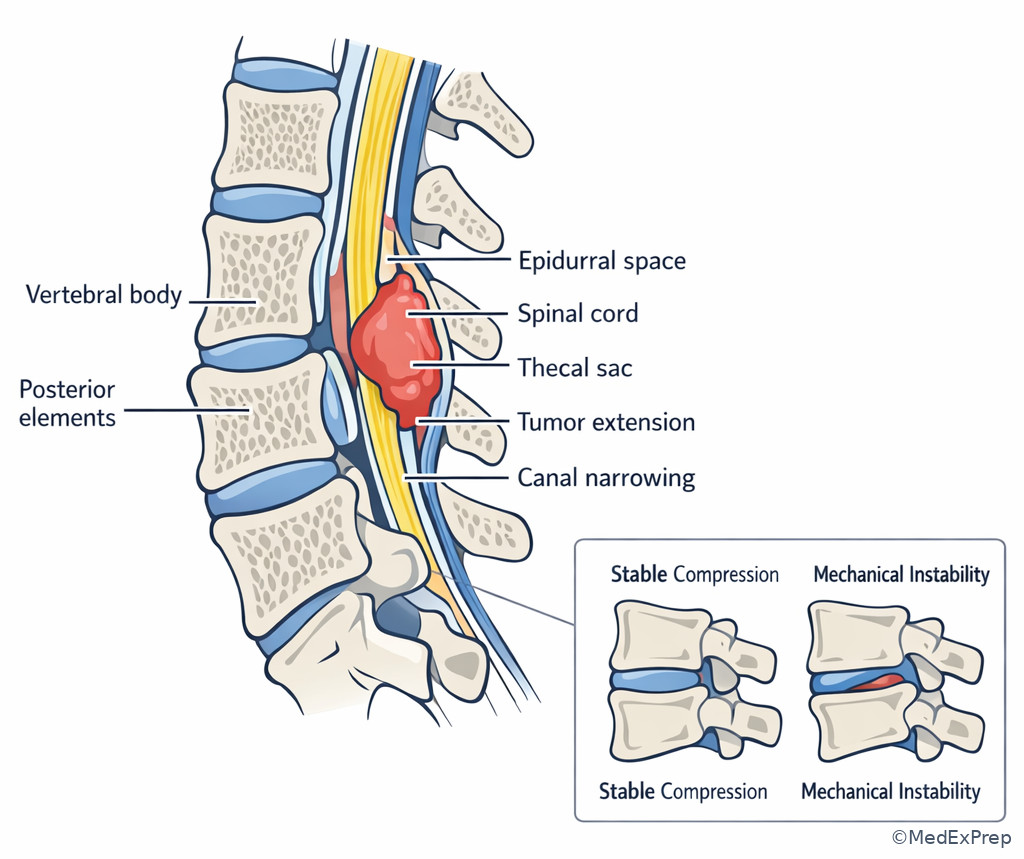
In urgent oncology, the decision conflict is expedite RT now versus stabilize or clarify first. RT is commonly indicated urgently for spinal cord compression, symptomatic brain metastasis-related mass effect in selected settings, SVC syndrome, bleeding tumors, and painful bone metastases, but urgency does not eliminate basic safety logic. The single rule that resolves many stems is: if a reversible life-threatening instability or a superior immediate decompressive intervention exists, address that first while coordinating RT.
For example, malignant spinal cord compression may require steroids immediately and surgical evaluation depending on instability, histology, neurologic status, and mechanical factors; RT remains important but may not be the first physical intervention. Airway threat may require stabilization before simulation. Major bleeding may justify rapid palliative RT, but hemodynamic collapse still requires acute supportive management. Conversely, severe focal pain from bone metastasis with stable neurologic status is a classic case where palliative RT can proceed quickly because local symptom control is the central problem.
WHY THIS IS TESTED: exam writers blur urgency and indication. They want to know whether you can distinguish "RT is indicated" from "RT is the first step this minute." See Fig 3.
Exam takeaway: Urgent indication does not always mean immediate beam-on; stabilization or surgery may be the safer first move.
flowchart TD
A[Oncologic emergency suspected] --> B{Hemodynamic or airway instability?}
B -->|Yes| C[Stabilize and involve appropriate specialists]
B -->|No| D{Surgery or procedure offers faster critical relief?}
D -->|Yes| E[Escalate for urgent decompression/intervention]
D -->|No| F[Expedite RT workup]
F --> G[Choose rapid symptom-focused regimen] Exam takeaway: Visualizing the epidural tumor, compressed cord, vertebral body, and posterior elements helps separate urgent RT from cases needing decompressive surgery first.
B Worked example
A 61-year-old man with metastatic prostate cancer, coronary disease, and obesity presents with 24 hours of progressive leg weakness, urinary retention, and severe mid-back pain. He is afebrile. A distracting clue in the stem notes a painful rib metastasis seen on last month's scan. MRI now shows epidural compression at T6 with retropulsed vertebral body collapse. The question asks for the most appropriate next step.
Reasoning chain: Identify task: urgent management sequencing. Extract key facts: neurologic deficit, urinary retention, vertebral collapse suggesting instability, cord compression. Apply rule: urgent RT is indicated in cord compression, but instability and acute deficits may make surgical decompression the first critical intervention. Eliminate distractors: single-fraction rib palliation addresses the wrong lesion; routine outpatient RT simulation delays needed action; observation with steroids alone is incomplete. Verify: immediate steroids and urgent surgical evaluation are required, with RT coordinated based on the decompression plan.
C Exam trap
D Checkpoint
Question: A 70-year-old woman with metastatic lung cancer, COPD, and chronic anemia presents with hemoptysis from a bulky central thoracic mass but remains hemodynamically stable and oxygenating adequately. Which statement best supports urgent RT candidacy?
- A. Symptomatic focal bleeding from a tumor source with relative physiologic stability
Tempting because hemoptysis can be alarming, and it is correct because urgent palliative RT can provide local bleeding control when the patient is stable enough for planning. - B. COPD alone mandates inpatient ventilation before any RT decision
Tempting because pulmonary disease increases risk, but it is wrong because stability, not diagnosis alone, determines urgency and sequencing. - C. Chronic anemia removes the local palliative role of RT
Tempting because anemia may worsen symptoms, but it does not negate the indication for focal hemostatic treatment. - D. All bleeding tumors require surgery rather than RT
Tempting because direct procedural control can be fast, but it is overly broad and not true across tumor sites.
Answer: A
1.1.1.6 Application: patient factors that modify RT candidacy without automatically eliminating it
A Explanation
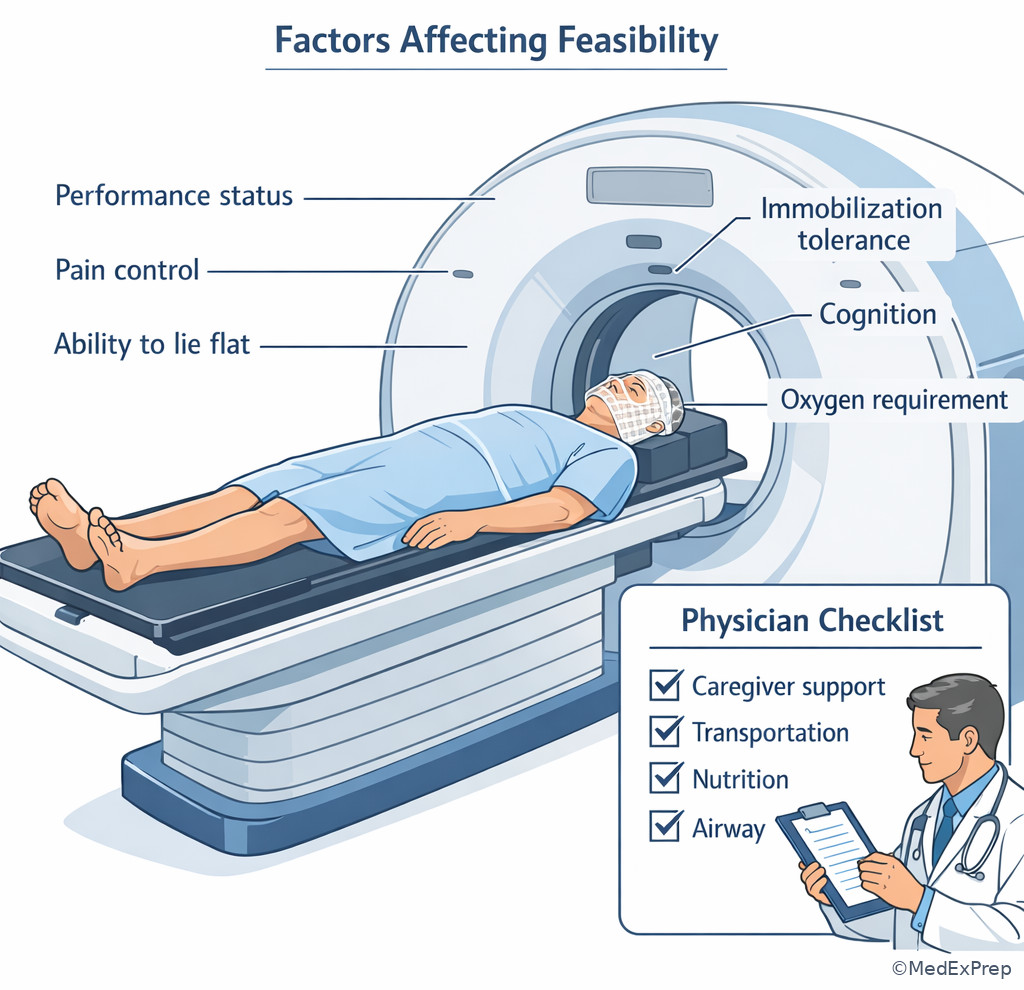
The decision conflict here is benefit versus disproportionate burden. Patient-specific factors do not merely alter toxicity; they can change whether RT is realistic, humane, or achievable. The single finding that often resolves the choice is whether the patient can complete a course whose burden matches the expected benefit. Key modifiers include performance status, life expectancy, transportation/logistics, cognition, ability to remain still, baseline organ dysfunction, frailty, prior adverse treatment experiences, and goals of care.
For palliative RT, poor performance status may actually favor shorter, simpler regimens because convenience and symptom relief dominate. For curative RT, the same performance status may force a harder discussion about whether the patient can safely complete a prolonged combined-modality course. Baseline dysphagia, severe malnutrition, or oxygen dependence may not contraindicate RT, but they may change urgency, support needs, or whether inpatient management is required. Board stems often include a detail like mild dementia, inability to lie flat, or severe claustrophobia. The correct move is often to adapt immobilization, support, or regimen rather than to assume impossibility.
WHY THIS IS TESTED: this section examines your ability to match treatment intensity to patient reserve, not just tumor characteristics. See Fig 4.
Exam takeaway: RT candidacy depends not only on tumor biology but on whether the patient can safely undergo simulation, immobilization, and treatment completion.
B Worked example
An 83-year-old woman with metastatic non-small cell lung cancer, severe osteoarthritis, mild cognitive impairment, and chronic heart failure presents with painful sacral metastasis causing difficulty sitting. She lives two hours from the center. A distracting lab value shows mild hyponatremia. The question asks for the most appropriate RT approach if RT is chosen.
Reasoning chain: Identify task: match indication to patient burden. Extract key facts: focal painful lesion, frailty, travel burden, cognition concerns, symptom palliation is realistic. Apply rule: when RT is indicated for palliation, use the least burdensome effective approach. Eliminate distractors: prolonged multifraction definitive-style treatment is excessive; no RT at all ignores likely benefit; aggressive inpatient workup for mild hyponatremia does not resolve the painful local problem. Verify: abbreviated palliative RT is favored because the patient can gain symptom relief without a long course.
C Exam trap
D Checkpoint
Question: A 79-year-old man with metastatic bladder cancer, ECOG 3 from cancer-related pain, COPD, and limited family support has a bleeding pelvic mass. Which factor most strongly argues for modifying rather than canceling RT?
- A. ECOG 3 always precludes tumor-directed therapy
Tempting because poor status predicts limited reserve, but it is wrong because palliative hemostatic RT may still provide high-value benefit. - B. Local bleeding can justify a short symptom-focused regimen despite limited performance status
Tempting because it balances urgency and burden, and it is correct because symptom control may still be realistic and worthwhile. - C. COPD requires definitive chemoradiation instead of palliation
Tempting because lung disease complicates planning, but it does not convert the goal to a long curative course. - D. Limited family support removes any RT role
Tempting because transport matters, but it is wrong because treatment may be adapted or supported rather than denied outright.
Answer: B
- The best palliative regimen is often the one the patient can actually complete.
- True or False: Poor performance status automatically removes the indication for symptom-relief RT. False.
- Name 3 non-tumor factors that change RT candidacy: immobilization tolerance, transportation, cognition.
| Patient factor | Why it matters | Typical board-safe adaptation |
|---|---|---|
| Poor performance status | May reduce ability to tolerate prolonged therapy | Shorter palliative course or reconsider goal |
| Severe pain lying flat | Simulation and setup may fail | Optimize analgesia, positioning, or simpler setup |
| Cognitive impairment | Impairs cooperation and reproducibility | Caregiver assistance, simpler regimen, possible sedation planning |
| Transportation barrier | Threatens completion | Use hypofractionated palliation if clinically appropriate |
| Malnutrition/dysphagia | Raises toxicity risk in head and neck/thoracic RT | Nutrition support before or during treatment |
| Oxygen dependence | May affect positioning and reserve | Assess outpatient feasibility and support needs |
| Severe anxiety/claustrophobia | Limits immobilization | Behavioral support, anxiolysis, alternative setup strategy |
1.1.1.7 Integration: technical, dosimetric, and safety limits that change proceed-versus-pause decisions
A Explanation
The final foundational integration question is is the treatment plan conceptually safe and technically achievable? RT may be indicated biologically and clinically, yet still require a pause if target definition, prior dose overlap, motion, anatomy, device interference, or organ-at-risk constraints make treatment unsafe in its current form. The single rule that resolves these stems is: never proceed when the correct patient, correct target, correct intent, or correct normal-tissue protection cannot be verified.
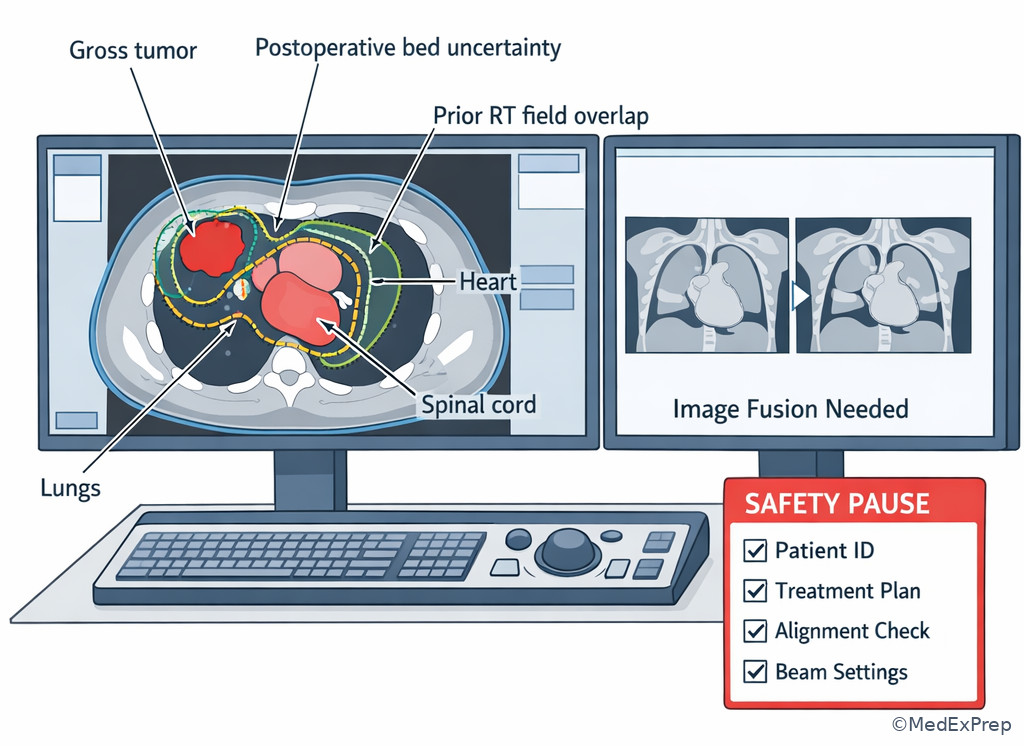
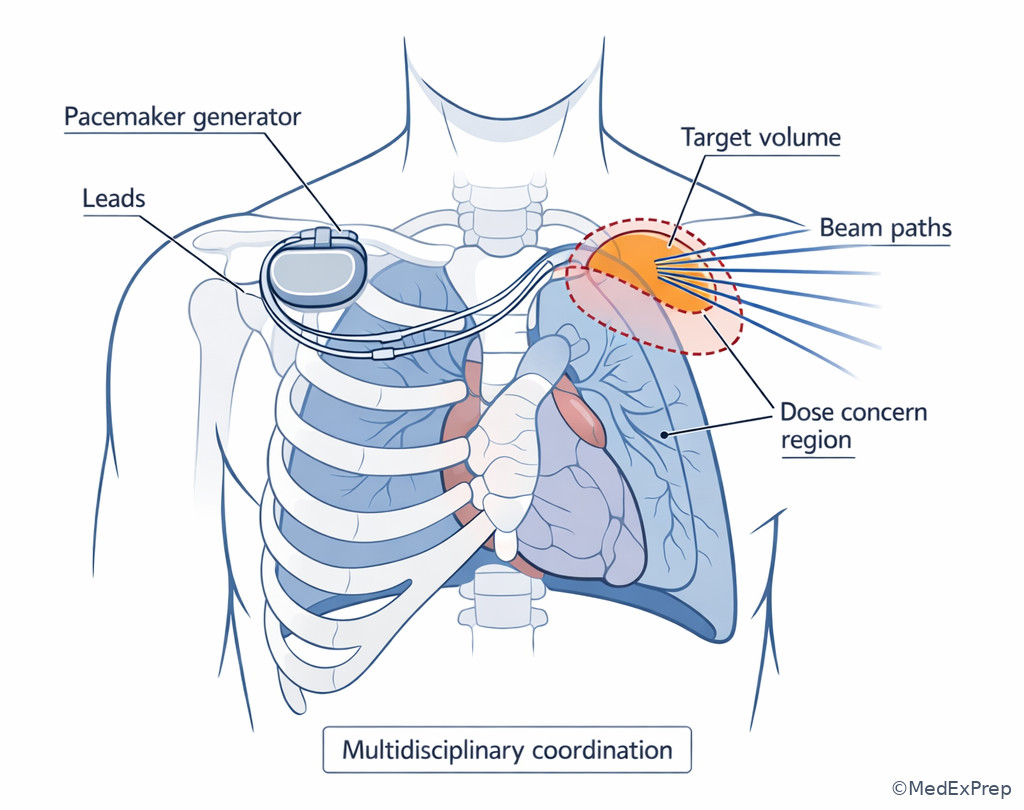
Board examples include: ambiguous postoperative anatomy without adequate imaging; prior RT records unavailable in a reirradiation case; large respiratory motion threatening target miss; near-field implanted device concerns; inability to separate tumor from postoperative change; or gross mismatch between proposed field and symptom source. The safest answer is often hold-and-clarify rather than proceed with an approximate field. This is physician-level QA reasoning, not physicist-only commissioning. Your role is to identify that something is unsafe or undefined and escalate appropriately.
WHY THIS IS TESTED: ABR emphasizes safety framing. Candidates lose points when they keep driving toward treatment despite unresolved target or OAR uncertainty. See Fig 5.
Exam takeaway: If target boundaries, prior overlap, motion, or nearby critical structures are uncertain, the safest answer is pause and clarify before treatment starts.
Exam takeaway: Device presence is usually a planning and coordination issue, not an automatic contraindication to RT.
B Worked example
A 59-year-old man with recurrent lung cancer, prior thoracic RT at an outside hospital, COPD, and coronary artery disease presents for possible reirradiation. He has mild hemoptysis but is stable. The imported CT shows a hilar mass abutting the mainstem bronchus, but the prior composite dose distribution is missing. A distracting detail notes a remote history of melanoma excision on the back. The question asks for the safest standard approach.
Reasoning chain: Identify task: proceed versus pause. Extract key facts: potential reirradiation, central thoracic target near critical structures, prior dose unknown, current stability. Apply rule: do not start without verifying prior overlap and OAR risk. Eliminate distractors: immediate empiric thoracic RT ignores unknown cumulative dose; rejecting all RT is too broad; melanoma history is irrelevant. Verify: obtain prior RT plan/records and complete multidisciplinary feasibility review before deciding on reirradiation.
C Exam trap
D Checkpoint
Question: A 65-year-old woman with postoperative pelvic recurrence, prior pelvic RT records unavailable, and severe baseline diarrhea is referred for reirradiation consideration. She is ambulatory and hemodynamically stable. What is the most appropriate next step?
- A. Start the planned course because recurrence proves the need for aggressive RT
Tempting because local control is important, but it is wrong because prior overlap and bowel risk are undefined. - B. Cancel RT permanently because prior pelvic RT always forbids retreatment
Tempting because bowel toxicity risk is real, but it is too absolute and ignores individualized reirradiation assessment. - C. Retrieve prior treatment records and reassess cumulative risk before finalizing candidacy
Tempting because it seems slower, and it is correct because safe reirradiation requires prior dose and overlap clarification. - D. Ignore the prior RT issue if the current target can be seen on CT
Tempting because visible disease encourages action, but visibility alone does not resolve cumulative OAR constraints.
Answer: C
Exam Traps & Differentiators
Most common wrong answer and why: "This is contraindicated" based on one scary detail. That is tempting because ABR stems often mention prior RT, autoimmune disease, pregnancy, frailty, or a device specifically to provoke overcalling risk. The best answer usually depends on whether the concern changes how RT is delivered rather than whether RT belongs.
| Looks similar | Actually means | Discriminating clue |
|---|---|---|
| Urgent symptom + stable patient | Expedite palliative RT | Local symptom is dominant and no faster lifesaving intervention is required. |
| Urgent symptom + instability or mechanical compromise | Stabilize/escalate before or alongside RT | Airway threat, hemodynamic collapse, or spinal instability changes first step. |
| Prior RT | Relative contraindication needing reconstruction | Question asks for next step and prior records are missing. |
| Frailty | Regimen modification, not automatic cancellation | Short-course palliation may still be high value. |
| Connective tissue disease | Individualized risk discussion | Controlled disease and standard field do not equal blanket refusal. |
| Visible target on current scan | Still may be unsafe to treat | Unknown prior dose or OAR overlap can remain disqualifying until clarified. |
- If the stem says "prior radiation at an outside hospital, records pending" think reconstruct dose/fields before final reirradiation decision.
- If the stem says "progressive weakness with vertebral collapse" think surgery/stabilization may precede RT.
- If the stem says "frail patient with focal pain or bleeding" think abbreviated palliation, not automatic no treatment.
- If the stem says "vague autoimmune history" think clarify severity and field-specific risk rather than refuse RT reflexively.
- If the stem says "target uncertain after surgery" think image review/fusion and multidisciplinary clarification before proceeding.
- If the stem says "device near field" think coordination and planning issue, not immediate absolute contraindication.
Exam takeaway: The safest exam answer usually falls into one of three bins: proceed, modify with safeguards, or defer pending clarification.
flowchart LR
A[RT considered] --> B{Benefit meaningful?}
B -->|No| C[Defer or choose alternative]
B -->|Yes| D{Safety/feasibility clear?}
D -->|Yes| E[Proceed]
D -->|No, fixable| F[Modify and coordinate]
D -->|No, unresolved major risk| G[Pause and clarify] Exam takeaway: Focal bleeding from a stable tumor source is a classic scenario where rapid symptom-focused RT may be appropriate.
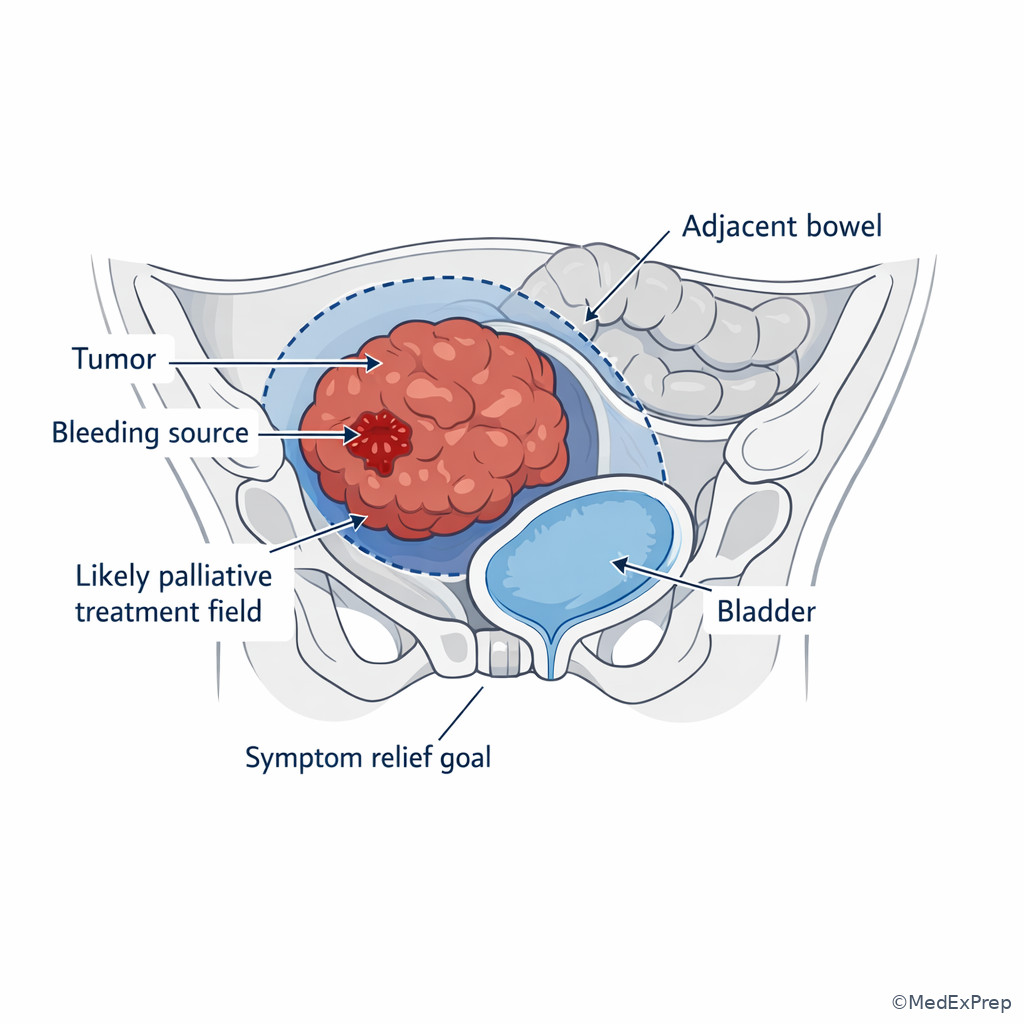
Related traps will recur in the upcoming topics on Treatment Intent Selection and Sequencing With Surgery And Systemic Therapy, where candidates confuse "RT is indicated" with "RT should happen now" or "RT should be definitive instead of adjunctive."
Algorithm / Approach
Rapid Review
- RT indication → focal local-control or symptom benefit beats vague theoretical shrinkage
- Contraindication language → most exam red flags are relative, not universal prohibitions
- Urgent palliation → stable bleeding or painful metastasis often supports rapid RT
- Cord compression → instability or vertebral collapse points toward surgical escalation before RT
- Prior RT → missing records means pause and reconstruct, not guess
- Frailty → argues for shorter courses more often than for no RT
- Pregnancy/device/connective tissue disease → field-specific risk assessment, not one-word cancellation
- Target ambiguity → inability to define what to treat is a stop sign for the current plan
- Palliative intent → convenience and speed matter more than maximal technical complexity
- Curative pathways → higher toxicity burden is acceptable only when durable benefit is credible
- Patient factors → the best regimen is one aligned with reserve, logistics, and symptom timeline
- Safety framing → correct patient, correct site, correct target, correct intent before beam-on
Self-check quiz
1. A 66-year-old man with metastatic renal cell carcinoma, hypertension, and chronic low back pain presents with a new painful isolated iliac bone metastasis causing focal tenderness. He is ambulatory and has no neurologic deficit. Which factor most strongly supports an RT indication?
- A. Focal tumor-related pain from a localized lesion
- B. History of hypertension
- C. Prior nephrectomy
- D. Age older than 65 years
2. A 42-year-old woman with breast cancer, controlled scleroderma history noted remotely in the chart, and no prior RT is seen after breast-conserving surgery. Which statement is most appropriate?
- A. Any connective tissue disease makes RT absolutely contraindicated
- B. Connective tissue disease is always irrelevant to RT decisions
- C. This history is usually a relative contraindication requiring individualized assessment
- D. Endocrine therapy automatically replaces indicated RT
3. A 59-year-old man with metastatic lung cancer, COPD, and diabetes presents with progressive facial swelling, dyspnea, and venous distention. CT suggests SVC obstruction from mediastinal tumor. He is oxygenating adequately and has no airway collapse. Which is the most appropriate next step regarding RT?
- A. Ignore RT because systemic disease makes local therapy useless
- B. Consider urgent RT as part of symptom-relief management after assessing stability and alternatives
- C. Delay all local therapy until complete restaging in several weeks
- D. Proceed with elective long-course definitive RT without urgent assessment
4. A 74-year-old woman with recurrent pelvic malignancy, chronic kidney disease, and prior pelvic RT at an outside hospital presents with bleeding but remains hemodynamically stable. Prior dose records are unavailable. Which is the most appropriate next step?
- A. Start empiric pelvic reirradiation immediately because bleeding confirms the target
- B. Cancel RT permanently because prior pelvic RT is an absolute contraindication
- C. Retrieve prior treatment records and reassess overlap before finalizing reirradiation
- D. Treat the whole pelvis with the previous standard adjuvant approach
5. An 81-year-old man with metastatic prostate cancer, ECOG 3, severe hip pain, CHF, and limited transportation presents for consultation. Imaging shows a painful acetabular metastasis without fracture. Which approach is most appropriate?
- A. Reject RT because ECOG 3 excludes tumor-directed therapy
- B. Choose a shorter palliative regimen if RT is expected to provide symptom relief
- C. Use the longest available course because pain control always improves with more fractions
- D. Observe only because comorbidities outweigh any local benefit
6. A 63-year-old woman with metastatic breast cancer, obesity, and well-controlled diabetes presents with thoracic back pain, new leg weakness, and urinary hesitancy. MRI shows epidural tumor with marked cord compression and vertebral body collapse at T7. Which is the most appropriate next step?
- A. Immediate standard outpatient palliative RT alone
- B. Urgent steroid treatment and surgical evaluation, with RT coordinated afterward as appropriate
- C. Routine analgesics and clinic follow-up next week
- D. Observation because systemic therapy will address the disease globally
7. A 55-year-old man with recurrent central lung cancer, prior thoracic RT 3 years ago, CAD, and mild hemoptysis is referred for possible reirradiation. He is stable, but prior dose distributions have not yet been obtained. Which choice is most appropriate?
- A. Proceed with thoracic RT because symptomatic central recurrence always overrides record uncertainty
- B. Defer all treatment permanently because prior RT makes retreatment impossible
- C. Obtain prior RT details and reassess cumulative OAR risk before final RT decision
- D. Base the decision only on the current CT-visible mass and ignore prior fields
8. A 68-year-old woman with locally advanced head and neck cancer, severe malnutrition, COPD, and active aspiration risk presents for definitive treatment planning. The tumor is potentially curable, but she cannot lie flat for simulation and has had repeated aspiration admissions. Which is the most appropriate interpretation of RT candidacy?
- A. RT is never indicated because comorbidity is present
- B. Curative RT may still be indicated, but candidacy depends on stabilizing and supporting feasibility before proceeding
- C. Immediate treatment should start without further support planning because delay is always worse
- D. Palliative RT is automatically the only acceptable option whenever simulation is difficult
Answer key
1. Correct answer: A
- A. Focal tumor-related pain from a localized lesion — Tempting because bone pain is a classic reason for referral, and it is correct because focal symptomatic metastasis is one of the strongest standard palliative RT indications. The single stem clue is localized painful iliac metastasis without neurologic instability. Mechanism-to-treatment logic: RT reduces tumor burden and inflammatory pain signaling at the involved site. Sources: NCCN Palliative Care and ASTRO palliative bone metastases guidance.
- B. History of hypertension — Tempting because comorbidity can alter treatment tolerance, but it is incorrect because hypertension neither creates nor removes local palliative RT benefit. The discriminating clue is that blood pressure history does not address the symptomatic lesion.
- C. Prior nephrectomy — Tempting because surgical history may affect cancer trajectory, but it is incorrect for this specific choice because it does not explain why RT is indicated for the current iliac pain.
- D. Age older than 65 years — Tempting because age influences frailty discussions, but it is incorrect because age alone is not the indication. The key discriminator is symptom-producing focal disease.
Sources: Lutz, Stephen, et al. ASTRO Evidence-Based Guideline for Palliative Radiotherapy of Bone Metastases; NCCN Guidelines.
2. Correct answer: C
- A. Any connective tissue disease makes RT absolutely contraindicated — Tempting because connective tissue disease can increase toxicity, but it is incorrect because modern board-defensible reasoning is not a universal ban. The discriminating clue is controlled remote history without field-specific severity details. Sources: Perez and Brady's Principles and Practice of Radiation Oncology; NCCN breast guidance.
- B. Connective tissue disease is always irrelevant to RT decisions — Tempting as the opposite extreme, but it is incorrect because the history does matter for counseling and risk assessment.
- C. This history is usually a relative contraindication requiring individualized assessment — Tempting because nuance can feel less exam-like, and it is correct because most such cases require field-specific toxicity consideration rather than blanket refusal. The key clue is lack of evidence of a categorical prohibition.
- D. Endocrine therapy automatically replaces indicated RT — Tempting because systemic therapy lowers recurrence risk, but it is incorrect because it does not universally substitute for adjuvant breast RT.
Sources: NCCN Breast Cancer; Halperin, Edward C., et al., Perez and Brady's Principles and Practice of Radiation Oncology.
3. Correct answer: B
- A. Ignore RT because systemic disease makes local therapy useless — Tempting because metastatic lung cancer often needs systemic therapy, but it is incorrect because SVC-type symptom burden can justify urgent local RT. The discriminating clue is symptomatic mediastinal obstruction. Source: NCCN NSCLC and emergency oncology references.
- B. Consider urgent RT as part of symptom-relief management after assessing stability and alternatives — Tempting because it balances urgency and safety, and it is correct. Mechanism-to-treatment logic: local mediastinal tumor reduction can relieve venous obstruction when clinically appropriate. The key clue is symptomatic obstruction without airway collapse, allowing urgent but organized local management.
- C. Delay all local therapy until complete restaging in several weeks — Tempting because staging matters, but it is incorrect because symptomatic obstructive disease should not wait casually.
- D. Proceed with elective long-course definitive RT without urgent assessment — Tempting because tumor shrinkage is desired, but it is incorrect because urgency and palliative symptom goals must first be defined.
Sources: NCCN NSCLC; Gunderson and Tepper, Clinical Radiation Oncology.
4. Correct answer: C
- A. Start empiric pelvic reirradiation immediately because bleeding confirms the target — Tempting because bleeding creates pressure to act, but it is incorrect because unknown prior overlap makes pelvic retreatment potentially unsafe. The discriminating clue is prior pelvic RT records unavailable. Source: reirradiation principles in standard oncology texts.
- B. Cancel RT permanently because prior pelvic RT is an absolute contraindication — Tempting because bowel and bladder toxicity can be severe, but it is incorrect because prior RT is usually a relative contraindication.
- C. Retrieve prior treatment records and reassess overlap before finalizing reirradiation — Tempting because it may seem slower, and it is correct because cumulative OAR risk cannot be judged responsibly without prior dose and field information.
- D. Treat the whole pelvis with the previous standard adjuvant approach — Tempting because standard schemas are familiar, but it is incorrect because reirradiation decisions are individualized and constrained by prior exposure.
Sources: Halperin, Edward C., et al.; Gunderson and Tepper, Clinical Radiation Oncology.
5. Correct answer: B
- A. Reject RT because ECOG 3 excludes tumor-directed therapy — Tempting because poor status suggests limited reserve, but it is incorrect because palliative RT can still offer meaningful pain relief with low burden. The discriminating clue is focal painful acetabular metastasis. Source: ASTRO palliative bone metastases guideline.
- B. Choose a shorter palliative regimen if RT is expected to provide symptom relief — Tempting because it addresses logistics and frailty, and it is correct. Mechanism-to-treatment logic: shorter RT preserves the symptom-relief benefit while reducing travel and treatment burden.
- C. Use the longest available course because pain control always improves with more fractions — Tempting because fractionation sophistication can sound superior, but it is incorrect because longer is not automatically better in frail palliative patients.
- D. Observe only because comorbidities outweigh any local benefit — Tempting because CHF and transport issues are real, but it is incorrect since a short course may still provide high-value palliation.
Sources: ASTRO Palliative Radiotherapy Guideline; NCCN Palliative Care.
6. Correct answer: B
- A. Immediate standard outpatient palliative RT alone — Tempting because malignant cord compression is a classic RT emergency, but it is incorrect here because vertebral body collapse and neurologic decline suggest possible instability and need for decompression first. The key clue is marked cord compression with vertebral collapse. Sources: NCCN CNS/spine metastases concepts; standard emergency oncology texts.
- B. Urgent steroid treatment and surgical evaluation, with RT coordinated afterward as appropriate — Tempting because it adds extra steps in an urgent case, and it is correct because acute neurologic compromise plus structural collapse makes stabilization and decompressive assessment the safest first move.
- C. Routine analgesics and clinic follow-up next week — Tempting because pain is prominent, but it is incorrect because neurologic decline requires immediate action.
- D. Observation because systemic therapy will address the disease globally — Tempting because metastatic disease needs systemic control, but it is incorrect because systemic therapy does not solve imminent cord injury fast enough.
Sources: NCCN; Gunderson and Tepper, Clinical Radiation Oncology.
7. Correct answer: C
- A. Proceed with thoracic RT because symptomatic central recurrence always overrides record uncertainty — Tempting because central tumors can deteriorate quickly, but it is incorrect because the patient is stable and unknown prior thoracic dose near major OARs is unsafe. The discriminating clue is prior dose distributions not yet obtained. Source: reirradiation principles in major radiation oncology texts.
- B. Defer all treatment permanently because prior RT makes retreatment impossible — Tempting because thoracic reirradiation is high risk, but it is incorrect because reirradiation may still be possible after careful review.
- C. Obtain prior RT details and reassess cumulative OAR risk before final RT decision — Tempting because it feels conservative, and it is correct because safe physician-level decision-making requires overlap and cumulative risk assessment before proceeding.
- D. Base the decision only on the current CT-visible mass and ignore prior fields — Tempting because current imaging shows disease clearly, but it is incorrect because visibility does not solve prior normal-tissue exposure.
Sources: Halperin, Edward C., et al.; Perez and Brady's Principles and Practice of Radiation Oncology.
8. Correct answer: B
- A. RT is never indicated because comorbidity is present — Tempting because aspiration risk and malnutrition make definitive therapy hazardous, but it is incorrect because the tumor remains potentially curable. The discriminating clue is potentially curable head and neck cancer. Sources: NCCN Head and Neck; standard radiation oncology texts.
- B. Curative RT may still be indicated, but candidacy depends on stabilizing and supporting feasibility before proceeding — Tempting because it requires nuance, and it is correct because the limiting issue is feasibility and support, not absence of oncologic indication. Mechanism-to-treatment logic: tumor control benefit exists, but safe delivery requires nutrition, airway/aspiration planning, and simulation tolerance.
- C. Immediate treatment should start without further support planning because delay is always worse — Tempting because head and neck delay can harm outcomes, but it is incorrect because treatment that cannot be delivered safely or completed is not the right answer.
- D. Palliative RT is automatically the only acceptable option whenever simulation is difficult — Tempting because setup challenges are real, but it is incorrect because support measures may preserve curative candidacy.
Sources: NCCN Head and Neck Cancers; Gunderson and Tepper, Clinical Radiation Oncology.
Keep going with the full ABR Radiation Oncology Prep Course (RadOnc)
You just studied the way members do, in the same lesson interface. Full access unlocks every lesson, the question bank and flashcards for a full year.
One payment · 1 year of access · No auto-renewal