1.1.1 - Autosomal Dominant Patterns
Why it matters
- Many board stems hide autosomal dominant inheritance behind incomplete family history, age-dependent onset, or a de novo case; pattern recognition prevents wrong risk estimates.
- Autosomal dominant disorders are common across adult, pediatric, prenatal, and cancer genetics settings, so the same logic recurs throughout the ABMGG exam.
- The exam often tests not just the pedigree label, but the implication: who is at 50% risk, when to pursue targeted testing, and when an apparently negative family history does not exclude a dominant condition.
- Autosomal dominant logic is the foundation for later topics on penetrance, mosaicism, de novo variation, anticipation, and syndrome-specific counseling.
Key Terms & Must-Know Facts
1.1.1.1 Key terms
- Autosomal dominant (AD): One altered allele on an autosome can be sufficient to cause disease.
- Vertical transmission: Affected individuals seen in successive generations.
- Male-to-male transmission: Father-to-son transmission; supports autosomal rather than X-linked inheritance.
- Heterozygous affected individual: Most classic AD patients carry one pathogenic allele and one normal allele.
- De novo variant: New pathogenic variant arising in the proband, absent in parental blood testing.
- Reduced penetrance: Not all individuals with the pathogenic variant show the phenotype.
- Variable expressivity: Severity or features differ among affected relatives with the same condition.
- Haploinsufficiency: One normal copy does not provide enough gene product.
- Dominant-negative effect: Abnormal protein interferes with the normal protein.
- Gain-of-function: Pathogenic variant increases or alters protein activity.
- Age-dependent penetrance: Phenotype appears only after a certain age.
- Germline mosaicism: A parent may carry the variant in germ cells and have more than one affected child despite negative blood testing.
- Phenocopy: Similar phenotype caused by a non-genetic or different genetic mechanism.
1.1.1.2 Must-know facts
- Classic AD clue: affected parent plus affected child across generations.
- If one heterozygous affected parent has children with an unaffected partner, each pregnancy usually carries a 50% risk.
- Both sexes are affected roughly equally in autosomal dominant inheritance.
- Male-to-male transmission strongly argues against X-linked inheritance.
- A negative family history does not exclude AD disease because of de novo variants, reduced penetrance, small family size, or early death.
- Variable expressivity can make one relative mildly affected and another severely affected in the same family.
- Reduced penetrance changes who appears affected, but does not erase transmission risk in a proven carrier.
- Exam stems often test AD through common disorders such as Marfan syndrome, achondroplasia, neurofibromatosis type 1, Huntington disease, and many hereditary cancer syndromes.
| Feature | Classic autosomal dominant expectation | Exam use |
|---|---|---|
| Sex distribution | Males and females affected similarly | Reject sex-limited logic unless a specific condition explains it |
| Generational pattern | Vertical transmission | Think AD when affected individuals appear in successive generations |
| Transmission from affected parent | Usually 50% to each child | Most commonly tested recurrence figure |
| Father-to-son transmission | Possible | Single clue that excludes X-linked inheritance |
| Skipped generation | Not typical, but can occur with reduced penetrance | Do not overcall recessive inheritance if penetrance explains the gap |
| New isolated case | Possible via de novo variant | Common trap in pediatrics and dysmorphology |
Exam takeaway: Use vertical transmission plus male-to-male transmission and equal sex distribution to identify classic autosomal dominant inheritance.
flowchart TD
A[Pedigree review] --> B{Affected in successive generations?}
B -->|Yes| C{Both sexes affected?}
B -->|No| D[Consider de novo, reduced penetrance, or another model]
C -->|Yes| E{Male-to-male transmission present?}
C -->|No| F[Consider X-linked or sex-limited pattern]
E -->|Yes| G[Autosomal dominant strongly favored]
E -->|No| H[Autosomal dominant still possible but compare X-linked clues]
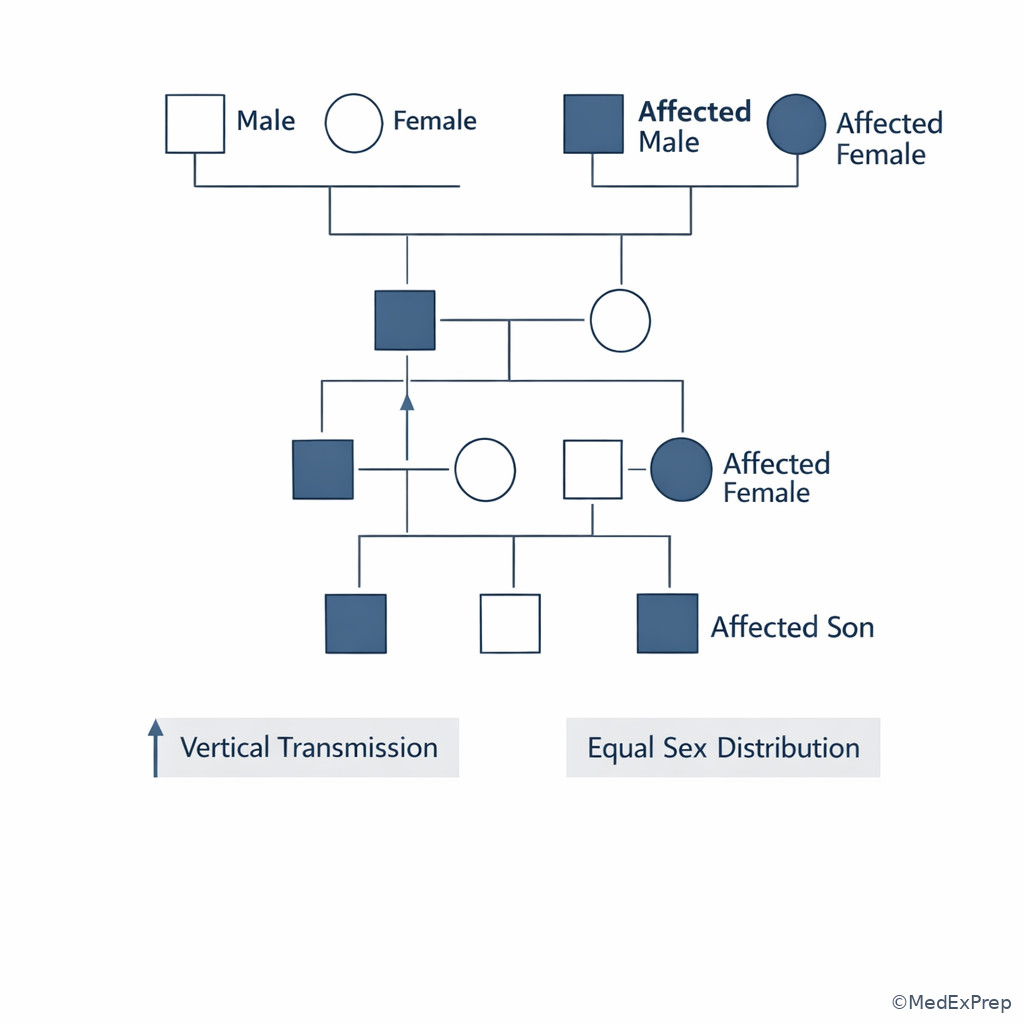
See Fig 1 for the shortest exam path from raw pedigree to inheritance label.
Exam takeaway: A visual of vertical transmission helps you recognize autosomal dominant inheritance faster under time pressure.
Core content
1.1.1.3 Foundational pedigree clues: when autosomal dominant is the best pattern
A Explanation
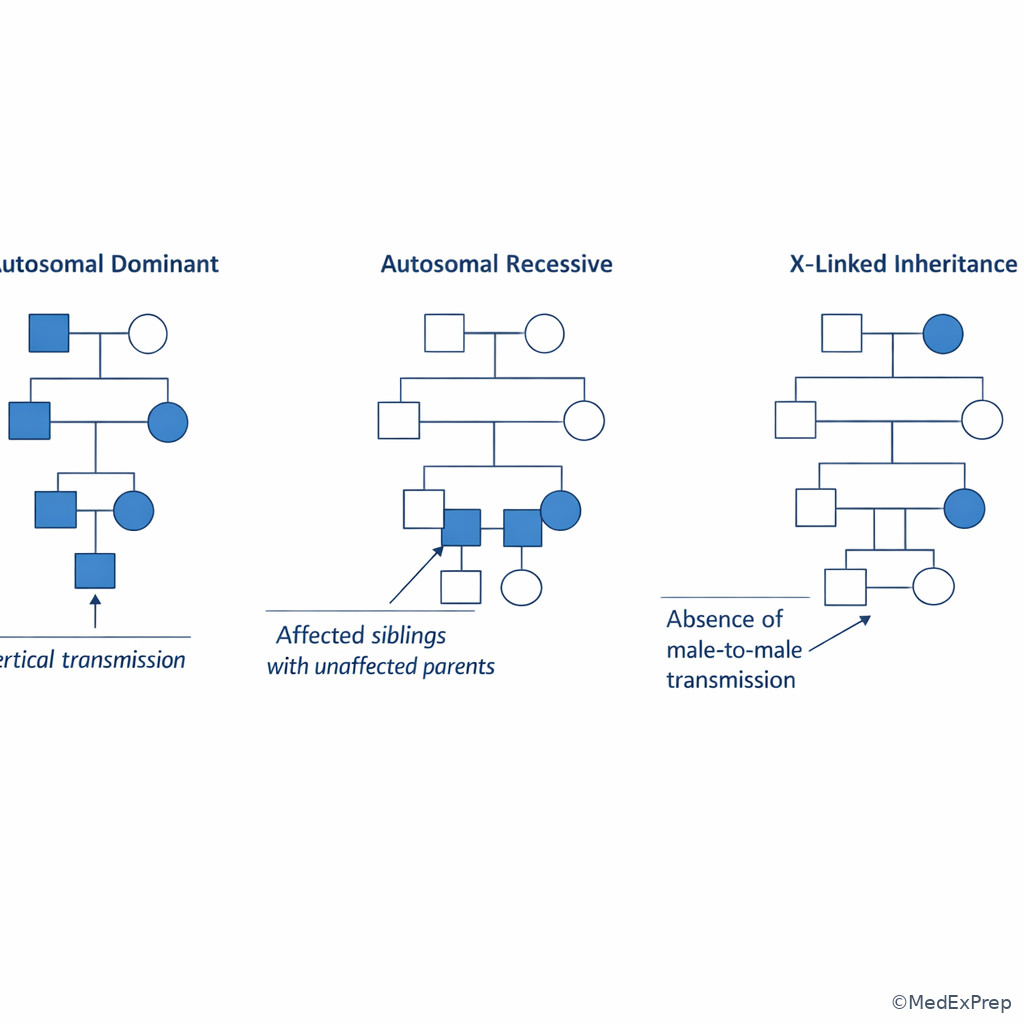
The central decision conflict is simple: Should you label this pedigree autosomal dominant, or reject that label in favor of recessive or X-linked inheritance? The single rule that resolves most stems is this: one affected parent transmitting to offspring in multiple generations, with both sexes affected and possible male-to-male transmission, strongly supports autosomal dominant inheritance. The exam rarely gives a perfect textbook pedigree; instead, it gives one decisive clue and several distractions. Choose autosomal dominant when the pedigree shows vertical transmission. Reject it when disease appears only among siblings of unaffected parents, or when the pattern specifically lacks father-to-son transmission and otherwise fits X-linked disease.
WHY THIS IS TESTED: testable pattern recognition under incomplete information. Board stems often include a family with an affected grandfather, affected mother, and affected son, plus one unaffected sibling, because examinees may be distracted by the unaffected relative and forget that AD transmission does not affect every child.
One unaffected child does not argue against autosomal dominant inheritance. In the usual heterozygous affected parent scenario, each child independently has a 50% chance of inheriting the pathogenic allele. Another critical clue is that males and females are affected similarly. If an affected father has an affected son, that finding should immediately push you away from X-linked inheritance. See Fig 1.
B Worked example
A 34-year-old man is referred for evaluation of tall stature and ectopia lentis. He has treated hypertension and mild asthma. Echocardiography from an outside hospital notes aortic root dilation. His father died at 41 years of a “heart problem,” and a paternal uncle is very tall but otherwise healthy. The patient’s 8-year-old son is also unusually tall. A distracted examinee may focus on the uncle’s milder features and think the pattern is inconsistent. Identify task: determine the most likely inheritance pattern. Extract key facts: affected individuals in successive generations, both sexes potentially affected, father-to-son transmission possible through the patient and son, variable severity in relatives. Apply rule: vertical transmission with variable expressivity supports autosomal dominant inheritance. Eliminate distractors: autosomal recessive is less likely because unaffected parents with multiple affected siblings are not described; X-linked inheritance is weakened by the apparent father-to-son transmission; mitochondrial inheritance would require maternal-only transmission. Verify: a condition such as Marfan syndrome classically follows autosomal dominant inheritance with marked variability.
C Exam trap
Why it is tempting: The stem may emphasize several affected males or provide only paternal-side history, making the pedigree look sex-skewed.
Single clue that eliminates it: Any true father-to-son transmission excludes X-linked inheritance.
D Checkpoint
Question: A three-generation pedigree shows an affected grandmother, her affected daughter, and the daughter’s affected son. An unaffected father is married to the affected daughter. Which inheritance pattern is most likely?
- Autosomal dominant
- Autosomal recessive
- X-linked recessive
- Mitochondrial
Answer: A. Autosomal dominant.
- A is tempting and correct: Vertical transmission across generations with affected parent-to-child transmission fits AD best.
- B is tempting but wrong: Recessive disease can cluster in families, but the classic pattern is affected siblings born to unaffected parents, not repeated parent-to-child transmission.
- C is tempting but wrong: X-linked recessive can appear in multiple generations, but an affected female transmitting as described is a weaker fit unless the pedigree is much more specific.
- D is tempting but wrong: Maternal transmission to all children would be expected, not selective transmission in a vertical pattern.
1.1.1.4 Mechanisms behind autosomal dominant disease: why one altered allele is enough
A Explanation
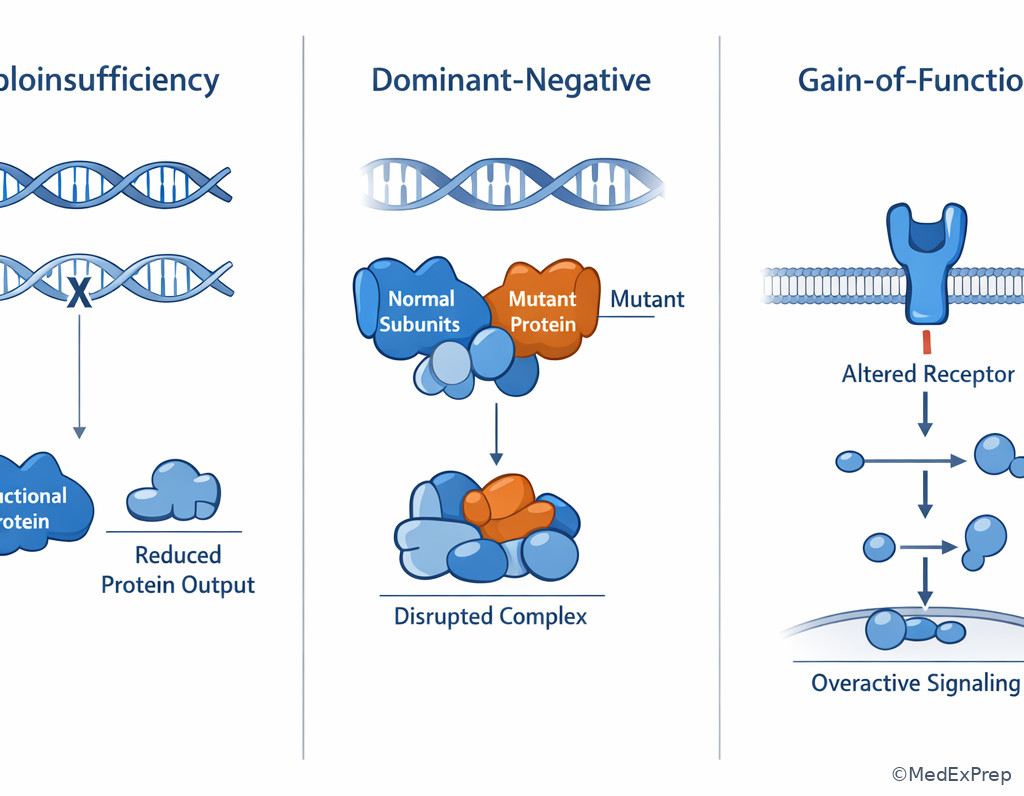
The decision conflict here is not “What is the mechanism in a molecular biology textbook?” but Which mechanism best explains why a heterozygous variant can cause disease, and when does that mechanism matter for exam reasoning? The single rule: autosomal dominant disease usually means one abnormal allele changes dosage or protein behavior enough to produce phenotype. Three high-yield mechanisms dominate exam questions: haploinsufficiency, dominant-negative effect, and gain-of-function.
Haploinsufficiency means 50% normal product is not enough. Think of a gene where dosage matters; losing one working copy crosses a functional threshold. Dominant-negative means the mutant protein poisons the normal one, often in multimeric structural proteins. Gain-of-function means the altered protein becomes overactive or acquires a new harmful activity. The testable move is to connect mechanism to phenotype severity and inheritance, not to over-memorize every gene.
WHY THIS IS TESTED: mechanism clarifies why two relatives with the “same inheritance pattern” can have different molecular logic, and it helps you interpret whether deletion testing, sequencing, or functional consequence matters. For example, if a disorder is usually caused by haploinsufficiency, a whole-gene deletion may be pathogenic. If caused by repeat expansion or activating missense change, a generic deletion-focused strategy may miss the diagnosis.
See Fig 2 for the mechanism comparison that compresses this logic.
| Mechanism | What the altered allele does | High-yield implication | Representative AD examples |
|---|---|---|---|
| Haploinsufficiency | Reduces total functional gene product below a critical threshold | Deletion or loss-of-function can be pathogenic | Many transcription factor and tumor suppressor disorders |
| Dominant-negative | Abnormal product interferes with the normal product | Missense change may be more disruptive than simple null allele | Structural protein disorders such as some collagenopathies |
| Gain-of-function | Protein becomes overactive or gains a harmful function | Specific activating variants may matter more than dosage loss | FGFR-related disorders, some channelopathies |
Exam takeaway: Match the gene-disease mechanism to the expected variant type and testing strategy rather than assuming all dominant disorders behave the same way.
flowchart LR
A[One altered allele] --> B[Haploinsufficiency]
A --> C[Dominant-negative]
A --> D[Gain-of-function]
B --> E[Too little normal product]
C --> F[Mutant protein disrupts normal complex]
D --> G[Excess or novel activity]
E --> H[Loss or deletion may explain phenotype]
F --> I[Specific missense variants often important]
G --> J[Activating variant class may be key]
Exam takeaway: A side-by-side molecular image helps separate dosage loss from mutant interference and activating mechanisms.
B Worked example
A 7-year-old boy with short-limbed disproportionate stature, recurrent otitis media, and normal intelligence is evaluated with his mother, who has the same body habitus. He also has mild iron deficiency from poor diet, which is irrelevant noise. The family asks whether a copy-number assay alone would be the best first molecular test. Identify task: link inheritance to mechanism and testing. Extract key facts: parent-child vertical transmission suggests AD; a classic disorder such as achondroplasia is often caused by a recurrent activating FGFR3 variant. Apply rule: gain-of-function disorders are often driven by specific sequence-level changes; broad deletion-focused testing may miss them. Eliminate distractors: a microarray can detect dosage change but not many single-nucleotide activating variants; karyotype is too low resolution; broad metabolic testing does not address the mechanism. Verify: targeted sequencing or a phenotype-appropriate molecular assay is the best next step.
C Exam trap
Why it is tempting: The phrase “one bad copy” sounds like simple reduction in gene dosage.
Single clue that eliminates it: If the disorder is classically caused by a recurrent activating missense change or toxic protein effect, loss alone is not the right mechanism.
D Checkpoint
Question: Which mechanism most directly explains an autosomal dominant disorder in which an abnormal protein disrupts the function of the normal protein made from the unaffected allele?
- Haploinsufficiency
- Dominant-negative effect
- Loss of heterozygosity
- Compound heterozygosity
Answer: B. Dominant-negative effect.
- A is tempting but wrong: Haploinsufficiency means reduced quantity of normal product, not active interference with the normal product.
- B is tempting and correct: The mutant product disrupts the normal product’s function, which defines a dominant-negative mechanism.
- C is tempting but wrong: Loss of heterozygosity is important in tumor genetics, not the classic explanation for the described inherited mechanism.
- D is tempting but wrong: Compound heterozygosity usually refers to recessive disease with two different pathogenic alleles in the same gene.
- The most common transmission risk from one heterozygous affected parent to each child is 50%.
- True or False: Male-to-male transmission supports X-linked inheritance. False.
- Name the 3 key autosomal dominant mechanisms: haploinsufficiency, dominant-negative, gain-of-function.
1.1.1.5 Application in clinic: recurrence risk, de novo cases, and apparently negative family history
A Explanation
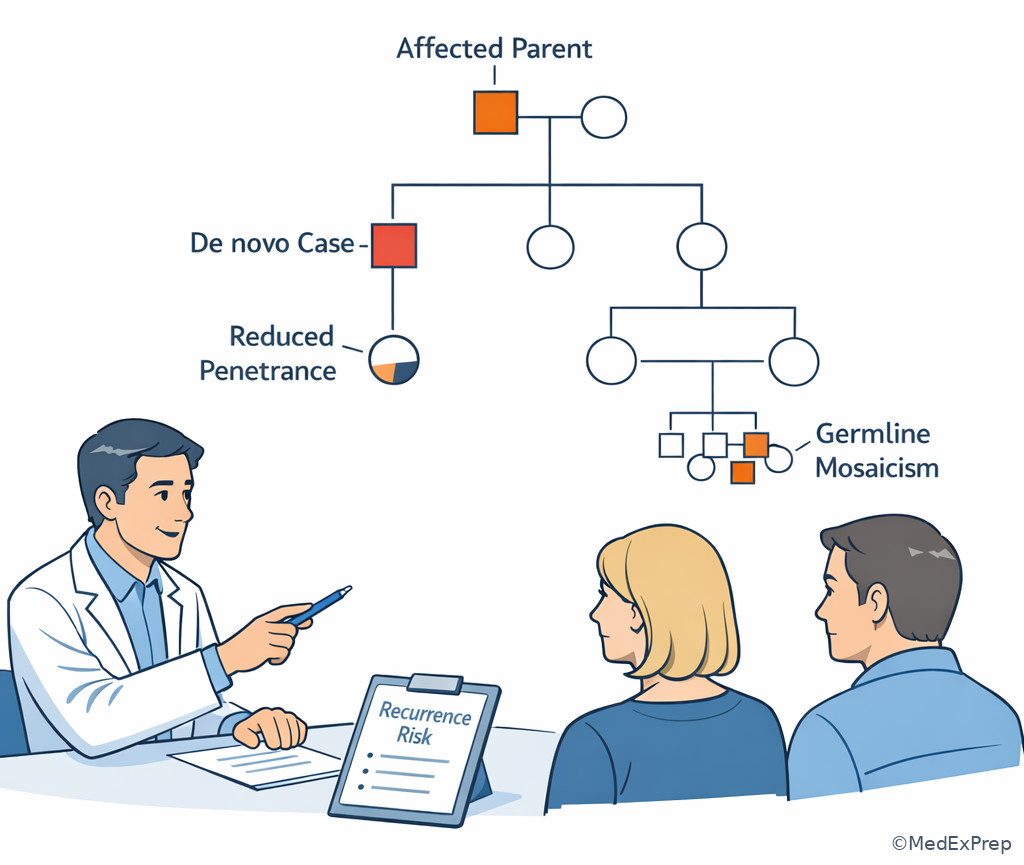
The decision conflict in real stems is rarely “Is AD possible?” More often it is: What recurrence risk should you quote, and when should you reject the default 50% figure? The single rule: use 50% only when a parent is known or strongly presumed to carry a heterozygous pathogenic variant causing an autosomal dominant disorder. Reject a reflexive 50% answer when the case suggests a de novo event, reduced penetrance, uncertain diagnosis, or possible germline mosaicism.
In a classic affected parent-unaffected partner scenario, each pregnancy has a 50% chance of inheriting the altered allele. That probability is independent for each pregnancy. However, many dominant disorders present as a single affected child with unaffected parents. In that context, a de novo variant may be most likely, especially in severe early-onset disorders that reduce reproductive fitness. The family history may be “negative” not because the condition is recessive, but because the event is new, penetrance is age-dependent, a parent is mildly affected, or the family is too small to reveal a pattern.
Reduced penetrance produces a common exam trap: a skipped generation. Do not jump straight to autosomal recessive inheritance if a grandparent and grandchild are clearly affected but the intervening parent seems unaffected. The parent may carry the variant but not express the phenotype. Germline mosaicism is another key exception. If unaffected parents have one child with an apparently de novo dominant disorder, recurrence is usually much lower than 50%, but not zero because a parent may carry the variant in some germ cells. Practice patterns and reporting thresholds may vary; confirm current local or specialty guidance for exact syndrome-specific counseling language.
See Fig 3 for the recurrence-risk shortcut.
Exam takeaway: Use 50% only when a parent is truly affected or known to carry the variant; isolated cases require de novo and mosaicism thinking.
flowchart TD
A[Autosomal dominant condition suspected] --> B{Parent affected or known carrier?}
B -->|Yes| C[Usual recurrence risk: 50% per pregnancy]
B -->|No| D{Single isolated affected child?}
D -->|Yes| E[Consider de novo variant]
E --> F[Recurrence lower than 50% but not zero because of possible germline mosaicism]
D -->|No| G[Review penetrance, family size, and misclassification] | Scenario | Best exam risk frame | Why |
|---|---|---|
| Affected heterozygous parent with unaffected partner | 50% per pregnancy | Each child independently may inherit the pathogenic allele |
| Single affected child, both parents clinically unaffected | Often de novo; recurrence much lower than 50% but not zero | Germline mosaicism remains a residual concern |
| Grandparent and grandchild affected, parent appears unaffected | Consider reduced or age-dependent penetrance | Skipped generation does not automatically mean recessive inheritance |
| Mildly affected parent overlooked on first review | Risk may return to the usual 50% | Variable expressivity can hide the familial pattern |
Exam takeaway: Counseling stems test whether you know when to use the default 50 percent risk and when to qualify it.
B Worked example
A 2-year-old girl with multiple café-au-lait macules and axillary freckling is evaluated for possible neurofibromatosis type 1. She was born after an uncomplicated pregnancy and also has mild eczema and a history of recurrent otitis media, which are distracting but not explanatory. Both parents deny relevant family history. Identify task: decide whether a negative family history excludes AD inheritance and what recurrence framework applies. Extract key facts: phenotype strongly suggests a classic AD disorder; parents are reportedly unaffected. Apply rule: isolated presentation in an AD disorder suggests a possible de novo pathogenic variant. Eliminate distractors: autosomal recessive inheritance is less favored because the phenotype maps strongly to a dominantly inherited syndrome; “sporadic means non-genetic” is incorrect; mitochondrial inheritance is incompatible with the syndrome pattern. Verify: the best counseling statement is that AD inheritance remains likely, the child may have a de novo variant, and recurrence for siblings is lower than 50% but not strictly zero because of possible parental germline mosaicism.
C Exam trap
Why it is tempting: Learners overlearn the textbook picture of a perfectly vertical pedigree.
Single clue that eliminates it: A syndrome strongly associated with autosomal dominant disease can present as a de novo case, especially in a child of unaffected parents.
D Checkpoint
Question: A man with a molecularly confirmed autosomal dominant disorder asks about risk to each future child with his unaffected partner. What is the most appropriate recurrence estimate?
- 25% per pregnancy
- 50% per pregnancy
- 75% per pregnancy
- 100% if the first child is affected
Answer: B. 50% per pregnancy.
- A is tempting but wrong: Twenty-five percent is the classic autosomal recessive recurrence risk for two carrier parents, not AD.
- B is tempting and correct: One heterozygous affected parent typically transmits the pathogenic allele to half of offspring, independently each pregnancy.
- C is tempting but wrong: This reflects confusion with conditional probability or severity, not Mendelian AD transmission.
- D is tempting but wrong: Prior births do not change the independent probability for the next pregnancy.
1.1.1.6 Reduced penetrance and variable expressivity: why dominant pedigrees can look messy
A Explanation
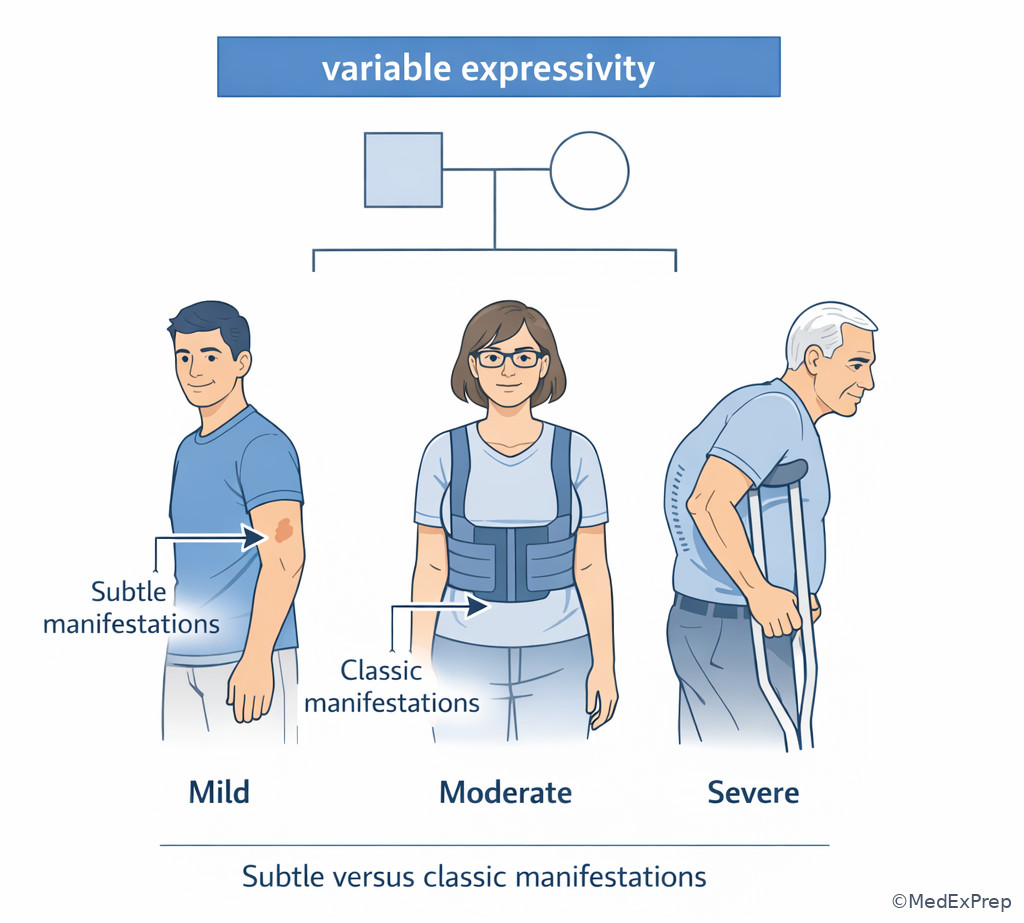
The decision conflict is: Is this “messy” pedigree still autosomal dominant, or should you switch to another inheritance model because relatives look different or a generation seems skipped? The single rule is this: variable expressivity changes how the phenotype looks; reduced penetrance changes whether it appears at all. This distinction rescues many board questions.
Variable expressivity means affected relatives share the same disorder but differ in severity or features. One person may have only a mild finding while another relative has a classic severe presentation. Reduced penetrance means a pathogenic variant carrier may appear unaffected, creating an apparent break in vertical transmission. The exam uses these concepts to test whether you can hold onto the dominant model despite imperfect pedigrees.
WHY THIS IS TESTED: candidates commonly misclassify pedigrees when they assume “same gene means same appearance” or “unaffected parent means impossible to transmit.” In clinic, a subtle sign in a parent can completely change counseling from “sporadic case” to “familial AD disorder.” In exam stems, the discriminating clue may be an older relative with only a few subtle features, or a younger at-risk person who has not yet reached the age of onset.
Reduced penetrance and age-dependent penetrance overlap but are not identical. If a disease usually appears after age 40, a healthy 22-year-old at risk has not yet “escaped” the condition. In contrast, true reduced penetrance means some carriers may never manifest. See Fig 4 for the comparison.
Exam takeaway: Different severity supports variable expressivity, while an apparently unaffected carrier supports reduced penetrance.
flowchart LR
A[Same dominant variant in family] --> B[Phenotype present in all but severity differs]
A --> C[Some carriers show no phenotype]
B --> D[Variable expressivity]
C --> E[Reduced penetrance]
D --> F[Do not expect identical clinical findings]
E --> G[Do not assume skipped generation means recessive]
| Concept | What changes | Pedigree effect | Common exam mistake |
|---|---|---|---|
| Variable expressivity | Severity or feature set | All may appear affected, but not uniformly | Assuming mild relative has a different diagnosis |
| Reduced penetrance | Whether phenotype appears | Can create an apparent skipped generation | Mislabeling the pedigree autosomal recessive |
| Age-dependent penetrance | Timing of phenotype appearance | Younger relatives may look unaffected for now | Assuming a young at-risk adult is definitively unaffected |
Exam takeaway: Variable expressivity means same disorder across relatives, not different diagnoses for every phenotype variation.
B Worked example
A 46-year-old woman is evaluated after her 17-year-old daughter is diagnosed with an autosomal dominant connective tissue disorder. The mother has mild myopia and joint laxity but no prior diagnosis. Her father reportedly died of an aortic event in his 50s, though records are unavailable. She also has hypothyroidism, which is unrelated noise. Identify task: decide whether the daughter’s case is likely de novo or familial. Extract key facts: subtle maternal findings plus suggestive maternal-line history. Apply rule: variable expressivity can make a parent appear “unaffected” until carefully examined. Eliminate distractors: a true de novo event becomes less likely because the mother herself has supportive features; recessive inheritance is weakened by vertical clues; X-linked inheritance is not needed to explain the pattern. Verify: the best next step is directed evaluation and molecular testing that includes the mother, because recognizing familial AD disease changes recurrence counseling for multiple relatives.
C Exam trap
Why it is tempting: Stems often give one relative a classic phenotype and another only subtle findings.
Single clue that eliminates it: The relatives share a known dominant syndrome pattern, and the mild relative still has core discriminating features.
D Checkpoint
Question: In a family with a confirmed autosomal dominant pathogenic variant, one carrier has severe disease, another has only mild findings, and another has no apparent manifestations. Which pairing best explains these observations?
- Allelic heterogeneity and pleiotropy
- Variable expressivity and reduced penetrance
- Genetic anticipation and imprinting
- Compound heterozygosity and founder effect
Answer: B. Variable expressivity and reduced penetrance.
- A is tempting but wrong: Those concepts can matter in genetics broadly, but the stem specifically describes differing severity and absent phenotype among carriers of the same variant.
- B is tempting and correct: Different severity is variable expressivity; absent phenotype in a carrier is reduced penetrance.
- C is tempting but wrong: Anticipation and imprinting explain other inheritance phenomena, not the direct pattern described here.
- D is tempting but wrong: These are not the key explanations for phenotype variation among known carriers in a dominant family.
- True or False: A skipped generation rules out autosomal dominant inheritance. False.
- The concept describing different severity among relatives with the same disorder is variable expressivity.
- The concept describing a carrier with no phenotype is reduced penetrance.
1.1.1.7 Integration: best next step, testing strategy, and differential with other inheritance models
A Explanation
The final decision conflict is the most board-relevant: Once autosomal dominant inheritance is suspected, what is the most appropriate next genetics action? The single rule: test the most clearly affected individual first, choose the assay that fits the phenotype and expected mechanism, and use family testing to clarify recurrence risk.
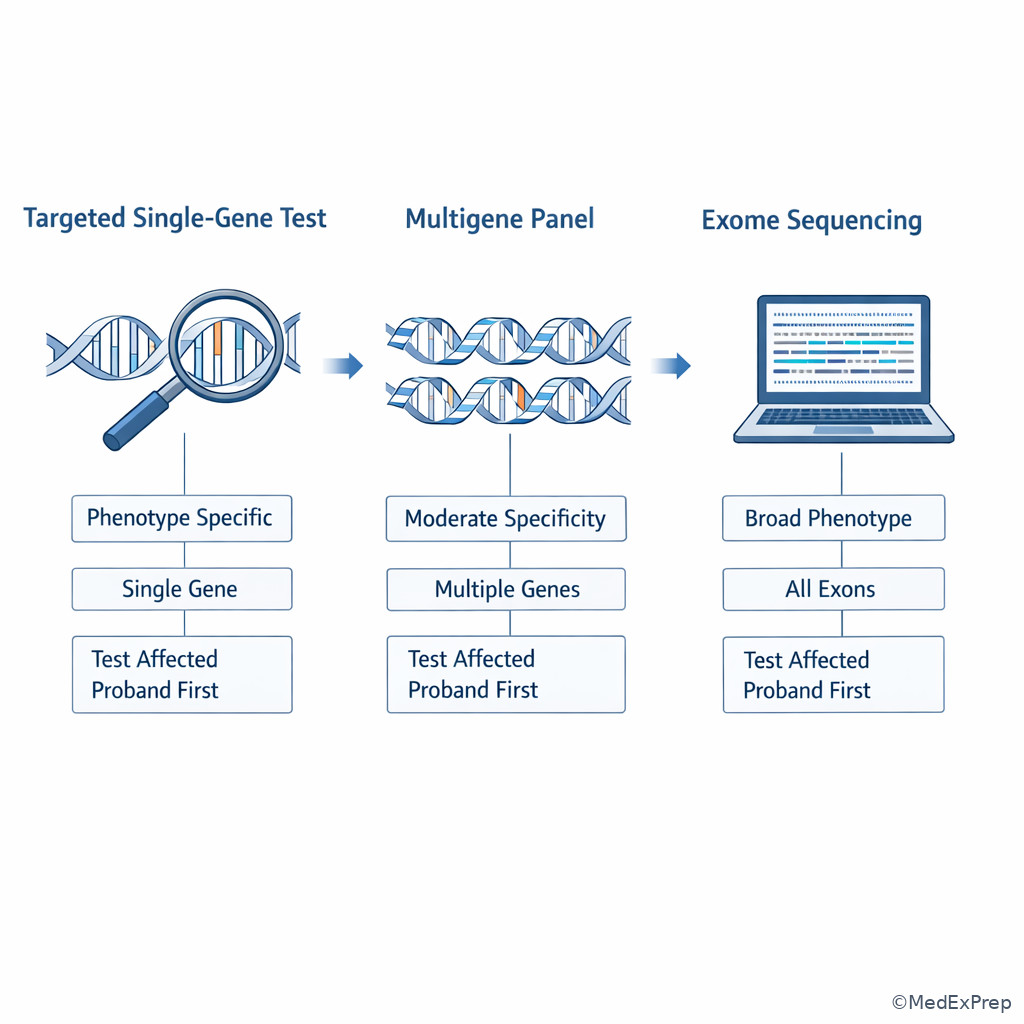
In ABMGG-style stems, you are often not asked only for the pedigree label. You may need to choose between targeted single-gene testing, a phenotype-focused panel, exome sequencing, deletion/duplication analysis, or no testing yet because the family history is too weak. The best answer depends on phenotype specificity. If a classic syndrome with a narrow differential is present, targeted testing is efficient. If the phenotype is broad and multiple dominant syndromes are plausible, a panel or exome may be more appropriate. If the condition is known to result from repeat expansion or a specific variant class, the assay must detect that mechanism.
Another testing rule: if the question is about clarifying inheritance, the ideal starting point is the clearly affected proband, not an unaffected at-risk relative. Testing an unaffected person first can be uninformative if the familial pathogenic variant is not already known. Family studies become most powerful after identifying the causative variant in the affected individual. See Fig 5 for the decision tree.
Exam takeaway: Start with the affected individual and match the assay to phenotype specificity and expected variant mechanism.
flowchart TD
A[Autosomal dominant pattern suspected] --> B{Phenotype classic and narrow?}
B -->|Yes| C[Targeted single-gene or syndrome-specific test]
B -->|No| D[Panel or exome depending breadth]
C --> E{Variant class requires special assay?}
D --> E
E -->|Yes| F[Use assay that detects repeat, CNV, or other required mechanism]
E -->|No| G[Standard sequencing-based approach may suffice]
F --> H[Test affected proband first]
G --> H
H --> I[Use familial targeted testing for relatives] Exam takeaway: The best next test depends on phenotype breadth and the expected variant class, not on inheritance pattern alone.
B Worked example
A 29-year-old woman presents for genetics evaluation because her father and paternal aunt both developed colon cancer before age 50, and her grandmother had endometrial cancer at 47. The patient herself is healthy except for migraine and iron deficiency from menorrhagia, which are distracting details. Identify task: select the best next genetics approach in a suspected dominant hereditary cancer syndrome. Extract key facts: vertical transmission, multiple related cancers across generations, phenotype broad enough to involve more than one plausible gene. Apply rule: likely autosomal dominant cancer predisposition; when the differential spans multiple genes, panel testing in an affected relative is typically most informative. Eliminate distractors: testing the unaffected patient first with a poorly targeted assay may be less informative if no familial variant is known; karyotype is irrelevant; microarray is not the primary tool for most inherited cancer syndrome sequence variants. Verify: the most appropriate next step is genetics evaluation with targeted hereditary cancer testing strategy, ideally beginning in the most clearly affected available family member.
C Exam trap
Why it is tempting: The person in clinic is right in front of you, so it feels operationally easier.
Single clue that eliminates it: Without a known familial pathogenic variant, testing the affected individual usually gives the highest diagnostic yield and makes relative testing interpretable.
D Checkpoint
Question: In a family with a strongly suspected autosomal dominant syndrome and an available clearly affected proband, what is the most appropriate initial testing principle?
- Test an unaffected child first because the result will predict future risk
- Begin with the affected individual and use a test that matches the expected mechanism
- Order karyotype in all relatives before molecular testing
- Defer all testing until three affected relatives are documented
Answer: B. Begin with the affected individual and use a test that matches the expected mechanism.
- A is tempting but wrong: Predictive testing is best after the familial pathogenic variant is identified; otherwise a negative result may be uninterpretable.
- B is tempting and correct: This maximizes yield and permits accurate targeted testing of relatives.
- C is tempting but wrong: Karyotype is too low yield for most classic single-gene AD syndromes unless a chromosomal mechanism is specifically suspected.
- D is tempting but wrong: You do not need an artificially large family history if a strong phenotype and pedigree already justify testing.
Exam Traps & Differentiators
- Most common wrong answer and why: Autosomal recessive, because learners see an unaffected relative and forget that AD disorders affect only about half the offspring of an affected heterozygous parent.
- Looks similar but isn't: X-linked inheritance can mimic AD when several males are affected, but true father-to-son transmission breaks the tie in favor of autosomal inheritance.
- Looks similar but isn't: A de novo AD case can look sporadic or “non-genetic,” but a classic syndrome phenotype should keep dominant inheritance on the table.
- Looks similar but isn't: A skipped generation may seem recessive, but reduced penetrance often explains the gap more elegantly.
- Neighbor-topic trap: In the upcoming Autosomal Recessive Patterns lesson, affected siblings with unaffected parents will become the signature clue. Do not import that rule into a pedigree with clear vertical transmission.
- Neighbor-topic trap: In the upcoming X-Linked Inheritance Clues lesson, absence of male-to-male transmission will matter. Here, one father-to-son pair is enough to reject X-linked inheritance.
| Pattern | Pedigree clue that favors it | Pedigree clue that argues against it | Exam discriminator |
|---|---|---|---|
| Autosomal dominant | Vertical transmission across generations | Only affected siblings with unaffected parents | Father-to-son transmission possible |
| Autosomal recessive | Affected siblings, unaffected parents | Repeated parent-to-child transmission in every generation | Consanguinity increases suspicion |
| X-linked recessive | Affected males through maternal line | Father-to-son transmission | Females less often affected in the classic form |
| Mitochondrial | Maternal transmission to multiple children | Affected father transmitting to child | Affected fathers do not pass mtDNA to offspring |
If the stem says ... think ...
- “Affected parent and affected child in multiple generations” -> think autosomal dominant first.
- “Father and son both affected” -> think autosomal, not X-linked.
- “Single affected child with unaffected parents but classic dominant syndrome phenotype” -> think de novo autosomal dominant.
- “Grandparent and grandchild affected, parent appears unaffected” -> think reduced penetrance before switching inheritance model.
- “Mildly affected parent discovered only after targeted exam” -> think variable expressivity with familial AD disease.
- “Best next test in suspected dominant syndrome” -> think affected proband first and mechanism-matched assay.
Exam takeaway: Rapid visual comparison helps you separate the dominant pattern from its two most common exam confounders.
Algorithm / Approach
Exam takeaway: A consistent stepwise workflow prevents common mistakes in pattern labeling, recurrence counseling, and test selection.
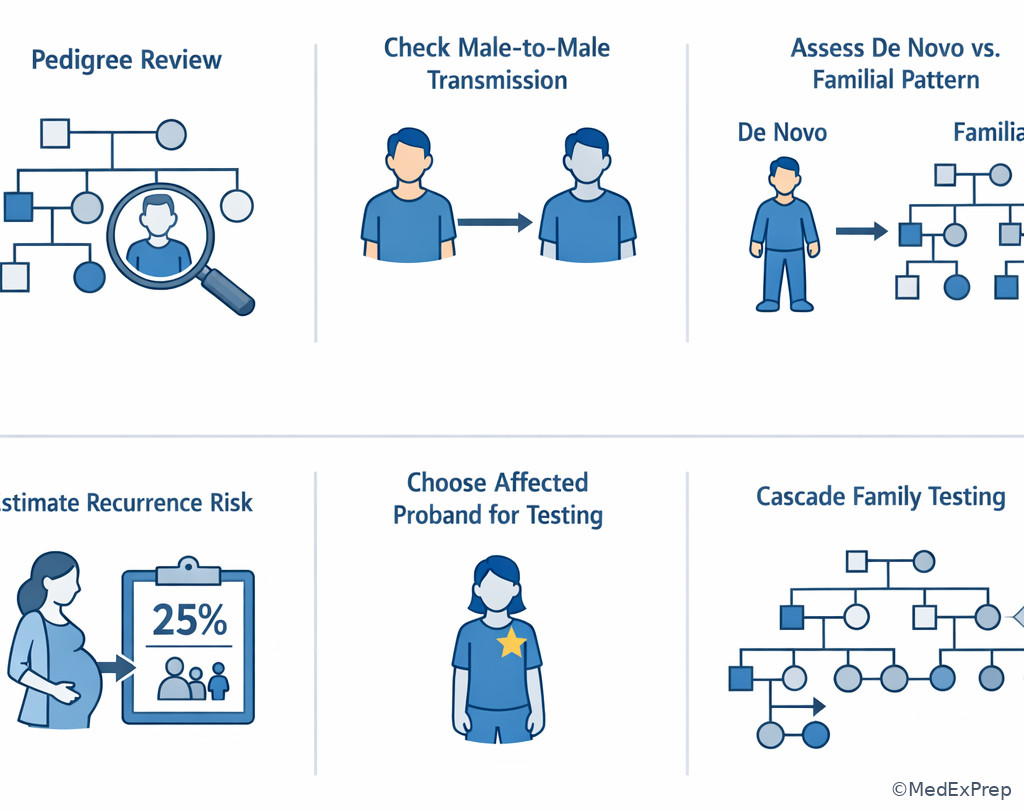
See Fig 6 when you need a last-minute exam-day workflow.
Rapid Review
- Autosomal dominant -> vertical transmission is the fastest pedigree clue.
- Father-to-son transmission -> rejects X-linked inheritance.
- Equal sex distribution -> favors autosomal rather than sex-linked pattern.
- Unaffected child of affected parent -> does not argue against AD; each pregnancy is independent.
- Negative family history -> does not exclude AD; think de novo, reduced penetrance, or small family size.
- Skipped generation -> think reduced penetrance before autosomal recessive.
- Different severity among relatives -> think variable expressivity, not separate diagnoses.
- Known affected heterozygous parent -> usual recurrence risk is 50% per pregnancy.
- Single isolated case -> recurrence lower than 50%, but not zero because of possible germline mosaicism.
- Mechanism matters -> haploinsufficiency, dominant-negative, and gain-of-function imply different variant expectations.
- Best first molecular test -> depends on phenotype breadth and expected variant class, not on inheritance label alone.
- Family testing strategy -> identify the familial variant in the affected person first, then test relatives.
Self-check quiz
1. A 12-year-old boy is evaluated because his father and paternal grandmother have the same neurocutaneous syndrome. He also has seasonal allergies and a normal complete blood count. Which inheritance pattern is most likely?
- Autosomal dominant
- Autosomal recessive
- X-linked recessive
- Mitochondrial
2. A 30-year-old woman with a molecularly confirmed autosomal dominant disorder asks about future pregnancies with her unaffected partner. She has one unaffected child already and mild iron deficiency. What is the most appropriate recurrence risk estimate for each pregnancy?
- 25%
- 50%
- 75%
- 100% if one prior child becomes affected
3. A 5-year-old girl has findings strongly suggestive of a classic autosomal dominant syndrome. Both parents appear unaffected on initial history, although the father has mild related features that were never evaluated. The most appropriate next step to clarify inheritance is:
- Conclude the case is non-genetic because family history is negative
- Assume autosomal recessive inheritance because one child is affected
- Carefully examine and, if indicated, test the mildly suggestive parent after proband evaluation
- Test only unaffected siblings first
4. A 9-year-old boy with disproportionate short stature has an affected mother with the same body habitus. He also has recurrent otitis media and mild vitamin D deficiency. The phenotype strongly suggests a dominant disorder caused by a recurrent activating sequence variant. Which testing approach is most appropriate?
- Chromosomal microarray as the sole first-line test because dosage changes cause all dominant disorders
- Targeted molecular testing that can detect the expected sequence-level activating variant
- Karyotype because all inherited skeletal disorders are chromosomal
- Biochemical metabolic screening as the primary test
5. A 24-year-old man is evaluated for a family history of a late-onset dominant neurologic disorder. His mother is affected at age 52, but he is asymptomatic. He also has controlled asthma and a mildly elevated LDL cholesterol level. Which interpretation is most appropriate?
- His lack of symptoms proves he did not inherit the variant
- Age-dependent penetrance means he may still be at risk despite current absence of symptoms
- The pedigree is more consistent with autosomal recessive inheritance
- Father-to-son transmission must be shown before AD inheritance can be considered
6. A 3-year-old girl has a phenotype highly specific for a well-known autosomal dominant syndrome. Her parents are clinically unaffected, and targeted blood testing in both parents does not detect the pathogenic variant found in the child. The family asks about recurrence in a future pregnancy. Which statement is most appropriate?
- Recurrence risk is zero because the variant is de novo and absent in both parents
- Recurrence risk is 50% because all autosomal dominant disorders recur at that rate
- Recurrence risk is lower than 50% but not zero because parental germline mosaicism remains possible
- Recurrence risk is 25% because unaffected parents imply autosomal recessive inheritance
7. A 41-year-old woman is referred after her son is diagnosed with a connective tissue disorder inherited in an autosomal dominant fashion. She reports only myopia and mild joint laxity, but her father died suddenly at 48 years. She also has migraine headaches and a normal metabolic panel. Which finding most strongly favors variable expressivity rather than a true de novo event in the son?
- The son is more severely affected than the mother
- The mother has mild but syndrome-consistent manifestations
- The family history includes only one sudden death
- The mother is currently asymptomatic from a cardiovascular standpoint
8. A 33-year-old woman seeks counseling because her father, paternal aunt, and paternal grandmother had a similar cancer predisposition syndrome consistent with autosomal dominant inheritance. One affected aunt is alive and available for testing; the patient is unaffected. She also has hypothyroidism and a benign ovarian cyst. What is the most appropriate next genetics action?
- Test the unaffected patient first with broad exome sequencing because she is the one in clinic
- Begin targeted syndrome-appropriate testing in the available affected aunt to identify the familial pathogenic variant
- Order karyotype in all relatives before any molecular testing
- Defer testing until the patient herself develops cancer
Answer key
1.1.1.8 Question 1
Correct answer: A. Autosomal dominant. The mechanism-to-diagnosis logic is vertical transmission of a likely single-gene disorder across generations, which strongly supports autosomal dominant inheritance. The discriminating clue is an affected father and affected child in successive generations. Source support: standard medical genetics texts emphasize vertical transmission, equal sex distribution, and male-to-male transmission as classic AD clues.
- A. Autosomal dominant - Tempting because the pedigree shows affected parent and grandparent; correct because that is the classic vertical pattern. Discriminating clue: successive generations with an affected father.
- B. Autosomal recessive - Tempting because single-gene disorders can cluster in families; incorrect because recessive disorders more often present as affected siblings with unaffected parents. Discriminating clue: parent-to-child transmission dominates the stem.
- C. X-linked recessive - Tempting because a boy is affected; incorrect because an affected father does not pass an X-linked recessive condition to a son. Discriminating clue: paternal transmission.
- D. Mitochondrial - Tempting because multigenerational inheritance exists; incorrect because paternal transmission is not how mitochondrial inheritance works. Discriminating clue: affected father in the direct line.
Sources: Nussbaum, McInnes, and Willard; GeneReviews.
1.1.1.9 Question 2
Correct answer: B. 50%. In the typical autosomal dominant setting with one affected heterozygous parent and one unaffected partner, each pregnancy independently carries a 50% risk of inheriting the pathogenic allele. The single discriminator is that prior unaffected children do not alter the next pregnancy’s Mendelian probability. Source support: core recurrence-risk principles in medical genetics texts and counseling references.
- A. 25% - Tempting because it is a famous Mendelian fraction; incorrect because it applies to autosomal recessive carrier couples, not classic AD transmission. Discriminating clue: one parent is already affected with a confirmed dominant disorder.
- B. 50% - Tempting and correct because this is the standard recurrence risk for a heterozygous affected parent. Discriminating clue: molecular confirmation of an AD disorder in one parent.
- C. 75% - Tempting because learners may confuse disease presence with combined probabilities; incorrect for simple AD transmission. Discriminating clue: no scenario-specific modifier justifies changing the usual 50%.
- D. 100% if one prior child becomes affected - Tempting because people intuitively believe previous outcomes predict future ones; incorrect because each pregnancy is independent. Discriminating clue: recurrence is asked per pregnancy.
Sources: Nussbaum, McInnes, and Willard; Bennett et al., pedigree standards and counseling principles.
1.1.1.10 Question 3
Correct answer: C. Carefully examine and, if indicated, test the mildly suggestive parent after proband evaluation. The mechanism-to-diagnosis logic is that variable expressivity may make a parent appear unaffected until subtle findings are sought. The discriminating clue is the father’s mild related features. Source support: standard genetics texts emphasize that subtle parental findings can reclassify a “sporadic” case as familial AD disease.
- A. Conclude the case is non-genetic because family history is negative - Tempting because both parents initially seem unaffected; incorrect because negative family history does not exclude AD disease. Discriminating clue: syndrome is strongly suggestive and one parent has mild related features.
- B. Assume autosomal recessive inheritance because one child is affected - Tempting because unaffected parents can suggest recessive disease; incorrect because the phenotype strongly suggests a classic dominant syndrome and subtle parental findings argue otherwise. Discriminating clue: father has suggestive manifestations.
- C. Carefully examine and, if indicated, test the mildly suggestive parent after proband evaluation - Tempting and correct because targeted parental evaluation clarifies whether the pattern is familial with variable expressivity. Discriminating clue: potential mild phenotype in the father.
- D. Test only unaffected siblings first - Tempting because family-wide testing feels comprehensive; incorrect because it is less informative than defining the molecular diagnosis in the proband and evaluating the suspicious parent. Discriminating clue: the key uncertainty lies in parental status, not sibling screening first.
Sources: GeneReviews; Nussbaum, McInnes, and Willard.
1.1.1.11 Question 4
Correct answer: B. Targeted molecular testing that can detect the expected sequence-level activating variant. The mechanism-to-treatment logic here is actually mechanism-to-test selection: a phenotype strongly linked to a recurrent activating sequence variant should be evaluated with an assay that can detect that class of change. The discriminating clue is “recurrent activating sequence variant.” Source support: modern genetics practice and GeneReviews emphasize matching assay choice to the known molecular mechanism.
- A. Chromosomal microarray as the sole first-line test because dosage changes cause all dominant disorders - Tempting because dominant disease is often oversimplified as dosage loss; incorrect because many AD disorders are caused by specific sequence variants, not copy-number changes. Discriminating clue: activating sequence variant.
- B. Targeted molecular testing that can detect the expected sequence-level activating variant - Tempting and correct because it directly matches the known mechanism. Discriminating clue: recurrent activating variant.
- C. Karyotype because all inherited skeletal disorders are chromosomal - Tempting because skeletal phenotypes may feel structural; incorrect because most monogenic skeletal dysplasias are not diagnosed by karyotype. Discriminating clue: syndrome points to a sequence-level single-gene disorder.
- D. Biochemical metabolic screening as the primary test - Tempting because growth disorders can have broad differentials; incorrect because the parent-child pattern and classic phenotype indicate a monogenic dominant skeletal syndrome. Discriminating clue: affected mother with same phenotype.
Sources: GeneReviews; ACMG practice resources on test selection.
1.1.1.12 Question 5
Correct answer: B. Age-dependent penetrance means he may still be at risk despite current absence of symptoms. The mechanism-to-diagnosis logic is that late-onset dominant disorders may not manifest in younger at-risk individuals. The discriminating clue is affected mother at age 52 with an asymptomatic 24-year-old son. Source support: medical genetics references distinguish age-dependent penetrance from proof of noninheritance.
- A. His lack of symptoms proves he did not inherit the variant - Tempting because the patient appears healthy; incorrect because onset may occur later. Discriminating clue: the disorder is explicitly late-onset.
- B. Age-dependent penetrance means he may still be at risk despite current absence of symptoms - Tempting and correct because asymptomatic status at 24 does not exclude future manifestation. Discriminating clue: age 24 is well before the affected mother’s age at onset.
- C. The pedigree is more consistent with autosomal recessive inheritance - Tempting because only one parent is clearly affected; incorrect because late-onset vertical transmission remains classic AD. Discriminating clue: affected parent.
- D. Father-to-son transmission must be shown before AD inheritance can be considered - Tempting because learners overvalue one clue; incorrect because male-to-male transmission supports AD but is not required in every pedigree. Discriminating clue: vertical transmission already exists through the mother.
Sources: Nussbaum, McInnes, and Willard; GeneReviews.
1.1.1.13 Question 6
Correct answer: C. Recurrence risk is lower than 50% but not zero because parental germline mosaicism remains possible. The diagnosis-mechanism-counseling logic is that a likely de novo dominant variant in the child reduces recurrence compared with classic familial AD transmission, but residual risk remains because blood testing can miss germline mosaicism. The discriminating clue is negative parental blood testing despite a specific pathogenic variant in the child. Source support: GeneReviews and standard counseling references consistently note residual recurrence risk after apparent de novo events.
- A. Recurrence risk is zero because the variant is de novo and absent in both parents - Tempting because parental blood testing is negative; incorrect because germline mosaicism cannot be excluded completely. Discriminating clue: parental testing was in blood, not all germ cells.
- B. Recurrence risk is 50% because all autosomal dominant disorders recur at that rate - Tempting because 50% is the memorized AD number; incorrect because that applies when a parent carries the pathogenic variant. Discriminating clue: neither parent is clinically affected and both test negative in blood.
- C. Recurrence risk is lower than 50% but not zero because parental germline mosaicism remains possible - Tempting and correct because it captures the appropriate exception-based counseling frame. Discriminating clue: isolated case with de novo appearance.
- D. Recurrence risk is 25% because unaffected parents imply autosomal recessive inheritance - Tempting because of a classic recessive rule; incorrect because the child’s specific syndrome is highly characteristic of a dominant disorder with a defined pathogenic variant. Discriminating clue: well-known autosomal dominant syndrome in the proband.
Sources: GeneReviews; ACMG counseling resources; Nussbaum, McInnes, and Willard.
1.1.1.14 Question 7
Correct answer: B. The mother has mild but syndrome-consistent manifestations. The mechanism-to-diagnosis logic is that variable expressivity allows the same dominant disorder to appear mildly in one relative and severely in another. The discriminating clue is the mother’s myopia and joint laxity, which are syndrome-consistent findings. Source support: classic medical genetics references emphasize targeted examination of parents for subtle manifestations.
- A. The son is more severely affected than the mother - Tempting because it reflects intrafamilial variability; incomplete because severity difference alone is less convincing than documented maternal manifestations. Discriminating clue: the question asks what most strongly favors familial variable expressivity.
- B. The mother has mild but syndrome-consistent manifestations - Tempting and correct because this directly indicates the same disorder may be present in her with milder expression. Discriminating clue: she is not truly unaffected once the phenotype is examined carefully.
- C. The family history includes only one sudden death - Tempting because the death is suspicious; incorrect because it is supportive but less direct than living maternal manifestations. Discriminating clue: the mother herself has relevant features.
- D. The mother is currently asymptomatic from a cardiovascular standpoint - Tempting because absence of severe findings could imply she is unaffected; incorrect because dominant disorders can be mildly expressed. Discriminating clue: cardiovascular silence does not erase other syndrome-consistent features.
Sources: GeneReviews; Nussbaum, McInnes, and Willard.
1.1.1.15 Question 8
Correct answer: B. Begin targeted syndrome-appropriate testing in the available affected aunt to identify the familial pathogenic variant. The diagnosis-mechanism-management logic is that the best first molecular test in a suspected dominant familial syndrome is usually performed in an affected relative, because that strategy maximizes yield and makes downstream predictive testing interpretable. The discriminating clue is that an affected aunt is alive and available for testing, while the patient is unaffected. Source support: GeneReviews and ACMG-aligned clinical genetics practice emphasize testing the most clearly affected available family member first.
- A. Test the unaffected patient first with broad exome sequencing because she is the one in clinic - Tempting because it seems logistically convenient; incorrect because a negative result in an unaffected person without a known familial variant may be uninformative. Discriminating clue: an affected relative is available.
- B. Begin targeted syndrome-appropriate testing in the available affected aunt to identify the familial pathogenic variant - Tempting and correct because it establishes the familial molecular diagnosis most efficiently. Discriminating clue: living affected relative with a strong phenotype.
- C. Order karyotype in all relatives before any molecular testing - Tempting because multigenerational disease sounds broad; incorrect because classic hereditary cancer syndromes are usually sequence-level or small CNV disorders, not first-line karyotype diagnoses. Discriminating clue: syndrome-consistent family history rather than chromosomal phenotype.
- D. Defer testing until the patient herself develops cancer - Tempting because penetrance is incomplete and testing can feel premature; incorrect because identifying a familial predisposition variant is precisely what enables prevention and surveillance. Discriminating clue: strong dominant cancer family history with an available affected relative.
Sources: GeneReviews; ACMG practice resources; NCCN hereditary cancer testing principles as a broadly accepted clinical framework.
Keep going with the full ABMGG Medical Genetics Prep Course (Genetics)
You just studied the way members do, in the same lesson interface. Full access unlocks every lesson, the question bank and flashcards for a full year.
One payment · 1 year of access · No auto-renewal