1.1.1 - AAHIVP Ambulatory Scope
Why it matters
- AAHIVP questions often hinge less on rare facts and more on choosing the right level of action: routine outpatient care, urgent referral, or emergency transfer.
- Many distractors are tempting because they sound proactive but actually assume inpatient authority, specialty procedures, or institution-specific policies.
- Scope-aware reasoning protects patient safety: an ambulatory HIV clinician must recognize red flags without pretending to manage ICU-level disease.
- Getting the role boundary right improves every later topic in this course, from HIV testing and PrEP to ART selection and opportunistic infection prevention.
Exam takeaway: Use this map to sort stems into routine outpatient care, urgent escalation, or emergency transfer.
flowchart TD
A[Patient scenario] --> B{Stable and ambulatory?}
B -->|Yes| C{Fits routine HIV prevention or longitudinal care?}
C -->|Yes| D[Assess, counsel, test, monitor, treat within scope]
C -->|No| E[Coordinate referral or specialist input]
B -->|No| F[Recognize red flags]
F --> G[Urgent evaluation or emergency transfer]
D --> H[Document follow-up and safety checks]
E --> H
G --> H
See Fig 1 for the core decision frame that will recur throughout the course.
Key Terms & Must-Know Facts
1.1.1.1 Key terms
- Ambulatory HIV care: outpatient prevention, diagnosis, monitoring, counseling, treatment support, and longitudinal follow-up.
- Best next step: the safest, guideline-based action supported by the current stem facts.
- Within scope: permitted by professional license, training, prescribing authority, and collaborative agreements.
- Escalation: moving care to a higher level because risk, instability, or complexity exceeds routine outpatient management.
- Urgent referral: same-day or prompt higher-level assessment for potentially serious but not immediately crashing patients.
- Emergency transfer: immediate ED or emergency services activation for instability or severe red flags.
- Stigma-aware care: respectful, nonjudgmental, person-centered communication that avoids blame.
- Confidentiality: protecting HIV-related information and discussing disclosure carefully and law-aware without overclaiming legal specifics.
- Guideline-based reasoning: using accepted HIV standards rather than local formulary or institutional habits.
- Routine monitoring: scheduled outpatient follow-up of viral load, CD4 count, safety labs, adherence, and prevention needs.
- Red flag: symptom, sign, lab pattern, or context suggesting opportunistic infection, severe toxicity, acute HIV concern, or another unstable condition.
- Collaborative practice: care delivered with referrals, consultation, and co-management when the case exceeds individual authority.
1.1.1.2 Must-know facts
- The exam tests ambulatory HIV medicine, not ICU, surgical, or procedural rescue management.
- If a patient is unstable, the correct answer is usually recognize instability and arrange urgent evaluation, not detailed inpatient treatment.
- When licensure or local authority is unclear, choose the answer framed as assessment, counseling, monitoring, coordination, or referral.
- Confidential, stigma-aware communication is not optional; it is part of correct care.
- AAHIVP stems favor safe outpatient action over institution-specific rules.
- Common ambulatory tasks include HIV screening, acute HIV recognition, PrEP/PEP reasoning, ART support, lab interpretation, adherence counseling, vaccination review, and common coinfection screening.
- Do not assume authority to independently manage pregnancy emergencies, sepsis, meningitis, respiratory failure, or ICU-level opportunistic infections.
- When a scenario exceeds scope, the exam-safe move is to stabilize within role, counsel, and escalate.
| Exam phrase in stem | What it usually signals | Default action frame |
|---|---|---|
| Most appropriate next step | Decision hierarchy matters more than broad knowledge dump | Pick the safest guideline-based outpatient action |
| Requires immediate clarification | Something unsafe, out of scope, or contradictory is present | Pause, verify, and escalate as needed |
| Best initial therapy | Choose first-line principle, not rare rescue therapy | Use routine ambulatory standard unless a red flag blocks it |
| Most important to monitor | Question is asking for follow-up parameter, not diagnosis | Choose the marker linked to treatment safety or response |
| Recent exposure / acute symptoms | Window period or acute HIV reasoning | Use HIV testing algorithm appropriately and avoid false reassurance |
| Dyspnea, confusion, severe headache, hypotension | Potential emergency or severe OI/toxicity | Urgent evaluation or emergency transfer |
Core content
1.1.1.3 Foundational role: what the ambulatory HIV clinician is expected to do
A Explanation
The first exam conflict is simple but highly testable: choose routine ambulatory HIV action versus reject answers that assume a different role. The ambulatory HIV clinician assesses risk, symptoms, labs, adherence, comorbidities, and prevention needs; interprets common HIV tests; supports ART, PrEP, and PEP decisions within scope; provides counseling; and coordinates referral. Reject answer choices that ask you to act as an intensivist, surgeon, inpatient subspecialist, or unrestricted prescriber.
WHY THIS IS TESTED: stems often tempt you with an answer that sounds decisive but is actually too advanced, too invasive, or too profession-specific. The single rule is: if the action can be safely performed in routine outpatient HIV care and is guideline-based, it is in scope; if it requires emergency or specialty-level management, recognition and escalation are in scope, not definitive rescue treatment.
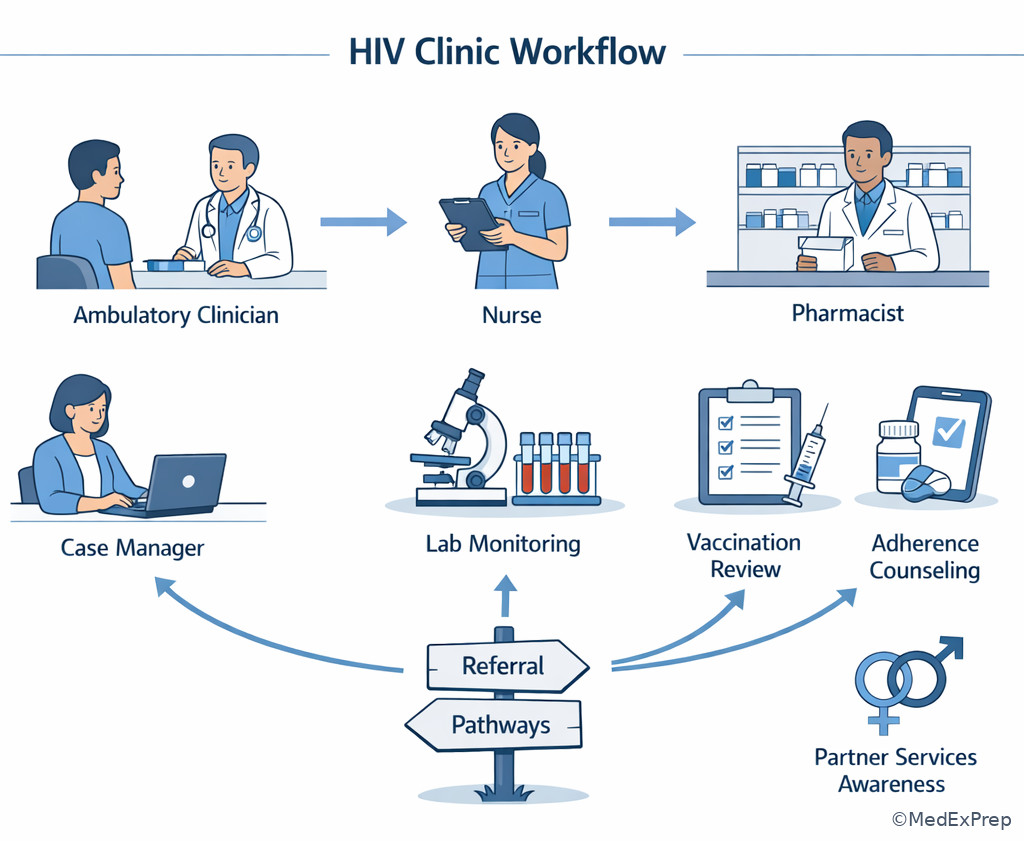
For this exam, think in bands. Band 1: assess, test, counsel, vaccinate, monitor, and coordinate routine care. Band 2: initiate or support evidence-based prevention and treatment decisions within licensure and collaborative agreements. Band 3: recognize when symptoms, organ dysfunction, pregnancy complexity, severe toxicity, or suspected opportunistic infection require urgent referral or transfer. See Fig 2.
Exam takeaway: Separate routine care, collaborative management, and escalation to avoid out-of-scope answer choices.
Exam takeaway: Visualize ambulatory care as coordinated longitudinal management rather than isolated prescribing.
B Worked example
A 34-year-old man presents to an outpatient HIV clinic for follow-up after a recent high-risk sexual exposure. He has hypertension and depression, takes lisinopril and sertraline, and reports fatigue and sore throat for 3 days. He asks whether the clinician can “just start everything today and also admit me directly if this is HIV.” He is afebrile, speaking comfortably, and has normal blood pressure and oxygen saturation. A tempting clue is his statement about direct admission, which may push the learner toward hospital-level action.
Reasoning chain: Identify task: determine what belongs in ambulatory scope right now. Extract key facts: recent exposure, possible acute HIV symptoms, but he is hemodynamically stable and not in respiratory distress or altered mental status. Apply rule: stable patients with possible acute HIV are managed with prompt outpatient assessment and appropriate HIV testing, not automatic inpatient admission. Eliminate distractors: “admit for acute HIV workup” is too aggressive; “ignore symptoms because vitals are normal” is unsafe; “start ICU-level OI treatment” is not supported. Verify: the best next step is outpatient evaluation using the HIV testing algorithm and timely follow-up, with escalation only if red flags emerge.
C Exam trap
D Checkpoint
Question: Which action best fits the expected AAHIVP ambulatory role in a stable patient with a new possible HIV-related concern?
- Arrange guideline-based outpatient testing, counseling, and close follow-up.
- Provide ICU-level management instructions for possible opportunistic infection.
- Perform invasive specialty procedures to secure definitive diagnosis.
- Rely on a hospital-specific formulary rule as the universal standard.
Answer: A.
- A: Tempting because it may seem less dramatic, but it is right because stable outpatient HIV care centers on structured assessment, counseling, testing, and follow-up.
- B: Tempting because serious HIV complications exist, but wrong because ICU-level instructions exceed the ambulatory role without instability.
- C: Tempting because definitive diagnosis sounds efficient, but wrong because invasive specialty procedures are outside routine ambulatory HIV scope.
- D: Tempting because local rules feel practical, but wrong because exam reasoning favors guideline-based actions over institution-specific policy.
1.1.1.4 Scope boundaries: what to escalate, refer, or transfer
A Explanation
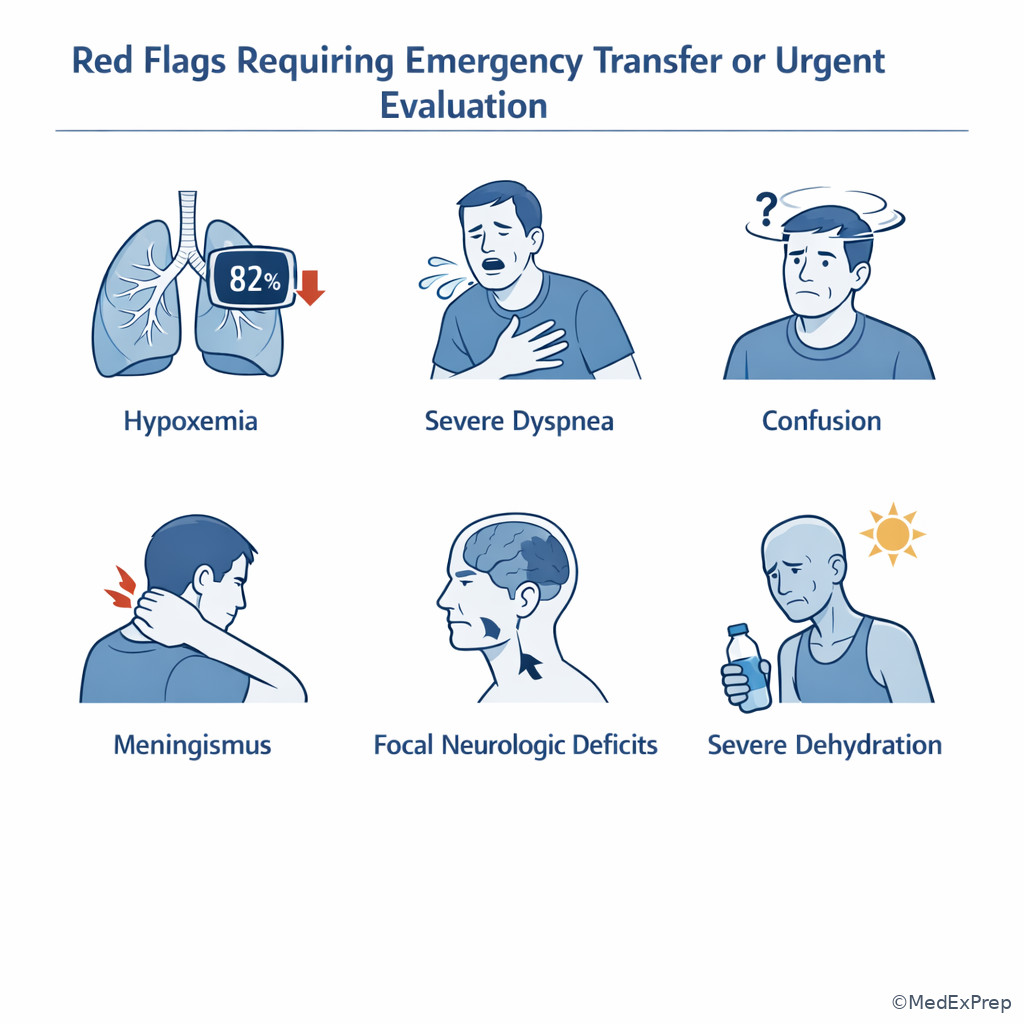
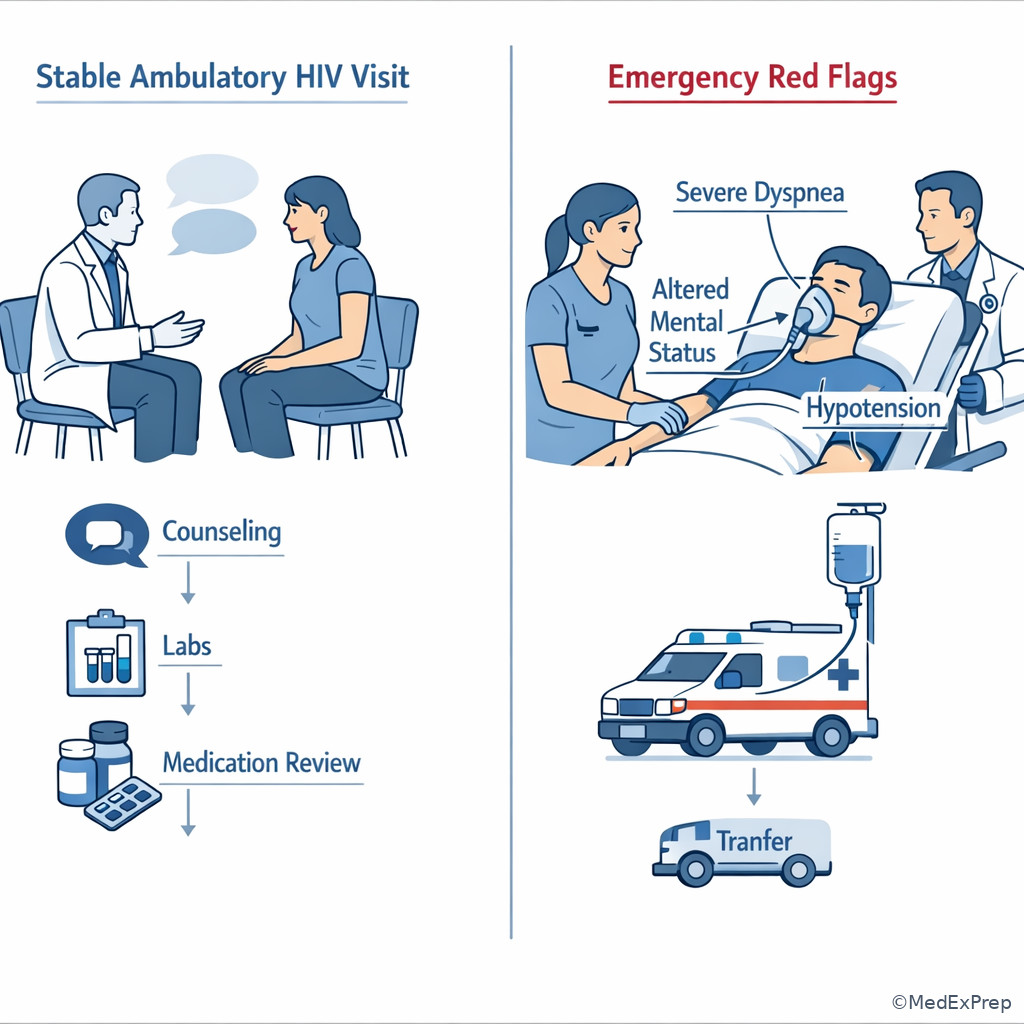
The second conflict is choose routine follow-up versus reject delay when red flags are present. The exam wants you to recognize when outpatient care is no longer enough. Red flags include severe dyspnea, hypoxemia, chest pain, new confusion, severe headache with meningismus, focal neurologic deficit, syncope, hypotension, severe dehydration, persistent vomiting preventing oral therapy, rapidly progressive rash with mucosal involvement, and symptoms suggesting a serious opportunistic infection or drug reaction. In these cases, the ambulatory clinician's correct role is not to manage the entire emergency but to recognize the danger, provide immediate guidance within scope, and arrange urgent evaluation or emergency transfer.
WHY THIS IS TESTED: the common board trap is false reassurance from a setting label such as “clinic follow-up.” The single resolving rule is: location does not define acuity; patient stability does. A patient can present to clinic with a condition that requires the ED. Likewise, not every alarming symptom means admission; some require urgent specialty referral or same-day evaluation rather than routine follow-up weeks later.
A practical way to think about escalation is three tiers: emergency transfer for instability, urgent same-day referral for high-risk but stable findings, and routine planned follow-up for stable issues without red flags. See Fig 3.
Exam takeaway: Use symptoms and stability, not clinic setting, to decide routine care versus urgent referral versus emergency transfer.
Exam takeaway: Severe neurologic, respiratory, or hemodynamic findings override routine outpatient plans.
flowchart TD
A[HIV patient in clinic] --> B{Severe red flag?}
B -->|Hypoxemia or dyspnea| C[Emergency evaluation]
B -->|Confusion or meningismus| C
B -->|Hypotension or syncope| C
B -->|Unable to take PO meds| D[Urgent same-day evaluation]
B -->|Stable minor complaint| E[Routine ambulatory assessment]
E --> F[Counsel, test, monitor]
D --> G[Escalate and coordinate]
C --> G Exam takeaway: Memorize visual red flags that push a case out of routine outpatient management.
B Worked example
A 46-year-old woman with HIV not currently on ART presents for a same-week clinic visit because of fever, progressive shortness of breath, and dry cough. She also has type 2 diabetes and chronic kidney disease. A distracting detail is that she mentions missing meals and feeling anxious, which could make dehydration or panic seem sufficient explanations. Her room-air oxygen saturation is 88%, respiratory rate is 28/min, and she speaks in short phrases.
Reasoning chain: Identify task: determine outpatient action level. Extract key facts: immunocompromised context, hypoxemia, tachypnea, inability to speak full sentences comfortably. Apply rule: unstable respiratory symptoms are beyond routine ambulatory management. Eliminate distractors: same-day chest x-ray with routine follow-up is too slow; starting empiric outpatient therapy without escalation is unsafe; focusing on anxiety ignores objective instability. Verify: the best next step is emergency evaluation/transfer. The ambulatory role is recognition, urgent arrangement, and communication of concern.
C Exam trap
D Checkpoint
Question: Which finding most strongly changes a routine ambulatory HIV visit into a same-day emergency evaluation?
- Missed one dose of ART last week
- Oral thrush without dysphagia in an otherwise stable patient
- Room-air oxygen saturation of 88% with progressive dyspnea
- Concern about insurance coverage for medications
Answer: C.
- A: Tempting because adherence matters, but wrong because a single missed dose alone does not create an emergency.
- B: Tempting because it may reflect immunosuppression, but wrong because a stable patient with localized thrush is usually managed outpatient.
- C: Tempting and right because hypoxemia with dyspnea is an objective instability signal requiring emergency evaluation.
- D: Tempting because access barriers affect outcomes, but wrong because this is an outpatient coordination issue rather than an emergency trigger.
- True or False: A clinic setting automatically means outpatient management is appropriate. False.
- The single most important discriminator between routine follow-up and emergency transfer is patient stability.
- Name 3 red flags in HIV clinic: hypoxemia, confusion, severe headache/meningismus.
1.1.1.5 Patient-centered boundaries: confidentiality, stigma-aware communication, and coordination
A Explanation
The next conflict is choose patient-centered ambulatory communication versus reject stigmatizing, coercive, or overconfident legal statements. AAHIVP expects you to protect confidentiality, use neutral language, support informed decision-making, and coordinate partner services or referrals appropriately. The exam does not expect sweeping legal conclusions based on jurisdiction-specific law. If a stem involves disclosure, adolescent care, partner notification, or workplace concerns, the safe move is usually to protect confidentiality, explain available support resources, and follow applicable policy or consultation channels rather than making universal legal pronouncements.
WHY THIS IS TESTED: learners often focus only on virology and medications, but real HIV care is longitudinal and relational. The single rule is: correct HIV care combines medical accuracy with confidentiality, nonjudgment, and coordinated support. An answer choice that is medically sound but disrespectful or privacy-blind can still be wrong.
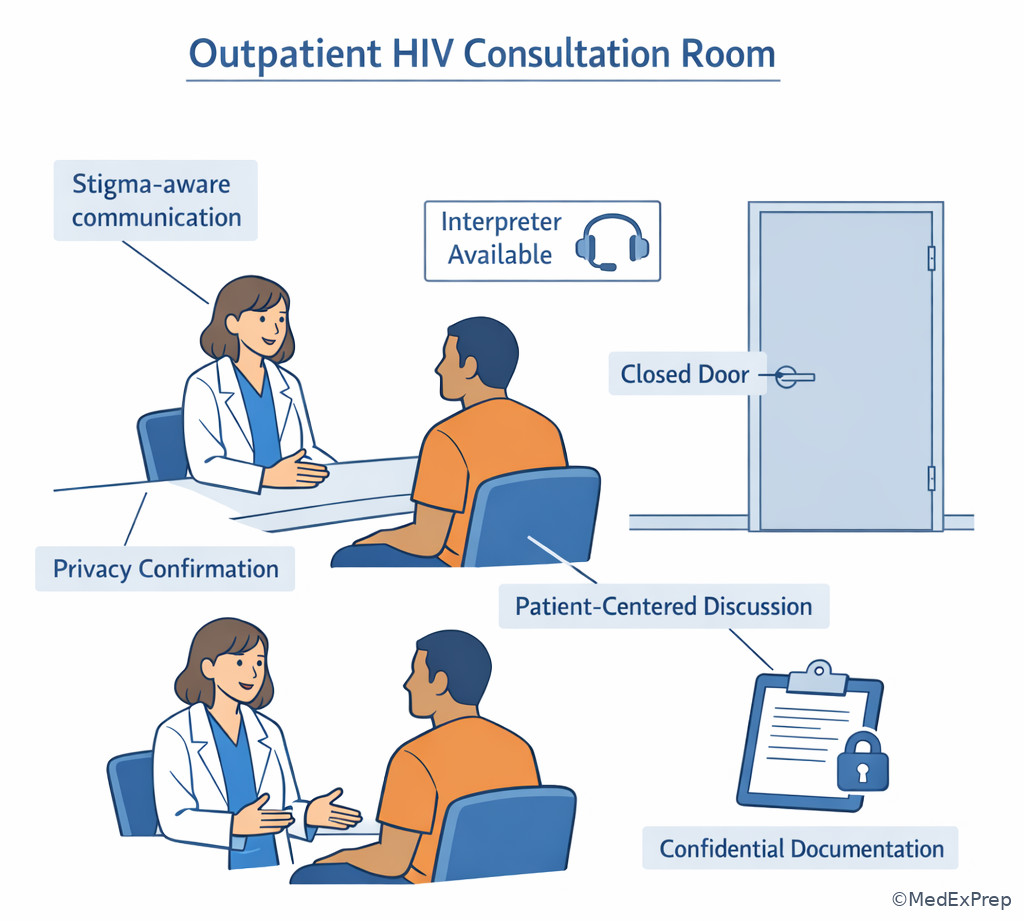
Use person-centered phrasing, ask permission before discussing sensitive details, avoid assumptions about partners or behaviors, and coordinate rather than coerce. In a stigmatized condition, communication errors can undermine adherence, retention, and trust as much as technical mistakes do. See Fig 4.
Exam takeaway: Protect privacy, use nonjudgmental language, and coordinate support instead of forcing disclosure or overclaiming legal rules.
Exam takeaway: The correct answer often includes privacy checks, respectful language, and shared decision-making.
B Worked example
A 23-year-old college student with newly diagnosed HIV presents with his mother in the room. He has asthma and ADHD, and his mother answers many questions for him. A distracting clue is that the mother says she “already knows everything” and wants the clinician to explain the diagnosis and next steps immediately. The patient is quiet and looking down.
Reasoning chain: Identify task: choose the best immediate outpatient communication action. Extract key facts: sensitive HIV information, another person present, unclear permission from the patient, potential confidentiality issue. Apply rule: confirm privacy preferences before discussing HIV details. Eliminate distractors: automatically disclosing everything to the mother ignores confidentiality; refusing all discussion without speaking to the patient is too rigid; discussing only general health maintenance may dodge the issue. Verify: the best next step is to ask the patient privately or directly whether he wants his mother present for the discussion and proceed using stigma-aware, patient-centered counseling.
C Exam trap
D Checkpoint
Question: A patient presents for HIV-related counseling with another person in the room. What is the most appropriate first step before discussing detailed results?
- Assume support persons may hear all results unless they object
- Confirm with the patient what information may be discussed and with whom
- Delay all counseling until a legal consultant reviews the situation
- Provide only medication names and omit the diagnosis
Answer: B.
- A: Tempting because support persons are common in clinic, but wrong because confidentiality should be actively confirmed rather than presumed.
- B: Tempting and right because privacy confirmation is the proper first step in sensitive HIV care.
- C: Tempting because laws vary, but wrong because a basic privacy check does not require legal delay.
- D: Tempting because it avoids explicit disclosure, but wrong because partial evasive communication is not a substitute for proper patient-directed discussion.
1.1.1.6 What belongs in routine ambulatory HIV care: prevention, diagnosis, treatment support, and monitoring
A Explanation
The next conflict is choose the broad outpatient care domain correctly versus reject a false narrowing of the ambulatory role. Ambulatory HIV care is not just writing ART prescriptions. It includes prevention counseling, sexual health assessment, HIV screening and diagnosis, PrEP and PEP reasoning, baseline evaluation, vaccination review, common coinfection screening, routine lab interpretation, treatment adherence support, adverse-effect review, drug-interaction checking, and continuity planning. This broad scope is central to AAHIVP.
WHY THIS IS TESTED: stems often bury the real task under noise. The single rule is: ambulatory HIV practice spans prevention through longitudinal monitoring. If a stable outpatient question asks about counseling, vaccination, routine safety labs, or prevention services, that is still HIV medicine. Conversely, rare salvage regimens, ICU complications, and invasive diagnostics are not the default expectation for this exam.
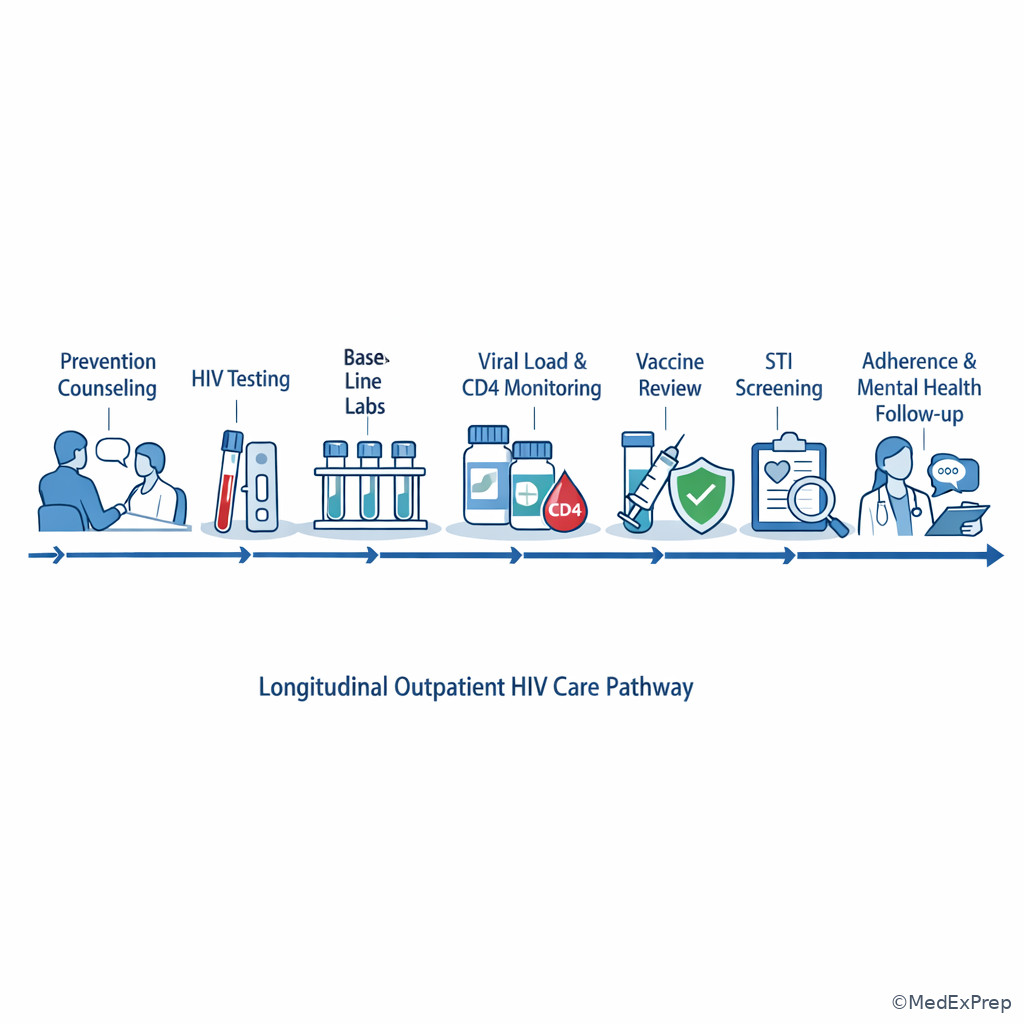
This breadth matters because a single visit may combine multiple ambulatory tasks: review a reactive screen, assess STI risk, update vaccines, identify a renal interaction affecting PrEP or ART choice, address transportation barriers, and schedule repeat labs. Later topics will fill in the details; for now, anchor the categories. See Fig 5.
Exam takeaway: HIV outpatient care includes prevention, diagnosis, treatment support, monitoring, and coordination in the same longitudinal framework.
Exam takeaway: Expect outpatient HIV questions to move from prevention to diagnosis to longitudinal monitoring across time.
flowchart LR
A[Risk assessment] --> B[Testing or prevention choice]
B --> C[Baseline evaluation]
C --> D[ART or PrEP support]
D --> E[Monitoring and adherence]
E --> F[Vaccination and coinfection screening]
F --> G[Retention and continuity]
Exam takeaway: A single visit can combine prevention, testing, medication review, and follow-up planning.
B Worked example
A 51-year-old woman with well-controlled HIV on stable ART presents for a routine visit. She also has hyperlipidemia and osteopenia. A distracting lab shows mildly elevated triglycerides, and she mainly wants refills. She has a new partner and has not had recent STI screening or vaccine review. The wrong move is to reduce the visit to “continue ART, no further action.”
Reasoning chain: Identify task: determine what routine ambulatory HIV care includes at follow-up. Extract key facts: stable longitudinal visit, refill request, new sexual history, preventive care gaps, chronic comorbidities. Apply rule: ambulatory HIV care includes prevention counseling, STI screening assessment, safety monitoring, and preventive services in addition to ART continuation. Eliminate distractors: focusing only on triglycerides misses the broader outpatient role; referring all preventive care elsewhere is too narrow; postponing all screening because HIV is controlled ignores longitudinal care. Verify: a comprehensive outpatient plan addresses medications, sexual health, labs, and preventive care.
C Exam trap
D Checkpoint
Question: Which task is most clearly part of routine ambulatory HIV care in a stable outpatient follow-up visit?
- Monitoring viral load and reviewing adherence barriers
- Directing ICU ventilator changes for severe pneumonia
- Performing a surgical biopsy without specialty referral
- Making a universal legal determination about state reporting law
Answer: A.
- A: Tempting and right because routine monitoring and adherence support are core outpatient HIV functions.
- B: Tempting because pneumonia can occur in HIV, but wrong because ventilator management is outside ambulatory scope.
- C: Tempting because biopsy may aid diagnosis, but wrong because invasive specialty procedures are not routine outpatient HIV practice.
- D: Tempting because HIV care intersects with law and policy, but wrong because the exam avoids broad jurisdiction-specific legal conclusions as universal answers.
- The most common mistake in stable HIV follow-up stems is forgetting prevention and routine monitoring.
- True or False: A suppressed viral load means STI screening and vaccine review can be ignored. False.
- Name the 3 broad ambulatory domains beyond ART prescribing: prevention, diagnosis, monitoring/coordination.
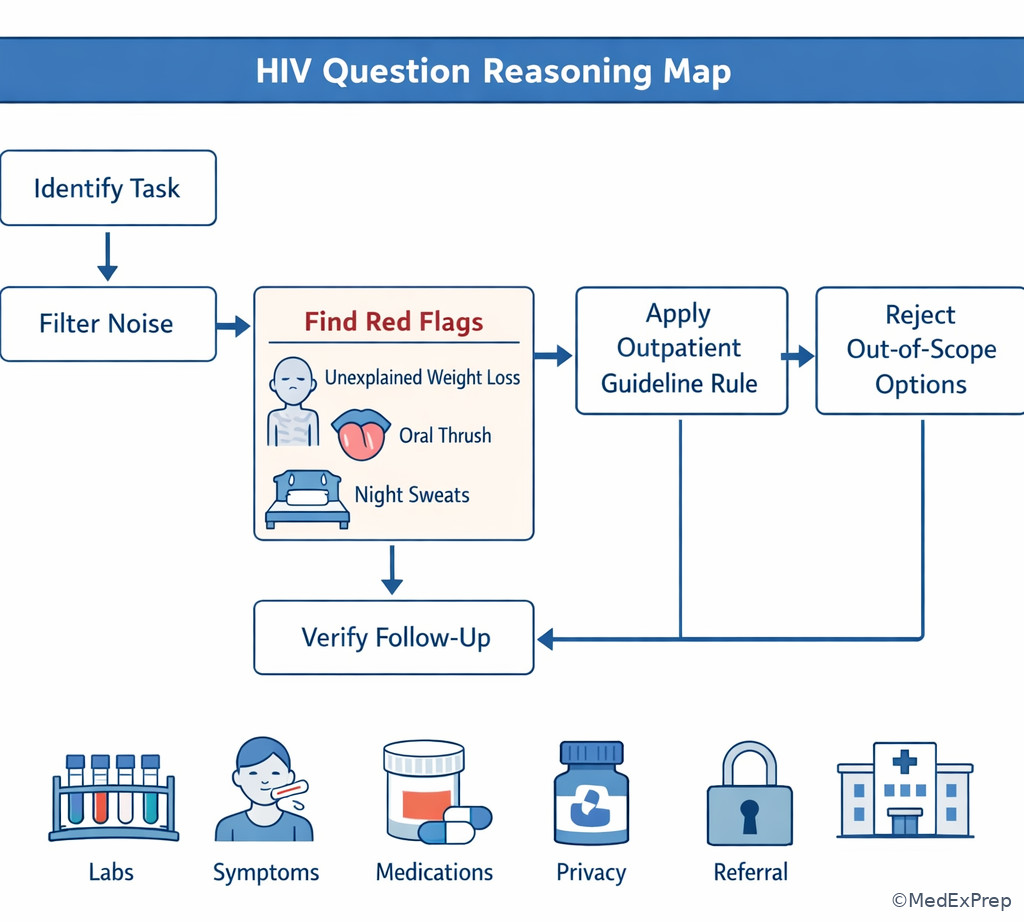
1.1.1.7 How board-style stems test scope: identify task, reject noise, choose the safest next step
A Explanation
The final integration conflict is choose the governing task in the stem versus reject seductive but irrelevant details. Scope questions are usually not announced directly. Instead, the stem mixes age, comorbidities, travel, one abnormal lab, a dramatic patient quote, and several possible actions. Your job is to identify what the question is really asking: diagnosis? monitoring? urgent transfer? counseling? drug interaction review? Once the task is clear, one rule usually resolves the item.
WHY THIS IS TESTED: exam success depends on disciplined triage of information. The single rule is: identify the decision category first, then apply the narrowest governing fact. If a patient is unstable, instability outranks chronic management details. If the question is about confidentiality, privacy outranks family convenience. If the issue is outpatient follow-up, guideline-based ambulatory care outranks aggressive but out-of-scope actions.
This topic prepares you for the next lesson on best-next-step reasoning. For now, practice a short mental algorithm: identify task, extract key facts, apply one governing rule, eliminate distractors that exceed scope or ignore safety, and verify the answer fits ambulatory HIV practice. See Fig 6.
Exam takeaway: Identify the task first, then let one governing rule eliminate out-of-scope or unsafe answer choices.
Exam takeaway: Visual sorting of signal versus noise improves best-next-step performance.
Exam takeaway: Comparing stable clinic management with true emergency features prevents over- and under-escalation.
B Worked example
A 39-year-old man with HIV on bictegravir/tenofovir alafenamide/emtricitabine comes for follow-up. He has obesity and GERD and takes over-the-counter antacids. He reports a mild headache after poor sleep, but his main concern is whether he should skip his appointment because work is busy. A tempting clue is the headache, which may misdirect attention toward urgent neurologic evaluation. He is afebrile, fully oriented, and otherwise well.
Reasoning chain: Identify task: this is a routine ambulatory management and monitoring question, not an emergency stem. Extract key facts: stable patient, adherence/retention issue, possible drug-interaction review with antacids, no red-flag neurologic findings. Apply rule: choose outpatient monitoring and counseling action over dramatic escalation. Eliminate distractors: ED referral for headache alone is unsupported; stopping ART preemptively is unsafe; ignoring follow-up misses retention and interaction care. Verify: the best next step is to maintain ambulatory follow-up, address the antacid interaction concern, and reinforce adherence and appointment retention.
C Exam trap
D Checkpoint
Question: What is the best first move when a board-style stem mixes multiple details and you suspect a scope question?
- Choose the most aggressive intervention because HIV is high risk
- Identify the task and determine whether the patient is stable before anything else
- Ignore all social and communication details and focus only on labs
- Prefer institution-specific workflow assumptions over published guidance
Answer: B.
- A: Tempting because urgency feels safe, but wrong because aggressive action is not automatically appropriate without instability.
- B: Tempting and right because task identification and stability screening are the fastest way to sort outpatient care from escalation.
- C: Tempting because labs are objective, but wrong because communication, privacy, and symptom severity can be the real discriminator.
- D: Tempting because workflows seem practical, but wrong because the exam prioritizes guideline-based reasoning, not local assumptions.
Exam Traps & Differentiators
| Looks similar | Actually means routine ambulatory care | Actually means escalation | Single discriminator |
|---|---|---|---|
| Mild headache in HIV | Stable vitals, no fever, no meningismus, no confusion | Fever, altered mental status, meningismus, focal deficit | Neurologic red flags |
| Cough in HIV | Comfortable breathing, normal oxygen saturation | Hypoxemia, tachypnea, inability to speak comfortably | Respiratory stability |
| Family present at visit | Patient confirms permission to discuss HIV details | Privacy unclear or patient preference not confirmed | Patient-directed confidentiality |
| Suppressed viral load | Continue longitudinal prevention, monitoring, and counseling | False reassurance leading to missed screening or safety review | Suppression does not end care |
| Complicated comorbidity profile | Coordinate guideline-based outpatient management | Assume unlimited authority to manage all specialty complexity | Scope and collaborative practice limits |
If the stem says... think:
- “Speaking in short phrases” → assess respiratory compromise and escalate.
- “Mother/partner/employer in the room” → confirm privacy preferences before discussing HIV details.
- “Stable for follow-up after exposure” → use outpatient testing/prevention logic, not admission logic.
- “Suppressed viral load, here for refill” → do not forget routine monitoring, prevention, and retention care.
- “Local policy says...” → unless the item explicitly asks about local protocol, prefer general guideline-based principles.
- “Severe headache, confusion, hypoxemia, hypotension” → outpatient scope ends; urgent evaluation begins.
Tables
| Routine ambulatory HIV actions | What to notice | Typical output |
|---|---|---|
| Risk assessment and counseling | Exposure type, timing, behaviors, prevention goals | Testing plan, safer-sex counseling, PrEP/PEP decision support |
| Screening and diagnosis | Symptoms, window period, test sequence | Appropriate HIV testing interpretation and follow-up |
| Baseline evaluation | Comorbidities, medications, renal/hepatic function, coinfections | Safe treatment planning and referrals |
| ART support | Adherence, adverse effects, interactions, access barriers | Counseling, monitoring, coordination, regimen review within scope |
| Longitudinal monitoring | Viral load, CD4, safety labs, retention | Trend interpretation and follow-up scheduling |
| Prevention maintenance | Vaccines, STI screening, partner concerns, reproductive considerations | Updated preventive care plan |
| Comparison | Routine outpatient management | Urgent same-day evaluation | Emergency transfer |
|---|---|---|---|
| Symptoms | Mild, stable, no red flags | Concerning but hemodynamically stable | Severe dyspnea, confusion, syncope, severe headache with red flags |
| Vitals | Stable | May be borderline or worsening concern | Hypoxemia, hypotension, marked tachypnea, severe instability |
| Action | Assess, counsel, test, monitor, schedule follow-up | Arrange same-day specialist or urgent assessment | Send to ED / emergency services |
| Role of ambulatory clinician | Direct routine care within scope | Coordinate fast escalation and communication | Recognize emergency and transfer safely |
| Common exam error | Undertreating prevention needs | Delaying referral with “watchful waiting” | Trying to manage definitive emergency treatment in clinic |
| Differential classification of answer choices | Usually correct | Usually incorrect |
|---|---|---|
| Guideline-based outpatient assessment and follow-up | Yes, if patient is stable | No only if clear instability or different task is present |
| Detailed ICU or emergency management plan | Only if framed as urgent recognition and transfer, not definitive management | Yes when stem is stable outpatient care |
| Invasive procedure performed directly by ambulatory clinician | Rarely | Usually out of scope for this exam frame |
| Absolute legal statement across all jurisdictions | Rarely | Usually unsafe overgeneralization |
| Confidentiality check and stigma-aware counseling | Often | Incorrect only if another immediate emergency outranks it |
| Ignoring nonmedical barriers such as transportation or stigma | No | Usually a trap because HIV care is longitudinal and patient-centered |
Algorithm / Approach
Rapid Review
- Ambulatory scope → outpatient assessment, counseling, monitoring, and coordination; not ICU rescue care.
- Emergency transfer → objective instability beats clinic location.
- Urgent referral → concerning complexity in a still-stable patient.
- Confidentiality → confirm who may hear HIV information before discussing details.
- Stigma-aware care → nonjudgmental language can make one otherwise similar answer correct.
- Stable post-exposure patient → outpatient testing/prevention logic, not automatic admission.
- Suppressed viral load → still needs prevention, screening, and safety review.
- Legal/policy distractor → avoid universal conclusions when jurisdiction-specific rules vary.
- Hospital protocol answer → weaker than national guideline reasoning unless explicitly asked.
- Red-flag headache → fever, confusion, meningismus, focal deficit separate emergency from routine complaint.
- Red-flag cough → hypoxemia and respiratory distress separate urgent transfer from clinic workup.
- Best-next-step method → identify task before interpreting details.
Self-check quiz
1.1.1.8 Question 1
A stable 29-year-old patient presents to an HIV clinic for follow-up and asks about recent condomless sex and whether testing is needed. Which action is most appropriate within the ambulatory HIV role?
- Provide outpatient risk assessment, counseling, and appropriate testing plan
- Delay any discussion until inpatient infectious disease consultation is obtained
- Arrange immediate ICU admission because exposure could lead to acute HIV
- Perform an invasive diagnostic procedure in clinic to speed diagnosis
1.1.1.9 Question 2
A patient with HIV and hypertension presents for routine follow-up with a spouse in the room. The spouse asks for all recent HIV test results before the patient speaks. What action requires immediate clarification?
- Confirm with the patient what may be discussed in front of the spouse
- Assume the spouse may receive results because they came together
- Ask the patient whether a private discussion is preferred
- Use person-centered language during counseling
1.1.1.10 Question 3
A 42-year-old man with HIV not currently engaged in care presents to clinic with fever, progressive dyspnea, and dry cough. He also has diabetes and chronic kidney disease. He drove himself, says he “just needs antibiotics,” and has an oxygen saturation of 87% on room air. What is the most appropriate next step?
- Begin routine outpatient follow-up in 1 week after counseling
- Arrange emergency evaluation/transfer because the patient is unstable
- Order outpatient labs and chest imaging, then send him home
- Focus on diabetes counseling and address respiratory symptoms later
1.1.1.11 Question 4
A 37-year-old woman with suppressed HIV RNA on ART presents for a refill visit. She has depression and hyperlipidemia, recently started a new relationship, and has not had recent STI screening. A mildly abnormal lipid panel distracts the visit. Which is the best ambulatory care approach?
- Continue ART only because viral suppression means HIV care goals are complete
- Address the refill plus prevention and monitoring needs such as STI screening review
- Refer all preventive care away because HIV clinic should manage medications only
- Stop ART until the lipid abnormality is fully evaluated by an inpatient team
1.1.1.12 Question 5
A 24-year-old college student with newly diagnosed HIV presents with his father in the room. He has asthma and no acute symptoms. The father asks the clinician to “just explain everything now.” Which is the most appropriate next step?
- Discuss the full diagnosis and plan because family support improves adherence
- Confirm the patient's privacy preferences before discussing HIV details
- Refuse to speak about HIV at all during the visit
- Discuss only laboratory values but not the diagnosis
1.1.1.13 Question 6
A 50-year-old man on stable ART presents with mild headache after poor sleep. He has obesity and GERD, uses over-the-counter antacids, and worries about missing work for follow-up. He is afebrile, fully oriented, and has normal vitals. Which is the best next step?
- Send him to the ED because any headache in HIV suggests meningitis
- Continue ambulatory follow-up, assess retention barriers, and review medication issues such as antacid use
- Hold ART until urgent brain imaging is completed
- Arrange hospital admission for observation because he has HIV and obesity
1.1.1.14 Question 7
A 33-year-old patient presents 5 days after a possible HIV exposure with fever, sore throat, and myalgias. She also has anxiety and seasonal allergies. Vitals are normal, she is drinking fluids, and she asks whether she needs admission “to be safe.” Which response best fits the ambulatory AAHIVP role?
- Admit directly because possible acute HIV always requires inpatient management
- Use outpatient HIV testing and follow-up logic because she is stable, while giving return precautions
- Dismiss the symptoms because anxiety is a more common cause
- Start ICU-level empiric treatment for opportunistic infection
1.1.1.15 Question 8
A 58-year-old woman with HIV, chronic hepatitis B, and CKD presents for follow-up. She is stable, but the clinic computer system flags a local formulary restriction on one medication. Which principle is most appropriate for an exam-style question about the next step?
- Use the local formulary rule as the universal correct answer for all settings
- Choose the option grounded in general HIV guideline reasoning and note that local protocols may vary
- Ignore renal and coinfection factors because formulary status matters more
- Transfer to the ICU because formulary issues can delay care
Answer key
1.1.1.16 Question 1 Answer: A
A. Provide outpatient risk assessment, counseling, and appropriate testing plan — Tempting because it seems basic, but it is correct for this stable outpatient prevention/diagnostic scenario. The single stem clue is that the patient is stable and asking about exposure-related outpatient care, which belongs squarely in ambulatory HIV practice.
B. Delay any discussion until inpatient infectious disease consultation is obtained — Tempting because specialist involvement can be helpful, but incorrect because stable exposure counseling and testing do not require inpatient consultation. The key clue is the absence of instability or complexity demanding hospital-level care.
C. Arrange immediate ICU admission because exposure could lead to acute HIV — Tempting because acute HIV is important not to miss, but incorrect because possible acute HIV in a stable patient is usually evaluated outpatient. The discriminating clue is stability.
D. Perform an invasive diagnostic procedure in clinic to speed diagnosis — Tempting because definitive diagnosis sounds efficient, but incorrect because invasive procedures are outside routine ambulatory HIV scope for this context. The single clue is that standard testing, not invasive diagnosis, is the appropriate route.
1.1.1.17 Question 2 Answer: B
A. Confirm with the patient what may be discussed in front of the spouse — Tempting because it may feel slower, but it is actually appropriate and protective of confidentiality. The stem clue is the presence of another person in the room during HIV-related discussion.
B. Assume the spouse may receive results because they came together — Tempting because shared attendance can look like implied permission, but it is incorrect. The single discriminating clue is that the patient has not yet confirmed permission to share sensitive HIV information.
C. Ask the patient whether a private discussion is preferred — Tempting and also appropriate; this is why the question asks what requires immediate clarification. The incorrect action is assuming disclosure is allowed without clarifying.
D. Use person-centered language during counseling — Tempting because communication matters, but this is not the unsafe action. The clue is that person-centered language remains appropriate regardless of who is present.
1.1.1.18 Question 3 Answer: B
A. Begin routine outpatient follow-up in 1 week after counseling — Tempting because counseling is always useful, but incorrect because the patient is not stable enough for routine follow-up. The key clue is oxygen saturation of 87% with progressive dyspnea.
B. Arrange emergency evaluation/transfer because the patient is unstable — Tempting and correct because this answer matches the objective instability. The single discriminating clue is hypoxemia in a symptomatic patient.
C. Order outpatient labs and chest imaging, then send him home — Tempting because it acknowledges serious illness while keeping workup moving, but incorrect because sending home a hypoxemic patient delays needed acute care. The stem clue that eliminates it is room-air oxygen saturation of 87%.
D. Focus on diabetes counseling and address respiratory symptoms later — Tempting because comorbidities matter, but incorrect because chronic counseling never outranks acute instability. The discriminator is severe respiratory compromise.
1.1.1.19 Question 4 Answer: B
A. Continue ART only because viral suppression means HIV care goals are complete — Tempting because viral suppression is a major goal, but incorrect because stable HIV care still includes prevention, screening, and monitoring. The discriminating clue is the new relationship and missed STI screening.
B. Address the refill plus prevention and monitoring needs such as STI screening review — Tempting and correct because it reflects the true breadth of ambulatory HIV care. The single clue is the combination of stable suppression with ongoing preventive care needs.
C. Refer all preventive care away because HIV clinic should manage medications only — Tempting because subspecialty boundaries can be real, but incorrect for exam logic because ambulatory HIV care includes prevention and coordinated screening. The stem clue is that these needs are routine and HIV-relevant.
D. Stop ART until the lipid abnormality is fully evaluated by an inpatient team — Tempting because treatment adverse effects can matter, but incorrect because a mild lipid abnormality does not justify inpatient escalation or ART interruption here. The single clue is that the abnormality is mild and the patient is otherwise stable.
1.1.1.20 Question 5 Answer: B
A. Discuss the full diagnosis and plan because family support improves adherence — Tempting because support can improve care engagement, but incorrect because confidentiality comes first. The key clue is that the patient's permission has not been confirmed.
B. Confirm the patient's privacy preferences before discussing HIV details — Tempting and correct because privacy is the first step in sensitive HIV counseling. The discriminator is the father being present and asking for information before the patient speaks.
C. Refuse to speak about HIV at all during the visit — Tempting because it avoids accidental disclosure, but incorrect because the clinician should still engage the patient and clarify preferences rather than shutting down care. The clue is that discussion is possible once privacy is addressed appropriately.
D. Discuss only laboratory values but not the diagnosis — Tempting because it seems like a middle path, but incorrect because partial disclosure still risks privacy issues and does not solve the consent problem. The single stem clue is unresolved confidentiality.
1.1.1.21 Question 6 Answer: B
A. Send him to the ED because any headache in HIV suggests meningitis — Tempting because HIV learners are taught not to miss CNS infections, but incorrect because the stem lacks fever, meningismus, altered mental status, or focal deficit. The single clue is normal vitals and orientation with a mild context-linked headache.
B. Continue ambulatory follow-up, assess retention barriers, and review medication issues such as antacid use — Tempting and correct because it matches the actual outpatient task while addressing a plausible interaction issue and follow-up barrier. The discriminator is that the patient is stable and the stem contains retention and medication-use clues.
C. Hold ART until urgent brain imaging is completed — Tempting because severe neurologic concerns can affect ART plans, but incorrect because there is no evidence of a neurologic emergency here. The single stem clue is mild headache after poor sleep with no red flags.
D. Arrange hospital admission for observation because he has HIV and obesity — Tempting because comorbidities can increase risk, but incorrect because neither HIV nor obesity alone mandates admission in a stable patient. The clue is objective stability.
1.1.1.22 Question 7 Answer: B
A. Admit directly because possible acute HIV always requires inpatient management — Tempting because acute HIV can be clinically significant, but incorrect because stable patients are usually evaluated outpatient. The key clue is normal vitals and preserved oral intake.
B. Use outpatient HIV testing and follow-up logic because she is stable, while giving return precautions — Tempting and correct because it respects both the possibility of acute HIV and the current ambulatory setting. The discriminator is stability despite symptoms.
C. Dismiss the symptoms because anxiety is a more common cause — Tempting because anxiety is a distracting comorbidity, but incorrect because recent exposure plus viral-like symptoms still deserve appropriate HIV evaluation. The clue is symptom timing after exposure.
D. Start ICU-level empiric treatment for opportunistic infection — Tempting because immunologic risk may be unknown, but incorrect because nothing in the stem supports a severe OI requiring ICU-level management. The single clue is preserved stability with an exposure-focused question.
1.1.1.23 Question 8 Answer: B
A. Use the local formulary rule as the universal correct answer for all settings — Tempting because formulary constraints matter in real practice, but incorrect because exam-style reasoning prioritizes broadly applicable guideline principles. The discriminating clue is that the question asks about general exam logic, not one institution.
B. Choose the option grounded in general HIV guideline reasoning and note that local protocols may vary — Tempting and correct because it preserves patient safety while acknowledging real-world variation. The single clue is the presence of a local-system flag in an otherwise general outpatient scenario.
C. Ignore renal and coinfection factors because formulary status matters more — Tempting because system barriers can dominate workflow, but incorrect because renal function and HBV coinfection are clinically central to HIV regimen decisions. The clue is the explicit mention of CKD and chronic hepatitis B.
D. Transfer to the ICU because formulary issues can delay care — Tempting only if one overreacts to system barriers, but incorrect because the patient is stable and this is not an emergency. The discriminating clue is clinical stability.
Keep going with the full AAHIVP Prep Course (AAHIVP)
You just studied the way members do, in the same lesson interface. Full access unlocks every lesson, the question bank and flashcards for a full year.
One payment · 1 year of access · No auto-renewal