Description
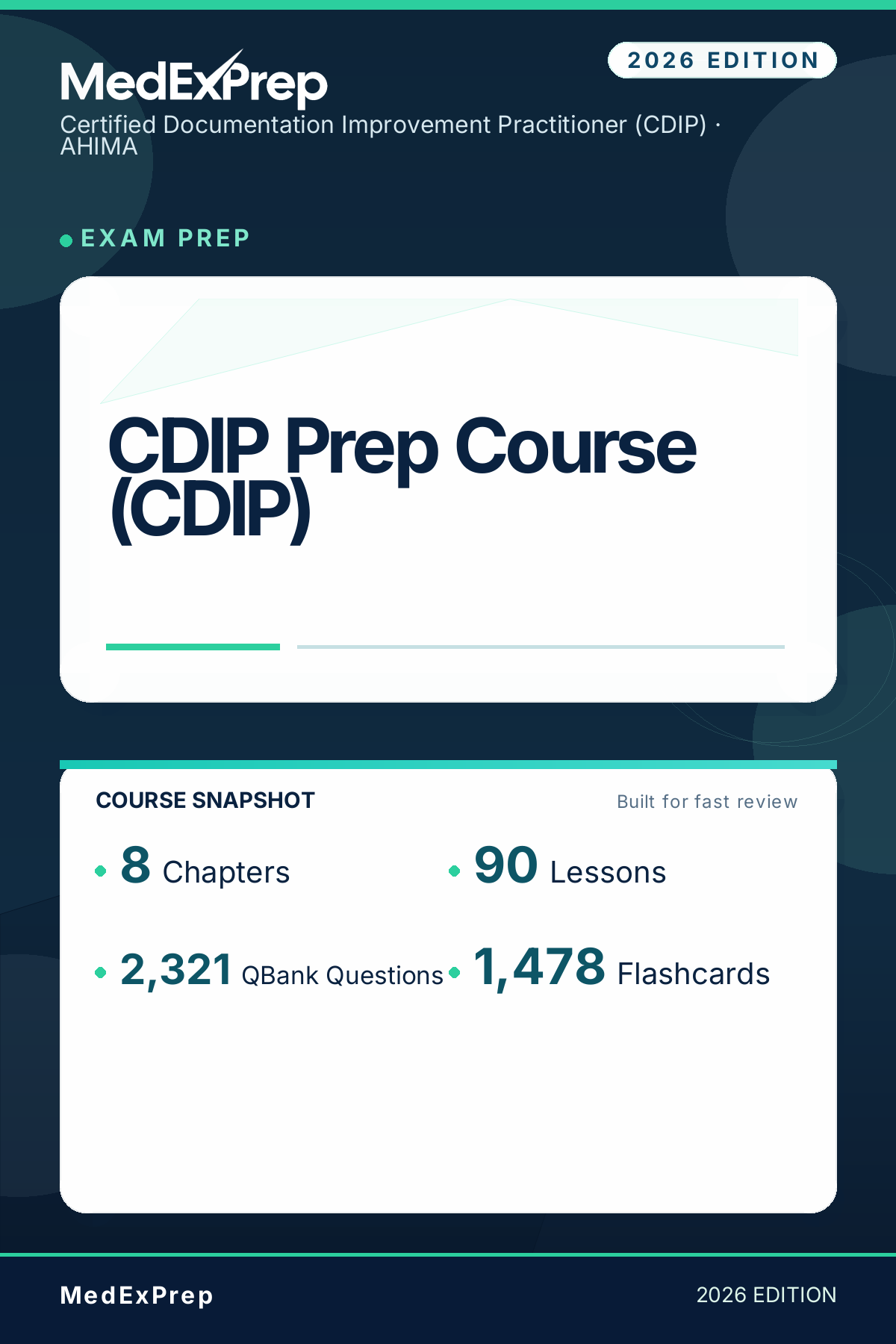
CDIP Prep Course (CDIP)
CDIP candidates, including inpatient clinical documentation integrity/documentation improvement professionals, coding professionals transitioning into CDI, nurses, HIM professionals, and other healthcare staff preparing for the AHIMA CDIP exam. Key goals: By the end of this course, learners will be able to:; Explain the purpose of the AHIMA CDIP exam and navigate the course’s transparent CDI prep framework, including how topics are organized when detailed official blueprint wording or weightings are not provided..
Exam: Certified Documentation Improvement Practitioner (CDIP) · Organization: AHIMA
Includes: Lessons + Flashcards + QBank
Audience: CDIP candidates, including inpatient clinical documentation integrity/documentation improvement professionals, coding professionals transitioning into CDI, nurses, HIM professionals, and other healthcare staff preparing for the AHIMA CDIP exam.
Goals:
- By the end of this course, learners will be able to:
- Explain the purpose of the AHIMA CDIP exam and navigate the course’s transparent CDI prep framework, including how topics are organized when detailed official blueprint wording or weightings are not provided.
- Master high-yield CDI concepts, definitions, and decision rules across core areas: CDI foundations, documentation quality, clinical indicators, compliant query practice, coding/reporting interface awareness, POA-sensitive thinking, reimbursement/quality impact, and CDI workflow/metrics.
- Apply CDI reasoning in realistic inpatient chart-review scenarios: identify the documentation question, extract key clinical facts, determine the controlling CDI/coding-reporting principle, decide whether clarification is justified, and verify compliance and role appropriateness.
- Distinguish clinically supported conditions from unsupported assumptions, documentation gaps from acceptable variation, compliant queries from leading/noncompliant queries, and documentation integrity goals from reimbursement-driven overreach.
- Use a consistent problem-solving framework for exam items: identify the task → extract key facts from the record → select the governing CDI principle/rule → decide the best next step → verify documentation support, compliance, and downstream impact.
- Build retrieval-ready memory using concise tables, indicator checklists, query decision pathways, POA reminders, severity/risk summaries, workflow maps, and spaced review summaries.
- Demonstrate readiness by completing self-checks and mini-assessments mapped to a transparent course framework with tags in the format D#: Objective -> Subskill.
- Coverage & Blueprint Mapping Requirements:
- Every chapter/section/subsection/topic must map to at least one framework tag in the format D#: Objective -> Subskill.
- Use this transparent course framework when detailed official blueprint text is not supplied:
- D1: CDI Foundations and Documentation Quality
- D2: Clinical Indicators and Record Review Analysis
- D3: Compliant Query Practice and Provider Communication
- D4: Coding/Reporting Interface and CDI Decision Support
- D5: Reimbursement, Quality, and Impact of Documentation
- D6: CDI Program Workflow, Metrics, and Operations
- For broad objectives, translate them into teachable subskills and label each consistently (for example, D2: Assess whether documentation is clinically supported -> Distinguish supported condition vs unsupported assumption).
- Ensure complete coverage: no domain/objective is left unmapped. If an official AHIMA detail is not provided, do not invent hidden blueprint content or weightings; instead, use learner-safe guidance and transparent mapping.
- Keep all content within the CDI candidate role: reviewing inpatient records, identifying documentation opportunities, interpreting chart evidence, supporting compliant provider clarification, and understanding documentation effects on coding, reimbursement, quality, and reporting without independently diagnosing conditions or directing treatment.
Access is granted immediately after purchase.