Description
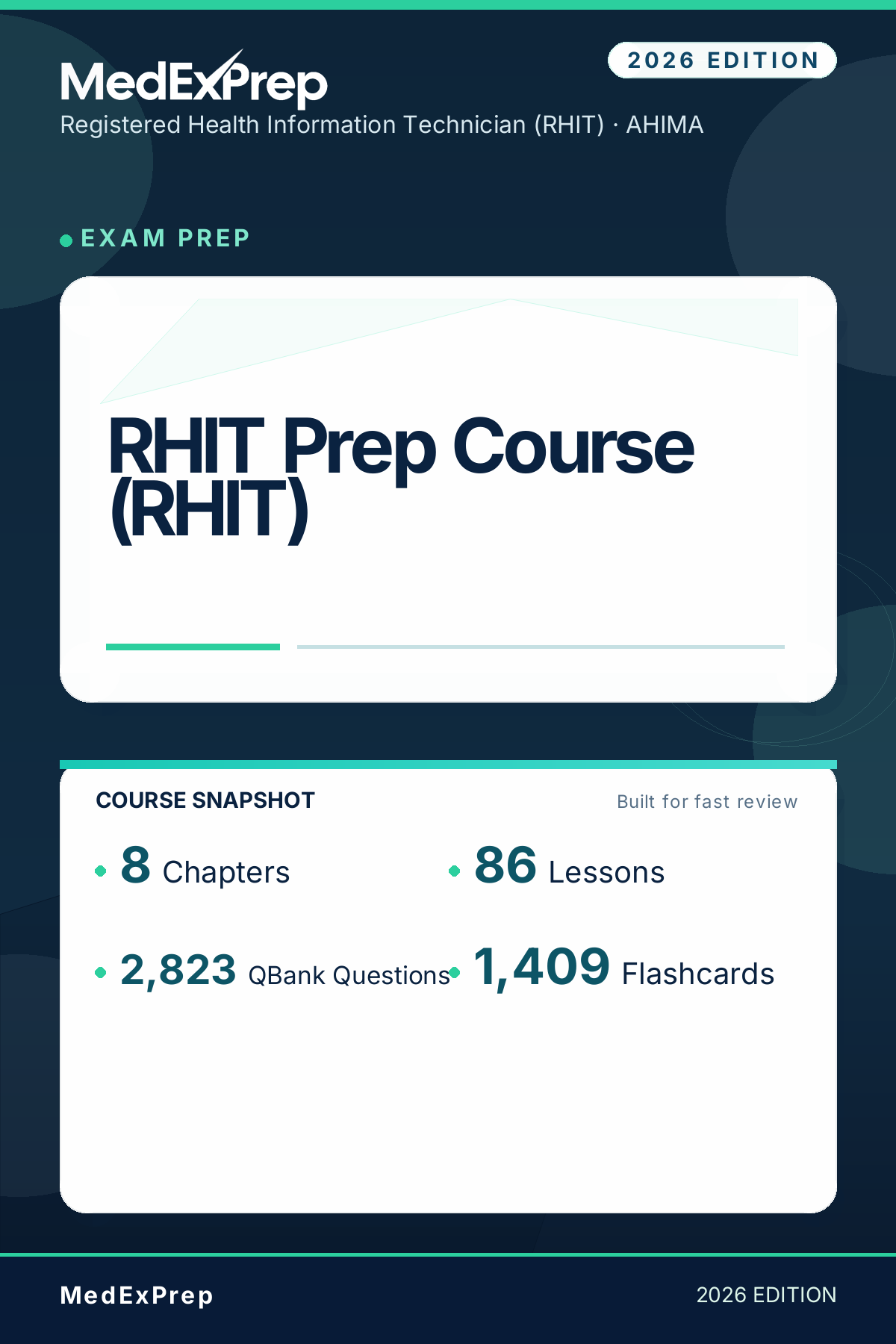
RHIT Prep Course (RHIT)
RHIT candidates preparing for the AHIMA Registered Health Information Technician exam, including health information students, recent graduates, and early-career HIM professionals seeking certification. Key goals: By the end of this course, learners will be able to:; Explain the AHIMA RHIT exam scope at a technician level and use published exam domains/objectives when available, without relying on invented weighting or unsupported blueprint detail..
Exam: Registered Health Information Technician (RHIT) · Organization: AHIMA
Includes: Lessons + Flashcards + QBank
Audience: RHIT candidates preparing for the AHIMA Registered Health Information Technician exam, including health information students, recent graduates, and early-career HIM professionals seeking certification.
Goals:
- By the end of this course, learners will be able to:
- Explain the AHIMA RHIT exam scope at a technician level and use published exam domains/objectives when available, without relying on invented weighting or unsupported blueprint detail.
- Master the high-yield concepts, definitions, standards, and workflow rules relevant to RHIT preparation across health data content and structure, documentation integrity, data quality, privacy/security/confidentiality, release of information, health information technologies, information governance support, revenue cycle support, coding-related concepts, regulatory/accreditation basics, and operational HIM practice.
- Apply concepts in realistic RHIT-style scenarios involving record review, disclosure decisions, data handling, documentation issues, workflow sequencing, reporting support, and compliance-aware judgment.
- Solve common logic, sequencing, validation, and data-handling tasks accurately when applicable, showing stepwise reasoning: identify the task → extract key facts → select the governing rule, standard, or workflow → execute → verify.
- Distinguish common distractors and boundary cases frequently tested in RHIT-style items, especially policy-vs-law confusion, requester-authority confusion, documentation-status confusion, data-source mismatch, and choices that exceed technician scope.
- Build retrieval-ready memory using concise tables, checklists, terminology contrasts, process maps, and spaced review summaries tailored to technician-level HIM practice.
- Demonstrate readiness through self-check questions and mini-assessments mapped to each exam area, with rationales that explain the governing rule/workflow and when local law, payer requirements, care setting, or organizational policy may vary.
- Coverage & Blueprint Mapping Requirements:
- Every chapter, section, subsection, topic, example, and assessment item must map to at least one RHIT exam domain/objective or a defensible teachable subskill derived from published AHIMA exam areas.
- When official blueprint language is broad, translate it into teachable subskills using consistent tags in this format: DOMAIN: Objective → Subskill.
- Ensure complete coverage across all major RHIT-relevant areas: data content/structure, documentation integrity, data quality, information governance support, health record systems and technologies, interoperability/data exchange concepts, privacy/security/confidentiality, release of information, revenue cycle support, reimbursement support, coding-related concepts, regulatory/accreditation basics, quality/reporting support, operational workflows, and professional practice within RHIT scope.
- No published exam area should be left unmapped. If a detail is uncertain or jurisdiction-dependent, provide learner-safe guidance such as: follow applicable law, regulation, payer rules, and organizational policy; local protocols vary.
- Keep all content within entry-level RHIT candidate scope; avoid administrator-only strategy, executive governance decisions, advanced legal interpretation, and vendor-specific software trivia unless framed as general HIM system literacy.
Access is granted immediately after purchase.