Description
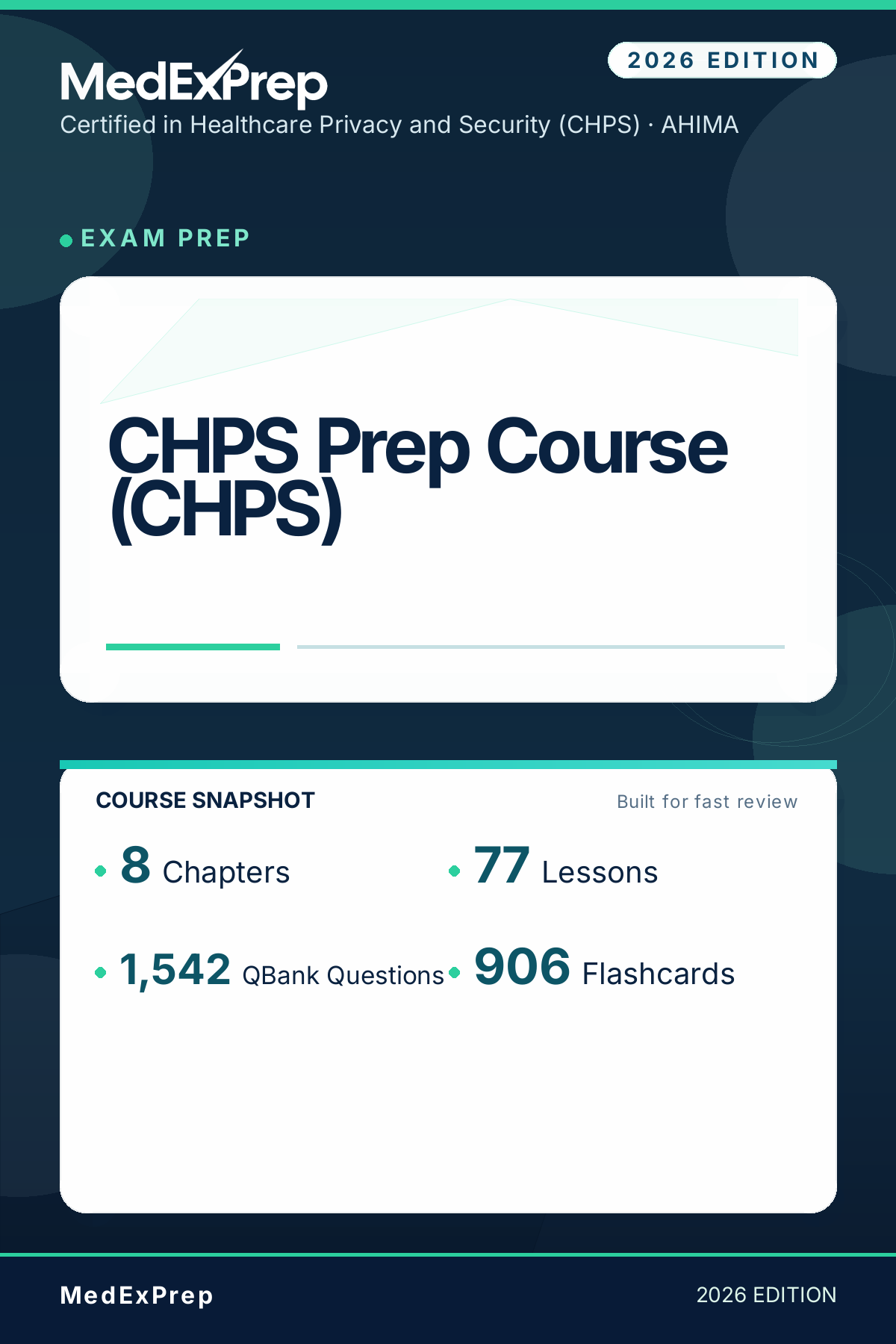
CHPS Prep Course (CHPS)
CHPS candidates preparing for the AHIMA Certified in Healthcare Privacy and Security (CHPS) exam, including health information professionals, privacy officers, security officers, compliance staff, HIM leaders, and related healthcare workforce members involved in privacy, confidentiality, security, risk management, incident response, and information governance in healthcare settings. Key goals: By the end of this course, learners will be able to:; Explain the CHPS exam-relevant competency areas and organize study using clearly labeled DOMAIN: Objective -> Subskill mappings rather than invented official blueprint details or unsupported weightings..
Exam: Certified in Healthcare Privacy and Security (CHPS) · Organization: AHIMA
Includes: Lessons + Flashcards + QBank
Audience: CHPS candidates preparing for the AHIMA Certified in Healthcare Privacy and Security (CHPS) exam, including health information professionals, privacy officers, security officers, compliance staff, HIM leaders, and related healthcare workforce members involved in privacy, confidentiality, security, risk management, incident response, and information governance in healthcare settings.
Goals:
- By the end of this course, learners will be able to:
- Explain the CHPS exam-relevant competency areas and organize study using clearly labeled DOMAIN: Objective -> Subskill mappings rather than invented official blueprint details or unsupported weightings.
- Master high-yield healthcare privacy, confidentiality, security, compliance, risk management, incident response, workforce accountability, and information governance concepts relevant to the CHPS role.
- Apply privacy and security principles in realistic healthcare scenarios involving use/disclosure decisions, access management, safeguards, complaints, incidents, breach-response considerations, audits, vendors, and leadership reporting.
- Use a consistent decision framework: identify the task -> extract key facts -> select the governing rule, principle, or policy direction -> execute the best next step -> verify documentation, escalation, mitigation, and follow-up.
- Distinguish closely related but testable concepts such as privacy vs security, incident vs breach, access vs authorization, mitigation vs notification, policy requirement vs operational best practice, and technical issue vs governance/accountability issue.
- Perform practical logic and prioritization tasks relevant to the CHPS role, including risk identification, control selection, response sequencing, documentation expectations, and defensible next-step decision-making.
- Recognize common distractors in CHPS-style questions, especially premature escalation, overbroad disclosure, unsupported legal conclusions, weak documentation, failure to apply minimum necessary, and actions inconsistent with role-based access or monitoring expectations.
- Build retrieval-ready memory using concise tables, decision checklists, comparison charts, incident/risk frameworks, and spaced review summaries tailored to healthcare privacy and security practice.
- Demonstrate readiness through self-check questions and mini-assessments mapped to CHPS-relevant competency clusters and subskills.
- Coverage & Blueprint Mapping Requirements:
- Every chapter, section, subsection, and topic must map to at least one competency cluster using a consistent tag in the form DOMAIN: Objective -> Subskill.
- Do not invent official AHIMA blueprint names, wording, or weightings if not explicitly provided. When official blueprint language is broad or unavailable, translate content into defensible CHPS-relevant competency clusters and teachable subskills.
- Ensure complete coverage across privacy program management, security program management, compliance and regulatory alignment, risk management, incident and breach management, information governance and data stewardship, workforce management and education, and leadership/organizational governance.
- If a legal, regulatory, or organizational detail varies by jurisdiction or institution, provide learner-safe guidance such as: local policy and applicable law may vary; confirm with your organization and current governing requirements.
- Keep all content within the judgment, prioritization, documentation, oversight, and operational decision-making responsibilities of a healthcare privacy and security professional; avoid highly technical engineering detail or software-specific training unless directly needed to explain CHPS-relevant concepts.
Access is granted immediately after purchase.