Description
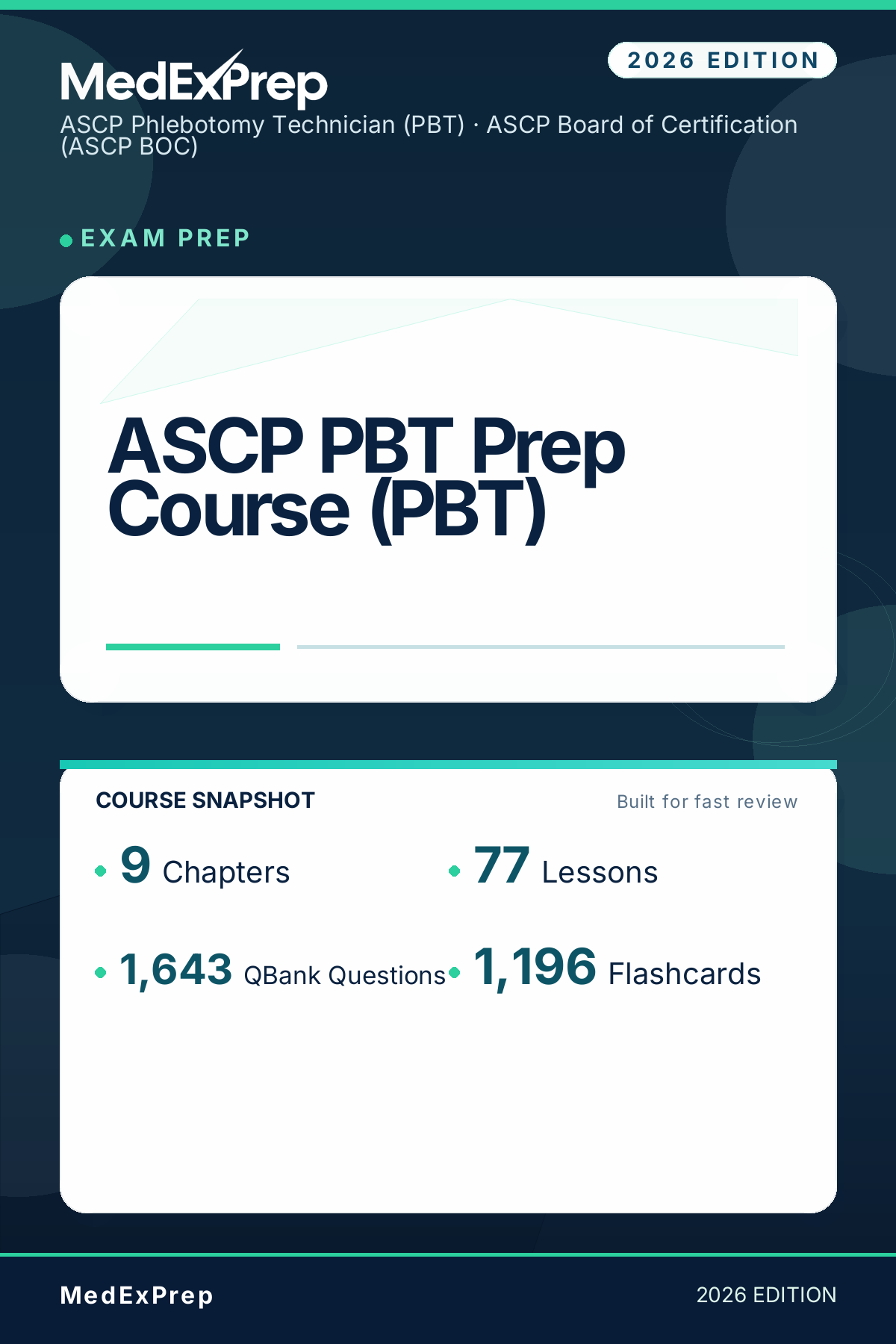
ASCP PBT Prep Course (PBT)
Learners preparing for the ASCP Board of Certification Phlebotomy Technician (PBT) exam, including phlebotomy students, recent program graduates, and working phlebotomy personnel seeking certification. Target the entry-level to early-career phlebotomy technician role and keep all teaching, examples, and questions within phlebotomy scope of practice. Key goals: By the end of this course, learners will be able to:; Explain the major ASCP PBT-relevant competency areas for phlebotomy practice and how course topics map to those areas, without asserting unverified official blueprint weights..
Exam: ASCP Phlebotomy Technician (PBT) · Organization: ASCP Board of Certification (ASCP BOC)
Includes: Lessons + Flashcards + QBank
Audience: Learners preparing for the ASCP Board of Certification Phlebotomy Technician (PBT) exam, including phlebotomy students, recent program graduates, and working phlebotomy personnel seeking certification. Target the entry-level to early-career phlebotomy technician role and keep all teaching, examples, and questions within phlebotomy scope of practice.
Goals:
- By the end of this course, learners will be able to:
- Explain the major ASCP PBT-relevant competency areas for phlebotomy practice and how course topics map to those areas, without asserting unverified official blueprint weights.
- Master the high-yield concepts, definitions, rules, and procedures for patient identification, order review, patient preparation, specimen collection, specimen handling, preanalytical quality, safety, and professional communication.
- Apply phlebotomy concepts in realistic exam-style scenarios focused on the safest and most appropriate next step, error prevention, specimen acceptability, and scope-appropriate escalation.
- Perform phlebotomy reasoning using a consistent framework: identify the task → extract key facts → select the governing rule/procedure → execute → verify patient safety and specimen integrity.
- Distinguish common distractors, misconceptions, and boundary cases frequently tested in phlebotomy, including order-of-draw errors, wrong tube/additive selection, labeling mistakes, contamination risks, collection complications, and out-of-scope actions.
- Solve stepwise timing, sequencing, and logic tasks when relevant to phlebotomy workflow, specimen handling, transport, and special collection requirements, showing reasoning clearly.
- Build retrieval-ready memory using concise tables, checklists, algorithms, order-of-draw summaries, tube/additive matchups, rejection criteria, and spaced review summaries.
- Demonstrate readiness through self-checks and mini-assessments mapped to phlebotomy-relevant domains such as Patient ID, Preparation, and Orders; Specimen Collection Procedures; Specimen Handling, Transport, and Processing; Specimen Integrity and Preanalytical Errors; Safety and Infection Control; Complications, Special Collections, and Difficult Draws; and Quality, Professionalism, and Regulatory-Aware Practice.
- Coverage & Blueprint Mapping Requirements:
- Every chapter, section, subsection, and topic must map to at least one phlebotomy-relevant domain, objective, or subskill.
- Use consistent learner-facing mapping tags in the format DOMAIN: Objective → Subskill.
- Ensure complete coverage across the course, including patient identification and labeling, patient preparation, venipuncture, capillary collection, equipment and site selection, order of draw, tube/additive matching, specimen handling and transport, specimen integrity and rejection, contamination prevention, safety and infection control, collection complications, special collections, professionalism, confidentiality, documentation, and scope-aware escalation.
- When blueprint language is broad, translate it into teachable phlebotomy subskills rather than guessing hidden exam details.
- Do not invent official ASCP blueprint percentages, item counts, scoring rules, or unpublished specifications.
- If a procedural detail may vary by institution or clinical site, use learner-safe wording such as: “Local protocols may vary; confirm with your institution or clinical site.”
- Keep all instruction within phlebotomy technician scope of practice; do not teach diagnosing disease, independent treatment decisions, or advanced analytic-phase laboratory responsibilities beyond specimen suitability and routing implications.
Access is granted immediately after purchase.