Description
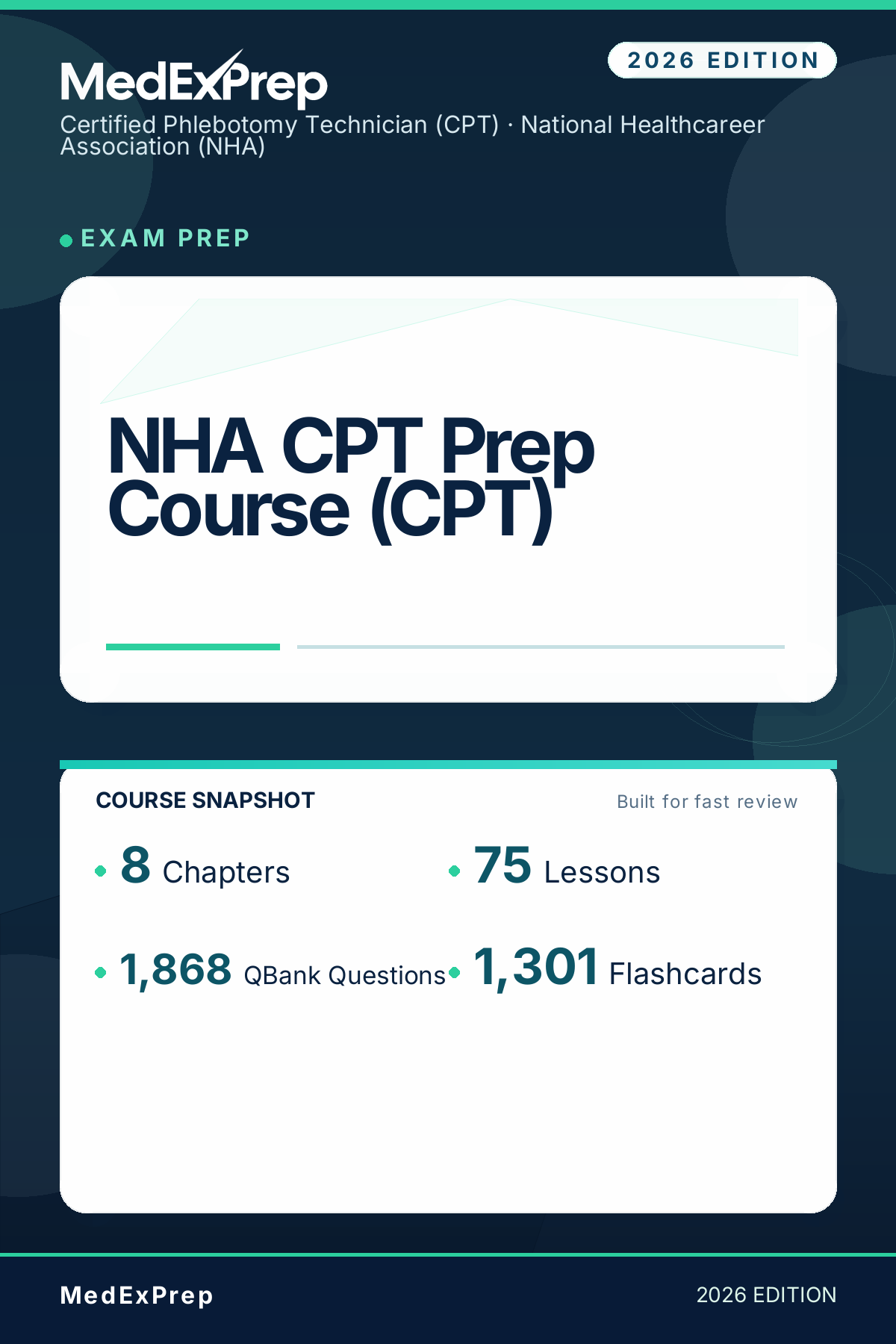
NHA CPT Prep Course (CPT)
Learners preparing for the NHA Certified Phlebotomy Technician (CPT) exam, including phlebotomy students, recent program graduates, allied health learners, and entry-level candidates seeking certification. Use the perspective of an entry-level phlebotomy technician candidate preparing to perform safe, standard specimen collection and handling tasks in routine healthcare settings. Key goals: By the end of this course, learners will be able to:; Explain the exam competency areas used for CPT preparation and organize study by major phlebotomy practice areas; confirm exact official wording and weighting in current NHA candidate materials..
Exam: Certified Phlebotomy Technician (CPT) · Organization: National Healthcareer Association (NHA)
Includes: Lessons + Flashcards + QBank
Audience: Learners preparing for the NHA Certified Phlebotomy Technician (CPT) exam, including phlebotomy students, recent program graduates, allied health learners, and entry-level candidates seeking certification. Use the perspective of an entry-level phlebotomy technician candidate preparing to perform safe, standard specimen collection and handling tasks in routine healthcare settings.
Goals:
- By the end of this course, learners will be able to:
- Explain the exam competency areas used for CPT preparation and organize study by major phlebotomy practice areas; confirm exact official wording and weighting in current NHA candidate materials.
- Master the high-yield concepts, definitions, safety rules, and workflow steps for entry-level phlebotomy practice, including patient identification, order verification, infection control, specimen collection, specimen labeling, handling, transport, and professionalism.
- Apply concepts in realistic exam-style scenarios involving the safest and most appropriate next step for routine venipuncture, capillary puncture, difficult collections, special collections, and specimen handling decisions.
- Use tube/additive knowledge, order-of-draw rules, site-selection criteria, and specimen integrity principles accurately in common test situations.
- Prevent and recognize preanalytical errors such as misidentification, incorrect tube selection, improper sequencing, hemolysis, contamination, labeling mistakes, and transport/processing problems, then choose the correct corrective action within role.
- Distinguish common distractors, misconceptions, and boundary cases frequently tested in phlebotomy certification prep, especially errors involving patient ID, labeling timing, order verification, tourniquet use, site restrictions, and actions outside entry-level scope.
- Use a consistent problem-solving framework: identify the task → verify patient and order → assess safety issues and contraindications → select equipment and site → perform and sequence steps correctly → label and handle the specimen → verify specimen quality and determine the next action.
- Build retrieval-ready memory using concise tables, checklists, order charts, tube/additive association summaries, and spaced review aids.
- Demonstrate readiness through self-check questions and mini-assessments mapped to teachable competency tags.
- Coverage & Blueprint Mapping Requirements:
- Every chapter, section, subsection, and topic must map to at least one exam-relevant competency tag.
- Do not claim unverified official NHA blueprint names or percentages; instead, translate broad CPT prep coverage into teachable subskills using a consistent tag format such as “COMPETENCY: Topic → Subskill.”
- Ensure complete coverage across these major areas: safety/infection control/quality; patient identification, preparation, and communication; equipment, tube/additive knowledge, site selection, and routine venipuncture; capillary and special collections; specimen labeling, handling, processing, storage, and transport; professionalism, documentation, role boundaries, and escalation.
- Ensure no major phlebotomy competency area is left unmapped; if a detail is uncertain or institution-specific, use learner-safe guidance such as “Follow current facility policy” or “Local protocols vary; confirm with your institution.”
- Keep all teaching and assessment within entry-level phlebotomy scope; emphasize safe specimen collection, preanalytical quality, and appropriate escalation rather than diagnosis or treatment.
Access is granted immediately after purchase.