Description
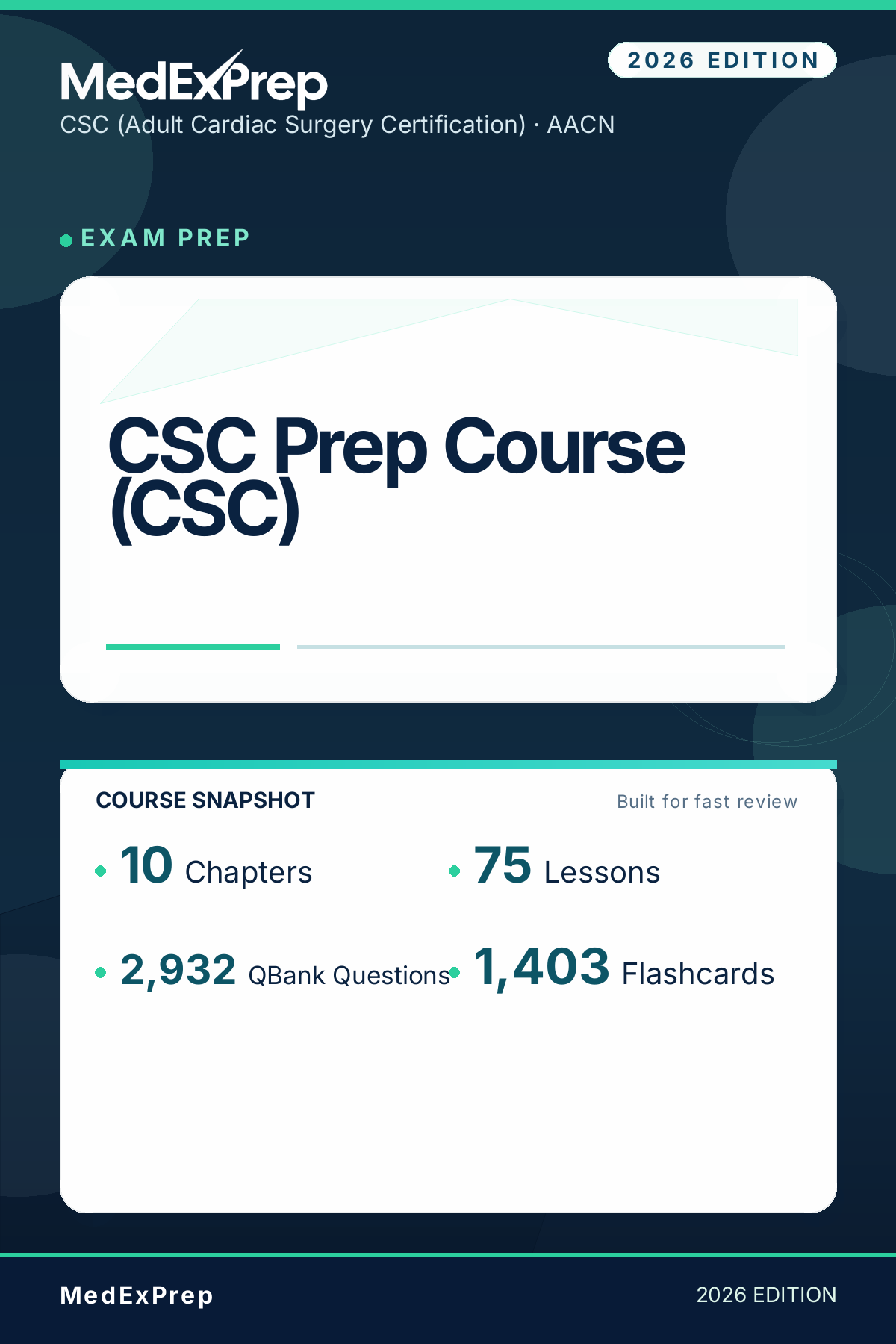
CSC Prep Course (CSC)
Registered nurses and other eligible critical care professionals preparing for the AACN CSC exam, especially clinicians caring for adult cardiac surgery patients in high-acuity, step-down, and intensive care settings. Key goals: By the end of this course, learners will be able to:; Explain the AACN CSC exam focus areas for adult cardiac surgery critical care and how course topics map to domains/subskills, without assuming unverified official weighting..
Exam: CSC (Adult Cardiac Surgery Certification) · Organization: AACN
Includes: Lessons + Flashcards + QBank
Audience: Registered nurses and other eligible critical care professionals preparing for the AACN CSC exam, especially clinicians caring for adult cardiac surgery patients in high-acuity, step-down, and intensive care settings.
Goals:
- By the end of this course, learners will be able to:
- Explain the AACN CSC exam focus areas for adult cardiac surgery critical care and how course topics map to domains/subskills, without assuming unverified official weighting.
- Master the high-yield concepts, definitions, physiologic relationships, and bedside decision rules relevant to adult postoperative cardiac surgery care.
- Apply concepts in realistic AACN CSC-style scenarios involving adult cardiac surgery ICU patients, including prioritization, data interpretation, complication differentiation, and best-next-action reasoning.
- Interpret hemodynamic, rhythm, ventilatory, laboratory, chest tube, device, and trend data in context to identify the most likely physiologic problem and safest immediate response.
- Solve common calculation and logic tasks accurately when applicable, showing steps and avoiding shortcuts that hide reasoning.
- Distinguish common distractors, misconceptions, and boundary cases frequently tested in adult cardiac surgery critical care, such as bleeding vs tamponade vs low cardiac output, rhythm problems vs perfusion problems, and pulmonary vs cardiac vs neurologic vs renal causes of deterioration.
- Use a consistent problem-solving framework: identify the task → extract key facts and trends → identify the likely postoperative physiologic issue or priority → select the best intervention/monitoring/escalation step → verify expected response and reassess.
- Build retrieval-ready memory using concise tables, checklists, algorithms, hemodynamic comparison charts, pacing/device summaries, and spaced review recaps.
- Demonstrate readiness by completing self-checks and mini-assessments mapped to every domain and subskill relevant to adult cardiac surgery CSC preparation.
- Coverage and blueprint mapping requirements:
- Every chapter, section, subsection, and topic must map to at least one domain and one subskill.
- Use this working domain structure unless a more current public AACN framework is provided: Preoperative and Procedure Context; Immediate Postoperative Assessment; Hemodynamics and Perfusion; Pharmacology and Vasoactive Support; Rhythms and Temporary Pacing; Mechanical Support and Devices; Pulmonary and Ventilatory Care; Bleeding, Tamponade, and Coagulation; Neurologic Care; Renal, Electrolyte, and Metabolic Issues; Infection and Mediastinal/Wound Concerns; Procedure-Specific and Structural Considerations; Professional Judgment and Safety.
- When blueprint language is broad, translate it into teachable subskills and label them consistently as DOMAIN: Subskill.
- Ensure complete coverage across the adult cardiac surgery continuum relevant to CSC prep, including postoperative assessment, hemodynamics, vasoactive support, temporary pacing, support devices, pulmonary care, bleeding/coagulation, neurologic issues, renal/metabolic issues, infection concerns, procedure-specific priorities, and safety/escalation.
- Do not invent official AACN blueprint details or weights. If a detail is uncertain, provide learner-safe guidance such as “Local protocols vary; confirm with your institution.”
- Keep all content within the adult cardiac surgery bedside critical care perspective; de-emphasize pediatric content, non-cardiac ICU topics not tied to cardiac surgery, and institution-specific workflows presented as universal facts.
Access is granted immediately after purchase.