Description
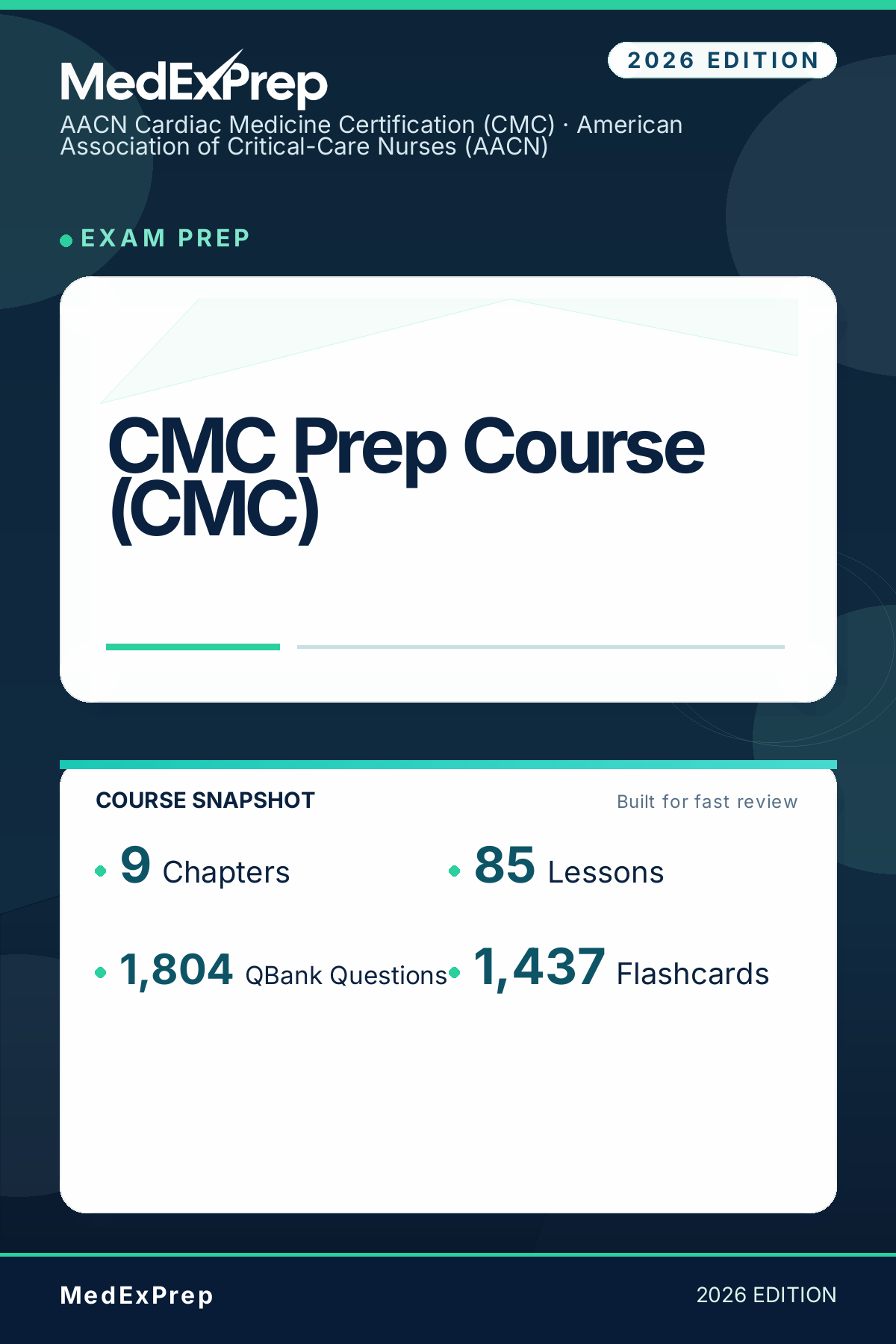
CMC Prep Course (CMC)
Registered nurses and advanced practice learners preparing for the AACN CMC exam, especially clinicians caring for acutely and critically ill adult patients with complex cardiac conditions in acute care, telemetry, progressive care, emergency, and critical care settings. Key goals: By the end of this course, learners will be able to:; Explain the AACN CMC exam focus areas/competency domains and organize study topics by domain emphasis when available..
Exam: AACN Cardiac Medicine Certification (CMC) · Organization: American Association of Critical-Care Nurses (AACN)
Includes: Lessons + Flashcards + QBank
Audience: Registered nurses and advanced practice learners preparing for the AACN CMC exam, especially clinicians caring for acutely and critically ill adult patients with complex cardiac conditions in acute care, telemetry, progressive care, emergency, and critical care settings.
Goals:
- By the end of this course, learners will be able to:
- Explain the AACN CMC exam focus areas/competency domains and organize study topics by domain emphasis when available.
- Master the high-yield concepts, definitions, and clinical rules relevant to adult cardiac medicine nursing, including cardiovascular anatomy/physiology, ischemia/infarction, heart failure syndromes, valvular/myocardial/pericardial disorders, dysrhythmias, diagnostics, hemodynamics, pharmacology, monitoring, devices, and complication recognition.
- Apply concepts in realistic AACN-style exam scenarios emphasizing nursing judgment, prioritization, hemodynamic interpretation, dysrhythmia recognition, medication safety, and the most appropriate nursing action or escalation step.
- Solve common calculation/logic tasks accurately when applicable, showing steps and clinical interpretation rather than using shortcuts that hide reasoning.
- Distinguish common distractors, misconceptions, look-alike rhythms/findings, and boundary cases frequently tested in adult cardiac medicine nursing.
- Use a consistent problem-solving framework: identify the task -> extract key facts -> determine stability/perfusion risk -> select the governing clinical rule -> choose the safest in-scope nursing action -> verify.
- Build retrieval-ready memory using concise tables, rhythm/hemodynamic interpretation frameworks, checklists, and spaced review summaries.
- Demonstrate readiness by completing self-check questions and mini-assessments mapped to each course domain/subskill.
- Coverage & Blueprint Mapping Requirements:
- Every chapter/section/subsection/topic must map to at least one exam domain/objective or, if no official blueprint detail is provided, to a consistent course tag in the format DOMAIN: Objective -> Subskill.
- Use broad but teachable domain labels appropriate to AACN CMC preparation, such as cardiovascular foundations, assessment/monitoring, acute coronary syndromes, heart failure/cardiogenic shock, valvular-myocardial-pericardial disorders, dysrhythmias/conduction, hemodynamics, pharmacology, devices/therapies, diagnostics/labs, and complications/prioritization.
- Ensure complete coverage: no domain/objective is left unmapped; if official weighting is unavailable or uncertain, do not invent it-instead note that weighting may vary and maintain balanced coverage across high-yield cardiac medicine nursing topics.
- Keep all teaching within the adult AACN CMC candidate role: assessment, monitoring, interpretation, prioritization, implementation of ordered therapies, patient safety surveillance, education, and escalation/collaboration-not independent prescribing, physician-level diagnosis, invasive procedural performance, or provider-only decision-making.
- When institution-specific thresholds, titration rules, or device protocols may vary, give learner-safe guidance such as "Local protocols vary; confirm with your institution" rather than guessing specifics.
Access is granted immediately after purchase.