Description
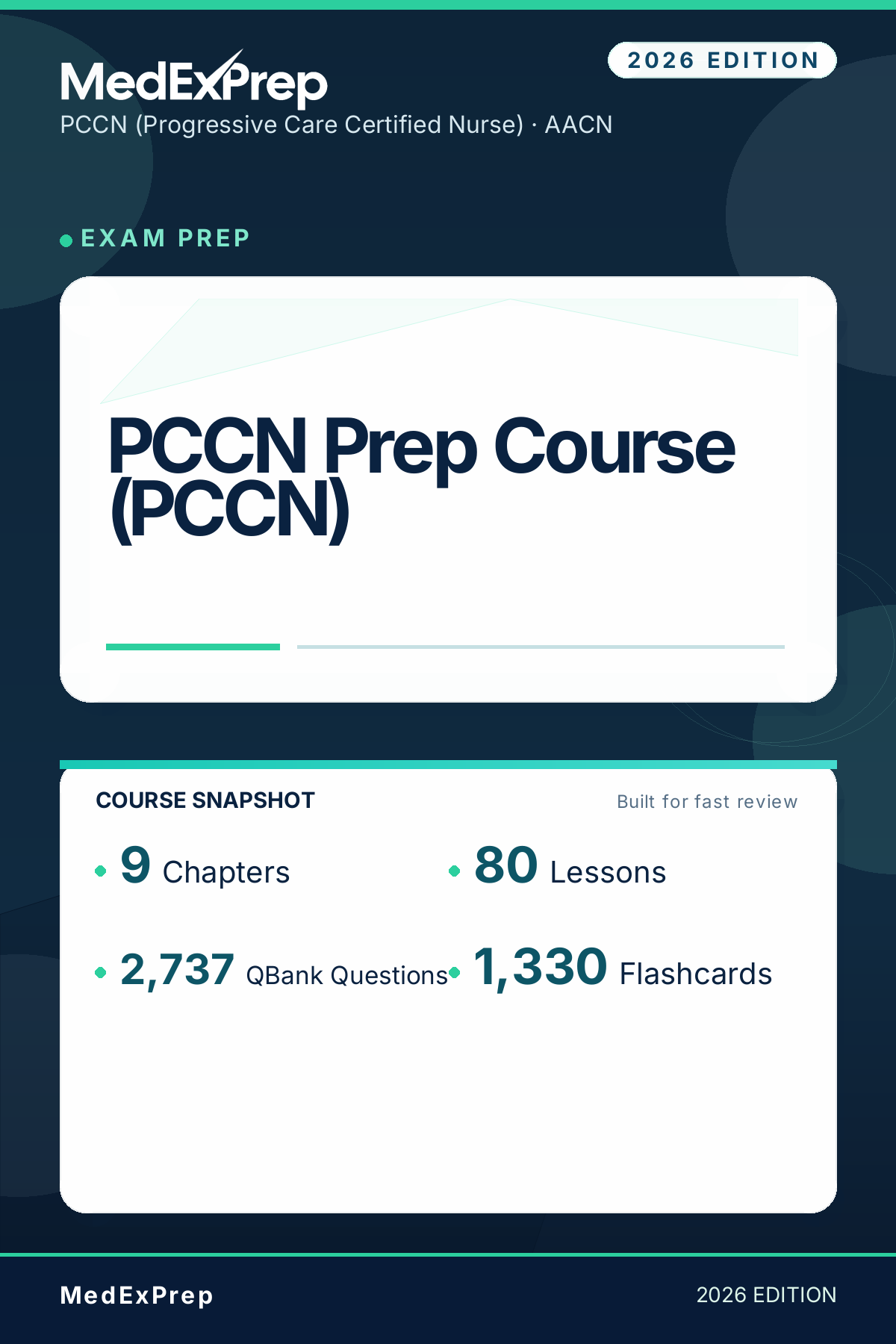
PCCN Prep Course (PCCN)
Registered nurses preparing for the AACN PCCN exam, especially adult progressive care nurses working in step-down, telemetry, intermediate care, direct observation, and similar progressive care settings. Learners are practicing within adult RN scope and need exam-focused review of clinical judgment, patient assessment, monitoring, recognition of deterioration, pharmacology, prioritization, escalation, and professional caring/ethical practice. Key goals: By the end of this course, learners will be able to:; Explain the AACN PCCN exam focus areas and organize studying by exam-relevant domains and subskills without relying on invented blueprint details or unofficial weighting..
Exam: PCCN (Progressive Care Certified Nurse) · Organization: AACN
Includes: Lessons + Flashcards + QBank
Audience: Registered nurses preparing for the AACN PCCN exam, especially adult progressive care nurses working in step-down, telemetry, intermediate care, direct observation, and similar progressive care settings. Learners are practicing within adult RN scope and need exam-focused review of clinical judgment, patient assessment, monitoring, recognition of deterioration, pharmacology, prioritization, escalation, and professional caring/ethical practice.
Goals:
- By the end of this course, learners will be able to:
- Explain the AACN PCCN exam focus areas and organize studying by exam-relevant domains and subskills without relying on invented blueprint details or unofficial weighting.
- Master the high-yield adult progressive care concepts, definitions, monitoring patterns, abnormal findings, safety principles, and nursing responses commonly tested on the PCCN exam.
- Apply concepts in realistic PCCN-style scenarios involving adult step-down, telemetry, and intermediate-care patients, including prioritization, trend interpretation, recognition of deterioration, and safest next-step decisions within RN scope.
- Interpret clinically relevant data accurately when applicable, including vital-sign trends, ECG/telemetry features, oxygenation/ventilation indicators, ABGs, laboratory abnormalities, fluid/electrolyte patterns, and response-to-therapy patterns; show steps for calculations and multi-step reasoning.
- Distinguish common distractors, misconceptions, and boundary cases frequently tested in progressive care nursing, especially unstable vs stable findings, urgent vs non-urgent cues, look-alike conditions, and actions that exceed RN scope or progressive-care context.
- Use a consistent problem-solving framework: identify the task → extract key patient clues → determine urgency/stability → select the governing nursing principle/protocol/safety rule → execute the safest best answer → verify fit with adult progressive care RN scope.
- Build retrieval-ready memory using concise tables, rhythm-recognition checklists, escalation frameworks, pharmacology summaries, and spaced review recaps tailored to adult progressive care nursing.
- Demonstrate readiness through self-check questions and mini-assessments mapped to explicit competency tags in the format DOMAIN: Objective → Subskill.
- Coverage & Blueprint Mapping Requirements:
- Every chapter/section/subsection/topic must map to at least one exam-relevant competency tag, even if the official blueprint language is broad or incomplete.
- Use published AACN PCCN domains/categories when available; otherwise translate broad PCCN-relevant areas into teachable subskills with consistent labels such as DOMAIN: Clinical Judgment → Recognition of deterioration and escalation.
- Ensure complete coverage across adult progressive care content areas, including clinical judgment; cardiovascular; pulmonary; neurologic; renal/fluid/electrolyte/acid-base; endocrine/metabolic; gastrointestinal/hepatic/nutrition; hematology/immunology/infection; multisystem/shock/sepsis; pharmacology; and professional caring/ethical practice.
- Do not invent official percentages, unpublished blueprint details, or institution-specific rules as universal facts.
- When details vary by institution, device, or protocol, write learner-safe guidance such as “Follow your institution’s protocol.”
- Keep content within adult progressive care RN scope: emphasize recognition, monitoring, first-line nursing action, prioritization, communication, patient safety, and escalation rather than independent provider-level management or ICU-only procedural detail.
- If exact blueprint wording or weighting is uncertain, include learner-facing framing that weighting may vary and ensure coverage through explicit mapping plus gap-safe subskill organization.
Access is granted immediately after purchase.