Description
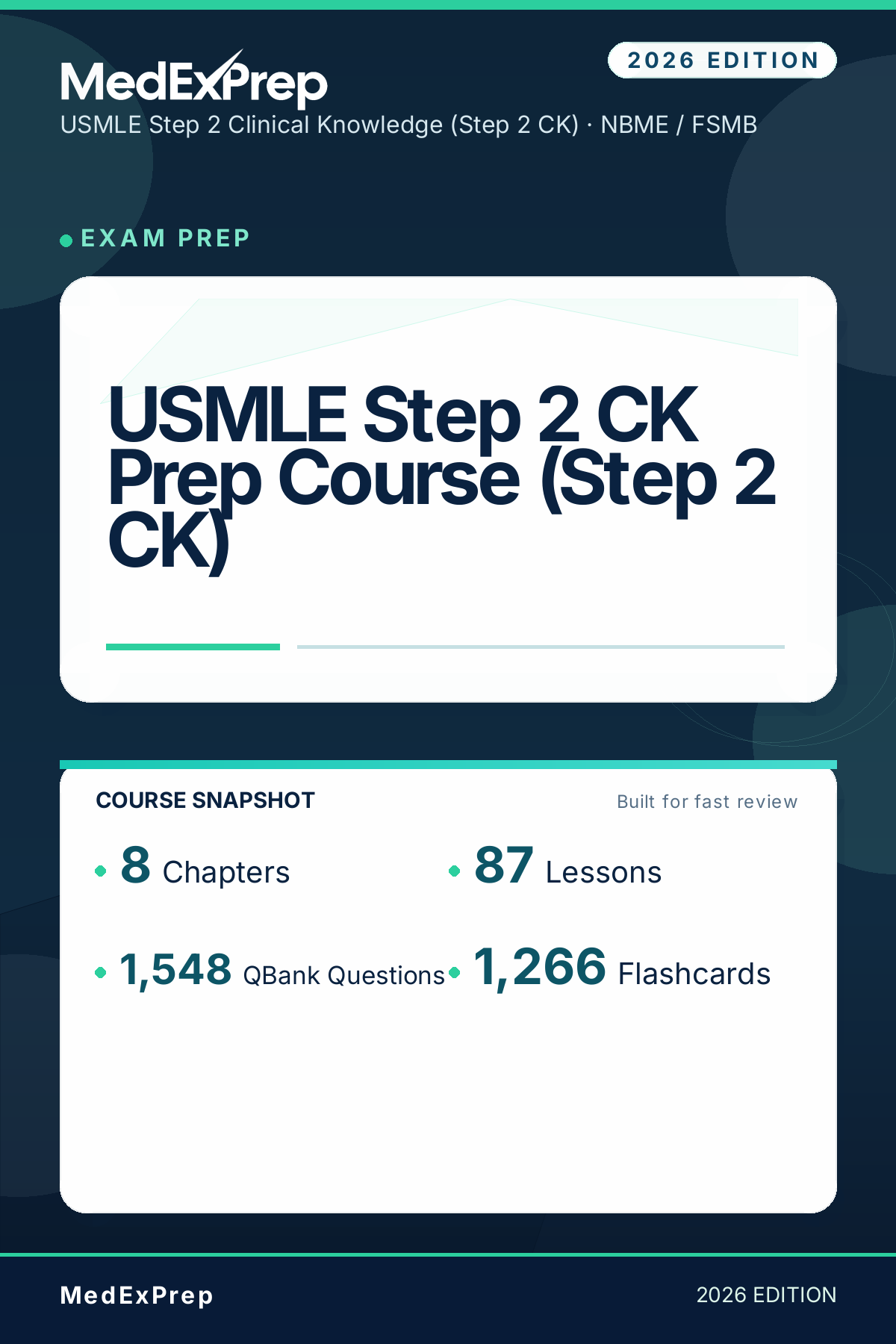
USMLE Step 2 CK Prep Course (Step 2 CK)
Medical students and other physician-licensure candidates preparing for USMLE Step 2 CK: a clerkship-style clinical knowledge exam focused on supervised patient-care decisions across inpatient, outpatient, emergency, perioperative, obstetric, pediatric, psychiatric, preventive, ethics, and communication settings. Key goals: By the end of this course, learners will be able to:; Explain the broad publicly described Step 2 CK content areas and candidate role without claiming unpublished blueprint percentages or proprietary weighting details..
Exam: USMLE Step 2 Clinical Knowledge (Step 2 CK) · Organization: NBME / FSMB
Includes: Lessons + Flashcards + QBank
Audience: Medical students and other physician-licensure candidates preparing for USMLE Step 2 CK: a clerkship-style clinical knowledge exam focused on supervised patient-care decisions across inpatient, outpatient, emergency, perioperative, obstetric, pediatric, psychiatric, preventive, ethics, and communication settings.
Goals:
- By the end of this course, learners will be able to:
- Explain the broad publicly described Step 2 CK content areas and candidate role without claiming unpublished blueprint percentages or proprietary weighting details.
- Master high-yield clinical presentations, illness scripts, diagnostic criteria, initial stabilization priorities, workup pathways, first-line management, contraindications, complications, prevention, and follow-up across core clerkship disciplines.
- Apply concepts in realistic Step 2 CK-style single-best-answer clinical vignettes that require multi-step reasoning, triage, sequencing, interpretation of history/exam/labs/imaging/ECG, and selection of the most appropriate next step.
- Distinguish closely related diagnoses, common distractors, management traps, and boundary cases frequently tested in supervised clinician decision-making.
- Use a consistent clinical reasoning framework: identify the task → determine acuity/stability → extract key facts → select the governing clinical principle → choose the most appropriate next step → verify safety, contraindications, and follow-up.
- Accurately solve calculation and logic tasks when relevant (for example acid-base interpretation, fluid/electrolyte reasoning, epidemiology basics, medication or preventive decision logic) with steps shown clearly.
- Build retrieval-ready memory using concise illness scripts, comparison tables, management algorithms, preventive care checklists, and spaced review summaries.
- Demonstrate readiness through self-check questions and mini-assessments mapped to explicit course domains and subskills.
- Coverage & Blueprint Mapping Requirements:
- Map every chapter, section, subsection, and topic to at least one explicit Step 2 CK preparation domain/subskill using a consistent format: SYSTEM/SETTING: Topic → Subskill.
- Because public Step 2 CK guidance is broad, translate coverage into teachable subskills across: Internal Medicine, Surgery & Perioperative Care, Pediatrics, Obstetrics & Gynecology, Psychiatry, Family Medicine & Ambulatory Care, Emergency Care & Critical Decision-Making, Ethics/Communication/Patient Safety, and Preventive Medicine & Population Health.
- Ensure complete coverage across these domains, including diagnosis, evaluation, stabilization, treatment, monitoring, prevention, prognosis, ethics, communication, and safe disposition.
- Keep content at the level of a supervised clinician-in-training: recognize emergencies, start first-line stabilization and treatment, choose appropriate initial tests, know when consultation/admission/escalation is required, and avoid requiring independent attending-level specialist judgment.
- Do not invent official unpublished blueprint details, exact percentages, proprietary scoring rules, or hidden exam specifications. If an official detail is uncertain, use learner-safe wording and explicit mapping plus gap flags through broad domain coverage rather than guessing.
- When practice questions or lessons involve variable local practice, phrase this as learner-facing guidance such as: “Local protocols may vary; confirm with your institution.”
Access is granted immediately after purchase.