Description
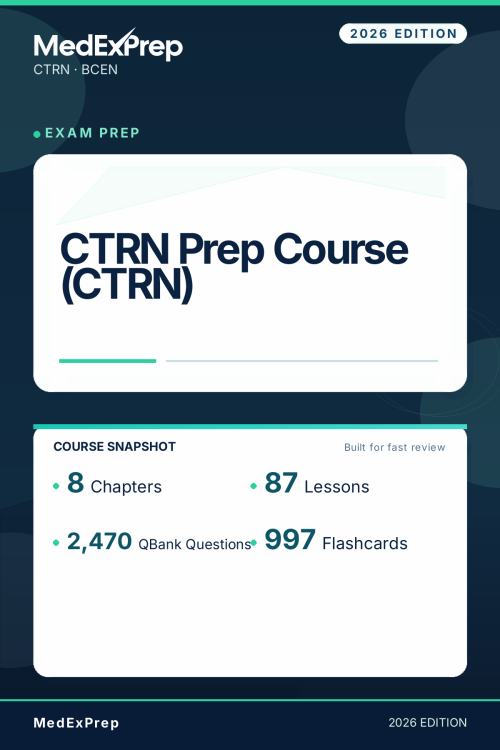
TCRN Prep Course (TCRN)
Registered nurses preparing for the BCEN Trauma Certified Registered Nurse (TCRN) certification exam, including emergency department/trauma nurses, ICU and critical care nurses, flight/transport nurses, and other acute care nurses seeking trauma certification. Key goals: By the end of this course, learners will be able to:; Explain the exam competency areas used in this course and how each topic maps to trauma nursing practice, using learner-safe domain labels when official blueprint wording or weighting is not provided..
Exam: Trauma Certified Registered Nurse (TCRN) · Organization: Board of Certification for Emergency Nursing (BCEN)
Includes: Lessons + Flashcards + QBank
Audience: Registered nurses preparing for the BCEN Trauma Certified Registered Nurse (TCRN) certification exam, including emergency department/trauma nurses, ICU and critical care nurses, flight/transport nurses, and other acute care nurses seeking trauma certification.
Goals:
- By the end of this course, learners will be able to:
- Explain the exam competency areas used in this course and how each topic maps to trauma nursing practice, using learner-safe domain labels when official blueprint wording or weighting is not provided.
- Perform trauma-focused prioritization using a consistent RN exam framework: identify the task -> extract key facts -> apply the governing trauma principle/protocol -> prioritize the safest nursing action -> verify and reassess.
- Master high-yield trauma nursing concepts across the care continuum: primary survey, secondary survey, ongoing reassessment, shock and hemorrhage recognition, resuscitation priorities, airway/ventilation support, neurologic trauma, thoracic trauma, abdominal/pelvic trauma, musculoskeletal and soft-tissue trauma, burns, special populations, monitoring, complications, triage, communication, and handoff.
- Apply concepts in realistic TCRN-style scenarios that emphasize best initial nursing action, recognition of hidden life threats, trend interpretation, mechanism-to-injury correlation, patient safety, and timely escalation within RN scope.
- Solve calculation and interpretation tasks accurately when applicable, including hemodynamic/perfusion reasoning, monitoring trends, fluid and blood product support concepts, and medication-related reasoning only when clearly within RN scope; always show steps and avoid shortcuts that hide reasoning.
- Distinguish common distractors and boundary cases frequently tested in trauma nursing, especially visible but lower-priority injuries vs occult life threats, compensated vs decompensated shock, stabilization vs definitive treatment, and action now vs waiting for more data.
- Build retrieval-ready memory using concise tables, checklists, algorithms, injury-pattern summaries, and spaced review tools organized by competency label.
- Demonstrate readiness through self-checks and mini-assessments mapped to consistent labels in the format DOMAIN: Objective -> Subskill.
- Coverage and blueprint mapping requirements:
- Every chapter, section, subsection, topic, worked example, and assessment item must map to at least one defensible trauma competency label.
- Use consistent mapping labels such as: DOMAIN: Trauma Assessment -> Primary Survey Prioritization; DOMAIN: Trauma Assessment -> Secondary Survey and Ongoing Reassessment; DOMAIN: Shock/Resuscitation -> Hemorrhage Recognition; DOMAIN: Shock/Resuscitation -> Resuscitation Priorities; DOMAIN: Airway/Breathing -> Airway Protection and Ventilation Support; DOMAIN: Neurologic Trauma -> Neuro Assessment and Deterioration; DOMAIN: Thoracic Trauma -> Recognition and Immediate Priorities; DOMAIN: Abdominal/Pelvic Trauma -> Internal Injury Recognition; DOMAIN: Musculoskeletal/Soft-Tissue Trauma -> Limb Threats and Tissue Injury; DOMAIN: Burns -> Burn Assessment and Early Nursing Priorities; DOMAIN: Special Populations -> Age, Pregnancy, and Comorbidity Considerations; DOMAIN: Monitoring/Complications -> Trend Interpretation and Escalation; DOMAIN: Prioritization/Triage -> Multiple Injury Decision Making; DOMAIN: Interprofessional Coordination -> Communication, Safety, and Continuum of Care.
- Ensure complete trauma continuum coverage even if official blueprint details are limited; do not leave any major trauma competency area unmapped.
- If an official blueprint detail is uncertain or institution-specific, provide learner-safe guidance such as local protocols vary; confirm with your institution, rather than guessing or claiming unsupported BCEN specifications.
- Keep all content within RN trauma certification scope: emphasize assessment, prioritization, intervention, monitoring, reassessment, escalation, collaboration, transport/handoff, and safety rather than provider-only definitive management.
Access is granted immediately after purchase.