Description
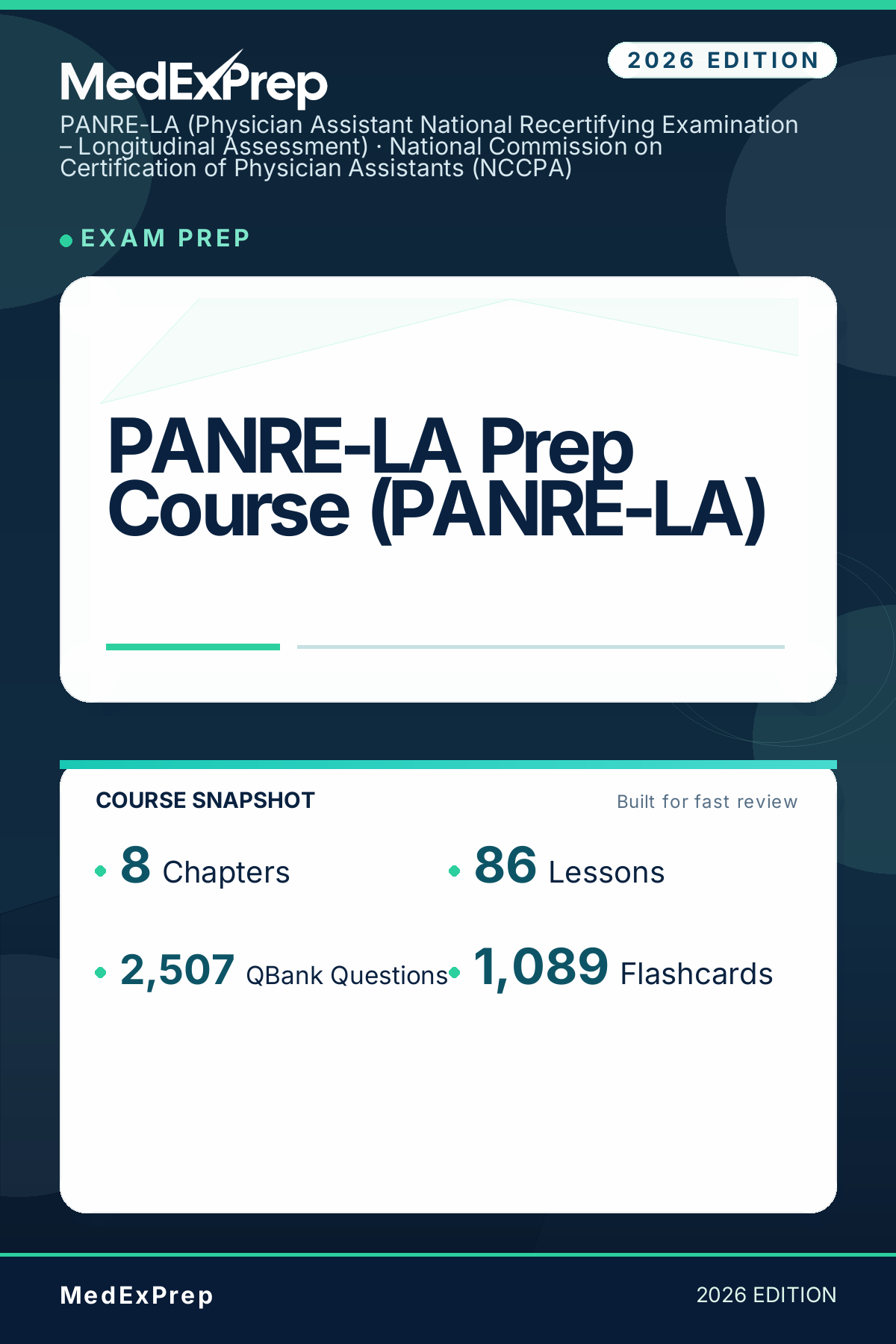
PANRE-LA Prep Course (PANRE-LA)
Certified physician assistants preparing for or actively participating in the NCCPA PANRE-LA longitudinal recertification assessment. Key goals: By the end of this course, learners will be able to:; Explain the PANRE-LA assessment purpose, item style, and broad content coverage expectations for recertification-level physician assistant practice..
Exam: PANRE-LA (Physician Assistant National Recertifying Examination – Longitudinal Assessment) · Organization: National Commission on Certification of Physician Assistants (NCCPA)
Includes: Lessons + Flashcards + QBank
Audience: Certified physician assistants preparing for or actively participating in the NCCPA PANRE-LA longitudinal recertification assessment.
Goals:
- By the end of this course, learners will be able to:
- Explain the PANRE-LA assessment purpose, item style, and broad content coverage expectations for recertification-level physician assistant practice.
- Organize study and clinical reasoning across major general medical practice areas commonly assessed in PANRE-LA, using explicit topic-to-domain mapping even when official blueprint detail is limited.
- Master high-yield diagnostic, therapeutic, preventive, and risk-stratification concepts relevant to recertification-level PA practice across organ systems and patient populations.
- Apply concepts in realistic PANRE-LA–style clinical scenarios involving differential diagnosis, next-best-step management, diagnostic test selection, interpretation of common labs/imaging/ECG data, medication safety, and follow-up planning.
- Use a consistent clinical problem-solving framework: identify the task → extract key facts → prioritize instability/red flags → select the governing rule or guideline-based principle → execute the next best step → verify safety, contraindications, and disposition.
- Distinguish common distractors, misconceptions, look-alike diagnoses, and boundary cases frequently encountered in broad recertification assessment.
- Solve common clinical calculation and logic tasks accurately when applicable, showing steps and avoiding shortcuts that hide reasoning.
- Build retrieval-ready memory using concise tables, checklists, algorithms, and spaced review summaries.
- Demonstrate readiness through self-checks and mini-assessments mapped to course topic tags and PANRE-LA-relevant clinical subskills.
- Coverage & Blueprint Mapping Requirements:
- Because PANRE-LA is broad and official blueprint granularity may be limited or evolve, every chapter/section/subsection/topic must map to at least one explicit course tag in a consistent format such as AREA: Presentation/Task → Subskill.
- Use teachable, exam-relevant tags that reflect practical PA reasoning, for example: CARDIOVASCULAR: Chest pain → risk stratification; ENDOCRINE: Diabetes → medication selection; INFECTIOUS DISEASE: Fever → initial workup; PREVENTIVE CARE: Screening → age/risk-based recommendation.
- Ensure complete coverage across broad recertification practice areas, including acute care, chronic disease management, preventive care, therapeutics, diagnostics, emergencies, and follow-up/disposition.
- If official weighting or blueprint detail is uncertain, do not guess. Instead, provide balanced coverage, state learner-safe uncertainty plainly, and flag where current NCCPA guidance or current clinical recommendations should be confirmed.
- Keep all content within the certified PA role: evaluating patients, forming differentials, selecting appropriate tests, interpreting common data, initiating evidence-based management, counseling patients, and recognizing when escalation, referral, transfer, or consultation is required.
- When a scenario exceeds routine PA scope, involves instability, specialist-only intervention, or legal/ethical complexity, teach stabilization plus appropriate escalation rather than unsupported independent management.
- Use current standard-of-care principles and commonly accepted guidelines; when recommendations may change over time, frame them as current guidance and encourage verification against up-to-date recommendations.
Access is granted immediately after purchase.