Description
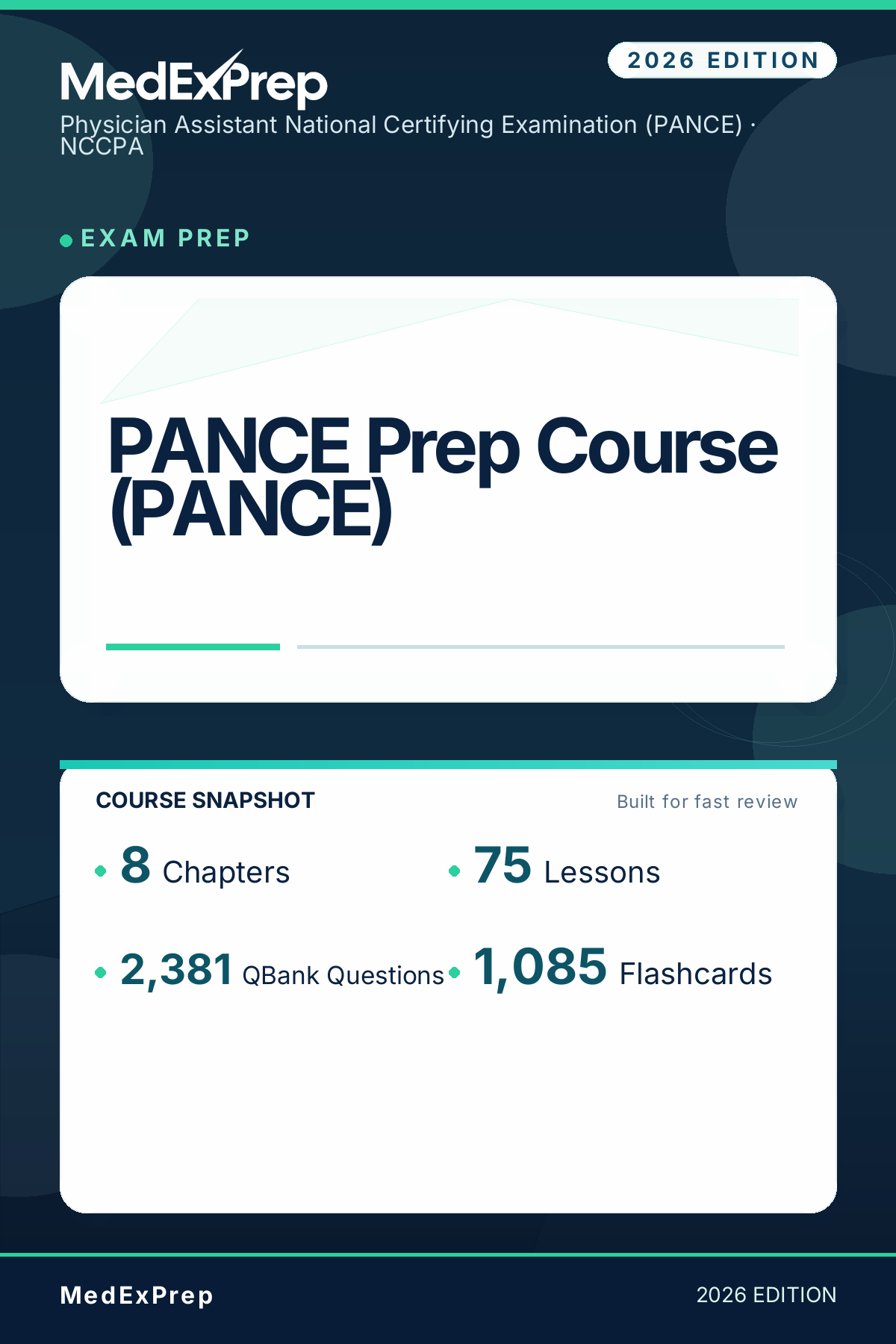
PANCE Prep Course (PANCE)
Physician assistant students and recent PA program graduates preparing for the PANCE initial certification exam. Key goals: By the end of this course, learners will be able to:; Explain the broad PANCE-relevant content structure and the major organ-system and cross-cutting clinical task areas assessed for entry-level PA practice, without relying on invented unpublished weighting details..
Exam: Physician Assistant National Certifying Examination (PANCE) · Organization: NCCPA
Includes: Lessons + Flashcards + QBank
Audience: Physician assistant students and recent PA program graduates preparing for the PANCE initial certification exam.
Goals:
- By the end of this course, learners will be able to:
- Explain the broad PANCE-relevant content structure and the major organ-system and cross-cutting clinical task areas assessed for entry-level PA practice, without relying on invented unpublished weighting details.
- Master high-yield concepts, disease scripts, diagnostic criteria, red flags, and initial management rules across major clinical systems commonly tested on the PANCE.
- Apply clinical reasoning in realistic board-style vignettes to identify the most likely diagnosis, best next step, most appropriate diagnostic test, initial therapy, definitive treatment, complication, prevention strategy, or referral/escalation decision.
- Interpret common clinical data accurately, including vitals, CBC/CMP/LFTs, urinalysis, arterial blood gases, ECG basics, imaging descriptions, microbiology clues, medication lists, and routine calculations relevant to patient care.
- Solve clinical calculation and logic tasks when applicable, including dosing/rate basics, fluid and electrolyte reasoning, acid-base interpretation, anion gap logic, and clinically contextualized test-characteristic questions, showing steps clearly.
- Distinguish common distractors, near-miss diagnoses, contraindications, unsafe options, and boundary cases frequently tested in board-style questions.
- Use a consistent vignette-solving framework: identify the task → extract key clinical facts → localize by organ system/problem representation → select the governing diagnosis or management rule → execute → verify against age, pregnancy status, severity, contraindications, and patient safety.
- Build retrieval-ready memory using concise tables, algorithms, checklists, comparison charts, and spaced-review summaries focused on discriminating features.
- Demonstrate readiness through self-check questions and mini-assessments mapped to broad PANCE-relevant systems and task categories.
- Coverage & Blueprint Mapping Requirements:
- Every chapter, section, subsection, and topic must map to at least one PANCE-relevant domain, objective, or broad content bucket.
- Because exact official blueprint detail may not be provided, organize and tag content using consistent learner-facing labels such as SYSTEM, DOMAIN, TASK, and CROSS-CUTTING.
- Ensure broad coverage across major clinical systems and recurring exam tasks, including diagnosis, workup, interpretation, initial management, stabilization, prevention, complication recognition, and referral/escalation.
- Use teachable subskills with tags such as "SYSTEM: Cardiovascular/Chest Pain → ACS recognition and initial management" or "TASK: Management → Best next step in unstable patient."
- No domain or major content bucket should be left unmapped; if a detail is uncertain or institution-dependent, provide learner-safe guidance such as "Local protocols vary; confirm with your institution" rather than guessing.
- Keep content aligned to the role of an entry-level PA candidate demonstrating broad generalist clinical knowledge rather than specialist-level management depth.
Access is granted immediately after purchase.