Description
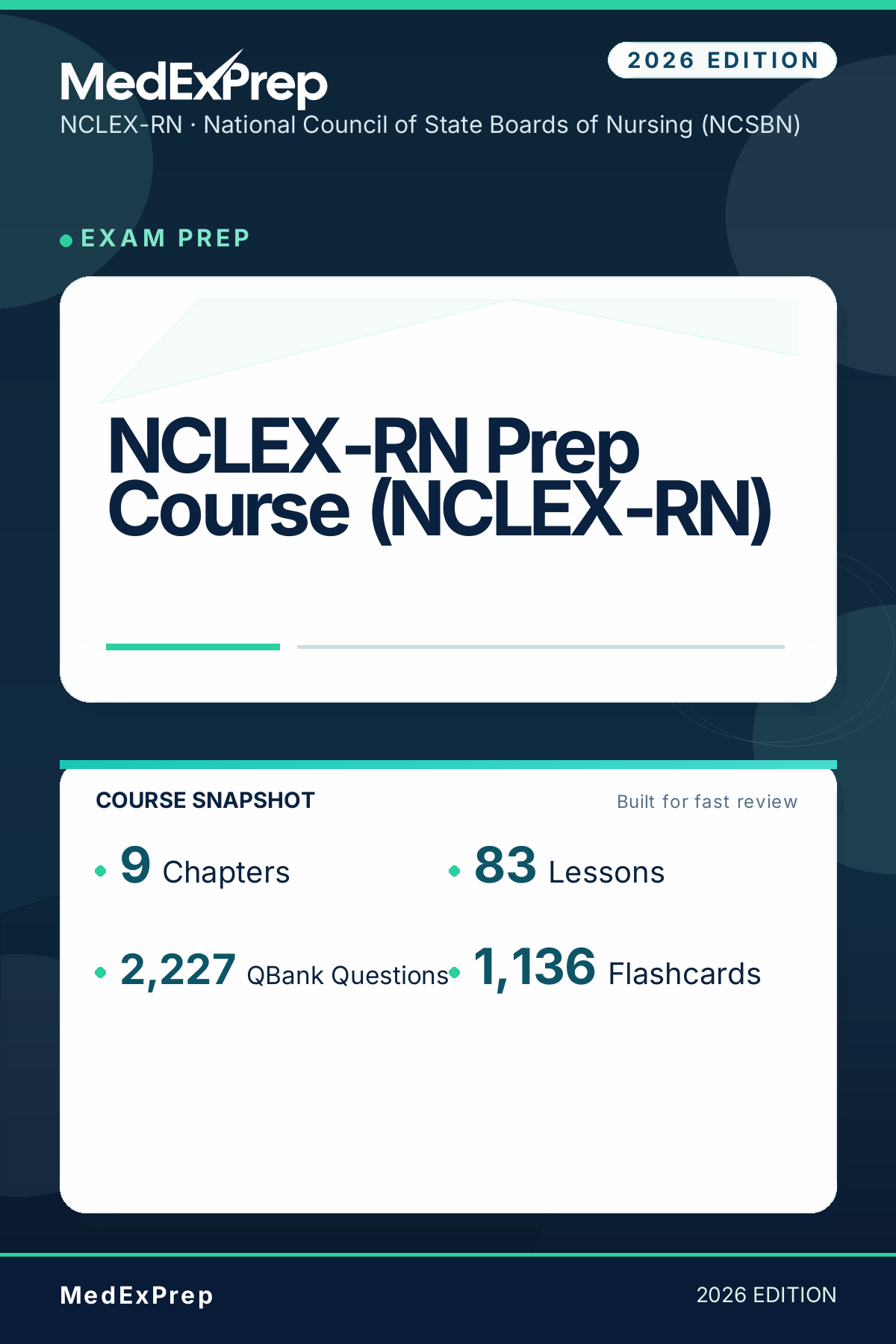
NCLEX-RN Prep Course (NCLEX-RN)
Prelicensure nursing graduates and RN licensure candidates preparing for the NCLEX-RN licensure exam. Key goals: By the end of this course, learners will be able to:; Explain the NCLEX-RN test plan at a high level and use it to organize study across client needs, integrated nursing processes, and clinical judgment skills without assuming unofficial weightings when not provided..
Exam: NCLEX-RN · Organization: National Council of State Boards of Nursing (NCSBN)
Includes: Lessons + Flashcards + QBank
Audience: Prelicensure nursing graduates and RN licensure candidates preparing for the NCLEX-RN licensure exam.
Goals:
- By the end of this course, learners will be able to:
- Explain the NCLEX-RN test plan at a high level and use it to organize study across client needs, integrated nursing processes, and clinical judgment skills without assuming unofficial weightings when not provided.
- Apply the Clinical Judgment Measurement Model in exam-style scenarios: recognize cues, analyze cues, prioritize hypotheses, generate solutions, take action, and evaluate outcomes.
- Master high-yield entry-level RN knowledge and decision rules for safe and effective care, including prioritization, delegation, supervision, infection prevention, medication safety, client education, documentation, and escalation of care.
- Apply nursing concepts in realistic NCLEX-style situations across adult medical-surgical, maternal-newborn, pediatric, mental health, community/public health, and older-adult settings.
- Interpret common assessment findings, vital-sign trends, labs, medication effects, and safety risks to determine the most appropriate next nursing action.
- Solve nursing calculations accurately when applicable, including dosage, IV flow, intake/output, and other medication-related math; show steps and avoid shortcuts that hide reasoning.
- Distinguish common distractors and near-miss answer choices, especially those that confuse RN scope with provider actions, misuse ABCs, overdelegate, undertreat safety risks, or ignore client-centered/least-restrictive principles.
- Use a consistent problem-solving framework for every item: identify the task -> extract key cues -> apply RN scope and safety priorities -> choose the best action -> verify against client outcomes and contraindications.
- Build retrieval-ready memory using concise tables, checklists, priority frameworks, delegation rules, isolation/safety summaries, and spaced review notes.
- Demonstrate readiness with self-checks and mini-assessments mapped to NCLEX-RN domains/subskills and major client populations.
- Coverage & Blueprint Mapping Requirements:
- Map every chapter/section/subsection/topic to at least one NCLEX-RN test-plan area or teachable subskill, even when official blueprint wording is broad.
- When blueprint language is broad, translate it into explicit, teachable tags using a consistent format such as CLIENT NEED: Integrated Process -> Subskill or CJMM: Step -> Subskill.
- Ensure complete coverage across safe and effective care environment, health promotion and maintenance, psychosocial integrity, and physiological integrity, while also integrating nursing process, caring, communication/documentation, teaching/learning, culture/spirituality, and clinical judgment.
- Ensure balanced coverage of recurring NCLEX themes: early recognition of deterioration, respiratory compromise, hemodynamic instability, sepsis/infection, medication adverse effects, electrolyte/lab abnormalities, falls/aspiration/pressure injury prevention, therapeutic communication, delegation boundaries, discharge planning, and home/community safety.
- Keep all content within entry-level RN scope. Emphasize what the RN should assess, do next, monitor, teach, delegate, document, or report. Do not teach independent medical diagnosis, prescribing, or provider-only decisions.
- If local law, institutional policy, or protocol may vary, provide learner-safe wording such as "Follow agency policy and state nurse practice rules" or "Local protocols vary; confirm with your institution" rather than guessing.
- Ensure no exam domain/objective is left unmapped; if a detail is uncertain, use conservative, learner-safe guidance rather than invented specificity.
Access is granted immediately after purchase.