Description
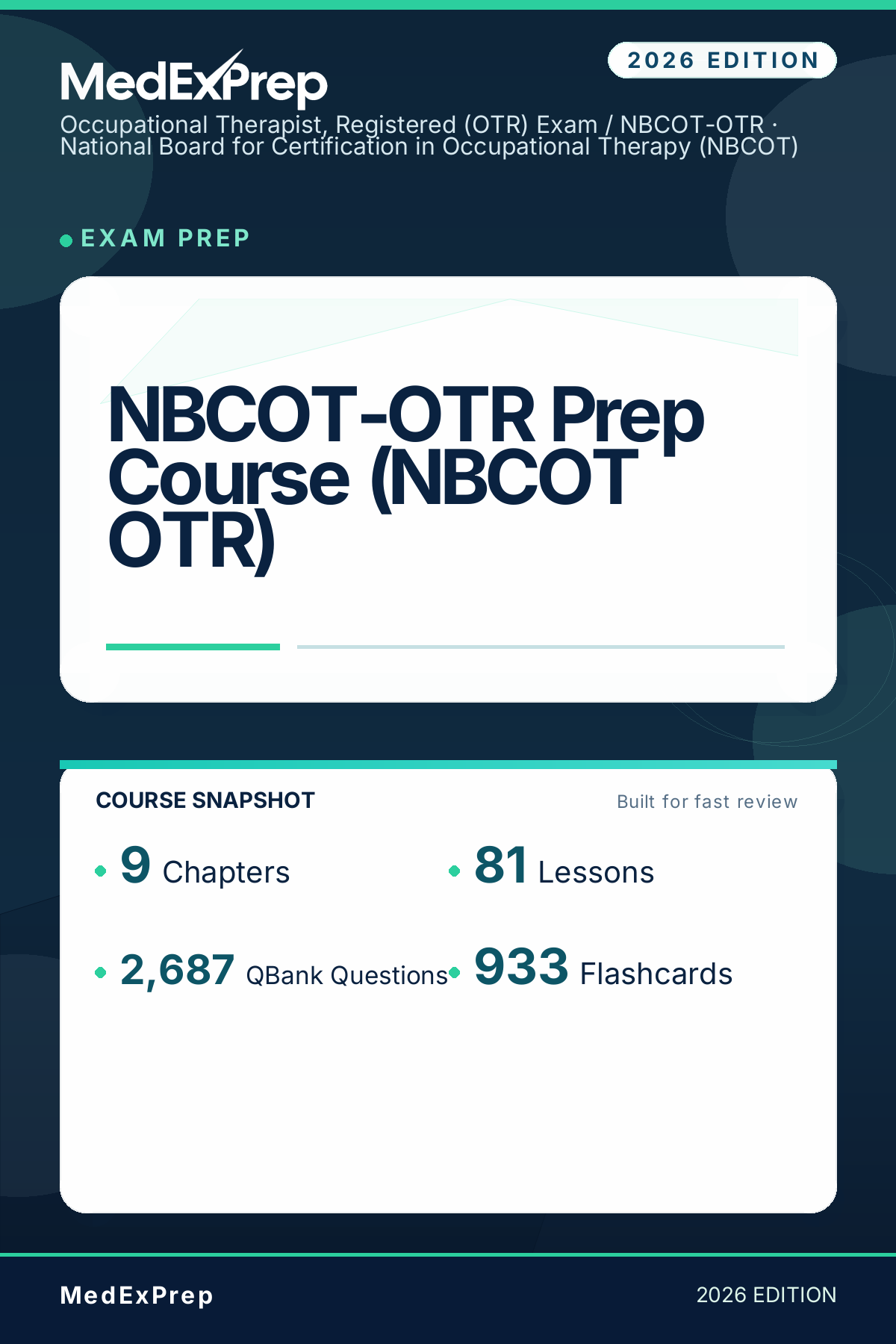
NBCOT-OTR Prep Course (NBCOT OTR)
Entry-level occupational therapy graduates and NBCOT-OTR candidates preparing for initial certification as occupational therapists. Key goals: By the end of this course, learners will be able to:; Explain the publicly available NBCOT-OTR exam framework at a high level and use transparent domain/subskill mapping for study planning without relying on unpublished weighting or blueprint details..
Exam: Occupational Therapist, Registered (OTR) Exam / NBCOT-OTR · Organization: National Board for Certification in Occupational Therapy (NBCOT)
Includes: Lessons + Flashcards + QBank
Audience: Entry-level occupational therapy graduates and NBCOT-OTR candidates preparing for initial certification as occupational therapists.
Goals:
- By the end of this course, learners will be able to:
- Explain the publicly available NBCOT-OTR exam framework at a high level and use transparent domain/subskill mapping for study planning without relying on unpublished weighting or blueprint details.
- Apply entry-level occupational therapy clinical reasoning across the full OT process: evaluation, problem identification, goal setting, intervention planning, intervention implementation, outcomes monitoring, discharge planning, and referral/consultation decisions.
- Select the most appropriate OT action in exam-style scenarios by using a consistent framework: identify the OT task -> extract key client, setting, and safety clues -> determine the stage of service and immediate priority -> apply the governing OT principle -> eliminate unsafe, premature, non-client-centered, or setting-inappropriate options -> verify the best answer.
- Interpret occupational profiles, performance data, client factors, contexts, environments, and precautions to choose appropriate assessments, identify functional priorities, and distinguish screening from full evaluation.
- Develop measurable goals and client-centered intervention plans using activity analysis, grading, adaptation, assistive technology, environmental modification, caregiver/team planning, and setting-appropriate service delivery decisions.
- Implement and modify occupation-based and preparatory interventions safely across ages and practice settings, including ADL/IADL training, motor, cognitive, perceptual, and psychosocial strategies, while recognizing contraindications and red flags.
- Monitor response to intervention, measure progress, adjust plans, and make discharge, home program, equipment, community reintegration, and follow-up recommendations based on functional outcomes and safety.
- Demonstrate sound professional practice in ethics, documentation, supervision/delegation concepts, interprofessional collaboration, cultural humility, scope/role clarification, and risk management within entry-level OT responsibilities.
- Use foundational knowledge only as applied to OT decisions, including anatomy, physiology, kinesiology, neuroscience, development, psychosocial factors, common conditions, and precautions relevant to function and occupational performance.
- Distinguish common distractors frequently tested on NBCOT-style items, especially unsafe recommendations, wrong priorities, developmental or setting mismatches, intervention-before-evaluation errors, and options that are overly restrictive or not client-centered.
- Build retrieval-ready memory with concise tables, comparison charts, decision rules, safety checklists, and spaced rapid reviews mapped to domains and teachable subskills.
- Demonstrate readiness through self-checks and mini-assessments mapped to transparent OT domains/subskills: Evaluation; Intervention Planning; Intervention Implementation and Management; Outcomes, Transition, and Discharge; Professional Practice, Safety, and Ethics; and Foundational Knowledge Applied to OT Decisions.
- Coverage and blueprint mapping requirements:
- Every chapter, section, subsection, and topic must map to at least one transparent exam-relevant OT domain/subskill label.
- Use consistent labels such as: DOMAIN: Evaluation -> Occupational Profile; DOMAIN: Intervention Planning -> Activity Analysis; DOMAIN: Professional Practice -> Documentation.
- Ensure complete coverage of the OT process and related professional responsibilities across the lifespan and settings, including pediatrics, adolescents, adults, older adults, acute care, inpatient rehabilitation, skilled nursing/long-term care, outpatient, home/community, school-based, mental/behavioral health, and work/community participation contexts.
- When official blueprint wording is broad or updated over time, translate it into teachable OT subskills and clearly map lessons to those subskills rather than inventing unpublished NBCOT categories or weights.
- If a topic varies by employer, payer, setting, or jurisdiction, provide learner-safe guidance such as: Local policies and jurisdiction-specific rules vary; confirm with your institution or state requirements.
Access is granted immediately after purchase.