Description
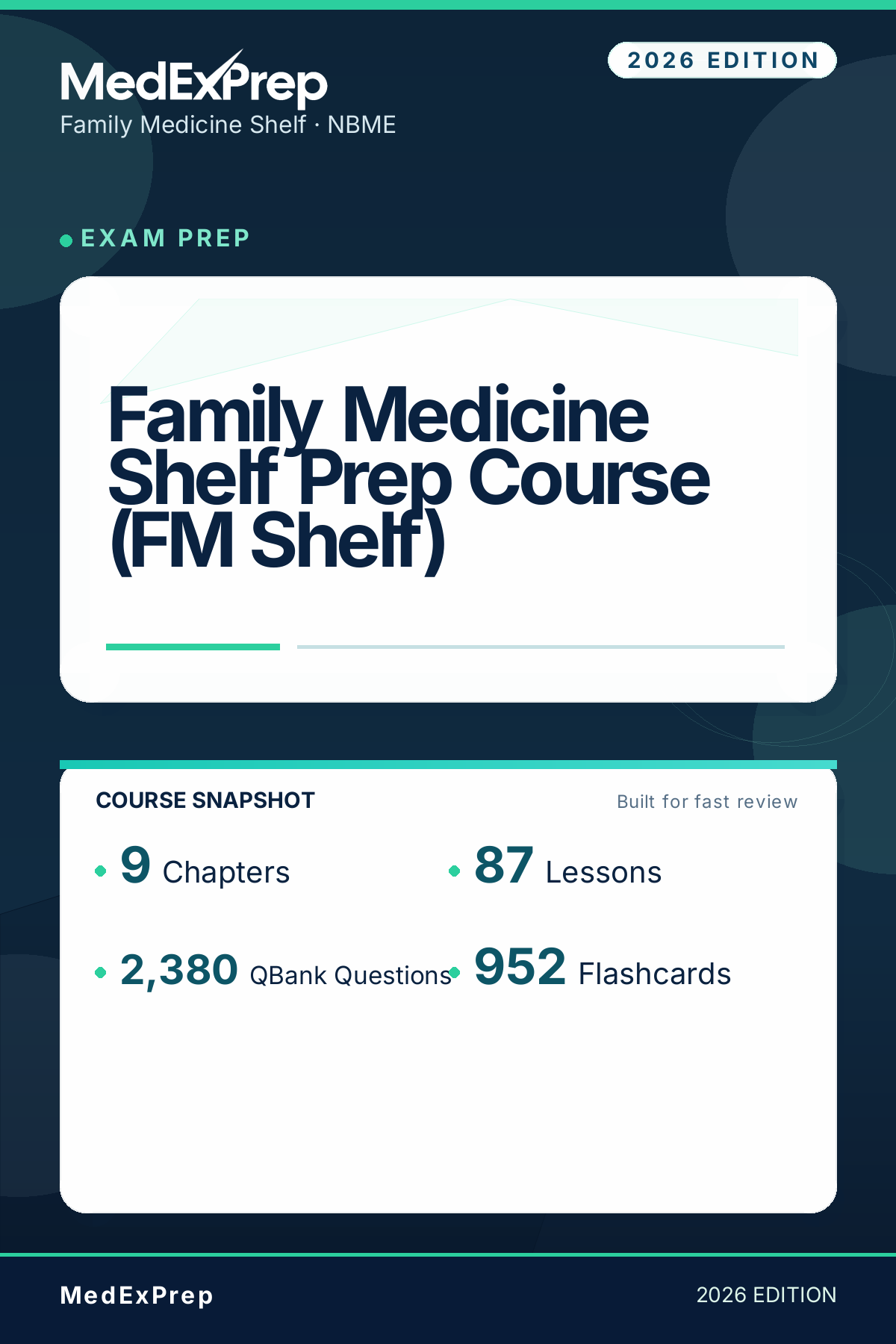
Family Medicine Shelf Prep Course (FM Shelf)
Medical students preparing for the NBME Family Medicine Shelf exam, especially learners needing high-yield outpatient-focused, vignette-based review across the lifespan. Key goals: By the end of this course, learners will be able to:; Explain the exam scope for the NBME Family Medicine Shelf and use the course blueprint domains and subskills to prioritize study, with emphasis on ambulatory care, prevention, chronic disease management, and age-specific primary care..
Exam: Family Medicine Shelf · Organization: NBME
Includes: Lessons + Flashcards + QBank
Audience: Medical students preparing for the NBME Family Medicine Shelf exam, especially learners needing high-yield outpatient-focused, vignette-based review across the lifespan.
Goals:
- By the end of this course, learners will be able to:
- Explain the exam scope for the NBME Family Medicine Shelf and use the course blueprint domains and subskills to prioritize study, with emphasis on ambulatory care, prevention, chronic disease management, and age-specific primary care.
- Master the high-yield concepts, definitions, screening rules, first-line therapies, red flags, and disposition principles for common family medicine presentations across adult, pediatric, women’s health, and geriatric care.
- Apply concepts in realistic NBME-style single-best-answer clinical vignettes focused on diagnosis, next best step, initial management, prevention, counseling, and interpretation of common clinical data.
- Use a consistent problem-solving framework: identify the task → extract key facts → determine setting/urgency → select the governing rule or first-line approach → eliminate tempting distractors → verify the answer fits the patient’s age, risk factors, and care setting.
- Distinguish common distractors, misconceptions, and boundary cases frequently tested in primary care, including when to reassure, when to treat empirically, when to screen, when to refer, and when urgent escalation is required.
- Build retrieval-ready memory using concise tables, prevention checklists, age-based screening/vaccine summaries, chronic disease algorithms, and spaced-review rapid recaps.
- Demonstrate readiness through self-check questions and mini-assessments mapped to each course domain and competency.
- Coverage & Blueprint Mapping Requirements:
- Map every chapter/section/subsection/topic to at least one domain and one competency tag using a consistent format such as DOMAIN: Preventive care and health maintenance → SUBSKILL: screening, immunization, counseling or DOMAIN: Cardiometabolic disease → SUBSKILL: diagnosis, initial therapy, risk reduction.
- Use these working domains for complete coverage unless a more specific validated framework is supplied: Preventive care and health maintenance; Cardiometabolic disease; Women’s health and reproductive care; Pediatrics in family medicine; Behavioral health and substance use; Musculoskeletal and sports medicine; Dermatology; Respiratory and infectious complaints; Gastrointestinal, renal, and endocrine complaints; Geriatrics, ethics, and care coordination.
- Also tag content by competency when relevant: Diagnosis; Next best step/workup; Initial management; Screening/prevention; Counseling/risk reduction.
- Ensure balanced coverage of common family medicine conditions across the lifespan, with outpatient primary care as the default setting while also including urgent care triage recognition, transition-of-care basics, and supervised medical-student-level inpatient relevance where appropriate.
- Emphasize common high-yield topics such as preventive screening, immunization basics, hypertension, diabetes, dyslipidemia, obesity, smoking cessation, depression/anxiety, contraception, prenatal basics, osteoarthritis, low back pain, common rashes, URI/asthma/COPD/pneumonia basics, UTI and common infections, and geriatric falls/cognition/polypharmacy.
- Do not invent official NBME blueprint details beyond the provided scope. If exact exam weighting or policy details are uncertain, present learner-safe guidance and explicitly map the lesson to practical family-medicine subskills rather than guessing.
- Ensure complete coverage: no domain or competency tag is left unmapped; if a topic is institution-dependent, write learner-facing guidance such as “Local protocols vary; confirm with your institution.”
Access is granted immediately after purchase.