Description
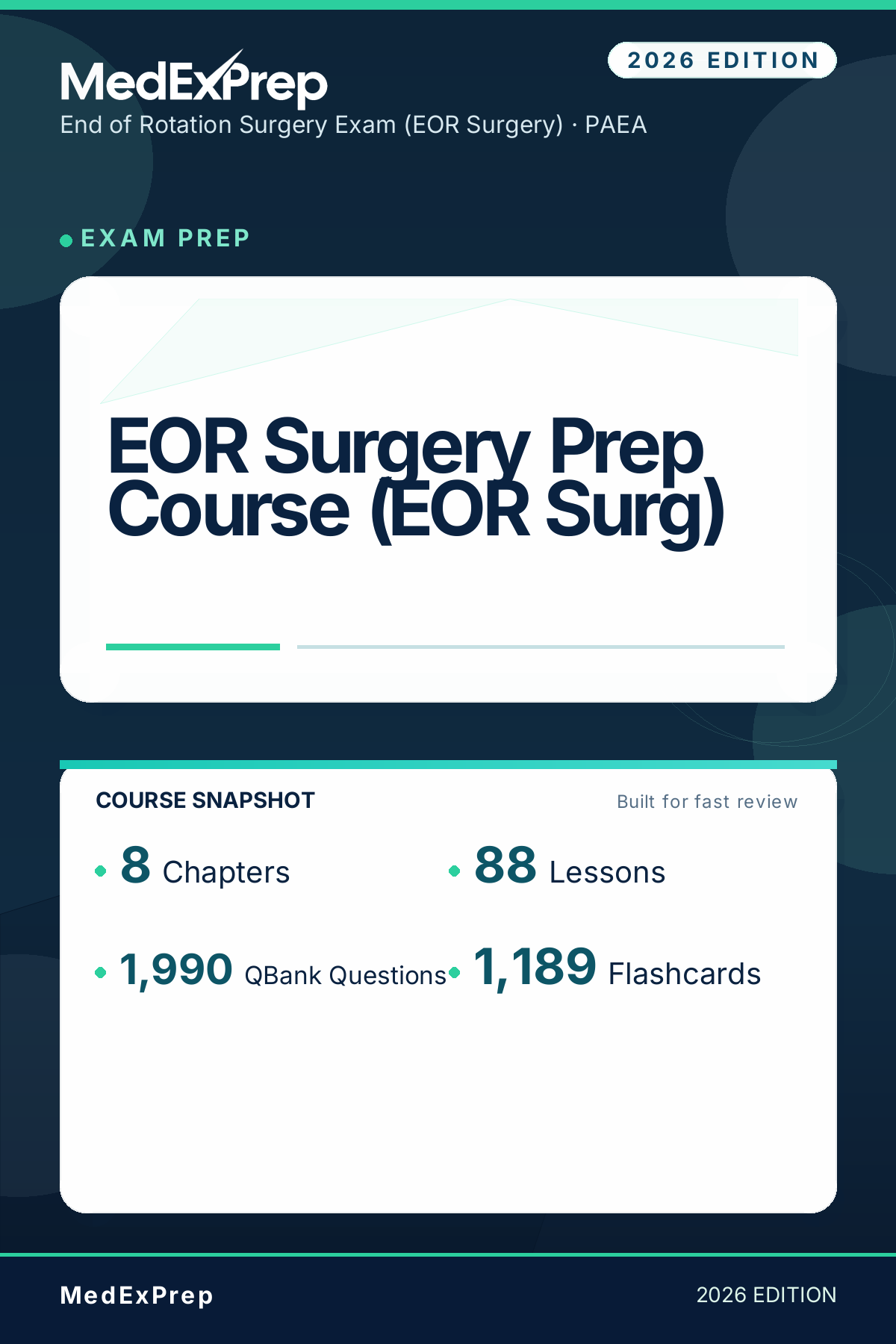
EOR Surgery Prep Course (EOR Surg)
Physician assistant students preparing for the PAEA End of Rotation Surgery exam during clinical rotations or dedicated exam review Key goals: By the end of this course, learners will be able to:; Explain the major content areas tested on the PAEA End of Rotation Surgery exam and organize study using explicit domain-to-topic mapping; when official weighting or blueprint detail is limited, use transparent coverage mapping and gap flags rather than assumed percentages..
Exam: End of Rotation Surgery Exam (EOR Surgery) · Organization: PAEA
Includes: Lessons + Flashcards + QBank
Audience: Physician assistant students preparing for the PAEA End of Rotation Surgery exam during clinical rotations or dedicated exam review
Goals:
- By the end of this course, learners will be able to:
- Explain the major content areas tested on the PAEA End of Rotation Surgery exam and organize study using explicit domain-to-topic mapping; when official weighting or blueprint detail is limited, use transparent coverage mapping and gap flags rather than assumed percentages.
- Master high-yield surgery-rotation concepts, definitions, clinical patterns, and decision rules across common general surgical conditions, perioperative care, trauma principles, wound care, postoperative complications, and other core clerkship-level surgical presentations.
- Apply concepts in realistic exam-style scenarios focused on recognition of unstable vs stable patients, the most appropriate next step in evaluation or management, initial stabilization, diagnostic selection, and timely consultation/escalation.
- Interpret common surgery-relevant labs and imaging in context, including CBC, CMP, coagulation studies, urinalysis, plain films, ultrasound, and CT, and connect findings to likely diagnosis and next action.
- Distinguish urgent operative or surgical-consult indications from situations appropriate for observation, outpatient follow-up, or nonsurgical management, while staying within the physician assistant student role under supervision.
- Use a consistent problem-solving framework: identify the task → determine stability/acuity → extract key facts → select the governing rule or syndrome script → choose the safest next step → verify why competing choices are less appropriate.
- Build retrieval-ready memory using concise tables, differential frameworks, red-flag checklists, perioperative algorithms, and spaced-review summaries tailored to surgery shelf/EOR-style reasoning.
- Demonstrate readiness through self-check questions and mini-assessments mapped to each course domain, with emphasis on acute abdomen, surgical emergencies, perioperative medicine, postoperative complication recognition, and trauma prioritization.
- Coverage & Blueprint Mapping Requirements:
- Every chapter/section/subsection/topic must map to at least one exam domain, competency, or teachable objective, even if the published blueprint language is broad.
- When blueprint language is vague, translate it into explicit subskills using consistent labels such as DOMAIN: Topic → Subskill (for example: Acute Abdomen → recognize peritonitis requiring urgent surgical evaluation).
- Ensure complete coverage across clerkship-level surgery expectations, including acute surgical complaints, perioperative evaluation, postoperative management, trauma fundamentals, wound/infection care, vascular/urologic emergencies commonly encountered in surgery review, and diagnostic reasoning for common surgical presentations.
- Maintain role-appropriate framing: the learner is a physician assistant student expected to recognize emergencies, initiate basic stabilization, recommend appropriate tests and initial measures, and escalate to the surgical team or appropriate specialist when indicated.
- Do not invent undisclosed blueprint details or specialty-specific operative preferences. If a management detail varies by institution, present learner-safe guidance such as “Local protocols vary; confirm with your institution,” and prioritize universally accepted exam-relevant principles.
- Keep patient safety central: explicitly flag conditions requiring immediate action, including hemodynamic instability, sepsis, hemorrhage, peritonitis, compartment syndrome, ischemia, perforation, obstruction with compromise, airway threats, and rapidly worsening postoperative complications.
Access is granted immediately after purchase.