Description
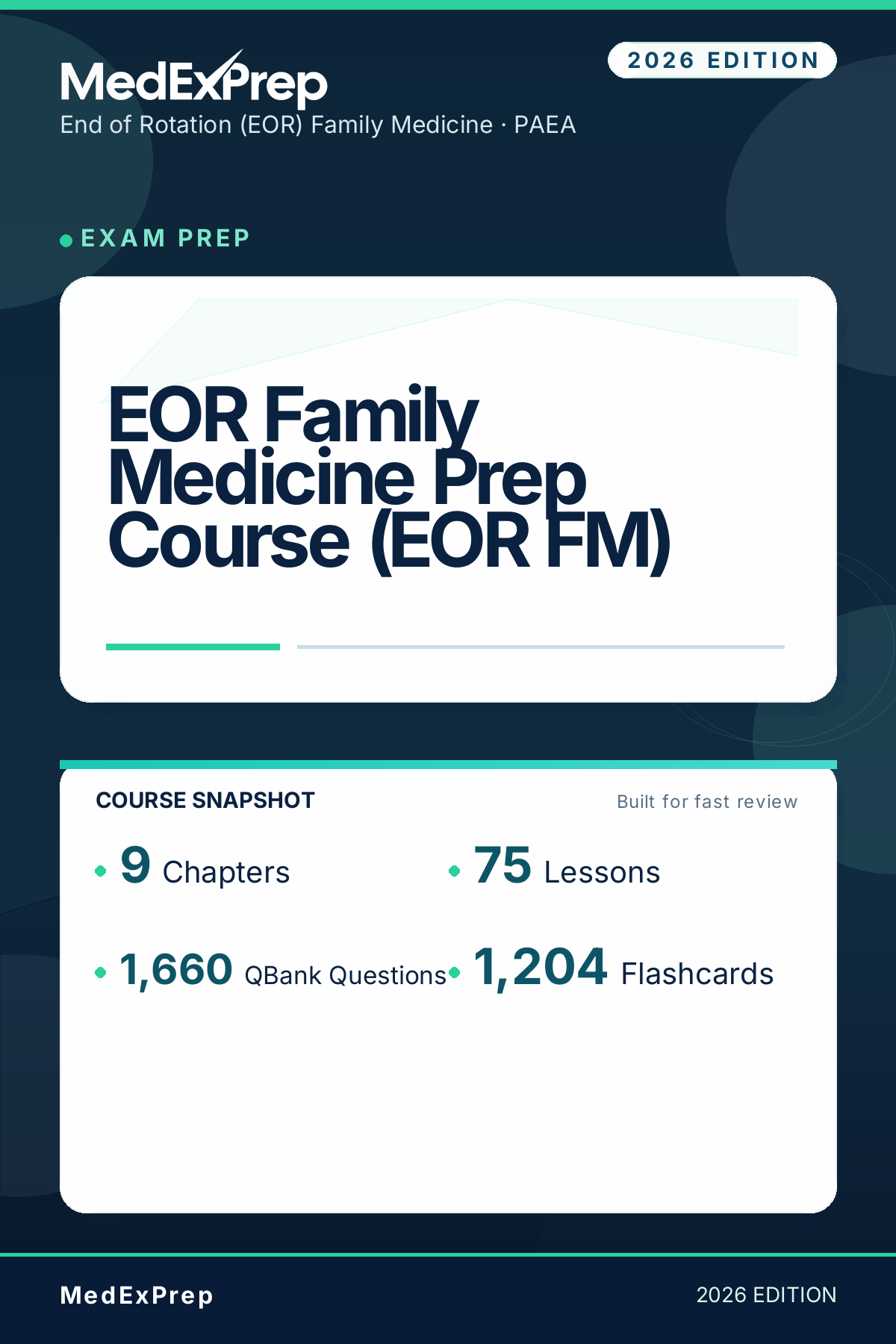
EOR Family Medicine Prep Course (EOR FM)
Physician assistant students preparing for the PAEA Family Medicine End of Rotation (EOR) exam Key goals: By the end of this course, learners will be able to:; Explain the exam structure for the PAEA Family Medicine EOR and organize study by major outpatient family medicine domains, task types, and high-yield presentation categories..
Exam: End of Rotation (EOR) Family Medicine · Organization: PAEA
Includes: Lessons + Flashcards + QBank
Audience: Physician assistant students preparing for the PAEA Family Medicine End of Rotation (EOR) exam
Goals:
- By the end of this course, learners will be able to:
- Explain the exam structure for the PAEA Family Medicine EOR and organize study by major outpatient family medicine domains, task types, and high-yield presentation categories.
- Master high-yield concepts, definitions, diagnostic criteria, first-line management, prevention, counseling, and disposition decisions for family medicine across the lifespan.
- Apply concepts in realistic, single-best-answer outpatient vignettes involving diagnosis, best initial test, best next step, first-line therapy, screening, counseling, follow-up, referral, and escalation.
- Use a consistent clinical reasoning framework for exam questions: identify the task → extract key age/risk factors and symptoms/signs → select the governing guideline/rule → choose diagnosis/evaluation/management/disposition → verify safety, red flags, and follow-up.
- Distinguish common distractors, near-miss diagnoses, urgent vs nonurgent presentations, and routine outpatient care vs same-day evaluation vs ED referral.
- Interpret common office-based data accurately, including vital signs, basic labs, screening results, preventive schedules, and risk-based management decisions.
- Build retrieval-ready memory with concise tables, compare/contrast sets, age-based checklists, red-flag summaries, and spaced review prompts.
- Demonstrate readiness through self-checks and mini-assessments mapped to family medicine domains and task labels.
- Coverage & Blueprint Mapping Requirements:
- Every chapter/section/subsection/topic must map to at least one exam domain, task area, or family medicine presentation category using the label format 'DOMAIN: Presentation/Task → Subskill'.
- Use an outpatient family medicine perspective across the lifespan, including preventive care, adult medicine, pediatrics, women’s health, behavioral health, musculoskeletal medicine, dermatology, infectious disease, geriatrics, and common procedures/counseling.
- Emphasize PA-student appropriate decision making: recognition, initial evaluation, first-line management, counseling, prevention, follow-up, and appropriate referral/escalation rather than specialist-level treatment detail.
- Ensure complete coverage of the Family Medicine EOR framework even when blueprint language is broad by translating broad categories into teachable outpatient subskills; no domain/objective may remain unmapped.
- Include explicit urgent/emergent safety distinctions whenever relevant: routine follow-up vs urgent same-day evaluation vs ED transfer.
- When screening intervals, local protocols, or institution-specific practices vary, provide learner-safe guidance such as 'screening intervals and local protocols may vary; confirm with your program or current guideline' rather than guessing.
- Prioritize high-yield family medicine content commonly tested in outpatient primary care: prevention and screening, chronic disease follow-up, acute outpatient complaints, mixed-comorbidity cases, and triage/red-flag presentations.
Access is granted immediately after purchase.