
Description
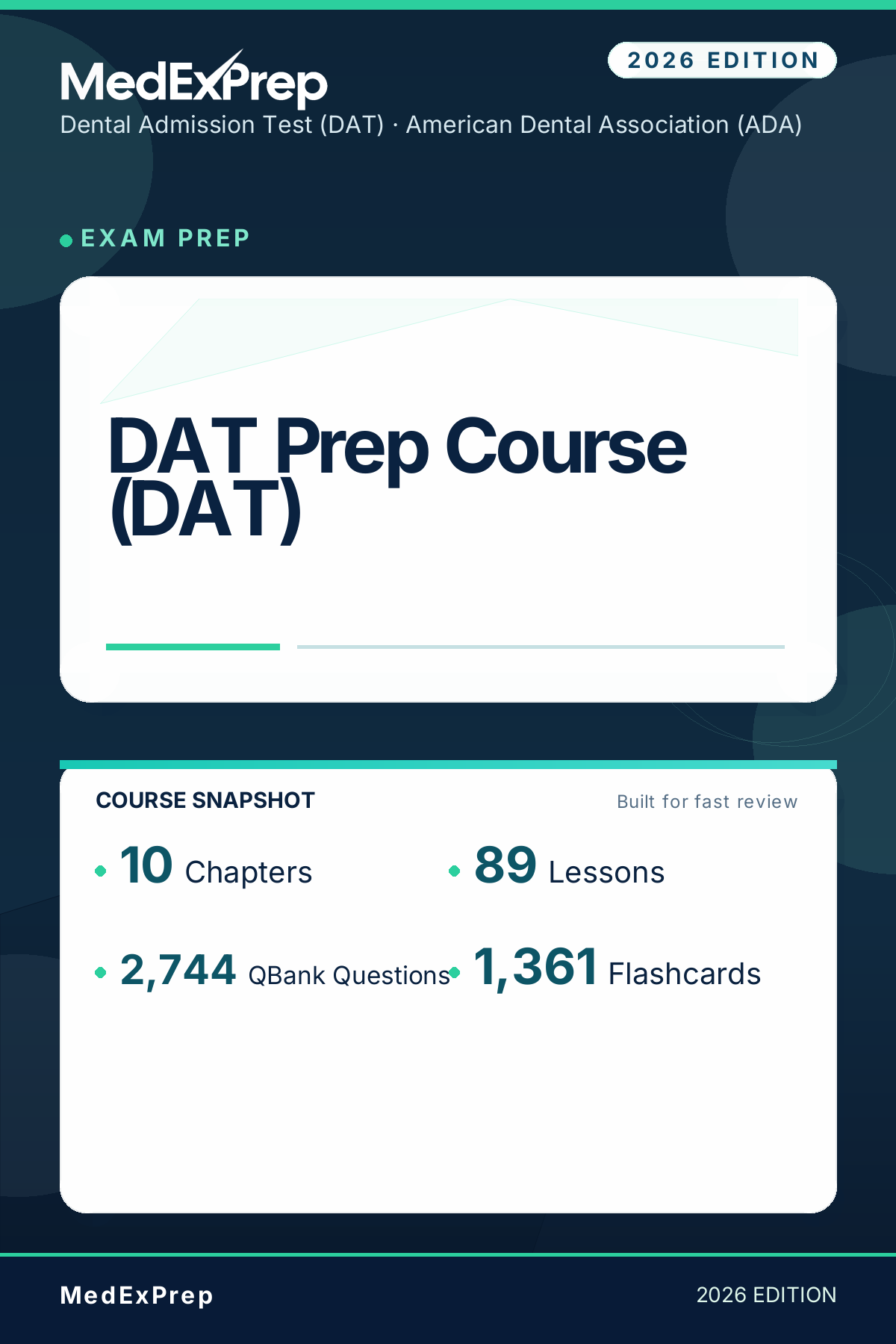
DAT Prep Course (DAT)
Prospective dental school applicants preparing for the DAT, including first-time test takers and repeat test takers seeking structured, exam-focused review across biology, general chemistry, organic chemistry, quantitative reasoning, reading comprehension, and perceptual ability. Key goals: By the end of this course, learners will be able to:; Explain the DAT content areas, tested skill types, and practical exam demands, using official public guidance where available and clearly flagging any area where subdomain detail is not explicitly specified..
Exam: Dental Admission Test (DAT) · Organization: American Dental Association (ADA)
Includes: Lessons + Flashcards + QBank
Audience: Prospective dental school applicants preparing for the DAT, including first-time test takers and repeat test takers seeking structured, exam-focused review across biology, general chemistry, organic chemistry, quantitative reasoning, reading comprehension, and perceptual ability.
Goals:
- By the end of this course, learners will be able to:
- Explain the DAT content areas, tested skill types, and practical exam demands, using official public guidance where available and clearly flagging any area where subdomain detail is not explicitly specified.
- Master high-yield concepts, definitions, rules, formulas, mechanisms, and recognition patterns across biology, general chemistry, organic chemistry, quantitative reasoning, reading comprehension, and perceptual ability.
- Apply concepts in realistic DAT-style questions involving multi-step reasoning, calculation, passage analysis, data interpretation, spatial visualization, and answer-choice elimination.
- Solve common quantitative and scientific reasoning tasks accurately and efficiently, showing steps, unit logic, and verification rather than relying on unexplained shortcuts.
- Distinguish common distractors, misconceptions, near-miss answer choices, and boundary cases that are frequently tested in admissions-exam contexts.
- Use a consistent problem-solving framework: identify the task → extract key facts → select the governing rule, concept, or strategy → execute → verify.
- Build retrieval-ready memory using concise tables, reaction/relationship summaries, pattern-recognition checklists, formula sheets, and spaced-review recaps.
- Demonstrate readiness through self-check questions and mini-assessments mapped to DAT content areas and subskills.
- Use time-aware strategies appropriate to a standardized admissions exam, including triage, estimation, elimination, passage navigation, and perceptual pattern recognition, without inventing unsupported claims about official scoring or unpublished weights.
- Coverage & Blueprint Mapping Requirements:
- Every chapter, section, subsection, and topic must map to at least one DAT content area or clearly defined subskill tag, even if official blueprint language is broad.
- When official detail is limited, translate broad areas into teachable subskills using consistent labels such as BIO, GC, OC, QR, RC, and PAT with objective-style subskill names.
- Ensure complete coverage across biology, general chemistry, organic chemistry, quantitative reasoning, reading comprehension, and perceptual ability; no major content area should be left unmapped.
- Do not invent official subtest weights, hidden blueprint objectives, or unpublished exam specifications. If a detail is uncertain, use learner-safe phrasing such as: “Official emphasis may vary; focus on broadly tested foundational skills and confirm with current ADA DAT resources.”
- Keep all instruction within the role of a pre-dental applicant demonstrating academic readiness, not a licensed clinician; redirect any drift into diagnosis, treatment planning, prescribing, or procedural dental care back to exam-relevant foundational knowledge.
Access is granted immediately after purchase.