Description
CPBP Prep Course (CPBP)
CPBP candidates preparing for a professional certification exam in patient/business operations, billing, practice administration, reimbursement, documentation, and compliance-aware healthcare administrative workflows. Include both first-time test takers and working professionals seeking structured, exam-focused review. Key goals: By the end of this course, learners will be able to:; Explain the CPBP exam scope using an explicit domain map and understand how topics connect across patient access, billing, reimbursement, documentation, compliance, and practice operations; if official weighting is unavailable, use balanced coverage and state that weighting is not confirmed..
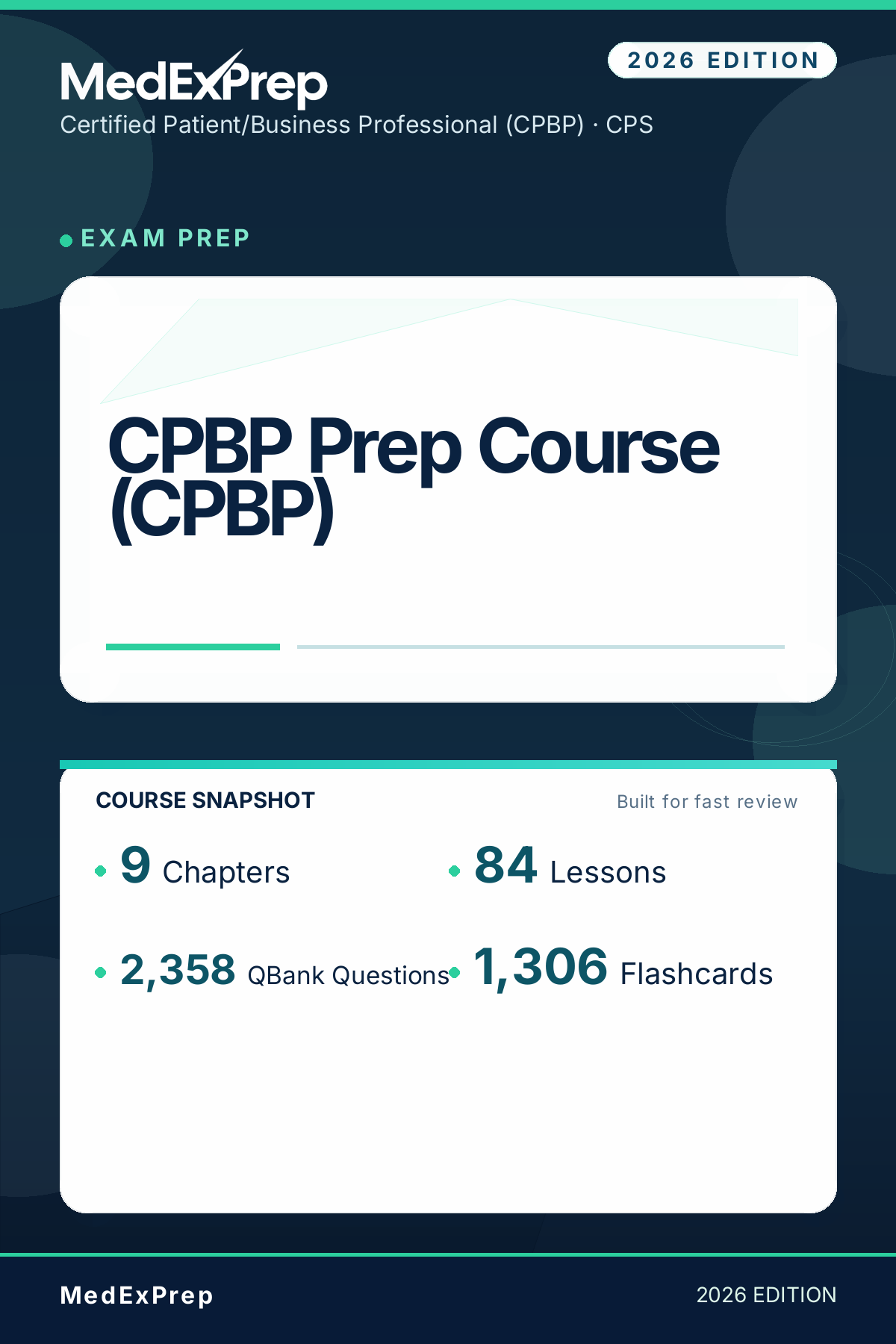
Exam: Certified Patient/Business Professional (CPBP) · Organization: CPS
Includes: Lessons + Flashcards + QBank
Audience: CPBP candidates preparing for a professional certification exam in patient/business operations, billing, practice administration, reimbursement, documentation, and compliance-aware healthcare administrative workflows. Include both first-time test takers and working professionals seeking structured, exam-focused review.
Goals:
- By the end of this course, learners will be able to:
- Explain the CPBP exam scope using an explicit domain map and understand how topics connect across patient access, billing, reimbursement, documentation, compliance, and practice operations; if official weighting is unavailable, use balanced coverage and state that weighting is not confirmed.
- Master high-yield concepts, definitions, and workflow rules for healthcare business operations, including front-end registration processes, back-end revenue cycle steps, reimbursement basics, documentation sufficiency, privacy/compliance expectations, and operational communication.
- Apply concepts in realistic CPBP-style scenarios involving scheduling, registration, eligibility/benefit verification, referrals/authorizations, charge/claim workflow, payment posting, denials, underpayments, accounts receivable follow-up, and documentation/compliance checkpoints.
- Solve common calculation and logic tasks accurately when applicable, including timelines, deadlines, patient responsibility basics, reimbursement reasoning, sequencing, and best-next-step workflow decisions; show steps and avoid shortcut-only solutions.
- Distinguish common distractors, misconceptions, and boundary cases such as look-alike front-end vs back-end tasks, documentation vs authorization issues, payer-rule vs office-policy confusion, and compliant vs merely convenient actions.
- Use a consistent problem-solving framework: identify the task -> extract key facts -> select the governing rule, policy, or workflow -> execute -> verify for accuracy, compliance, and completeness.
- Build retrieval-ready memory using concise tables, checklists, compare/contrast summaries, denial-prevention frameworks, revenue-cycle flow maps, and spaced review recaps.
- Demonstrate readiness through self-check questions, domain quizzes, and mini-assessments mapped to each domain/subskill.
- Coverage and blueprint mapping requirements:
- Map every chapter, section, subsection, lesson, and assessment item to at least one tag in the format DOMAIN: Objective -> Subskill.
- If an official CPS CPBP blueprint is unavailable, incomplete, or broad, use a transparent inferred domain map appropriate for CPBP preparation and ensure no domain/objective is left unmapped.
- Use an inferred domain structure that covers, at minimum: healthcare business operations foundations; patient access/registration/front-end processes; claims, billing, and revenue cycle workflow; reimbursement, payer rules, and financial basics; documentation/medical record/audit readiness; compliance, privacy, and regulatory-aware operations; practice administration, communication, and operational problem solving; and integrated case application/exam readiness.
- When blueprint language is broad, translate it into teachable subskills and label them consistently with DOMAIN: Objective -> Subskill tags.
- Do not invent official weighting, proprietary policies, unpublished specifications, or jurisdiction-specific mandates.
- When payer, employer, state, software, or institution rules vary, provide learner-safe guidance such as: Local policies vary; confirm with your organization or current official source.
- Keep content within the likely CPBP candidate role, emphasizing healthcare administrative/business operations, billing, reimbursement workflow, documentation linkage, and compliance-aware decision-making rather than deep clinical or specialty-coding detail unless explicitly supported by source materials.
- Prefer balanced coverage unless official CPS weighting is provided, with modest emphasis on workflow application, billing/reimbursement processes, documentation sufficiency, and compliance-aware administrative judgment.
Access is granted immediately after purchase.