Description
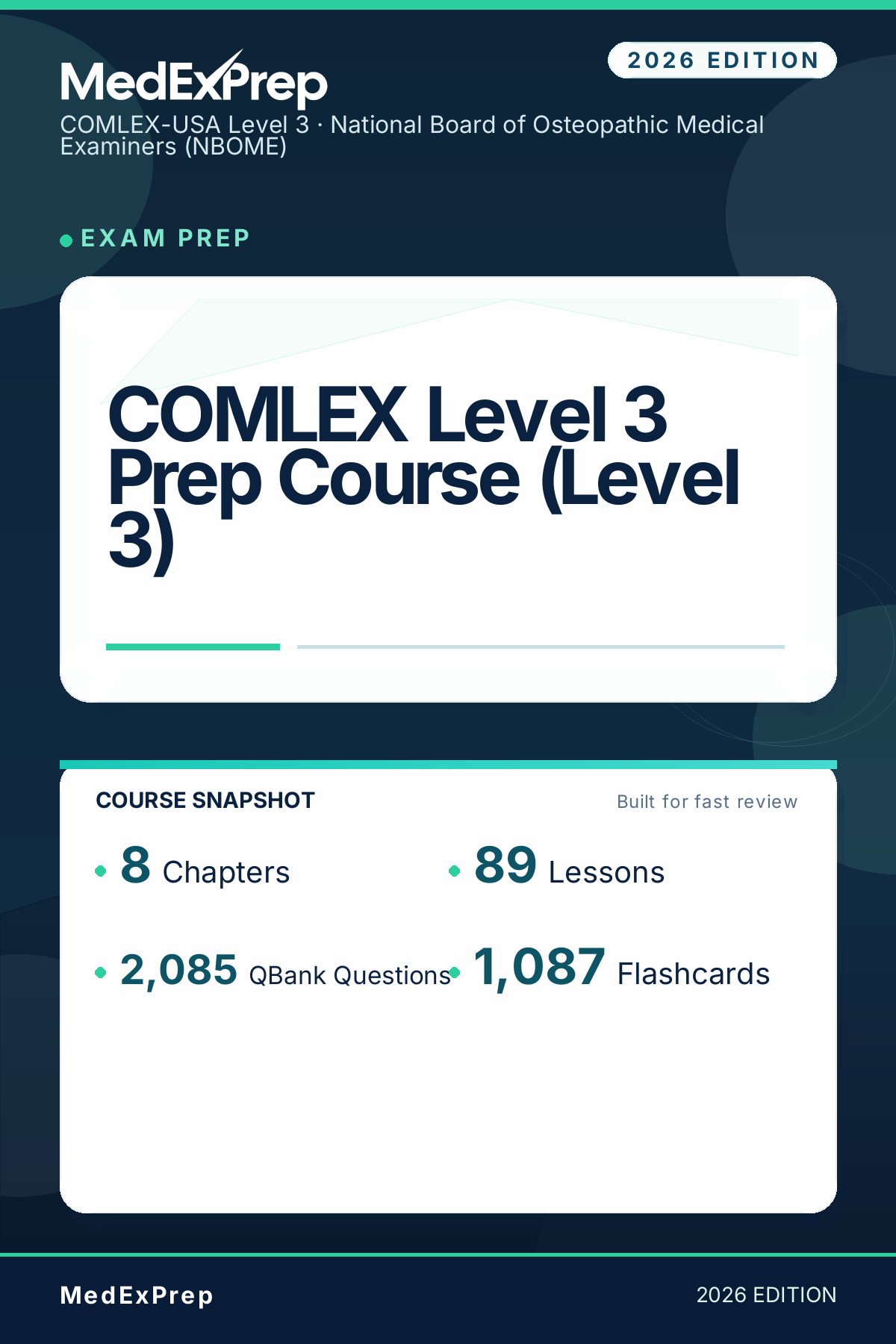
COMLEX Level 3 Prep Course (Level 3)
Physicians preparing for COMLEX-USA Level 3, typically osteopathic residents or graduates seeking licensure-level readiness in unsupervised clinical decision-making. Key goals: By the end of this course, learners will be able to:; Explain the exam framework/major competency areas for COMLEX-USA Level 3 and organize study by broad physician tasks, patient presentations, and osteopathic clinical reasoning; if official weighting or blueprint detail is limited, explicitly map lessons to inferred domains and flag any coverage uncertainty rather than guessing..
Exam: COMLEX-USA Level 3 · Organization: National Board of Osteopathic Medical Examiners (NBOME)
Includes: Lessons + Flashcards + QBank
Audience: Physicians preparing for COMLEX-USA Level 3, typically osteopathic residents or graduates seeking licensure-level readiness in unsupervised clinical decision-making.
Goals:
- By the end of this course, learners will be able to:
- Explain the exam framework/major competency areas for COMLEX-USA Level 3 and organize study by broad physician tasks, patient presentations, and osteopathic clinical reasoning; if official weighting or blueprint detail is limited, explicitly map lessons to inferred domains and flag any coverage uncertainty rather than guessing.
- Master high-yield licensure-level concepts for physician management across ambulatory, inpatient, emergency, preventive, behavioral, pediatric, obstetric/gynecologic, and adult medicine settings, including diagnosis, stabilization, treatment, monitoring, disposition, and follow-up.
- Apply osteopathic principles and practice when clinically relevant, including integrating structural findings, recognizing indications/contraindications for osteopathic manipulative treatment, and selecting OMT appropriately as part of whole-person care rather than as a forced add-on.
- Apply concepts in realistic exam-style scenarios that emphasize physician-level judgment: identify unstable vs stable patients, choose the most appropriate next step, prioritize differentials, interpret labs/imaging, initiate evidence-based therapy, and determine disposition.
- Solve common clinical calculation and logic tasks accurately when applicable, including medication dosing, fluids, acid-base interpretation, risk/biostatistics interpretation, and screening/prevention decisions; show steps and avoid shortcuts that hide reasoning.
- Distinguish common distractors, near-miss diagnoses, contraindications, red flags, and management boundary cases that are frequently tested in licensure-style clinical reasoning questions.
- Use a consistent problem-solving framework: identify the task → assess acuity/safety → extract key facts → select the governing rule or guideline-based principle → execute the best next step → verify against contraindications, alternatives, and disposition needs.
- Build retrieval-ready memory using concise tables, algorithms, checklists, illness scripts, and spaced review summaries tailored to broad generalist physician practice.
- Demonstrate readiness through self-check questions and mini-assessments mapped to each course domain, ensuring every chapter/section/subsection/topic maps to at least one explicit competency tag.
- Coverage & Blueprint Mapping Requirements:
- Every chapter, section, subsection, and topic must map to at least one exam-relevant domain/objective, even if the public blueprint language is broad or incomplete.
- Use consistent tags that translate broad exam expectations into teachable subskills, such as: CLINICAL DECISION-MAKING, ACUITY & STABILIZATION, DIAGNOSIS & DIFFERENTIAL, TEST SELECTION & INTERPRETATION, MANAGEMENT & THERAPEUTICS, PREVENTION & SCREENING, ETHICS/PROFESSIONALISM/PATIENT SAFETY, OSTEOPATHIC PRINCIPLES & OMT, DISPOSITION & FOLLOW-UP, and CLINICALLY RELEVANT BIOSTATS/CALCULATIONS.
- Ensure complete coverage across adult, pediatric, women’s health/obstetric-gynecologic, behavioral, preventive, emergency, inpatient, and ambulatory care contexts expected of a licensure-readiness osteopathic physician.
- Keep candidate role strictly physician-level: lessons should assume responsibility for diagnosis, treatment initiation, stabilization, counseling, prescribing, consultation, and disposition, not student- or staff-level tasks.
- When blueprint or policy details are uncertain or institution-dependent, provide learner-safe guidance such as “local protocols vary; confirm with your institution,” instead of inventing specifics.
- Do not leave any domain unmapped; if an area is broad, subdivide it into practical subskills and map all generated content accordingly.
Access is granted immediately after purchase.