Description
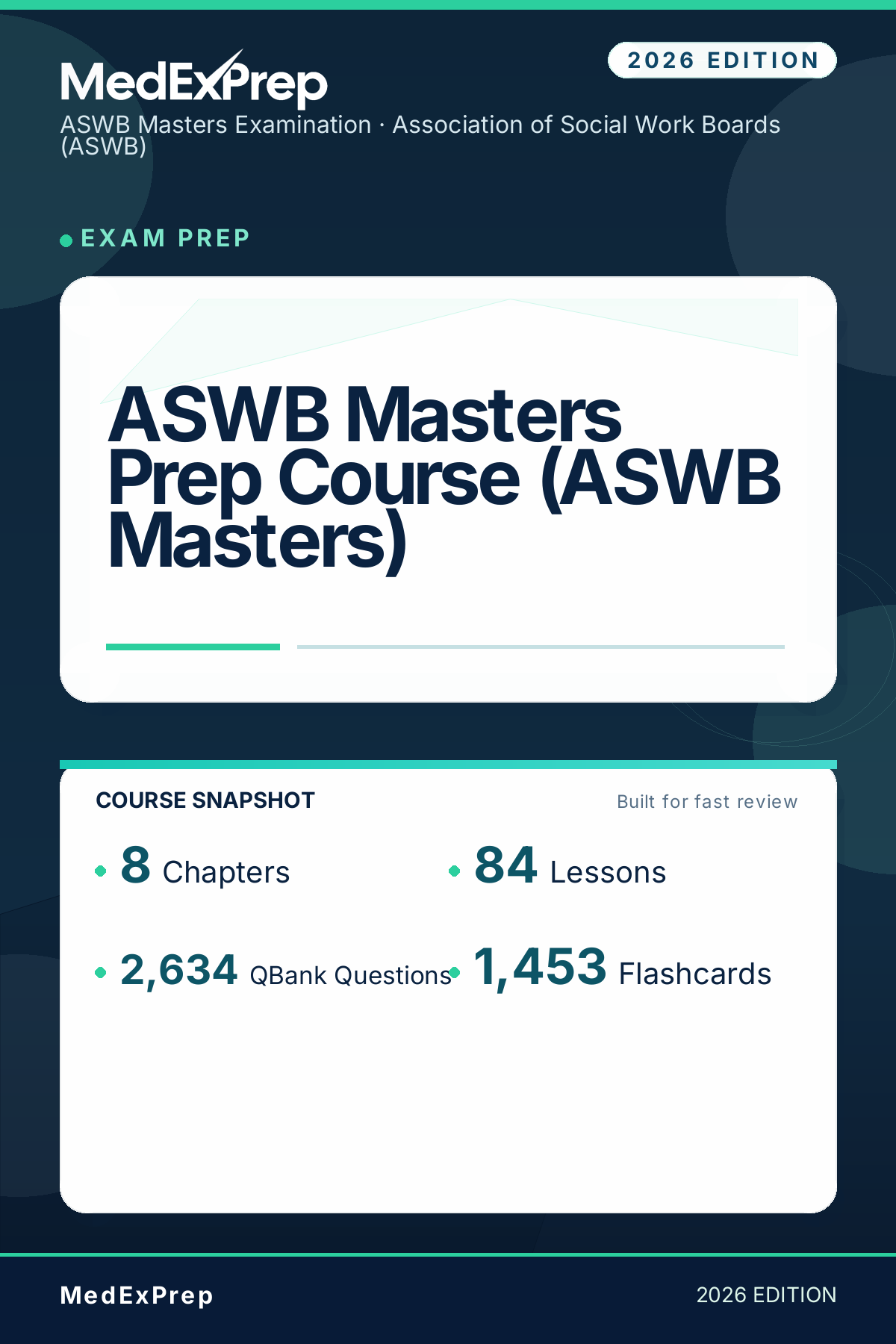
ASWB Masters Prep Course (ASWB Masters)
Master's-level social work candidates preparing for the ASWB Masters licensing exam, including recent MSW graduates and social workers seeking licensure at the master's level. Key goals: By the end of this course, learners will be able to:; Explain the major ASWB Masters exam content areas using current publicly available ASWB information and understand how topics are organized; include weighting only when supported by official public sources..
Exam: ASWB Masters Examination · Organization: Association of Social Work Boards (ASWB)
Includes: Lessons + Flashcards + QBank
Audience: Master's-level social work candidates preparing for the ASWB Masters licensing exam, including recent MSW graduates and social workers seeking licensure at the master's level.
Goals:
- By the end of this course, learners will be able to:
- Explain the major ASWB Masters exam content areas using current publicly available ASWB information and understand how topics are organized; include weighting only when supported by official public sources.
- Master high-yield master's-level social work concepts, definitions, practice principles, and ethical rules across human development, assessment, intervention planning, direct and indirect practice, professional relationships, crisis/safety, documentation, and evaluation.
- Apply concepts in realistic ASWB-style scenarios requiring best next step, most appropriate action, priority response, assessment-versus-intervention distinctions, and ethics-first reasoning when applicable.
- Use a consistent social work exam framework: identify the practice task → determine the client system and setting → extract key safety, ethical, cultural, and clinical facts → apply the governing practice principle/ethical standard/best-practice rule → choose the most appropriate action → verify why competing options are less appropriate.
- Distinguish common distractors frequently tested on the ASWB Masters exam, including first intervention versus next intervention, crisis response versus routine response, confidentiality versus duty to protect/report, rapport building versus boundary violation, assessment versus intervention, premature referral, and actions beyond master's-level scope.
- Prioritize immediate safety, abuse/neglect recognition, risk screening, mandated-reporting awareness, consultation, and continuity-of-care decisions within the candidate's master's-level role.
- Build retrieval-ready memory using concise tables, comparison grids, checklists, decision algorithms, and spaced review summaries.
- Demonstrate readiness through self-check questions and mini-assessments mapped to each major content area and teachable subskill.
- Coverage & Blueprint Mapping Requirements:
- Every chapter/section/subsection/topic must map to at least one ASWB Masters content area or a clearly labeled teachable subskill tag in the format DOMAIN: Content Area → Subskill.
- Ensure complete coverage across these major areas: Human Development, Diversity, and Behavior in the Environment; Assessment, Problem Identification, and Intervention Planning; Direct and Indirect Practice; Professional Relationships, Values, and Ethics; Crisis, Safety, Abuse, Neglect, and Risk; Documentation, Evaluation, and Practice Management.
- When official blueprint language is broad or non-specific, translate it into teachable subskills without claiming unofficial ASWB blueprint authority.
- Do not invent unofficial blueprint percentages, hidden categories, or jurisdiction-specific rules as universal facts.
- If a legal, reporting, title, or scope issue varies by jurisdiction, write learner-safe guidance such as: laws and reporting requirements vary by jurisdiction; confirm the rule in your licensing state.
- Keep all content within master's-level social work scope: emphasize what the master's social worker is expected to recognize, assess, prioritize, document, communicate, refer, and do next.
Access is granted immediately after purchase.