Description
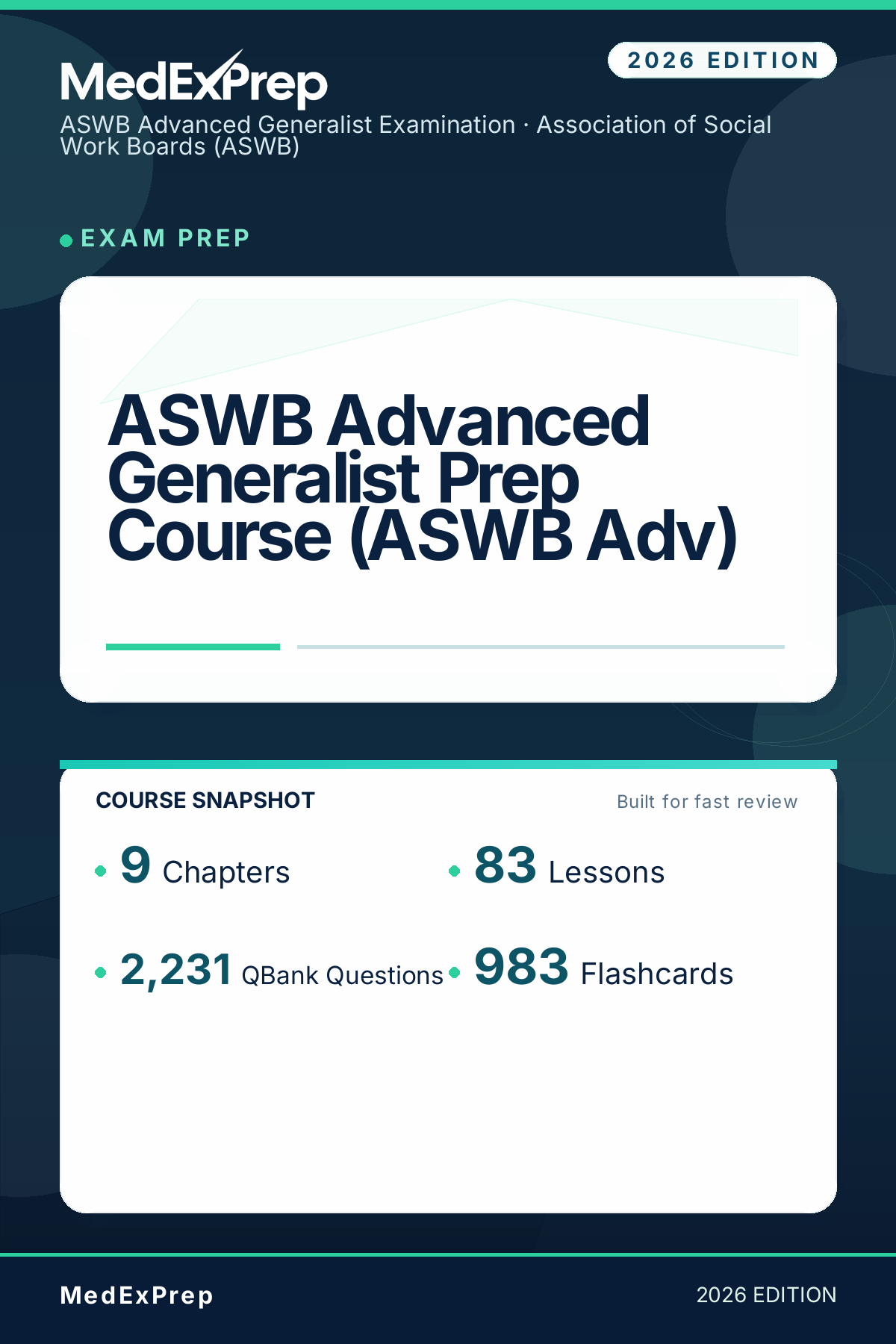
ASWB Advanced Generalist Prep Course (ASWB Adv)
Social workers preparing for the ASWB Advanced Generalist Examination, including candidates seeking advanced generalist-level licensure or credentialing where this exam is required. Learners should be taught to reason within the advanced generalist social work role across individuals, families, groups, organizations, and communities, with emphasis on ethics, safety, scope of practice, assessment, intervention planning, documentation, and systems-aware decision-making. Key goals: By the end of this course, learners will be able to:; Explain the exam content framework used for this prep course and how major domains connect to advanced generalist social work practice, without relying on unofficial ASWB weighting claims..
Exam: ASWB Advanced Generalist Examination · Organization: Association of Social Work Boards (ASWB)
Includes: Lessons + Flashcards + QBank
Audience: Social workers preparing for the ASWB Advanced Generalist Examination, including candidates seeking advanced generalist-level licensure or credentialing where this exam is required. Learners should be taught to reason within the advanced generalist social work role across individuals, families, groups, organizations, and communities, with emphasis on ethics, safety, scope of practice, assessment, intervention planning, documentation, and systems-aware decision-making.
Goals:
- By the end of this course, learners will be able to:
- Explain the exam content framework used for this prep course and how major domains connect to advanced generalist social work practice, without relying on unofficial ASWB weighting claims.
- Master the high-yield concepts, definitions, principles, and decision rules commonly tested in advanced generalist social work exam scenarios, including ethics, confidentiality, informed consent, boundaries, assessment, intervention planning, crisis/risk response, collaboration, and documentation.
- Apply concepts in realistic, exam-style social work scenarios involving individuals, families, groups, organizations, and communities, especially first/next/best-action, prioritization, ethics, and service-planning questions.
- Use a consistent exam reasoning framework: identify the task -> determine the practice context/client system -> extract key facts and risk cues -> select the governing principle or best action -> eliminate plausible distractors -> verify the most appropriate next step within role and scope.
- Distinguish common distractors and boundary cases, especially premature intervention before assessment, ignoring immediate safety concerns, actions outside scope, ethically appealing but not best first step choices, overly intrusive responses, poor documentation choices, and errors involving confidentiality, consent, duty-related reasoning, or mandated reporting principles.
- Build retrieval-ready memory using concise tables, checklists, comparison charts, cross-system decision frameworks, and spaced review summaries.
- Demonstrate readiness through self-checks and mini-assessments mapped across broad advanced generalist preparation domains such as professional values and ethics; human development and the social environment; assessment and formulation; intervention planning and direct/indirect practice; practice across systems; collaboration, supervision, and consultation; crisis, risk, and safety; and documentation and professional communication.
- Coverage & Blueprint Mapping Requirements:
- Every chapter, section, subsection, and topic must map to at least one exam domain, objective, or teachable subskill, even when official blueprint language is broad.
- Use consistent mapping tags in the format DOMAIN: Objective -> Subskill.
- Do not invent official ASWB blueprint wording, percentages, hidden domains, or scoring details.
- When official outline language is broad or unspecified, translate it into learner-ready, observable subskills and present them as course mapping language, not as official ASWB wording.
- Ensure complete coverage across the major advanced generalist preparation areas represented in the provided exam specification; no domain/objective should be left unmapped.
- Keep all content within the expected candidate role on the exam, emphasizing what the social worker should do first, next, or best while honoring ethics, client safety, least intrusive appropriate action, scope of practice, and systems context.
- For legal, policy, confidentiality, mandated reporting, duty-to-protect/warn, or documentation topics that vary by jurisdiction or agency, teach the broadly applicable exam-relevant principle and include learner-safe guidance such as: Laws and agency policies vary; confirm local requirements.
Access is granted immediately after purchase.