Description
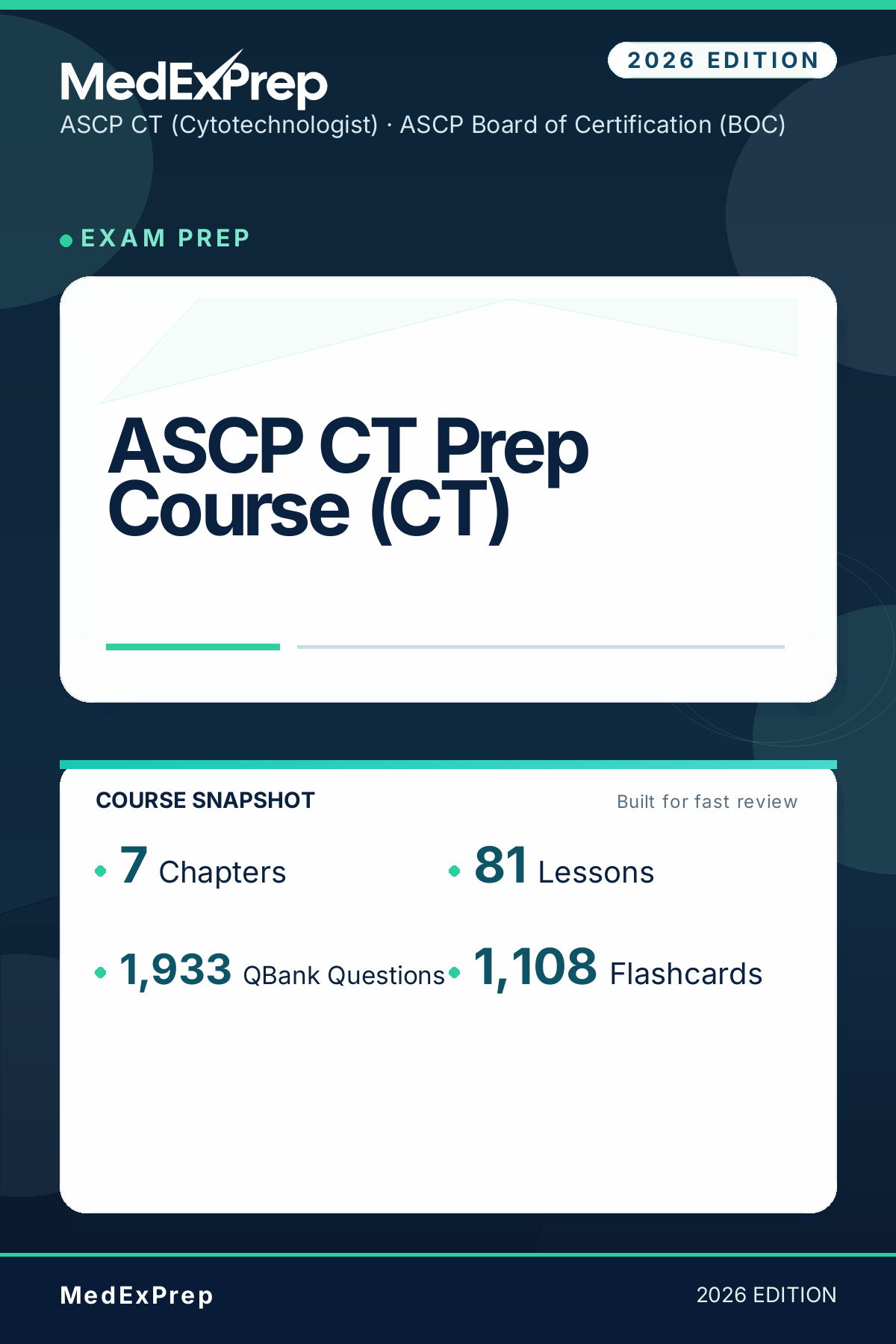
ASCP CT Prep Course (CT)
Cytotechnology certification candidates preparing for the ASCP BOC CT exam, including recent graduates of accredited cytotechnology programs and eligible laboratory professionals seeking initial CT certification. Key goals: By the end of this course, learners will be able to:; Explain the ASCP CT exam scope using learner-facing domain mappings and organize study by major content areas relevant to CT preparation; confirm current exam emphasis with the latest ASCP BOC content guideline..
Exam: ASCP CT (Cytotechnologist) · Organization: ASCP Board of Certification (BOC)
Includes: Lessons + Flashcards + QBank
Audience: Cytotechnology certification candidates preparing for the ASCP BOC CT exam, including recent graduates of accredited cytotechnology programs and eligible laboratory professionals seeking initial CT certification.
Goals:
- By the end of this course, learners will be able to:
- Explain the ASCP CT exam scope using learner-facing domain mappings and organize study by major content areas relevant to CT preparation; confirm current exam emphasis with the latest ASCP BOC content guideline.
- Master high-yield cytotechnology concepts, terminology, morphologic discriminators, adequacy principles, preparation methods, staining concepts, artifacts, and laboratory practice rules across gynecologic cytology, non-gynecologic cytology, fine-needle aspiration concepts/correlation, specimen handling, screening/interpretation, quality assurance, safety, workflow, and professionalism.
- Apply cytotechnology knowledge in realistic exam-style scenarios at the CT candidate level: identify findings, assess adequacy, recognize normal/reactive/infectious/premalignant/malignant patterns, correlate clinical and specimen context, and select the single best answer without drifting into pathologist-only authority.
- Use a consistent problem-solving framework: identify the task -> extract key morphologic and clinical clues -> select the governing cytology principle, adequacy rule, or classification concept -> eliminate close distractors and common mimics -> verify the best answer.
- Distinguish common distractors, look-alikes, contaminants, preparation artifacts, threshold distinctions, and boundary cases frequently tested in gynecologic and non-gynecologic cytology.
- Apply specimen collection, fixation, staining, labeling, transport, preservation, and preparation principles; recognize causes of low cellularity, obscuring factors, and other adequacy limitations.
- Demonstrate judgment in CT-relevant quality systems, laboratory operations, specimen integrity, safety, infection control, confidentiality, professionalism, and ethics scenarios within entry-level CT scope.
- Build retrieval-ready memory using concise tables, adequacy checklists, differential frameworks, classification crosswalks, and spaced review summaries.
- Demonstrate readiness through self-check questions and mini-assessments mapped to each learner-facing domain and subskill tag.
- Coverage & Blueprint Mapping Requirements:
- Every chapter, section, subsection, and topic must map to at least one learner-facing exam domain/objective/subskill tag in the format DOMAIN: Objective -> Subskill.
- Use public ASCP CT content guidance where available. Do not claim unpublished blueprint wording, percentages, or confidential scoring details as official.
- When blueprint language is broad or current wording is uncertain, translate it into transparent teachable subskills and label them consistently. Example domains may include: Gynecologic Cytology; Non-Gynecologic Cytology; Fine-Needle Aspiration Concepts/Correlation; Specimen Collection and Preparation; Screening and Interpretation Principles; Quality Assurance and Quality Control; Laboratory Operations and Workflow; Safety, Professionalism, and Ethics.
- Ensure balanced coverage across gynecologic cytology, non-gynecologic cytology, FNA concepts/correlation, specimen collection/preparation, screening/interpretation, QA, laboratory operations, safety, and professionalism/ethics.
- No domain/objective should be left unmapped. If a detail is uncertain or institution-specific, use learner-safe wording such as: "Local protocols vary; confirm with your institution" or "Confirm current exam emphasis with the latest ASCP BOC content guideline." Do not guess or insert internal review notes.
- Keep all teaching and assessment within CT candidate scope: recognition, adequacy assessment, pattern differentiation, classification-oriented interpretation, correlation, workflow, and safe laboratory practice. Exclude independent pathologist-only sign-out authority and advanced treatment-management decisions beyond exam needs.
Access is granted immediately after purchase.