Description
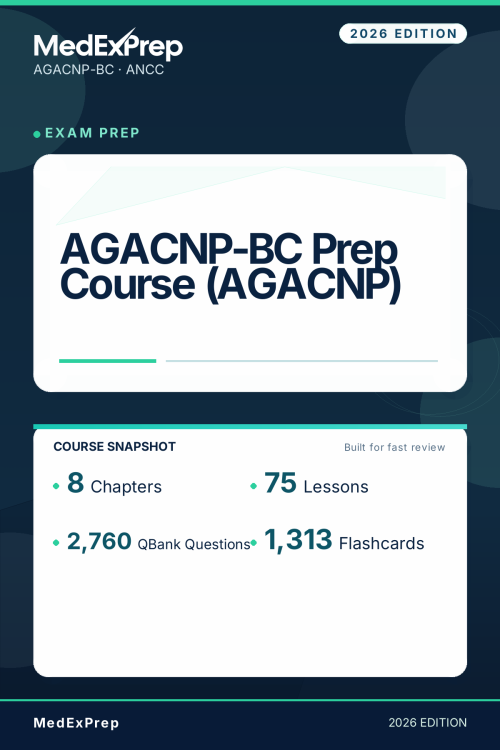
ACNP-BC Prep Course (ACNP)
Nurse practitioner candidates preparing for the ANCC adult-gerontology acute care nurse practitioner board exam, including recent graduates seeking initial acute care NP certification and practicing NPs pursuing initial certification in adult-gerontology acute care. Key goals: By the end of this course, learners will be able to:; Explain the ANCC AGACNP-BC prep framework used in this course and how topics are organized, while recognizing that official domain wording/weighting should be used only if explicitly provided..
Exam: Adult-Gerontology Acute Care Nurse Practitioner–Board Certified (AGACNP-BC) — ACNP-BC prep context as titled · Organization: American Nurses Credentialing Center (ANCC)
Includes: Lessons + Flashcards + QBank
Audience: Nurse practitioner candidates preparing for the ANCC adult-gerontology acute care nurse practitioner board exam, including recent graduates seeking initial acute care NP certification and practicing NPs pursuing initial certification in adult-gerontology acute care.
Goals:
- By the end of this course, learners will be able to:
- Explain the ANCC AGACNP-BC prep framework used in this course and how topics are organized, while recognizing that official domain wording/weighting should be used only if explicitly provided.
- Master high-yield adult-gerontology acute care concepts across advanced assessment, differential diagnosis, diagnostics/data interpretation, acute and critical illness management, pharmacology/therapeutics, procedures/safety/monitoring, transitions of care, and professional/legal/ethical practice.
- Apply concepts in realistic board-style scenarios involving adults and older adults in acute, inpatient, critical care, and urgent stabilization settings using role-appropriate NP reasoning.
- Use a consistent clinical decision framework: identify the task → determine acuity/stability → extract key findings → select the governing rule or best next step → execute → verify safety, escalation needs, and role appropriateness.
- Interpret common acute care data accurately when applicable, including laboratory trends, acid-base patterns, ECG-level findings, oxygenation/ventilation concepts, hemodynamic/shock patterns, imaging summaries, and medication/calculation tasks, showing steps rather than relying on hidden shortcuts.
- Distinguish look-alike diagnoses, common distractors, contraindications, escalation triggers, consultation thresholds, and boundary cases frequently tested in adult-gerontology acute care board prep.
- Build retrieval-ready memory using concise tables, illness scripts, stabilization algorithms, checklists, and spaced-review summaries.
- Demonstrate readiness through self-checks and mini-assessments mapped to all covered topic areas.
- Coverage & Blueprint Mapping Requirements:
- Every chapter/section/subsection/topic must map to at least one blueprint domain/objective or learner-facing teaching tag.
- Do not invent official ANCC blueprint domain names, percentages, or objectives if they are not explicitly supplied in the source materials.
- When official blueprint language is broad or unavailable, translate content into teachable subskills and label them consistently as: DOMAIN: Objective → Subskill.
- Ensure no covered domain/objective is left unmapped.
- Use transparent prep domains when needed, such as: DOMAIN: Assessment & Clinical Reasoning; DOMAIN: Acute Illness & Critical Care Management; DOMAIN: Diagnostics & Data Interpretation; DOMAIN: Pharmacology & Therapeutics; DOMAIN: Procedures, Safety & Monitoring; DOMAIN: Transitions of Care & Health Promotion; DOMAIN: Professional, Legal, Ethical & Systems Practice.
- Keep scope strictly within adult-gerontology acute care NP candidate practice: adults and older adults only; acute/inpatient/critical care and transition contexts relevant to certification prep.
- Emphasize patient safety, stabilization priorities, monitoring trends, complication recognition, collaboration, and escalation/consultation when appropriate.
- Exclude pediatric-focused management and avoid unsupported institution-specific privileging assumptions.
- If a detail depends on local policy, formulary, credentialing, or protocol, write learner-safe guidance such as: Local protocols vary; confirm with your institution.
Access is granted immediately after purchase.