Description
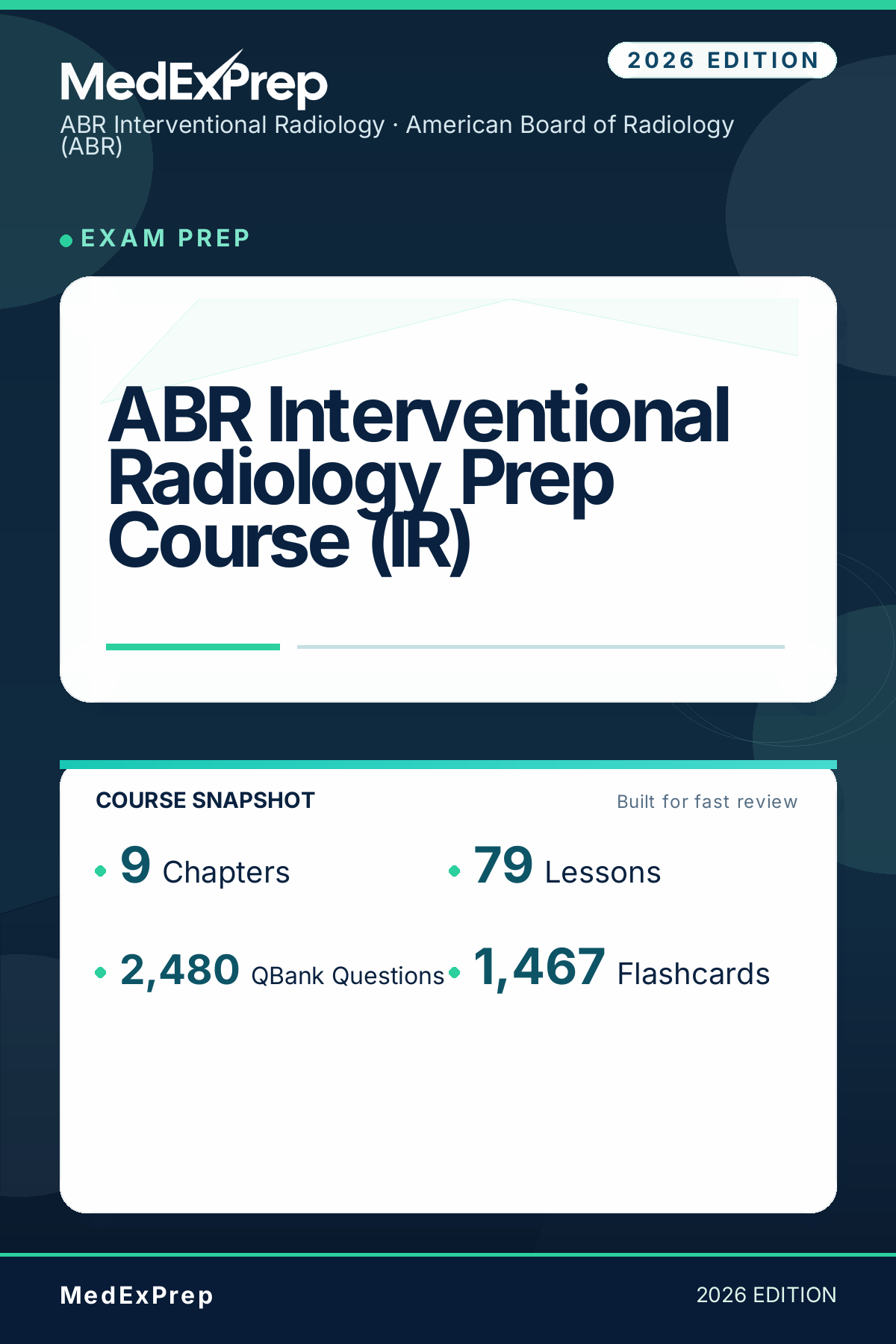
ABR Interventional Radiology Prep Course (IR)
Physicians preparing for the ABR Interventional Radiology examination, including diagnostic radiology residents, integrated interventional radiology trainees, independent interventional radiology trainees, and practicing radiologists seeking focused board-style preparation in interventional radiology. Key goals: By the end of this course, learners will be able to:; Explain the exam blueprint/domain structure used for this course and how each lesson maps to ABR Interventional Radiology content areas; when official blueprint granularity is limited, use consistent inferred tags in the format DOMAIN: Objective -> Subskill..
Exam: ABR Interventional Radiology · Organization: American Board of Radiology (ABR)
Includes: Lessons + Flashcards + QBank
Audience: Physicians preparing for the ABR Interventional Radiology examination, including diagnostic radiology residents, integrated interventional radiology trainees, independent interventional radiology trainees, and practicing radiologists seeking focused board-style preparation in interventional radiology.
Goals:
- By the end of this course, learners will be able to:
- Explain the exam blueprint/domain structure used for this course and how each lesson maps to ABR Interventional Radiology content areas; when official blueprint granularity is limited, use consistent inferred tags in the format DOMAIN: Objective -> Subskill.
- Master the high-yield concepts, definitions, indications, contraindications, anatomy, imaging findings, devices, materials, and safety rules relevant to interventional radiology board preparation.
- Apply interventional radiology knowledge in realistic exam-style scenarios involving patient selection, pre-procedure evaluation, image-guided procedural planning, intra-procedural decision-making, troubleshooting, complication recognition, and post-procedure care.
- Solve calculation and logic tasks accurately when applicable, including explicit stepwise reasoning for sedation/monitoring, coagulation and anticoagulation concepts, contrast considerations, radiation safety, hemodynamics, and device/planning decisions.
- Distinguish common distractors, unsafe choices, look-alikes, and boundary cases frequently tested in physician-level IR questions, especially where the best answer depends on the safest appropriate next step.
- Use a consistent problem-solving framework: identify the task -> extract key clinical and imaging facts -> select the governing rule or best next step -> execute the decision pathway -> verify safety, appropriateness, and alternatives.
- Build retrieval-ready memory using concise tables, checklists, anatomy/procedure summaries, complication frameworks, comparison grids, and spaced-review summaries.
- Demonstrate readiness through self-checks, domain quizzes, and mini-assessments mapped to each blueprint area.
- Coverage and blueprint mapping requirements:
- Every chapter, section, subsection, and topic must map to at least one blueprint domain/objective.
- Ensure complete coverage across these course domains: FOUNDATIONS; PERIPROCEDURAL_CARE; VASCULAR_INTERVENTION; EMBOLIZATION; INTERVENTIONAL_ONCOLOGY; HEPATOBILIARY_GI_GU; VENOUS_AND_DIALYSIS_ACCESS; TRAUMA_EMERGENCY_IR.
- For broad blueprint language, translate content into teachable subskills and label them consistently as DOMAIN: Objective -> Subskill.
- No domain/objective may be left unmapped.
- Stay within the expected physician candidate role: selecting, planning, performing, troubleshooting, and managing image-guided interventional procedures at an exam-appropriate level.
- Do not invent nonpublic ABR weighting claims or unsupported blueprint details.
- If institutional protocols vary, provide learner-safe guidance such as 'Local protocols vary; confirm with your institution.'
- Prioritize indications/contraindications, device and material selection, complication avoidance/rescue, and post-procedure management throughout.
Access is granted immediately after purchase.