Description
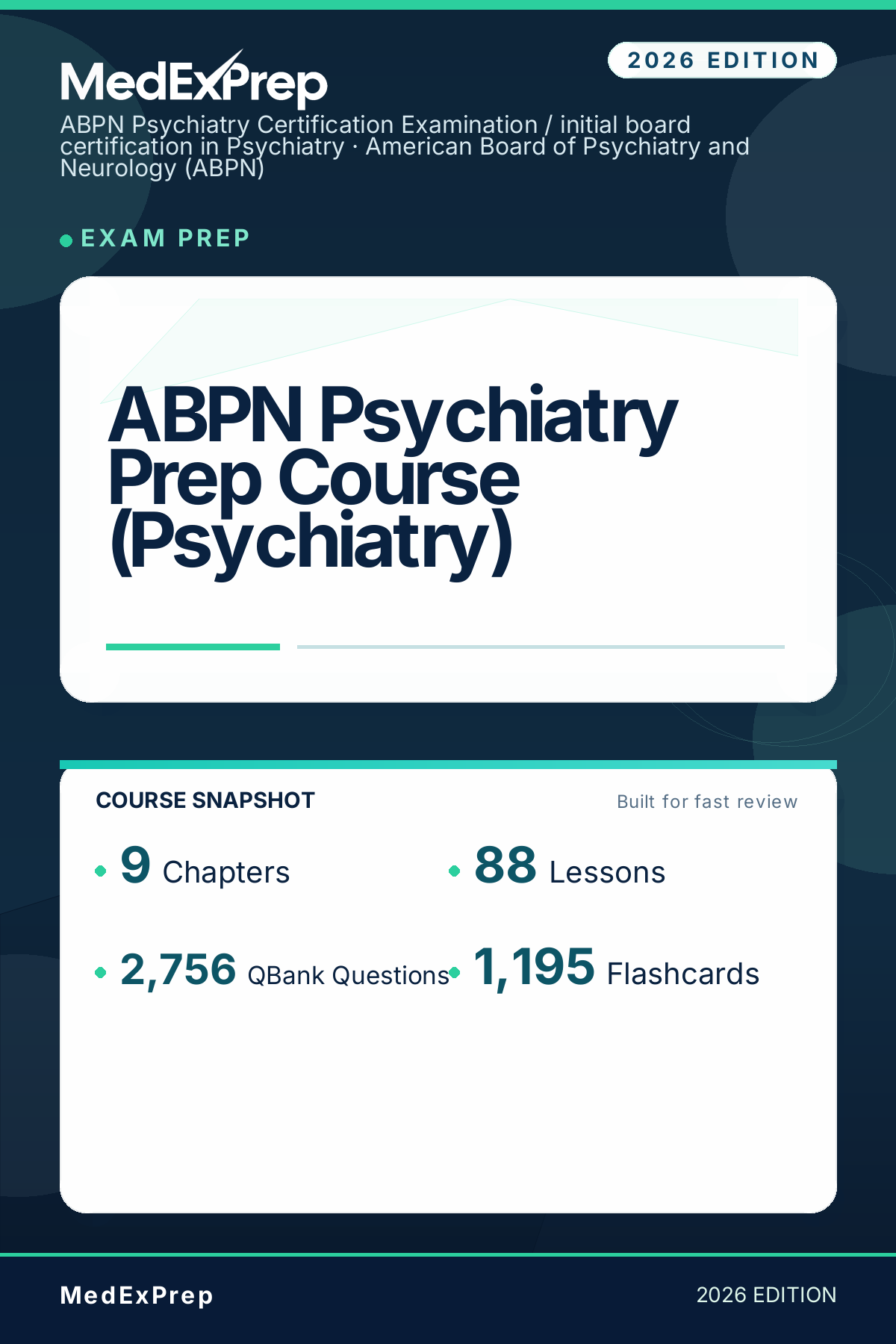
ABPN Psychiatry Prep Course (Psychiatry)
Psychiatry board candidates, including senior residents and psychiatrists preparing for initial ABPN Psychiatry certification or a structured board review course. Key goals: By the end of this course, learners will be able to:; Explain the exam framework for ABPN Psychiatry preparation and organize study by major psychiatry domains, without assuming unpublished weights or hidden scoring rules..
Exam: ABPN Psychiatry Certification Examination / initial board certification in Psychiatry · Organization: American Board of Psychiatry and Neurology (ABPN)
Includes: Lessons + Flashcards + QBank
Audience: Psychiatry board candidates, including senior residents and psychiatrists preparing for initial ABPN Psychiatry certification or a structured board review course.
Goals:
- By the end of this course, learners will be able to:
- Explain the exam framework for ABPN Psychiatry preparation and organize study by major psychiatry domains, without assuming unpublished weights or hidden scoring rules.
- Master high-yield, board-testable concepts across core psychiatry practice: psychiatric evaluation and mental status examination, DSM-based diagnostic formulation, differential diagnosis, psychopharmacology, psychotherapy, emergency psychiatry, consultation-liaison psychiatry, addiction psychiatry, child/adolescent psychiatry, geriatric psychiatry, neurocognitive and neurodevelopmental conditions, sleep-related disorders, and ethics/legal principles.
- Apply concepts in realistic board-style clinical scenarios requiring diagnosis, differential diagnosis, risk assessment, best next step, treatment selection, longitudinal management, and recognition of urgent complications.
- Use a consistent psychiatrist's decision framework: identify the task → extract discriminating clinical facts → formulate the leading diagnosis or risk state → select the governing rule or safest next step → eliminate tempting distractors → verify the choice against scope and safety.
- Recognize and manage psychiatric emergencies and urgent adverse effects, including suicidality, violence risk, agitation, intoxication/withdrawal syndromes, delirium, catatonia, serotonin syndrome, neuroleptic malignant syndrome, extrapyramidal symptoms, and lithium or other medication toxicities.
- Distinguish primary psychiatric disorders from medical, neurologic, developmental, cognitive, medication-induced, and substance-related conditions, and choose appropriate workup or referral when symptoms exceed routine psychiatric scope.
- Select evidence-aligned treatments, including psychotherapies, somatic therapies, and psychopharmacologic strategies, with attention to indications, contraindications, adverse effects, monitoring, and special populations across the lifespan.
- Apply core ethics and legal judgment relevant to psychiatry, including capacity, informed consent, confidentiality, involuntary treatment concepts, boundaries, documentation-oriented reasoning, and collateral information decisions.
- Build retrieval-ready memory using concise tables, checklists, comparison grids, adverse-effect summaries, and spaced-review synthesis.
- Demonstrate readiness through self-check questions and mini-assessments mapped to explicit psychiatry domains and subskills.
- Coverage and blueprint mapping requirements:
- Every chapter, section, subsection, and topic must map to at least one explicit psychiatry domain/subskill tag.
- Because publicly available ABPN blueprint detail may be broad, translate broad domains into teachable subskills using a consistent label format such as PSY Domain: Objective → Subskill.
- Ensure complete coverage across the major psychiatry board-prep domains listed above; do not leave any domain unmapped.
- Do not invent official ABPN percentages, hidden blueprint details, or unsupported scoring rules.
- When a content boundary is uncertain or may vary by jurisdiction or institution, provide learner-safe guidance such as: general principles apply; local laws or protocols vary, so confirm with your institution/jurisdiction.
- Keep all teaching within the role of a board-eligible psychiatrist; when a vignette exceeds psychiatric scope, emphasize stabilization, safety, appropriate medical evaluation, and consultation/referral.
Access is granted immediately after purchase.