Description
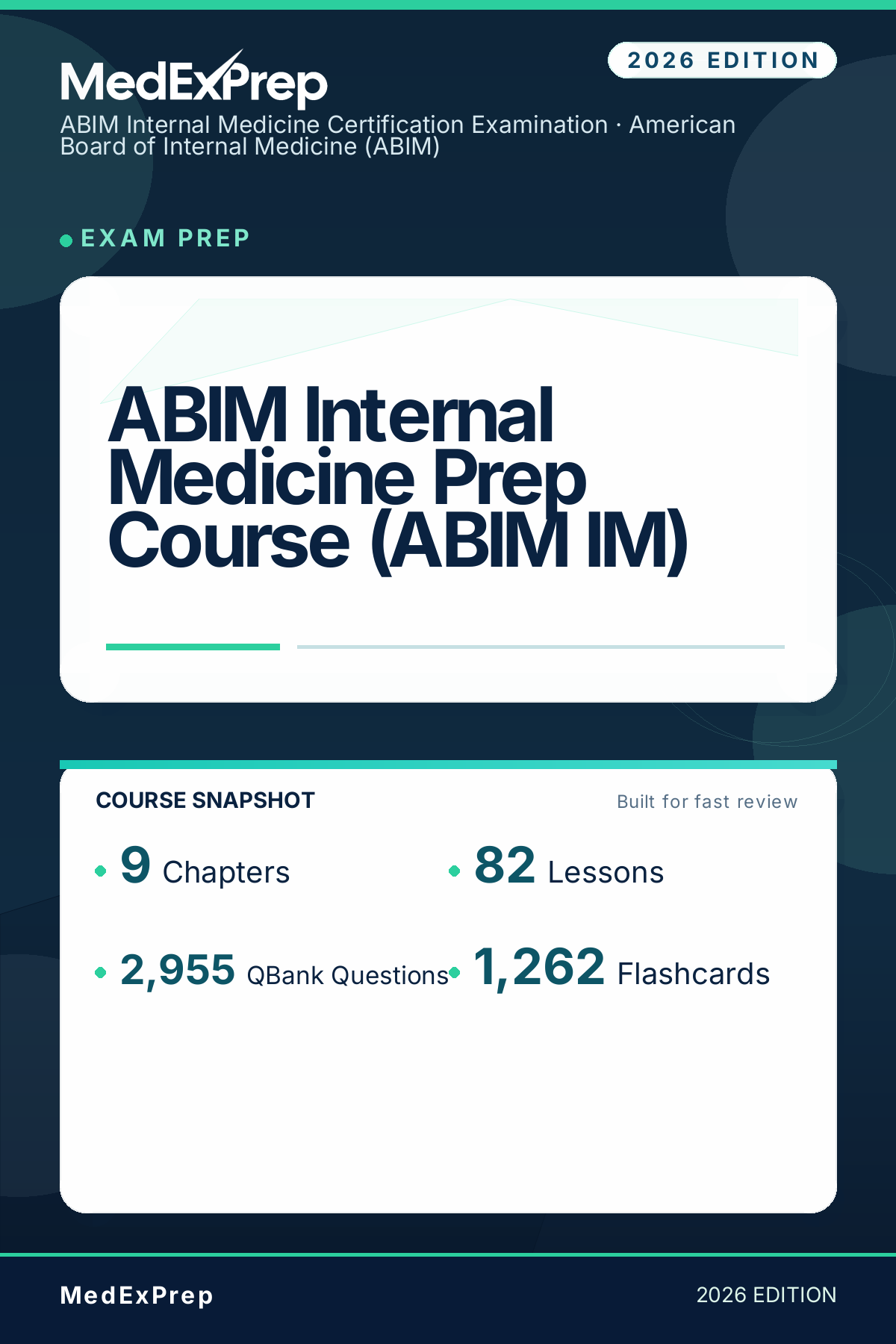
ABIM Internal Medicine Prep Course (ABIM IM)
Physicians and eligible trainees preparing for the ABIM Internal Medicine Certification Examination, including internal medicine residents, recent graduates, and re-certifying internists seeking broad, board-style review of adult internal medicine. Assume the learner is functioning in the role of an internist or internal medicine trainee making evidence-based diagnostic, management, prevention, and longitudinal care decisions for adult patients in ambulatory, inpatient, urgent, and transitional care scenarios. Key goals: By the end of this course, learners will be able to:; Explain the broad exam-relevant internal medicine domains and reasoning skills tested in ABIM-style board preparation without assigning unverified official weighting..
Exam: ABIM Internal Medicine Certification Examination · Organization: American Board of Internal Medicine (ABIM)
Includes: Lessons + Flashcards + QBank
Audience: Physicians and eligible trainees preparing for the ABIM Internal Medicine Certification Examination, including internal medicine residents, recent graduates, and re-certifying internists seeking broad, board-style review of adult internal medicine. Assume the learner is functioning in the role of an internist or internal medicine trainee making evidence-based diagnostic, management, prevention, and longitudinal care decisions for adult patients in ambulatory, inpatient, urgent, and transitional care scenarios.
Goals:
- By the end of this course, learners will be able to:
- Explain the broad exam-relevant internal medicine domains and reasoning skills tested in ABIM-style board preparation without assigning unverified official weighting.
- Master the high-yield concepts, definitions, illness scripts, and governing rules across adult internal medicine, including cardiovascular, pulmonary, renal, endocrine, hematology/oncology, infectious disease, rheumatology, gastroenterology/hepatology, neurology, dermatology, geriatrics, psychiatry/behavioral medicine, ethics, prevention, and multisystem/general internal medicine.
- Apply concepts in realistic, clinical vignette-based single-best-answer scenarios that emphasize diagnosis, best initial test, confirmatory testing, best next step in management, acute stabilization, chronic disease management, prevention, medication selection/avoidance, contraindications, complications, and follow-up.
- Accurately interpret common internal medicine data sources when applicable, including ECGs, ABGs, basic and advanced laboratory data, urinalysis, hemodynamics, imaging descriptions, microbiology results, and medication-related decision points.
- Solve calculation and logic tasks accurately when applicable, showing steps and clinical reasoning rather than relying on shortcuts that hide the decision process.
- Distinguish common distractors, mimics, misconceptions, and boundary cases frequently tested in board-style adult internal medicine questions.
- Use a consistent problem-solving framework: identify the clinical task → extract discriminating findings → localize the relevant organ system or theme → apply the governing rule, mechanism, or guideline-level principle → select the best answer → verify against age, comorbidities, acuity, and safety.
- Build retrieval-ready memory using concise tables, compare/contrast frameworks, diagnostic algorithms, treatment ladders, preventive care checklists, and spaced-review summaries.
- Demonstrate readiness through self-checks and mini-assessments mapped to exam-relevant domains and subskills.
- Coverage & Blueprint Mapping Requirements:
- Every chapter, section, subsection, and topic must map to at least one exam-relevant tag in the format DOMAIN: Organ System/Theme → Clinical Task → Subskill.
- Use broad ABIM-style internal medicine domain labels without claiming unpublished or unsupported official blueprint structure.
- Ensure complete coverage across adult internal medicine domains commonly relevant to board certification preparation, including cross-cutting subskills such as data interpretation, acute prioritization, risk stratification, medication safety, prevention, and distinguishing look-alike diagnoses.
- When blueprint language is broad or unspecified, translate it into teachable subskills and label them consistently.
- No domain should be left unmapped; if a content edge is uncertain, provide learner-safe guidance such as “Local protocols vary; confirm with your institution,” rather than guessing or inventing specifics.
- Do not invent percentages, hidden blueprint details, or unsupported exam structure claims; maintain broad, exam-focused coverage through mapping and explicit gap-aware labeling where needed.
Access is granted immediately after purchase.