Description
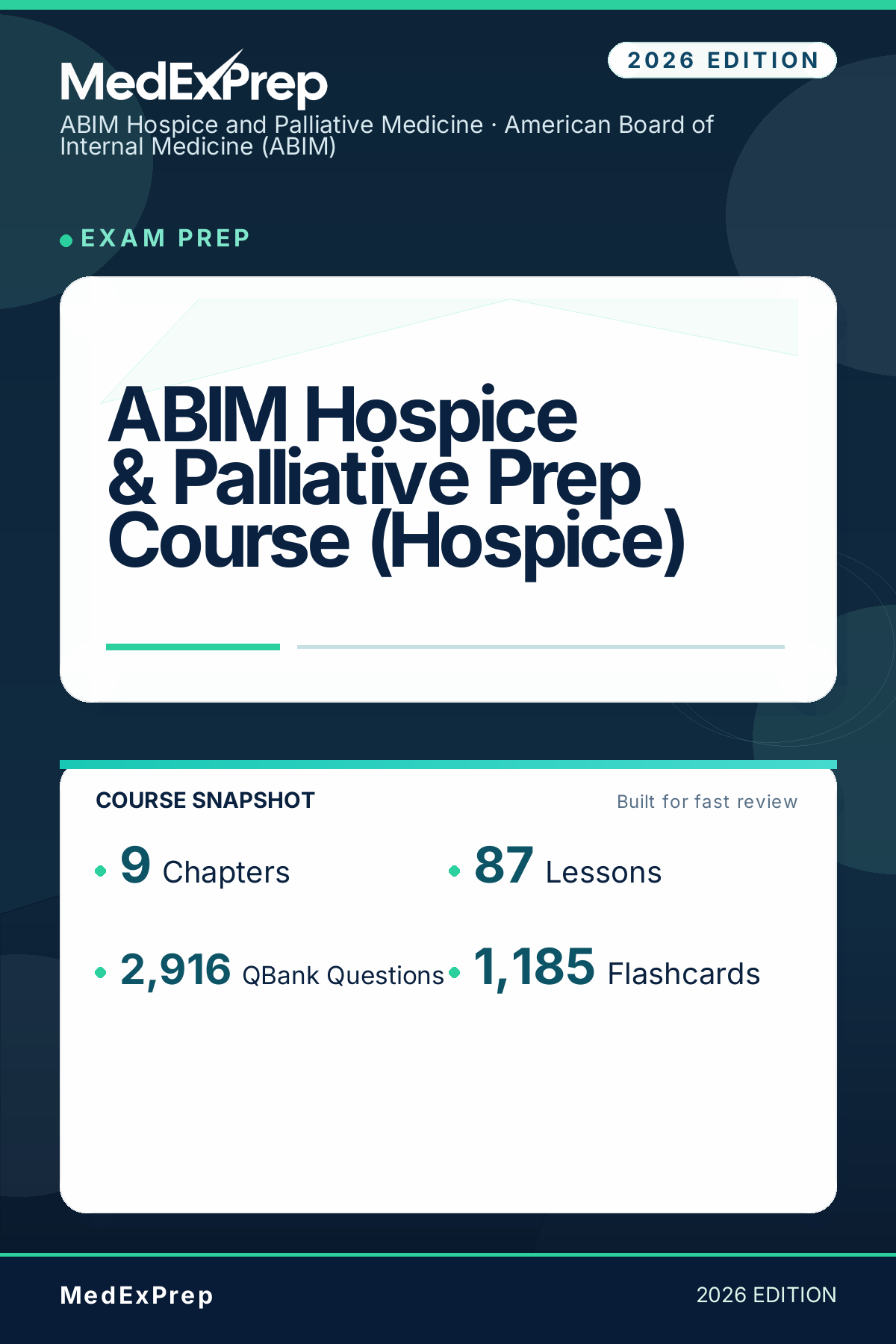
ABIM Hospice & Palliative Prep Course (Hospice)
Physicians preparing for the ABIM Hospice and Palliative Medicine certification or recertification examination, including internal medicine physicians and subspecialty candidates seeking a board-style, exam-focused review of hospice and palliative medicine. Key goals: By the end of this course, learners will be able to:; Explain the exam’s broad competency areas for ABIM Hospice and Palliative Medicine and use a domain-based study plan, while recognizing that detailed official weighting may not be publicly specified..
Exam: ABIM Hospice and Palliative Medicine · Organization: American Board of Internal Medicine (ABIM)
Includes: Lessons + Flashcards + QBank
Audience: Physicians preparing for the ABIM Hospice and Palliative Medicine certification or recertification examination, including internal medicine physicians and subspecialty candidates seeking a board-style, exam-focused review of hospice and palliative medicine.
Goals:
- By the end of this course, learners will be able to:
- Explain the exam’s broad competency areas for ABIM Hospice and Palliative Medicine and use a domain-based study plan, while recognizing that detailed official weighting may not be publicly specified.
- Master high-yield concepts, definitions, and decision rules in pain management, non-pain symptom management, serious-illness communication, goals of care, prognostication, hospice and end-of-life care, ethics/legal issues, psychosocial/spiritual care, interdisciplinary teamwork, and care across settings.
- Apply hospice and palliative medicine principles in realistic board-style clinical vignettes by choosing the most appropriate next step, safest management option, and goal-concordant plan.
- Use a consistent clinical reasoning framework: identify the task → extract key facts → determine the governing palliative principle or best next step → eliminate close distractors → verify safety, proportionality, and goal-concordance.
- Distinguish commonly tested distractors, including confusion between palliative care and hospice, interventions mismatched to prognosis or care setting, unsafe opioid/sedative choices, misapplied ethical reasoning, and failure to address psychosocial, spiritual, caregiver, or systems factors.
- Build retrieval-ready memory using concise algorithms, comparison tables, checklists, communication frameworks, and spaced-review summaries tailored to board preparation.
- Demonstrate readiness through self-checks and mini-assessments mapped to explicit domain/objective tags.
- Coverage & Blueprint Mapping Requirements:
- Every chapter/section/subsection/topic must map to at least one domain/objective tag.
- Because detailed official blueprint language may be broad or incomplete, translate broad topics into teachable subskills using a consistent format such as DOMAIN: Objective → Subskill.
- Ensure complete coverage across these exam-relevant domains: pain assessment and management; non-pain symptom management; communication/shared decision-making/goals of care; psychosocial, spiritual, and cultural aspects of care; prognostication and clinical trajectories; hospice, end-of-life care, and care across settings; ethical and legal issues; interdisciplinary teamwork and systems-based practice; and special populations/boundary cases.
- No domain/objective should be left unmapped. If a topic is not clearly specified in published blueprint language, map it to the closest broad domain and include a learner-facing gap flag such as: “Blueprint detail broad/unspecified here; mapped to high-yield hospice and palliative medicine subskills for complete exam-relevant coverage.”
- Do not invent unpublished ABIM blueprint details or exact weighting. When legal, regulatory, hospice operations, prescribing, or documentation rules vary by state, institution, or setting, use learner-safe wording such as: “Practice patterns and local regulations may vary; confirm with your institution and jurisdiction.”
Access is granted immediately after purchase.