Description
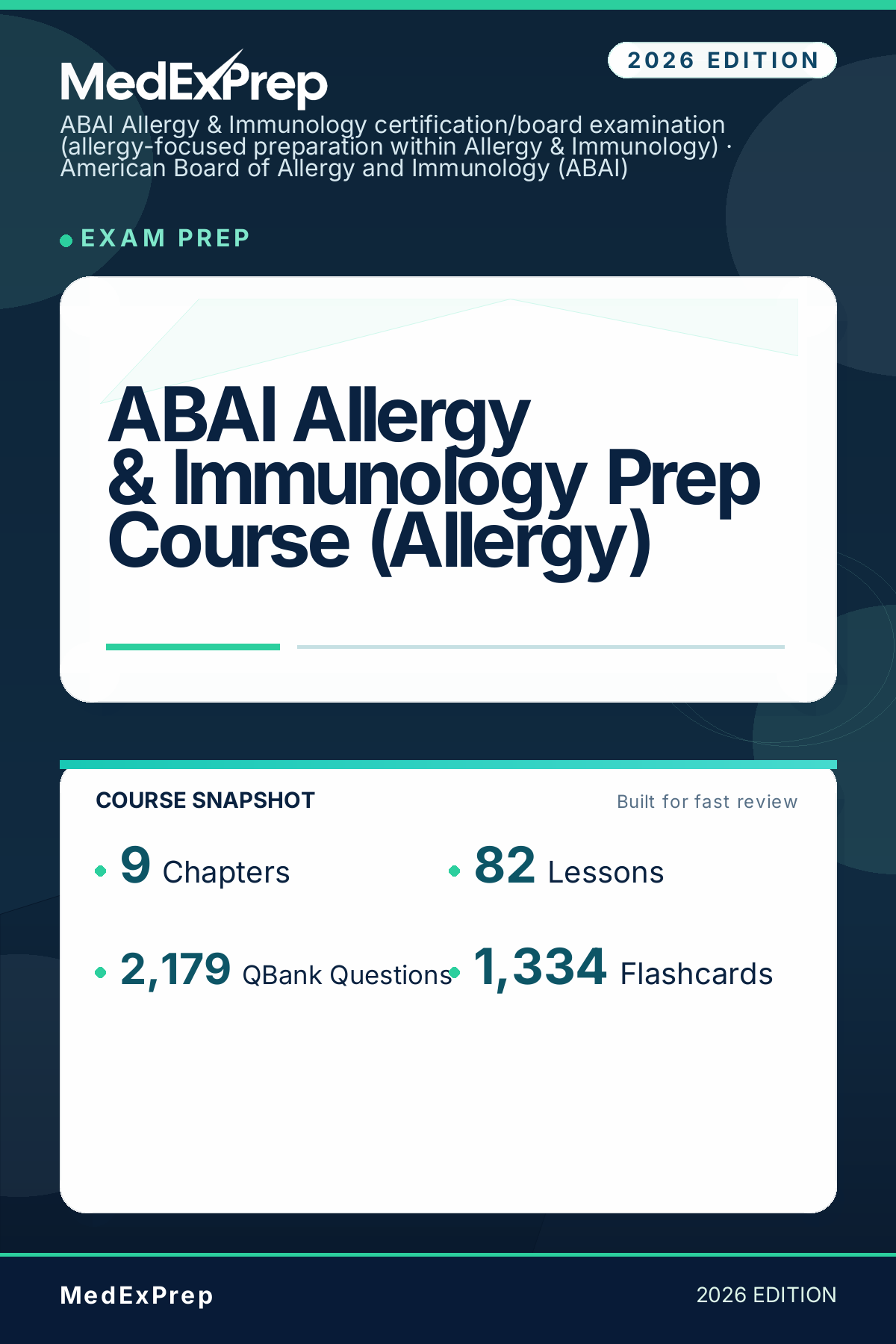
ABAI Allergy & Immunology Prep Course (Allergy)
Physicians and fellows preparing for the ABAI Allergy & Immunology board/certification examination, especially candidates seeking stronger preparation in allergy-focused content, clinical reasoning, diagnosis, testing interpretation, management, and patient safety. Key goals: By the end of this course, learners will be able to:; Explain the exam scope for ABAI Allergy & Immunology board preparation and organize study using practical derived domains for allergy-focused content, without assuming unpublished official weighting..
Exam: ABAI Allergy & Immunology certification/board examination (allergy-focused preparation within Allergy & Immunology) · Organization: American Board of Allergy and Immunology (ABAI)
Includes: Lessons + Flashcards + QBank
Audience: Physicians and fellows preparing for the ABAI Allergy & Immunology board/certification examination, especially candidates seeking stronger preparation in allergy-focused content, clinical reasoning, diagnosis, testing interpretation, management, and patient safety.
Goals:
- By the end of this course, learners will be able to:
- Explain the exam scope for ABAI Allergy & Immunology board preparation and organize study using practical derived domains for allergy-focused content, without assuming unpublished official weighting.
- Master the high-yield concepts, mechanisms, definitions, diagnostic criteria, and management rules for allergy-focused topics commonly tested in physician-level board scenarios.
- Apply concepts in realistic, board-style clinical vignettes involving diagnosis, differential diagnosis, best next step in evaluation, test interpretation, management selection, longitudinal care, and safety prioritization.
- Interpret allergy-relevant testing appropriately, including skin testing concepts, serum specific IgE context, challenge/desensitization concepts, and pulmonary or upper-airway data relevant to allergy practice.
- Recognize and manage high-risk presentations, including anaphylaxis, medication and procedure-related reactions, immunotherapy safety issues, contraindications, precautions, adverse effects, and emergency preparedness.
- Distinguish common distractors, mimics, and boundary cases across allergic rhinitis/conjunctivitis, asthma relevant to allergy practice, atopic dermatitis interface topics, urticaria/angioedema, food allergy, drug allergy, venom hypersensitivity, eosinophilic disorders, and allergen immunotherapy.
- Use a consistent board-style reasoning framework: identify the task → extract key history/exam/testing clues → determine the likely mechanism or diagnosis → choose the best next diagnostic or management step → verify safety issues, contraindications, and reasonable alternatives.
- Build retrieval-ready memory using concise tables, checklists, comparison charts, algorithms, and spaced review summaries mapped to derived domains and subskills.
- Demonstrate readiness through self-check questions and mini-assessments mapped to each major domain/subskill in an allergy-focused board preparation framework.
- Coverage & Blueprint Mapping Requirements:
- Every chapter/section/subsection/topic must map to at least one domain and one explicit subskill tag.
- Because publicly available ABAI blueprint detail may be broad, use practical derived mapping tags consistently, such as: D1 Allergic Disorders and Clinical Diagnosis; D2 Diagnostic Testing and Interpretation; D3 Therapeutics and Management; D4 Immunotherapy, Procedures, and Safety; D5 Anaphylaxis, Adverse Reactions, and High-Risk Scenarios; D6 Disease-Specific Allergy Topics; D7 Mechanisms, Epidemiology, and Foundational Clinical Immunology; D8 Board Strategy, Retrieval, and Gap-Flagged Common Topics.
- When blueprint language is broad, translate it into teachable subskills and label them clearly as derived tags in the format DOMAIN: Subskill.
- Ensure complete coverage: no domain/subskill set used by the course is left unmapped. Include learner-facing gap notes when a topic is included because it is commonly board-relevant despite broad blueprint wording.
- Do not invent official ABAI blueprint details, percentages, or unpublished priorities. If a recommendation varies, use learner-safe wording such as: Practice patterns may vary; confirm with current guidelines and institutional protocols.
Access is granted immediately after purchase.