This lesson teaches the PTCE-facing boundary between tasks a pharmacy technician may support and decisions that must be referred to the pharmacist. The core skill is not memorizing a list of every workplace task. The core skill is recognizing whether the stem asks for operational support, accuracy checking, documentation, billing, inventory, or preparation within protocol, versus clinical judgment, counseling, prescribing, or final verification.
What you'll learn
DOMAIN: Federal Requirements -> Technician scope: distinguish technician-supported workflow tasks from pharmacist-only professional judgment.
DOMAIN: Patient Safety and Quality Assurance -> Escalation triggers: identify when an incomplete, unclear, suspicious, or clinically judgment-based situation must be referred.
DOMAIN: Order Entry and Processing -> Data accuracy: recognize what information a technician may collect, enter, organize, and route for pharmacist review.
DOMAIN: Federal Requirements -> Law and policy hierarchy: apply the safest rule when federal law, state law, and local policy differ.
DOMAIN: Patient Safety and Quality Assurance -> Error prevention: choose stop-and-escalate actions when proceeding could cause an unsafe or illegal dispensing event.
Blueprint mapping
Federal Requirements -> Technician scope -> percent weight not provided in source; confirm with current PTCB exam outline.
Patient Safety and Quality Assurance -> Escalation triggers -> percent weight not provided in source; confirm with current PTCB exam outline.
You should be able to choose process, document, prepare, or route versus stop and refer to the pharmacist.
WHY
Why it matters
Scope is a safety rule. A technician can prevent errors by recognizing when a task moves from operational workflow into clinical or legal judgment.
PTCE questions often test the next step. The correct answer is frequently not the most clinically detailed option; it is the safest technician-level action.
Local practice varies. Follow federal requirements, applicable state law, and site policy when more restrictive; when uncertain, escalate.
Final authority remains with the pharmacist. Technicians support the medication-use process but do not independently approve therapy or counsel patients.
Fig 1. Scope boundary overview Exam takeaway: The technician may support the workflow, but pharmacist judgment controls clinical appropriateness, counseling, and final verification.
graph TD
A[Medication-use task appears]-->B{Operational or judgment-based?}
B-->C[Operational: collect, enter, prepare, document, bill, inventory]
B-->D[Judgment-based: clinical appropriateness, counseling, legality uncertainty]
C-->E[Complete within protocol and route for verification]
D-->F[Stop and refer to pharmacist]
See Fig 1 for the main mental model used throughout this course.
KEY TERMS
Key Terms & Must-Know Facts
1.1.2.1 Key terms
Technician scope
The set of tasks a pharmacy technician may perform under supervision according to law, regulation, and site policy.
Pharmacist supervision
The authority structure in which the pharmacist is responsible for clinical judgment, final verification, and professional decision-making.
Final clinical verification
The pharmacist-only step of determining whether a medication order is clinically and legally appropriate before dispensing.
Counseling
Pharmacist-level patient education about medication use, therapy expectations, warnings, and clinical questions.
Operational task
A workflow step such as data entry, counting, labeling, inventory handling, billing support, documentation, or preparing products according to protocol.
Escalation trigger
A clue that the technician should pause and involve the pharmacist, such as a missing required element, unclear direction, suspected forgery, clinical question, or unsafe abbreviation.
Local policy
Employer or site-specific procedure that may be more restrictive than broad national rules.
Applicable state law
State-specific legal requirements that may define technician duties, registration, supervision, transfer rules, and immunization-related limits.
Federal requirements
National rules affecting pharmacy workflow, such as privacy, controlled substances, and prescription validity concepts tested at the technician level.
Red flag
A suspicious or unsafe feature in a prescription, order, claim, product, or inventory record that requires further review before proceeding.
Documentation
Recording required information accurately in the pharmacy system, inventory record, claim record, compounding log, or other approved workflow tool.
Protocol
An approved procedure that defines how a technician performs a task and when pharmacist review is required.
1.1.2.2 Must-know facts
Technicians support processing, preparation, inventory, billing, and documentation under supervision.
Technicians do not diagnose disease, prescribe therapy, independently counsel patients, or make final clinical verification decisions.
When a question requires clinical judgment, the safest technician action is to refer to the pharmacist.
When a prescription is incomplete, unclear, suspicious, or potentially illegal, do not fix it by guessing; escalate according to protocol.
When federal law, applicable state law, and local policy conflict, follow the most restrictive applicable requirement and involve the pharmacist when unsure.
Data entry is not final approval. A technician may enter information, but the pharmacist verifies appropriateness and accuracy before dispensing.
A patient question about how to use, change, stop, or choose medication therapy requires pharmacist involvement.
Inventory and billing tasks can still create safety risks; inaccurate NDC selection, incorrect product selection, and improper controlled-substance handling must be caught early.
Determine whether therapy is clinically appropriate or clarify clinical intent.
Data entry
Enter information exactly as authorized and flag missing or unclear elements.
Perform final verification and resolve clinical ambiguity.
Preparation
Count, package, label, compound within protocol, and stage for verification.
Approve final product for dispensing and address therapeutic questions.
Inventory
Receive, store, rotate, quarantine, document, and report discrepancies.
Decide unresolved legal, controlled-substance, or patient-safety issues.
Patient interaction
Collect factual information and route questions.
Counsel, recommend therapy, diagnose, or interpret patient-specific clinical concerns.
CORE
Core content
1.1.2.3 1. Operational support versus professional judgment
A. Explanation
Decision conflict: The exam may present two answers that both sound helpful. One answer completes a technician workflow task; the other requires professional judgment. Choose the action that keeps the technician inside supervised operational support.
WHY THIS IS TESTED: PTCE candidates must recognize that a technician can be highly responsible without being the final clinical decision-maker. The role is to prepare accurate information, perform assigned tasks, and stop when a pharmacist decision is required.
Operational support includes receiving prescriptions, entering data, counting and packaging medications, selecting stock according to the order, applying labels and auxiliary labels according to policy, managing inventory, supporting claims processing, and documenting workflow steps. Professional judgment includes diagnosing, selecting therapy, changing therapy, determining appropriateness, counseling, and final verification.
Read the taskAsk: factual workflow or judgment?Complete factual task if authorizedStop if appropriateness or counseling is neededRoute to pharmacist
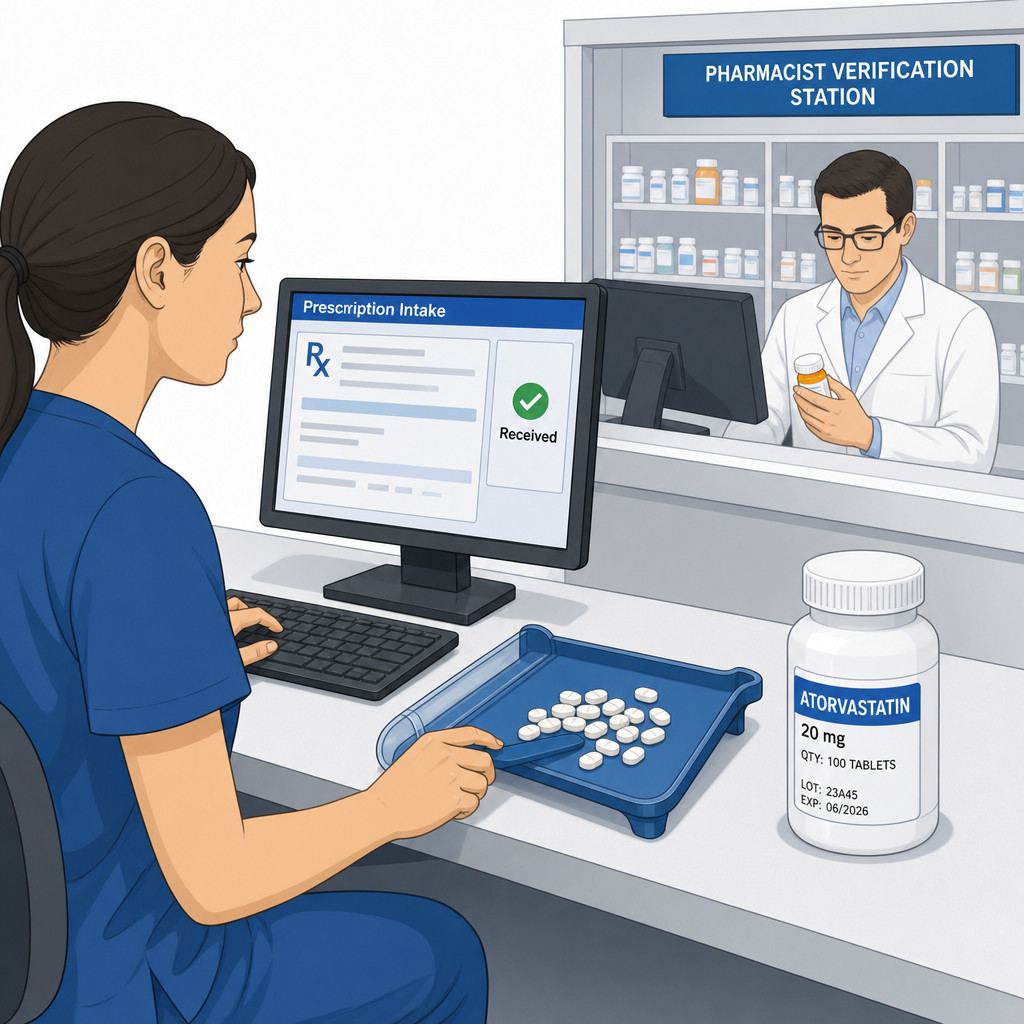
Fig 2. Technician workstation boundary Exam takeaway: The technician may enter and prepare the order, but pharmacist verification remains the safety gate before dispensing.
In Fig 2, the workstation tasks are technician-facing, while final verification is separated as the pharmacist safety gate.
B. Worked example
A 68-year-old patient with diabetes and hypertension drops off a prescription. The patient says, 'I usually take the white tablet, but my doctor may have changed it because my blood pressure was high.' The insurance card is expired, and the prescription direction is legible. A stock bottle on the shelf has similar packaging to another strength. The most appropriate next step by the technician is to collect updated insurance information, enter the prescription as written if complete, use product verification safeguards, and route any therapy-change question to the pharmacist.
Identify task: Prescription intake and processing, not therapy selection.
Extract key facts: Patient mentions possible therapy change; packaging look-alike exists; insurance card is expired.
Apply rule: Technician may update insurance and process data, but cannot explain or judge the medication change.
Eliminate distractors: Do not reassure the patient that the change is correct; do not choose a different strength based on memory.
Verify: Use NDC/product checks and refer the clinical question to the pharmacist.
C. Exam trap
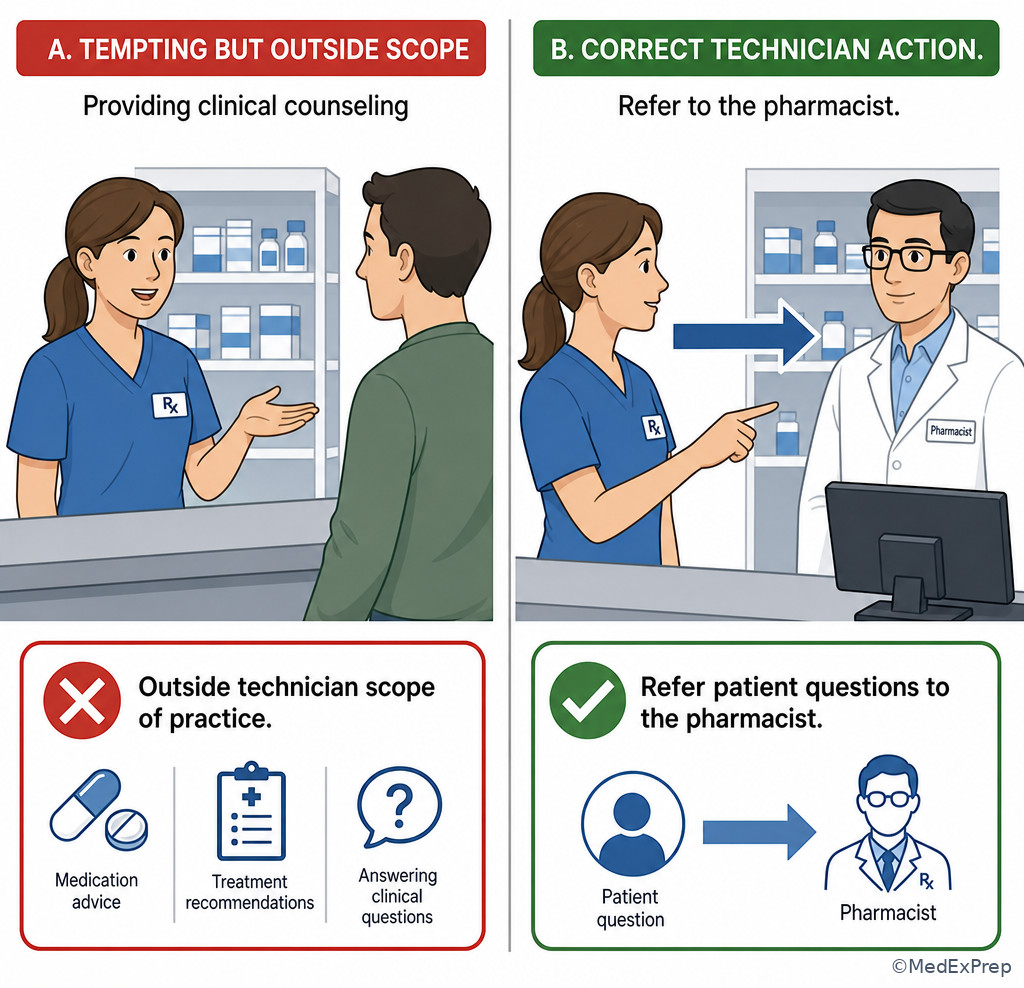
Common wrong answer: Explain to the patient why the prescriber changed therapy. Why it is tempting: The patient directly asks and the technician may recognize the medication name. Single clue that eliminates it: The question asks for interpretation of a therapy change, which requires pharmacist counseling or prescriber clarification through pharmacist workflow.
D. Checkpoint MCQ
A patient asks whether a new medication will replace one of their current medications. What is the best action by the technician?
A. Explain that the new medication probably replaces the old one because both treat the same condition.
B. Tell the patient to stop the old medication until the pharmacist can call the prescriber.
C. Refer the patient to the pharmacist for counseling about the medication change.
D. Update the medication profile and mark the old medication as discontinued.
Answer: C. A is tempting because it sounds clinically knowledgeable, but it makes an independent therapy interpretation. B is tempting because it seems cautious, but it gives stop-therapy advice. C is correct because counseling and therapy-change interpretation require pharmacist involvement. D is tempting because data maintenance is a technician task, but discontinuing medication status based on the patient's question is outside scope without authorization.
If you missed this: Review Operational support versus professional judgment - focus on the rule that therapy interpretation belongs to the pharmacist.
1.1.2.4 2. The law-policy hierarchy: federal, state, and local requirements
A. Explanation
Decision conflict: PTCE stems may ask what to do when a technician remembers a general rule but the pharmacy policy seems stricter. The safest answer is to follow federal requirements, applicable state law, and local policy when more restrictive, while escalating unclear legal questions.
WHY THIS IS TESTED: Technician practice is not identical in every jurisdiction or employer setting. The exam expects nationally safe behavior: do not assume a permissive rule applies when a stricter requirement may control.
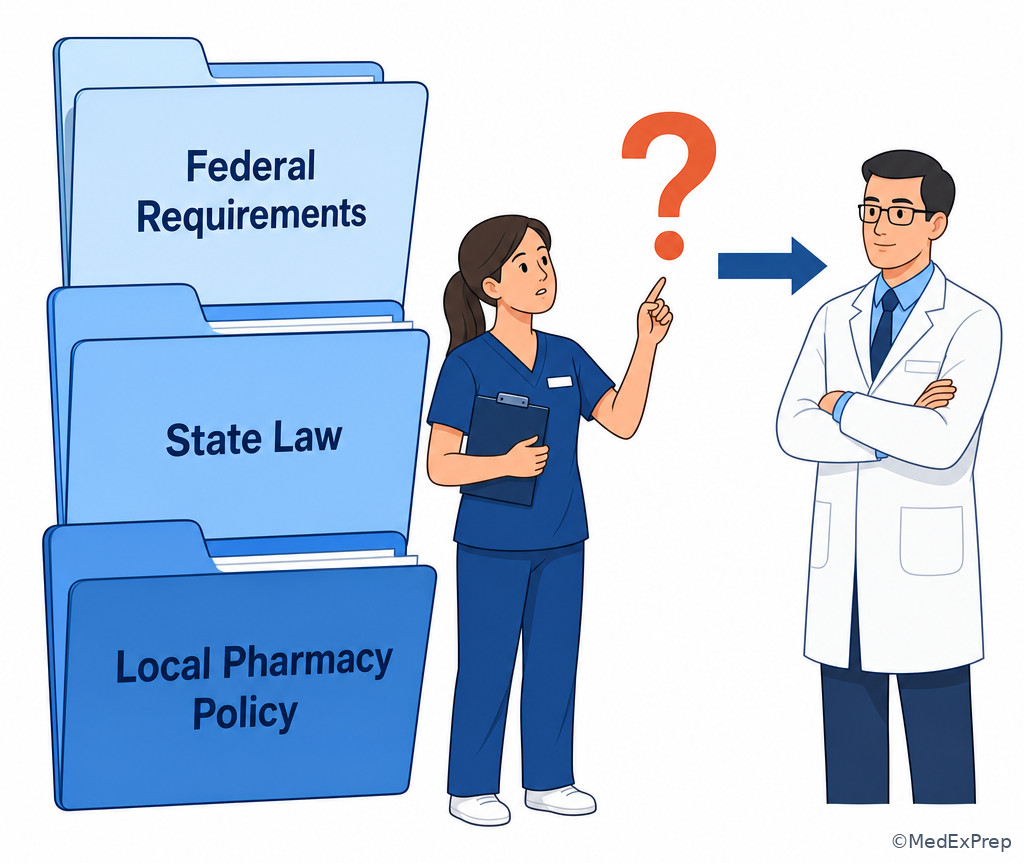
Think of requirements as a safety stack. Federal rules create baseline requirements for national issues such as controlled substances and privacy. State law may define technician duties, supervision, registration, transfer rules, and allowed tasks. Local policy may add stricter workflow controls, documentation, double checks, or escalation points. A technician should not override these layers based on convenience.
Identify the governing issueApply federal baselineCheck state law and site policyUse stricter applicable ruleEscalate uncertainty
Fig 3. Requirement hierarchy for technician decisions Exam takeaway: When rules vary, the technician follows the more restrictive applicable requirement and escalates uncertainty.
graph TD
A[Technician task]-->B[Federal requirement]
B-->C[Applicable state law]
C-->D[Local site policy]
D-->E{Any rule more restrictive?}
E-->F[Follow stricter rule]
E-->G[Proceed only within protocol]
F-->H[Refer unclear legal or clinical issue]
See Fig 3 whenever a stem says that a policy, state rule, or controlled-substance process varies.
B. Worked example
A 31-year-old pharmacy technician trainee in a community pharmacy receives a transfer request. The patient has asthma and migraine history, but the clinical diagnoses are not the issue. The caller is from another pharmacy, the medication name sounds familiar, and the local policy requires pharmacist handling for certain transfers. The technician remembers seeing another technician take transfer information at a different workplace. The best action is to follow local policy and refer the transfer process to the pharmacist or authorized workflow.
Identify task: Prescription transfer processing, which may be limited by law and policy.
Extract key facts: Local policy is stricter; prior workplace habit is irrelevant.
Apply rule: Follow federal requirements, applicable state law, and site-specific policy when more restrictive.
Eliminate distractors: Do not proceed based on what was allowed elsewhere.
Verify: Route the call according to current pharmacy protocol.
C. Exam trap
Common wrong answer: Complete the task because the technician has seen it done before. Why it is tempting: Experience feels like permission. Single clue that eliminates it: The stem includes a stricter local policy or uncertain legal authority.
D. Checkpoint MCQ
A technician is unsure whether state law allows a specific task, and the pharmacy's policy requires pharmacist approval before the task is performed. What is the best action?
A. Perform the task if federal law does not specifically prohibit it.
B. Follow the pharmacy policy and refer the issue to the pharmacist.
C. Ask another technician how the task is usually handled and proceed the same way.
D. Perform the task if the patient has been waiting a long time.
Answer: B. A is tempting because federal law is important, but it ignores state and local restrictions. B is correct because the more restrictive applicable policy controls and uncertainty requires escalation. C is tempting because peer experience may be useful for learning, but it is not legal authorization. D is tempting because service pressure is real, but patient wait time never expands scope.
If you missed this: Review The law-policy hierarchy - focus on the rule that the stricter applicable requirement controls.
Policy stack visual
Exam takeaway: Scope decisions should be checked against federal law, state law, and local policy rather than habit.
Quick Recall:
Fill in the blank: When a policy is more restrictive than a general rule, follow the __________ applicable requirement.
True/False: A technician may rely on prior workplace practice when current site policy is unclear.
One-liner: Who should receive unclear legal or clinical scope questions?
1.1.2.5 3. Escalation triggers in prescription and order processing
A. Explanation
Decision conflict: A stem may include a partially complete order and ask whether the technician should fix, guess, enter, call, or refer. The technician may collect and organize information, but must not independently resolve missing, suspicious, or clinically ambiguous information.
WHY THIS IS TESTED: Many medication errors begin with a small unresolved discrepancy. PTCE questions expect the technician to identify red flags early, pause the workflow, and involve the pharmacist before dispensing risk reaches the patient.
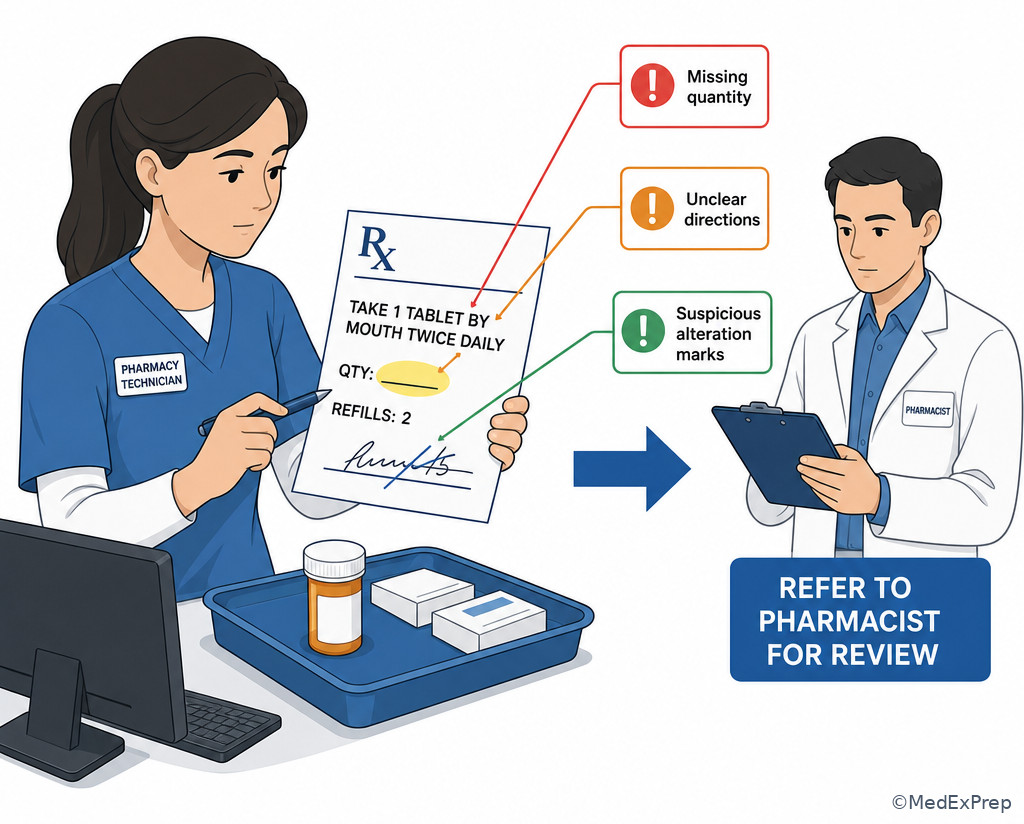
Escalation triggers include missing required prescription elements, illegible directions, unclear strength or dosage form, unsafe abbreviations, suspicious controlled-substance patterns, possible forgery, patient-specific therapeutic questions, product mismatch, allergy or interaction alerts requiring judgment, and any uncertainty about whether the order is legally valid.
Screen the orderFind missing or unclear dataDo not guess or alterDocument according to protocolRefer to pharmacist
Fig 4. Escalation screen for incomplete or risky orders Exam takeaway: Missing, unclear, suspicious, or clinical information should stop the technician workflow until pharmacist review occurs.
graph TD
A[Prescription or medication order]-->B{Complete and clear?}
B--Yes-->C[Enter and prepare within protocol]
B--No-->D[Do not guess]
D-->E{Clinical, legal, or safety issue?}
E--Yes-->F[Refer to pharmacist]
E--No-->G[Collect allowed factual information]
G-->H[Route for verification]
Process PA workflow or route; do not make clinical conclusions.
Look-alike package selected
Trust shelf position.
Use barcode/NDC/product checks and pharmacist verification.
B. Worked example
A 54-year-old patient with chronic pain and anxiety presents a prescription for a controlled medication. The prescriber information is present, but the handwriting for quantity appears altered. The patient also says they are traveling tomorrow and need it immediately. A lab value printed on a discharge sheet is normal, but that lab is not relevant to the prescription validity question. The best technician action is to stop routine processing and alert the pharmacist according to controlled-substance and suspicious-prescription policy.
Identify task: Prescription validity and controlled-substance red-flag screening.
Extract key facts: Altered quantity and urgency are red flags; normal lab value is noise.
Apply rule: Technician recognizes suspicious features but does not independently decide validity.
Eliminate distractors: Do not fill because the patient is traveling; do not accuse the patient; do not alter the quantity.
Verify: Refer to pharmacist and document according to policy.
C. Exam trap
Common wrong answer: Correct the questionable field based on what seems most likely. Why it is tempting: The technician wants to keep workflow moving. Single clue that eliminates it: The order contains missing, altered, illegible, or suspicious information.
D. Checkpoint MCQ
A prescription direction appears to read 'take 1 tablet qd,' but the handwriting is unclear and the medication has multiple strengths. What is the best technician action?
A. Enter the most common directions and send to pharmacist verification.
B. Ask the patient what directions they expected and enter that answer.
C. Pause processing and refer the unclear prescription to the pharmacist.
D. Change the directions to a safer lower dose until clarified.
Answer: C. A is tempting because pharmacist verification follows data entry, but entering a guess creates error risk. B is tempting because patient input can be useful, but it cannot replace authorized directions. C is correct because unclear directions require pharmacist clarification workflow. D is tempting because it seems conservative, but changing therapy is outside technician scope.
If you missed this: Review Escalation triggers in prescription and order processing - focus on the no-guessing rule for unclear orders.
Prescription red flag screen
Exam takeaway: A suspicious or incomplete order should be paused and routed rather than corrected by guessing.
1.1.2.6 4. Patient questions, counseling boundaries, and safe communication
A. Explanation
Decision conflict: A patient may ask a question that sounds simple, and one option may be a polite answer the technician knows from experience. On the PTCE, if the question asks for therapeutic meaning, side effects, dose changes, drug selection, administration counseling, or whether to start or stop therapy, the technician should refer to the pharmacist.
WHY THIS IS TESTED: Patient-facing communication is a common place where scope can be crossed unintentionally. Technicians may provide nonclinical operational information, but pharmacist counseling protects patients when medication use or clinical interpretation is involved.
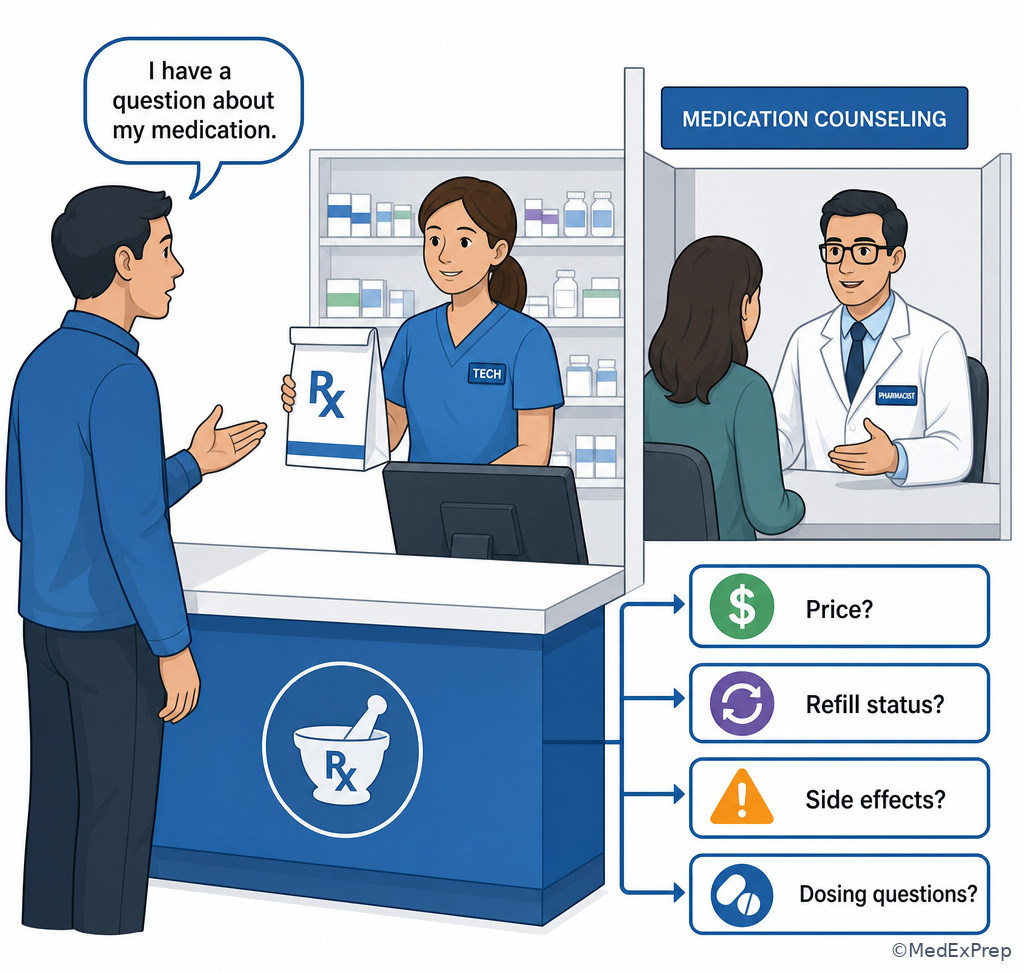
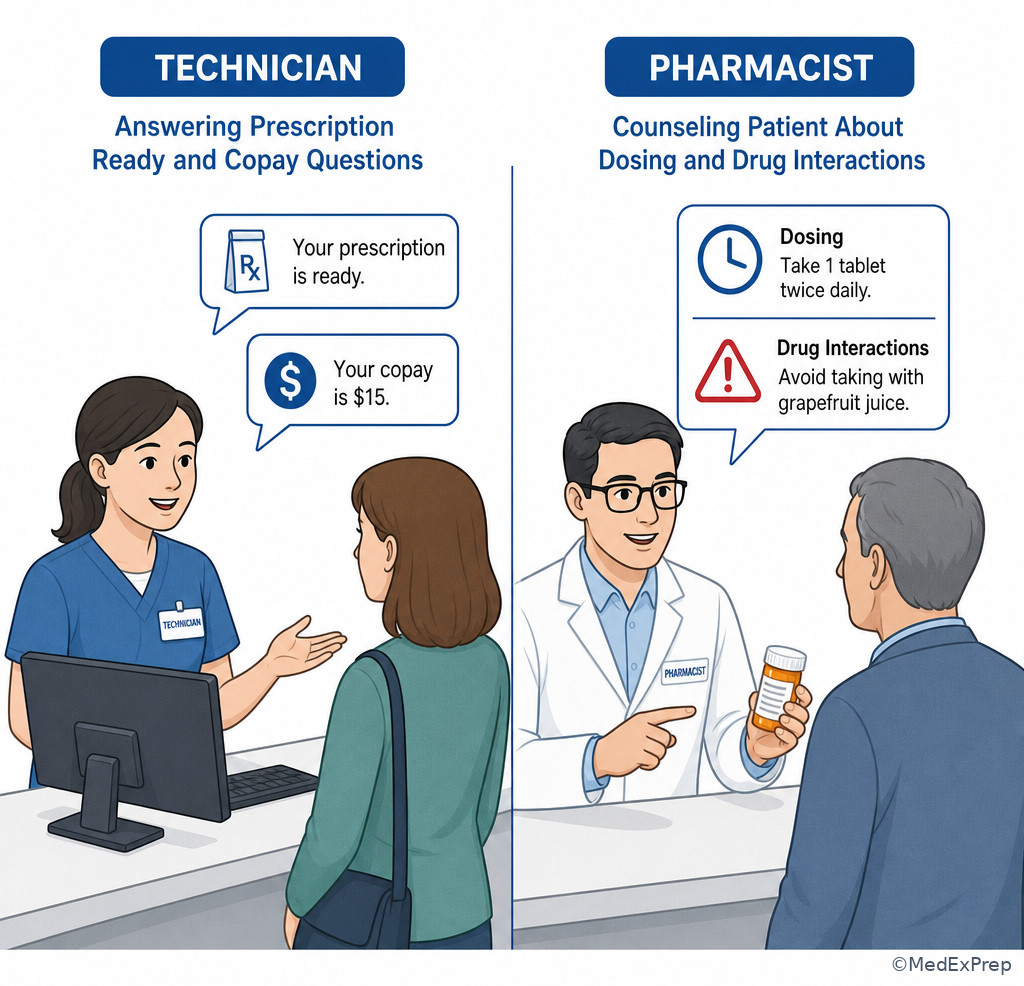
Safe technician communication includes confirming pickup status, price, insurance status, refill timing, basic label location, whether the pharmacist is available, and that a question will be referred. It does not include interpreting interactions, recommending OTC therapy, explaining whether a side effect is dangerous, or instructing a patient to change use.
Listen to the questionClassify: operational or clinical?Answer factual workflow itemsRefer medication-use questionsDocument if policy requires
Fig 5. Patient question routing Exam takeaway: Operational questions may be answered by protocol, but medication-use counseling is routed to the pharmacist.
See Fig 5 for the safest way to classify patient questions.
Question type
Technician may handle?
Best PTCE action
'Is my prescription ready?'
Yes, if allowed by workflow.
Check system status and respond factually.
'Why did my doctor change this medication?'
No.
Refer to pharmacist.
'Can I take this with my other medicine?'
No.
Refer to pharmacist for interaction counseling.
'What is my copay?'
Yes, after claim processing.
Provide billing result or route claim issue.
'Should I stop if I feel dizzy?'
No.
Refer immediately to pharmacist.
B. Worked example
A 72-year-old patient with COPD and kidney disease asks whether an OTC sleep product is safe with a new prescription. The claim also rejected because the insurance plan wants a different NDC, and the patient's daughter says they are in a hurry. The technician recognizes the drug name and has heard that the OTC product can cause drowsiness. The best action is to refer the medication-safety question to the pharmacist while continuing only nonclinical billing workflow according to protocol.
Identify task: Patient counseling boundary plus claim processing.
Extract key facts: Safety question involves OTC plus prescription; kidney disease is clinical noise for technician decision-making; NDC rejection is operational.
Apply rule: Technician may process billing/NDC workflow but cannot advise on safety of combination therapy.
Eliminate distractors: Do not say it is safe, do not recommend stopping, and do not select therapy alternatives independently.
Verify: Refer to pharmacist and handle claim issue within protocol.
C. Exam trap
Common wrong answer: Give a brief common-sense safety answer. Why it is tempting: The technician may know the medication from work experience. Single clue that eliminates it: The patient asks whether a medication is safe or appropriate for them.
D. Checkpoint MCQ
A patient asks, 'Can I take this antibiotic with my seizure medication?' What is the best technician response?
A. Tell the patient the antibiotic is safe if the prescriber ordered it.
B. Look up the interaction and explain the result.
C. Refer the question to the pharmacist for counseling.
D. Tell the patient to separate the medications by 2 hours.
Answer: C. A is tempting because prescribers authorize therapy, but the pharmacy still must address counseling questions appropriately. B is tempting because drug databases exist, but interpreting an interaction for the patient is pharmacist-level counseling. C is correct because interaction questions require pharmacist involvement. D is tempting because separation advice is common for some drugs, but giving patient-specific instructions is outside technician scope.
If you missed this: Review Patient questions, counseling boundaries, and safe communication - focus on the difference between operational status questions and medication-use counseling.
Operational versus counseling questions
Exam takeaway: Price, status, and refill logistics are operational; safety, dosing, and interactions require pharmacist counseling.
Quick Recall:
Fill in the blank: Questions about drug interactions, side effects, dose changes, or whether to stop therapy require __________ referral.
True/False: A technician may provide factual copay information after claim processing if site policy allows.
One-liner: What should a technician do with a patient-specific safety question?
1.1.2.7 5. Scope boundaries during preparation, inventory, billing, and documentation
A. Explanation
Decision conflict: Not every scope issue involves patient counseling. PTCE questions may test whether a technician can continue with a preparation, inventory, or billing task when the product, record, NDC, quantity, storage condition, or documentation is questionable. The technician should complete routine steps only when the task remains clear, authorized, and verifiable.
WHY THIS IS TESTED: Technicians often touch the medication before the pharmacist's final check. Product selection, NDC choice, expiration control, controlled inventory, claim adjudication, and documentation errors can all become patient-safety or legal problems.
Preparation tasks include counting, labeling, compounding within protocol, selecting products by exact identifiers, and staging for pharmacist verification. Inventory tasks include receiving, storing, rotating, quarantining, and documenting. Billing tasks include entering insurance information and processing claim rejections at the technician level. Documentation tasks include recording facts accurately. The boundary is crossed when the technician independently decides clinical suitability, legal acceptability, substitution authority, or final approval.
Perform assigned workflowVerify identifiers and recordsFlag mismatch or discrepancyDo not override judgment issuesEscalate before final release
Fig 6. Non-counseling scope boundaries Exam takeaway: Preparation, inventory, billing, and documentation are technician-supported, but mismatches and judgment issues must be escalated.
graph LR
A[Preparation]-->E[Verify product identifiers]
B[Inventory]-->F[Verify storage and records]
C[Billing]-->G[Process factual claim workflow]
D[Documentation]-->H[Record facts accurately]
E-->I{Mismatch or judgment needed?}
F-->I
G-->I
H-->I
I--Yes-->J[Refer to pharmacist or supervisor protocol]
I--No-->K[Continue within workflow]
See Fig 6 for the non-counseling areas where scope errors commonly appear.
B. Worked example
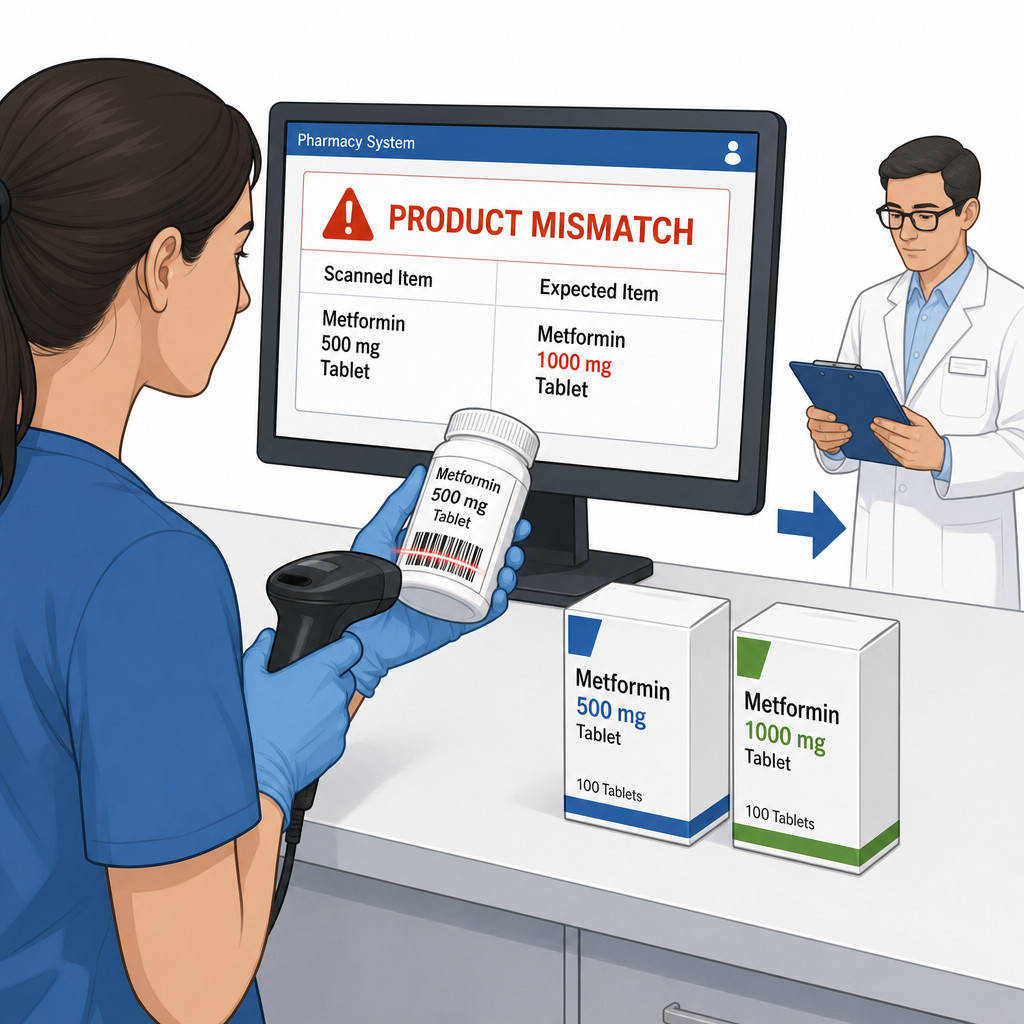
A hospital pharmacy technician is preparing a unit-dose cart fill. A 59-year-old patient has heart failure and diabetes, but the order has already been verified by the pharmacist. The technician notices two bins with similar labels and one package with a different NDC than the medication listed in the system. A printer alert also shows a billing code warning unrelated to the cart fill. The best action is to stop product selection for that item, use barcode or product verification steps according to policy, and escalate the mismatch rather than selecting the package by appearance.
Identify task: Product selection and preparation after verification.
Extract key facts: Similar labels and different NDC create product mismatch risk; comorbidities are not for technician interpretation.
Apply rule: Technician must verify identifiers and cannot override a mismatch by appearance.
Eliminate distractors: Do not select based on shelf location; do not ignore barcode mismatch; do not make clinical judgments about the patient's diagnoses.
Verify: Follow product-check protocol and escalate discrepancy.
C. Exam trap
Common wrong answer: Continue because the pharmacist already verified the order. Why it is tempting: Pharmacist verification occurred earlier. Single clue that eliminates it: The technician now sees a product, NDC, package, record, storage, or documentation mismatch.
D. Checkpoint MCQ
During filling, a technician scans a bottle and receives a product mismatch alert. The medication name looks similar to the selected drug, and the patient is waiting. What is the best action?
A. Override the alert because the names are similar.
B. Continue filling and leave a note for the pharmacist after dispensing.
C. Stop filling that item and follow product mismatch escalation policy.
D. Ask the patient whether the tablet looks familiar.
Answer: C. A is tempting because the product looks similar, but similarity is exactly the risk. B is tempting because pharmacist verification is part of workflow, but the product mismatch must be addressed before final release. C is correct because barcode or product mismatch alerts require escalation according to policy. D is tempting because patient familiarity can help identify problems after dispensing, but it cannot authorize product selection.
If you missed this: Review Scope boundaries during preparation, inventory, billing, and documentation - focus on the rule that mismatches stop routine workflow.
Product mismatch checkpoint
Exam takeaway: A barcode or NDC mismatch is a stop signal, not an inconvenience to override.
TRAPS
Exam Traps & Differentiators
Most common wrong answer: The technician gives a helpful clinical answer. Why it is tempting: It sounds efficient, knowledgeable, and patient-centered. Single clue that eliminates it: The stem asks for diagnosis, therapy selection, medication-use advice, side-effect interpretation, interaction interpretation, or final appropriateness.
Looks similar
But is not the same
Discriminator
Answering a price question
Answering a drug-safety question
Billing facts are operational; safety interpretation is counseling.
Entering a prescription
Approving a prescription
Data entry routes information; final verification approves dispensing.
Collecting allergy information
Deciding whether an allergy makes therapy inappropriate
Collection is factual; clinical interpretation belongs to pharmacist.
Processing a prior authorization workflow
Choosing a therapeutic alternative
Administrative routing is allowed; therapy substitution requires authority.
Noticing a suspicious prescription
Declaring the prescription valid or invalid independently
Technician identifies red flags and escalates.
Decision visual: choose versus avoid Exam takeaway: Choose technician workflow actions and avoid independent clinical or legal conclusions.
graph TD
A[PTCE answer choice]-->B{Does it require judgment?}
B--No, factual workflow-->C[Choose if within protocol]
B--Yes, clinical/legal/final approval-->D[Avoid and refer]
C-->E[Document and route]
D-->F[Pharmacist involvement]
Scope trap comparison
Exam takeaway: The right PTCE answer often sounds less dramatic because it preserves safe workflow boundaries.
1.1.2.8 If the stem says, think
'Patient asks whether to start, stop, or combine medications' -> pharmacist counseling referral.
'Illegible, missing, altered, or suspicious prescription information' -> stop, do not guess, refer.
'Policy is more restrictive' -> follow stricter policy and escalate uncertainty.
'Product scan mismatch, different NDC, look-alike package' -> stop filling that item and follow product verification policy.
'Insurance rejection or prior authorization' -> process administrative workflow, not clinical substitution.
'Final verification or appropriateness' -> pharmacist-only decision.
Use this five-step approach whenever a PTCE question asks for the best technician action.
1. Identify the task2. Extract scope clues3. Classify operational vs judgment4. Apply stricter law/policy5. Complete or escalate
Operational algorithm for scope questions Exam takeaway: The safest PTCE answer keeps the technician inside protocol and escalates judgment-based decisions.
graph TD
A[Identify task]-->B[Extract key facts]
B-->C{Within technician protocol?}
C--Yes-->D[Perform accurately and document]
C--No or unsure-->E[Stop and refer]
D-->F[Route for pharmacist verification when required]
E-->F
QUIZ
Self-check quiz
A technician receives a prescription with all required patient information, but the directions are unclear. What is the most appropriate next step?
A. Enter the most likely directions based on common use.
B. Ask the patient what directions they think the prescriber intended.
C. Refer the unclear prescription to the pharmacist for clarification workflow.
D. Fill the prescription and let the patient call the prescriber later.
A patient asks whether they should stop an old blood pressure medication now that a new prescription is ready. What should the technician do?
A. Tell the patient to stop the old medication because the new one replaces it.
B. Refer the question to the pharmacist.
C. Tell the patient to take both until the next appointment.
D. Ask the patient to decide based on how they feel.
A pharmacy policy requires pharmacist approval before a technician handles a certain controlled-substance documentation step. Another technician says the task is usually quick and should be done immediately. What is the best action?
A. Complete the task to avoid delaying workflow.
B. Follow the policy and involve the pharmacist.
C. Complete it if the patient is waiting.
D. Complete it if no inventory discrepancy is visible.
During filling, the computer displays an NDC mismatch for a medication with similar packaging. What is the technician's best action?
A. Override because the package looks similar.
B. Stop and follow product mismatch escalation policy.
C. Dispense and document the mismatch afterward.
D. Ask the patient whether the manufacturer matters.
Which task is most clearly within technician scope when performed under supervision and policy?
A. Determining whether a dose is clinically appropriate for renal function.
B. Counseling a patient about whether dizziness is a serious side effect.
C. Entering prescription and insurance information accurately into the pharmacy system.
D. Approving a therapeutic substitution because insurance rejected the claim.
ANSWERS
Answer key & explanations
1.1.2.9 Question 1
Correct answer: C. Unclear directions are an escalation trigger. The technician should not guess or convert unclear handwriting into a final entered SIG without clarification workflow. A is tempting because common directions may be familiar, but guessing can create a medication error. B is tempting because the patient may know how they usually take a medication, but patient memory cannot replace authorized directions. D is wrong because dispensing before clarification bypasses safety checks. Boundary: unclear prescription interpretation requires pharmacist involvement. If you missed this: Review Escalation triggers in prescription and order processing — focus on the no-guessing rule.
1.1.2.10 Question 2
Correct answer: B. Whether to stop an old medication after starting a new one is a therapy-change question. A is tempting because one medication may indeed replace another, but the technician cannot independently determine that. C is tempting because it avoids stopping therapy, but it still gives medical advice. D is wrong because it shifts a clinical decision to the patient without pharmacist counseling. Boundary: medication-use counseling and therapy interpretation require the pharmacist. If you missed this: Review Patient questions, counseling boundaries, and safe communication — focus on patient-specific medication-use questions.
1.1.2.11 Question 3
Correct answer: B. If policy requires pharmacist approval, the technician must follow policy even if another staff member suggests a shortcut. A is tempting because it speeds workflow, but efficiency does not expand scope. C is tempting because patient waiting time creates pressure, but urgency does not override law or policy. D is tempting because the record appears normal, but the policy requirement still applies. Boundary: follow federal requirements, applicable state law, and more restrictive local policy. If you missed this: Review The law-policy hierarchy — focus on stricter applicable requirements.
1.1.2.12 Question 4
Correct answer: B. An NDC mismatch is a product verification stop signal. A is tempting because look-alike packaging can feel reassuring, but look-alike packaging is exactly why verification is needed. C is wrong because documentation after dispensing does not prevent the error. D is tempting because patients may recognize products, but patient preference or recognition cannot authorize selection. Boundary: product mismatch requires escalation before final release. If you missed this: Review Scope boundaries during preparation, inventory, billing, and documentation — focus on mismatch alerts as stop signals.
1.1.2.13 Question 5
Correct answer: C. Entering prescription and insurance information accurately is a technician-supported operational task under supervision. A is wrong because renal appropriateness requires clinical interpretation. B is wrong because side-effect seriousness is counseling. D is wrong because therapeutic substitution requires proper authority and pharmacist involvement. A, B, and D are tempting because they may occur in pharmacy workflow, but each requires professional judgment beyond entry-level technician scope. Boundary: operational data tasks are permitted; clinical appropriateness, counseling, and substitution decisions are not. If you missed this: Review Operational support versus professional judgment — focus on factual workflow versus judgment.
RAPID
Rapid review / cheat-sheet
Operational task -> collect, enter, prepare, package, bill, document, or inventory within protocol.
Professional judgment -> diagnose, prescribe, counsel, interpret therapy, approve appropriateness, or final verify.
Unclear prescription -> do not guess; refer for clarification workflow.