
Why it matters
- Many wrong answers come from using the wrong task model: reading a QR item like a pure algebra drill, or treating an RC question like outside-knowledge trivia.
- The DAT rewards section-specific discipline: chemistry demands rule selection, RC demands passage evidence, and PAT demands visual elimination rather than factual memorization.
- Official public blueprint detail is broad, so your safest prep target is broad foundational mastery plus sharp task recognition across all sections.
- The earlier you know what the test is asking you to do, the faster you can reject attractive but off-task answer choices.
Key Terms & Must-Know Facts
1.1.1.1 Key terms
- DAT: Dental Admission Test used for U.S. dental school admissions.
- BIO: Biology content area focused on foundational life science.
- GC: General Chemistry content area focused on principles, relationships, and calculations.
- OC: Organic Chemistry content area focused on structures, reactions, and mechanisms.
- QR: Quantitative Reasoning section focused on setup, calculation, estimation, and data interpretation.
- RC: Reading Comprehension section focused on answering from the passage.
- PAT: Perceptual Ability Test focused on spatial and visual reasoning.
- Task identification: Determining what the question wants before solving.
- Distractor: A plausible wrong answer.
- Best supported answer: The choice most directly justified by the question or passage.
- Rule selection: Choosing the governing concept, formula, or strategy.
- Verification: Checking units, magnitude, wording, or fit before locking an answer.
- Scope boundary: Limiting your response to DAT-level academic reasoning rather than clinical action.
1.1.1.2 Must-know facts
- The DAT spans biology, general chemistry, organic chemistry, quantitative reasoning, reading comprehension, and perceptual ability.
- Not every section rewards the same first move; section recognition changes strategy.
- RC answers should come from passage evidence, not outside expertise.
- PAT is pattern recognition and spatial analysis, not science memorization.
- QR often hinges on setup and estimation before exact arithmetic.
- GC and OC reward identifying the governing rule before manipulating details.
- Broad official guidance means you should master foundational, repeat-tested academic skills across sections.
- DAT scope is pre-dental academic readiness; avoid clinical-dentistry framing.
Exam takeaway: Match the section to the task type first so you do not apply the wrong solving method.
flowchart TD
A[DAT] --> B[BIO]
A --> C[GC]
A --> D[OC]
A --> E[QR]
A --> F[RC]
A --> G[PAT]
B --> B1[Recall + application]
C --> C1[Concepts + calculations]
D --> D1[Structures + reactions]
E --> E1[Setup + solve + estimate]
F --> F1[Passage evidence]
G --> G1[Spatial pattern matching]
Exam takeaway: The fastest way to improve accuracy is to choose your first move based on task type, not topic alone.
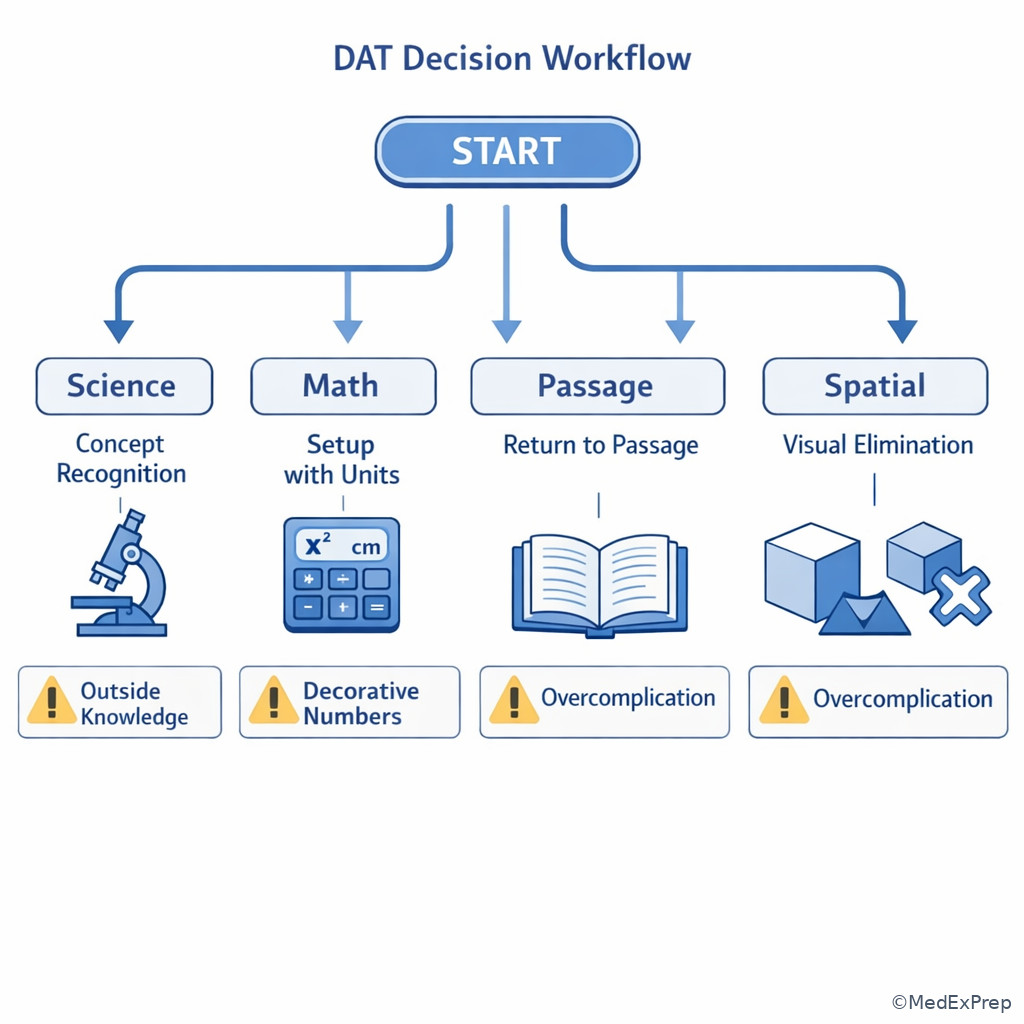
flowchart TD
A[Read prompt] --> B{What is being tested?}
B -->|Science fact or principle| C[Recall rule or relationship]
B -->|Calculation| D[Set up units and variables]
B -->|Passage question| E[Return to passage evidence]
B -->|Spatial item| F[Visual elimination and orientation]
C --> G[Answer and verify]
D --> G
E --> G
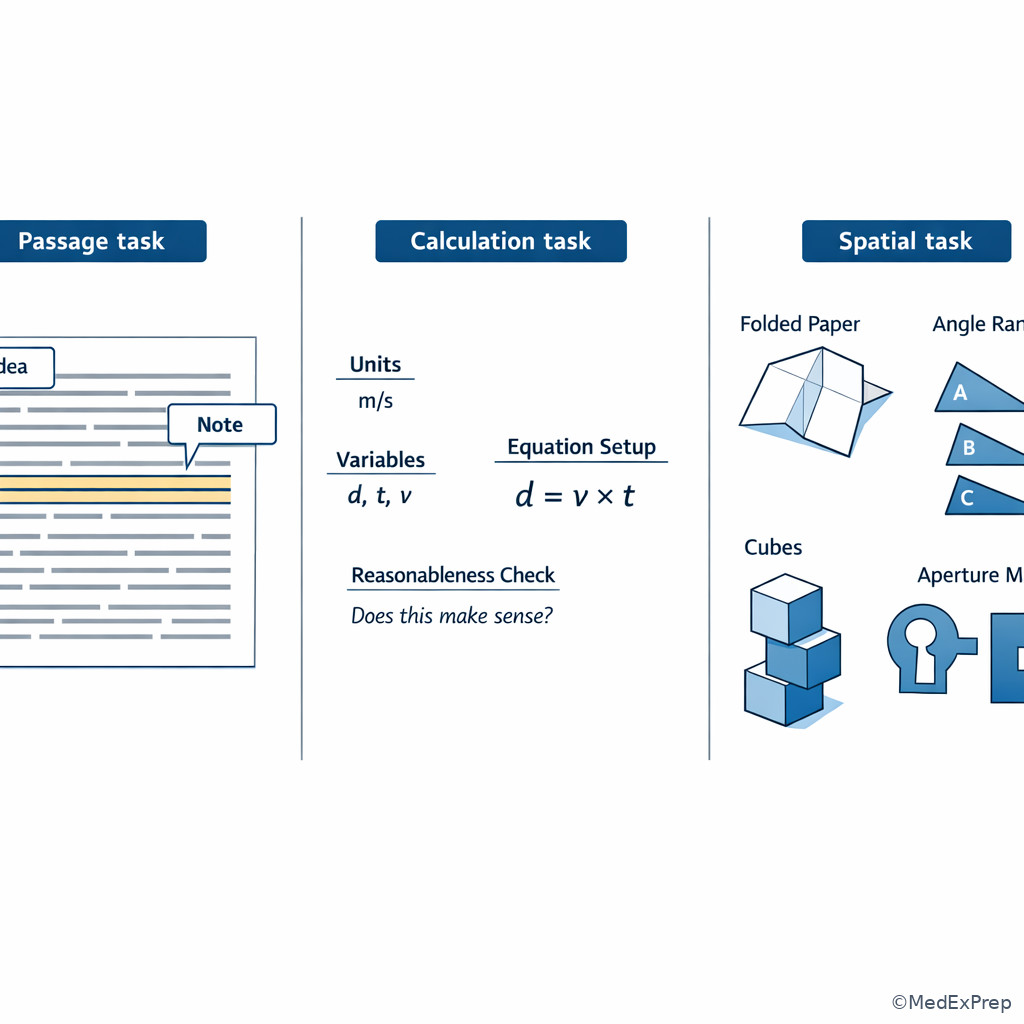
F --> G Exam takeaway: Use a mental dashboard of section-specific tasks so you switch methods quickly under time pressure.
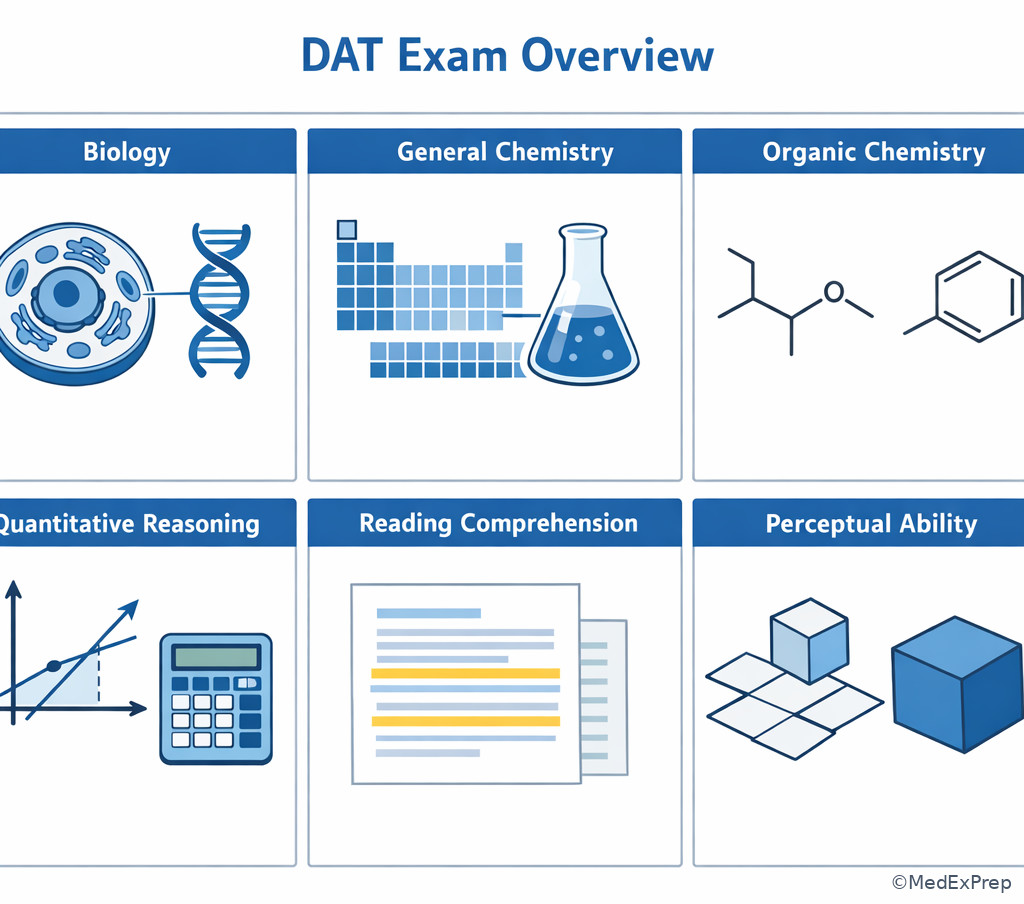
Exam takeaway: Visually separating task families helps prevent cross-section mistakes such as using outside knowledge on RC or formulas on PAT.
Core content
1.1.1.3 Foundational map: what sections exist and what each one is really testing
A Explanation
The first decision conflict on the DAT is simple but high yield: Are you being tested on content knowledge, structured reasoning, passage evidence, or spatial pattern recognition? Students often over-focus on labels like “biology” or “chemistry” and miss the more practical question: What action does this item require? BIO, GC, and OC are science-heavy, but they do not all ask for the same mental move. BIO often rewards broad foundational recall plus light application. GC often rewards picking the correct principle, law, or relationship before calculating. OC often rewards structural recognition and reaction logic. QR tests mathematical setup and execution under time pressure. RC tests what the passage supports. PAT tests what the eye and mind can rotate, compare, and eliminate.
WHY THIS IS TESTED: DAT items are easier when you identify the required mode of thinking early. The exam can hide a straightforward task inside unfamiliar wording, extra numbers, or tempting details from the wrong domain.
Choose this rule: section label tells you the content pool; task type tells you the solving method. Reject the instinct to solve every question with the same generic sequence. For example, an RC inference item is not a vocabulary contest, and a PAT item is not improved by memorizing science facts. See Fig 1 for the section map and Fig 2 for the task-to-strategy chooser.
B Worked example
A student sees a question asking which statement is best supported by a short scientific passage about enzyme inhibition. The options mention competitive inhibition, active site binding, a numerical rate table, and a flashy outside fact about enzyme naming. The student took biochemistry recently, notices the enzyme term, and is tempted to answer from memory. Identify task: this is still an RC-style evidence question if the answer must be supported by the provided text. Extract key facts: the passage states the inhibitor competes with substrate at the active site and that increasing substrate concentration reduces inhibition effect. Apply rule: answer from passage-supported evidence, not outside memory. Eliminate distractors: a fancy option that names an unrelated enzyme family may sound expert but lacks passage support. Verify: the supported answer is the one directly tied to the passage’s evidence pattern, not the most sophisticated wording.
C Exam trap
D Checkpoint
Question: A DAT item shows a dense paragraph about climate effects on plant distribution and asks for the author’s most likely conclusion. A student begins recalling outside ecology facts about desert adaptation. What is the best first move?
- Scan the answer choices for the most scientifically specific statement.
- Return to the passage and locate the lines that support the conclusion.
- Estimate which answer is most often correct on standardized tests.
- Translate the question into a chemistry-style rule-selection problem.
Answer: B
- A: Tempting because technical wording can feel more rigorous; wrong because RC rewards textual support, not jargon density.
- B: Tempting because it feels slower; right because the question asks for the best-supported conclusion from the passage.
- C: Tempting under time pressure; wrong because pattern guessing is weaker than direct evidence.
- D: Tempting because students want a universal strategy; wrong because RC requires passage navigation, not chemistry rule matching.
1.1.1.4 Foundational map: section-specific tasks and the best first move
A Explanation
Once you know the section, your next conflict is which first move saves time without sacrificing accuracy? In BIO, the best first move is usually to identify whether the item is asking for a definition, process relationship, classification, or simple application. In GC, it is often to determine whether the item is conceptual or computational, then set up units or governing laws. In OC, start by spotting the functional group, reagent pattern, or stability rule. In QR, define variables and translate words into structure before doing arithmetic. In RC, decide whether the item is main idea, detail, inference, tone, or function, then go to the relevant passage location. In PAT, compare shapes systematically rather than holistically guessing.
WHY THIS IS TESTED: Wrong answers are often “correct thoughts in the wrong section.” For example, careful calculation is useful in QR but can waste time on a PAT item. Outside scientific knowledge may be true but still invalid for an RC question.
Use a choose-versus-reject frame. Choose direct evidence retrieval for RC detail questions; reject memory-based answering. Choose unit setup for QR rates and proportions; reject jumping into raw arithmetic. Choose pattern elimination for PAT; reject intuitive guessing after one glance.
Exam takeaway: Different sections reward different opening moves, so use the correct first step before you commit time.
flowchart LR
A[BIO] --> A1[Identify concept family]
B[GC] --> B1[Pick principle or formula]
C[OC] --> C1[Spot structure or reagent pattern]
D[QR] --> D1[Translate and define variables]
E[RC] --> E1[Locate evidence in passage]
F[PAT] --> F1[Use visual elimination]
Exam takeaway: The right opening move reduces wasted time and lowers the chance of solving the wrong problem.
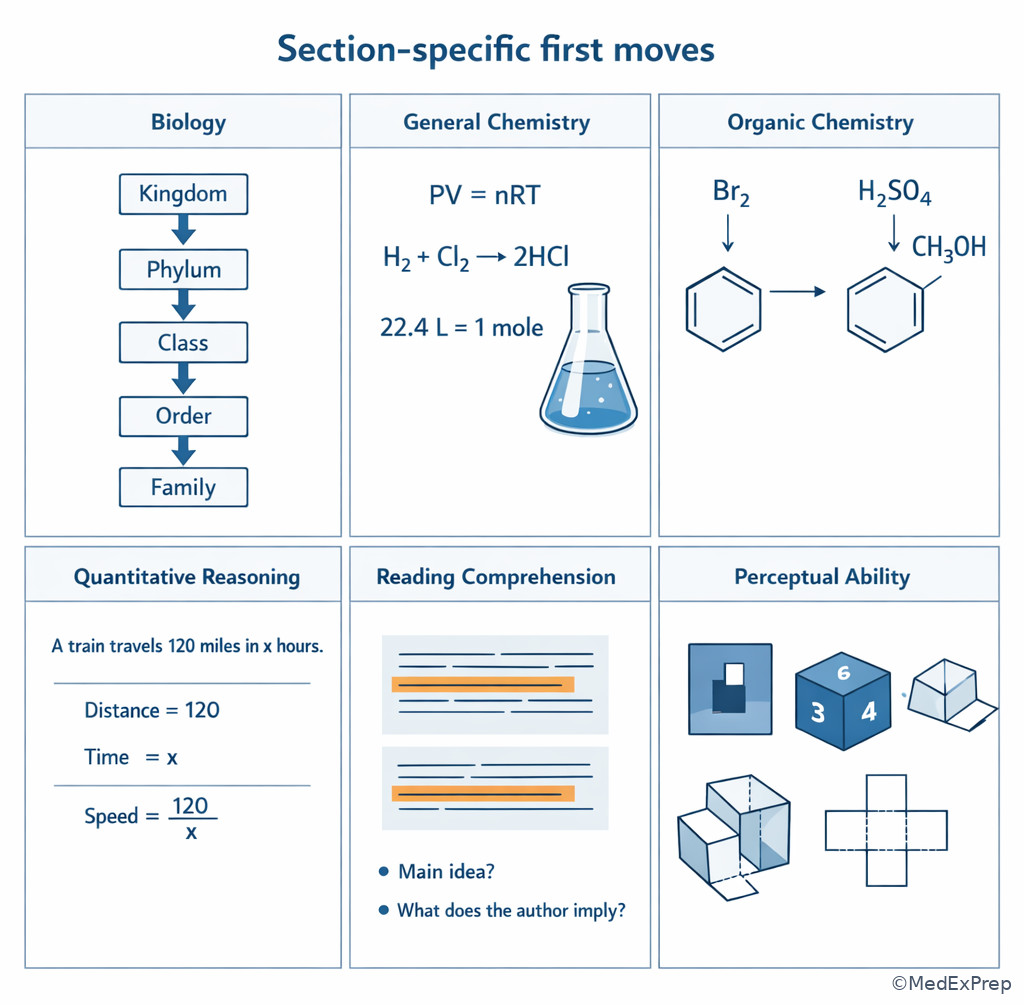
B Worked example
A student gets a QR problem: “A solution is diluted from 200 mL to 500 mL. What happens to concentration?” The stem also mentions a beaker label, a temperature reading, and a note about laboratory cleanliness. The tempting wrong move is to focus on the irrelevant details or to search for an advanced chemistry law. Identify task: QR-style ratio reasoning. Extract key facts: same amount of solute, larger volume. Apply rule: concentration varies inversely with volume for fixed solute amount. Eliminate distractors: any choice discussing temperature effects or laboratory technique is noise here. Verify: since volume increased by \( \frac{500}{200} = 2.5 \), concentration becomes \( \frac{1}{2.5} = 0.4 \) times the original.
C Exam trap
D Checkpoint
Question: A PAT item asks which folded shape matches a given pattern. Which first move is most efficient?
- Write an algebraic expression for each fold.
- Recall general chemistry polarity rules.
- Track orientation changes and eliminate impossible face adjacencies.
- Skim answer choices for the longest description.
Answer: C
- A: Tempting because structure feels systematic; wrong because PAT is visual-spatial, not symbolic algebra.
- B: Tempting if you are stronger in chemistry than PAT; wrong because factual science knowledge does not solve spatial matching.
- C: Tempting because it requires disciplined visualization; right because adjacency and orientation are the decisive PAT rules.
- D: Tempting under time stress; wrong because verbal length has no relation to spatial correctness.
- The best first move on RC detail questions is to return to the passage.
- True or False: PAT performance mainly improves by memorizing more science facts. False.
- Name the first move for QR word problems: translate words into variables/relationships.
1.1.1.5 Application: how the DAT hides the real task inside noise
A Explanation
DAT questions are often not hard because the core concept is obscure; they are hard because the stem adds noise. Noise can be irrelevant numbers, flashy terminology, extra background, tempting prior knowledge, or answer choices from the same broad domain that differ by one critical clue. Your decision conflict becomes: Which details are governing, and which are just there to pull attention away?
WHY THIS IS TESTED: The exam measures disciplined reasoning under time pressure. If you chase every detail equally, you lose both time and accuracy. Strong test takers reduce stems to the minimum set of decisive facts.
In BIO, noise may be an extra organelle or taxonomic term that sounds relevant but does not determine the answer. In GC, it may be an unnecessary numerical value when the question is conceptual. In OC, it may be a reagent or stereochemical detail that matters only after functional-group recognition. In QR, extra measurements can distract from the single needed ratio. In RC, emotionally loaded wording can distract from the exact sentence support. In PAT, visually busy answer choices can overwhelm if you do not compare one feature at a time.
Choose this rule: underline the minimum decisive clue set. Reject this habit: treating all details as equally important. See Fig 2 again for the task chooser and Fig 3 for the first-move comparison.
Exam takeaway: Most DAT stems become easier when you strip them down to the few clues that actually control the answer.
flowchart TD
A[Read stem] --> B[Mark ask word]
B --> C[Find decisive clues]
C --> D[Ignore decorative details]
D --> E[Apply one rule]
E --> F[Eliminate close distractors]
Exam takeaway: Training your eye to separate decisive clues from extra wording improves both speed and answer-choice discrimination.
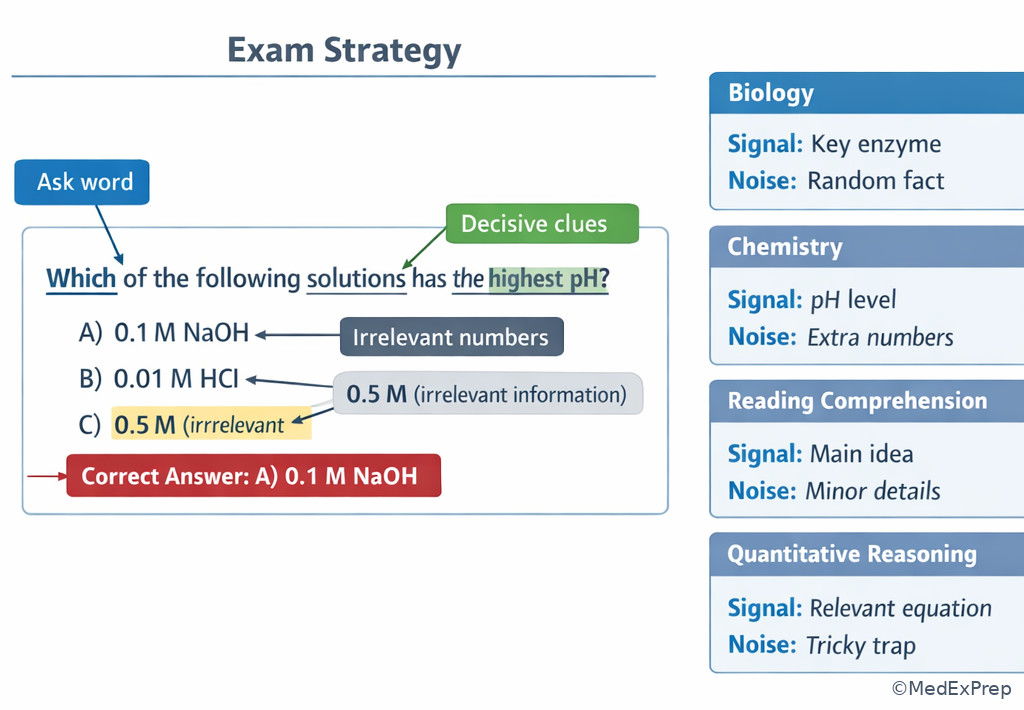
B Worked example
A student reads: “A researcher measures bacterial growth over 6 hours in two media, one supplemented with glucose and one with lactose. The graph shows a lag phase, then rapid growth in the glucose condition. Which interpretation is best supported?” The stem also mentions room temperature, flask volume, and the color of the indicator dye. A tempting wrong answer discusses dye chemistry. Identify task: interpret graph-based biology evidence. Extract key facts: glucose condition shows shorter lag and earlier rapid growth. Apply rule: select the interpretation that directly follows from the graph, likely easier immediate utilization of glucose. Eliminate distractors: dye color and flask volume are not tied to the asked interpretation. Verify: the chosen option must match the observed pattern, not a laboratory side detail.
C Exam trap
D Checkpoint
Question: A GC question includes pressure, color, container shape, and a statement that the number of moles remains constant. The question asks what happens to concentration when volume decreases. Which detail is decisive?
- The color of the gas
- The shape of the container
- The number of moles is constant while volume decreases
- The gas was described as “reactive”
Answer: C
- A: Tempting because vivid sensory details stand out; wrong because color does not control concentration here.
- B: Tempting because geometry sounds physical; wrong because shape is irrelevant if volume is already specified.
- C: Tempting because it feels plain; right because concentration depends on amount per volume, and the changing volume is decisive.
- D: Tempting because chemical reactivity sounds important; wrong because the question is about concentration, not reaction behavior.
1.1.1.6 Application: section boundaries and what the DAT is not asking you to do
A Explanation
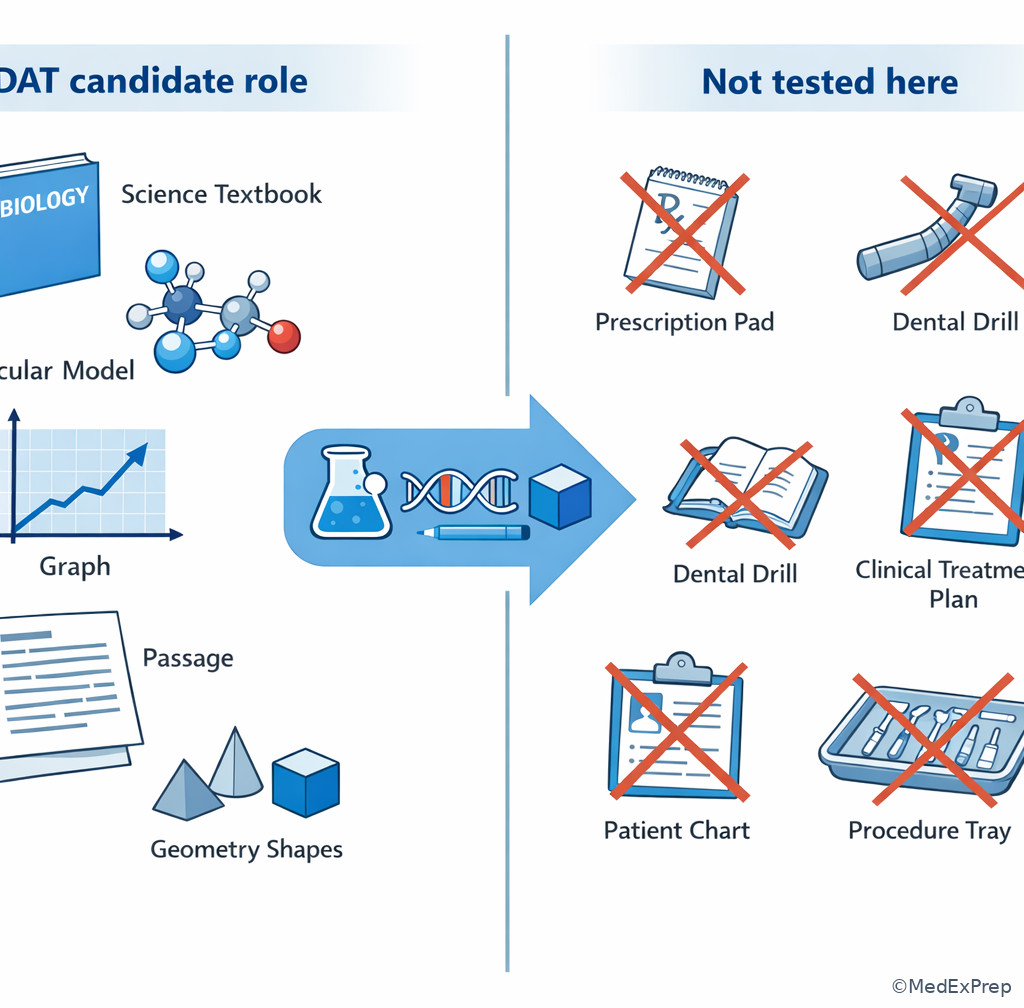
A foundational DAT skill is recognizing when a prompt looks clinical or professional but still only tests underlying science or reasoning. Your conflict is: Do I answer like a future student showing academic readiness, or do I drift into licensed-provider thinking? The correct answer is the first. The DAT is not a clinical licensure exam. It does not ask you to diagnose patients, prescribe treatment, choose procedures, or act as a practicing dentist. If a stem uses dental or health-related language, step back and identify the underlying tested concept: chemistry of buffers, biology of tissues, reading interpretation of a passage, or quantitative analysis of data.
WHY THIS IS TESTED: Official scope matters. Students sometimes over-interpret realistic wording and choose answers that sound professionally authoritative rather than academically justified.
Choose scientific reasoning within the DAT scope. Reject answer choices that depend on clinical authority or patient-management assumptions. A dental-looking scenario may still just be asking about acid-base balance, polymer structure, anatomy terminology, or passage logic. This lesson is the first warning sign; the next lesson, Candidate Role And Boundaries, develops this explicitly.
Exam takeaway: When a stem sounds clinical, translate it back to the underlying science or reasoning skill being tested.
flowchart TD
A[Dental-looking prompt] --> B{Does the answer require licensed clinical judgment?}
B -->|Yes| C[Step back and find underlying science task]
B -->|No| D[Answer within DAT academic scope]
C --> E[Biology, chemistry, QR, RC, or PAT principle]
D --> E
E --> F[Choose evidence-based academic answer] Exam takeaway: A stem may use dental context, but the exam still expects undergraduate science and reasoning rather than clinical judgment.
B Worked example
A stem says: “A student observing a dental materials demonstration notes that a solution becomes less acidic after addition of a buffer. Which principle best explains the pH change?” The tempting wrong move is to think about clinical selection of materials. Identify task: general chemistry acid-base principle. Extract key facts: buffer added, acidity reduced. Apply rule: buffers resist pH change by neutralizing added acid or base through conjugate pairs. Eliminate distractors: any answer discussing which material a dentist should choose is beyond the DAT task. Verify: the correct answer explains the chemical principle, not a clinical action.
C Exam trap
D Checkpoint
Question: A prompt describes tooth enamel exposure to an acidic beverage and asks which chemistry concept best explains mineral dissolution. What is the best framing?
- Choose the best restorative procedure.
- Identify the acid-base or solubility principle involved.
- Recommend a patient-specific treatment plan.
- Determine which prescription medication should be used.
Answer: B
- A: Tempting because the context is dental; wrong because procedural treatment is outside DAT scope.
- B: Tempting because it feels less realistic; right because the DAT tests the underlying chemistry concept.
- C: Tempting if you drift into professional-role thinking; wrong because patient-specific planning is not the exam’s role.
- D: Tempting because acidic injury sounds medical; wrong because prescribing is far outside DAT expectations.
- If a DAT stem sounds clinical, first ask: what underlying science or reasoning skill is being tested?
- True or False: The DAT expects you to answer as if you are already a licensed dentist. False.
- RC answers should come from passage evidence, not outside expertise.
1.1.1.7 Integration: building a reusable DAT task workflow across all sections
A Explanation
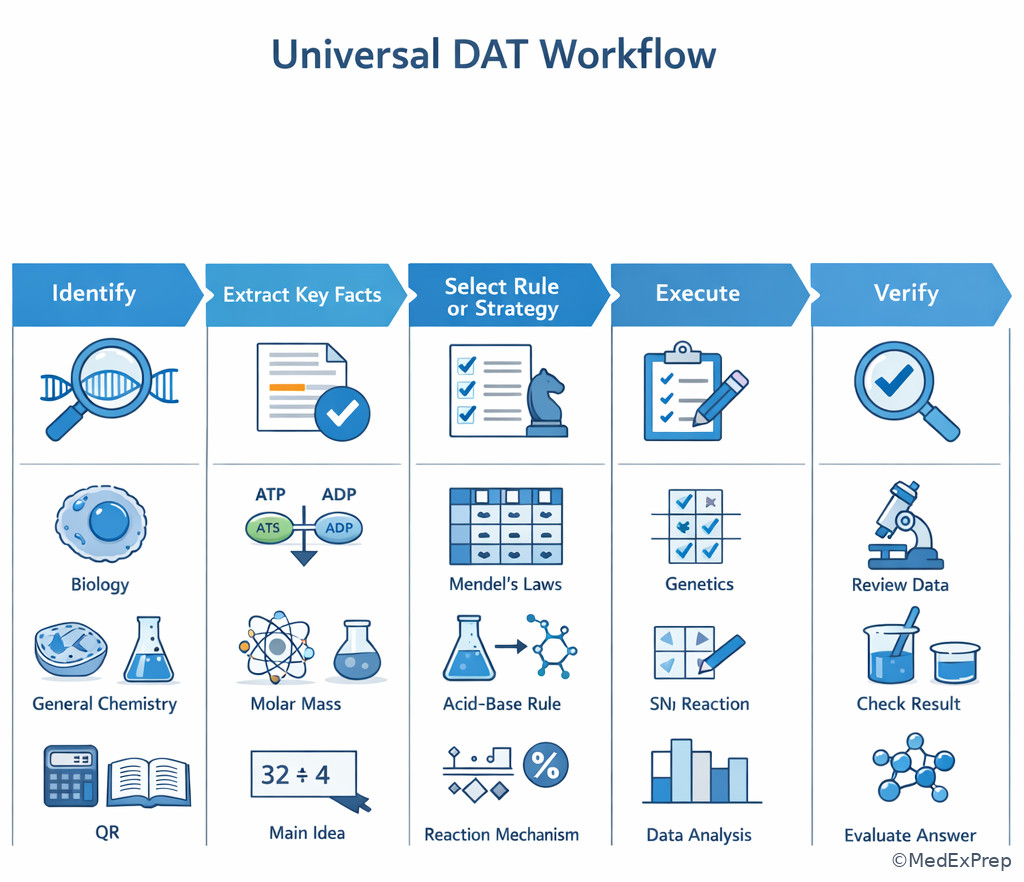
The strongest DAT habit is not memorizing isolated facts; it is using the same reliable workflow across sections while changing the section-specific tools. The decision conflict here is: Do I improvise on every problem, or do I run a stable sequence? Stable sequence wins. The course-wide workflow is identify task → extract key facts → select governing rule or strategy → execute → verify. This sequence works in BIO, GC, OC, QR, RC, and PAT, but the content of each step changes by section.
WHY THIS IS TESTED: The DAT rewards consistency under timed conditions. A reusable workflow protects you from panic, flashy distractors, and answer choices that are nearly right but do not satisfy the exact ask.
For BIO, “select governing rule” may mean choosing the correct cellular process or taxonomic pattern. For GC, it may mean selecting the gas law, equilibrium principle, or periodic trend. For OC, it may mean choosing the reaction family or stability logic. For QR, it may mean selecting a proportion, algebraic setup, or probability model. For RC, it may mean deciding whether the question is detail, inference, or function before finding support. For PAT, it may mean choosing the right visual heuristic such as face adjacency or line-of-symmetry tracking. See Fig 4 for noise filtering and Fig 5 for scope reframing.
Exam takeaway: Use one stable workflow across sections, then swap in the section-specific rule or strategy at step three.
flowchart LR
A[Identify task] --> B[Extract key facts]
B --> C[Select rule or strategy]
C --> D[Execute]
D --> E[Verify fit, units, or evidence]
Exam takeaway: A consistent five-step workflow reduces panic and improves transfer across biology, chemistry, math, reading, and PAT.
B Worked example
A student faces an OC problem: “What is the major product when an alkene reacts with HBr in the absence of peroxides?” The stem also includes boiling points of two solvents, the reaction flask color, and an unrelated note about purification. Identify task: organic reaction prediction. Extract key facts: alkene, HBr, no peroxides. Apply rule: standard hydrohalogenation pattern rather than radical anti-Markovnikov addition. Eliminate distractors: choices based on peroxide-driven logic are tempting but contradicted by the stem. Verify: the final product must match the stated reagent conditions, not a different but nearby reaction family. The workflow, not brute memory, keeps the student on track.
C Exam trap
D Checkpoint
Question: Which sequence best captures the most reliable DAT-wide workflow?
- Memorize all formulas → scan answers → pick the most technical one → review later
- Identify task → extract key facts → select rule/strategy → execute → verify
- Read all options first → guess likely section emphasis → avoid calculations → move on
- Use outside knowledge first → confirm with stem only if needed → choose fast
Answer: B
- A: Tempting because memorization feels safe; wrong because the DAT punishes mismatched task choice and unverified answers.
- B: Tempting because it seems basic; right because it is the most transferable and error-resistant sequence across sections.
- C: Tempting under time pressure; wrong because it skips the governing rule and encourages premature guessing.
- D: Tempting for strong content students; wrong because many DAT items require stem or passage evidence rather than outside recall.
Exam Traps & Differentiators
Most common wrong answer and why: The most common early-course DAT error is choosing the answer that sounds the most advanced instead of the one that fits the task. Technical wording, clinical flavor, or extra numerical detail can make a distractor look “higher level,” but the DAT rewards task fit, not verbal sophistication.
| Looks like... | Actually tests... | Single clue | Think... |
|---|---|---|---|
| Dental/health scenario | Underlying science or reasoning | Question asks for principle, inference, or calculation | Translate to BIO/GC/OC/QR/RC/PAT task |
| Passage with familiar science topic | RC evidence use | Asks what is supported by the passage | Return to text, not memory |
| Number-heavy chemistry item | Conceptual relationship | Only one variable change actually matters | Reduce to controlling relationship |
| Complex PAT answer set | Feature-by-feature elimination | One adjacency or orientation mismatch kills a choice | Compare one feature at a time |
| Wordy QR prompt | Basic ratio, rate, or algebra setup | Core relationship can be written in one line | Translate before calculating |
| Confusable pair | How they differ on test day | Best discriminator |
|---|---|---|
| RC outside knowledge vs RC evidence | Outside knowledge may be true but unsupported | Find explicit line support |
| GC conceptual item vs GC calculation item | One needs a relationship; the other needs numeric setup | Ask whether the stem requires a number |
| OC reagent recognition vs OC mechanism overthinking | Many items are solved by reaction-family pattern alone | Spot reagent-condition trigger words |
| QR arithmetic grind vs QR efficient setup | Fast setup often matters more than long computation | Define variables first |
| PAT holistic guess vs PAT structured elimination | Visual clutter misleads when not compared systematically | Use one decisive feature per pass |
If the stem says..., think...
- “Best supported by the passage” → think text evidence, not outside knowledge.
- “Major product” with named reagents → think reaction-family recognition before mechanism detail.
- “Most appropriate setup” in a word problem → think variables, units, and relationships before arithmetic.
- “Which figure matches” in PAT → think visual elimination by orientation or adjacency.
- Dental or health context plus a science ask → think foundational concept, not clinical decision.
As upcoming topics develop, one especially confusable pair will be scope boundary versus response format. A student may know that a stem should be answered at the academic level but still miss it because the format demands passage support, figure interpretation, or single-best-answer elimination. That is why this lesson points forward to both neighboring topics rather than treating “scope” and “question type” as the same issue.
Tables
| Section | Primary skill family | Best first move | Typical mistake |
|---|---|---|---|
| BIO | Foundational science recall + application | Identify process, structure, or classification being tested | Overcomplicating a basic concept item |
| GC | Principles, relationships, calculations | Decide conceptual vs computational | Using formulas when a relationship alone works |
| OC | Structures, reactions, mechanisms | Spot functional group and reagent pattern | Ignoring the condition that changes the reaction outcome |
| QR | Math setup, algebra, estimation, data | Translate words into variables and units | Starting arithmetic before setup |
| RC | Passage analysis | Classify question type and locate evidence | Answering from outside knowledge |
| PAT | Spatial visualization | Use structured visual elimination | Holistic guessing based on first impression |
| Task family | Best evidence source | What to monitor | When to reject a choice |
|---|---|---|---|
| Fact recall | Core content knowledge | Exact definition or relationship | If it is from the wrong category or process |
| Calculation | Formula/relationship + units | Units, sign, magnitude | If the setup violates the stated conditions |
| Passage inference | Textual support | Scope and wording strength | If it goes beyond what the passage supports |
| Reaction prediction | Reagent-condition pattern | Functional group and exceptions | If it belongs to a nearby but different reaction family |
| Spatial match | Visual orientation features | Adjacency, hidden faces, symmetry | If one geometric feature is impossible |
| Distractor type | Why it feels right | How to defeat it |
|---|---|---|
| Advanced-sounding option | Feels more “exam level” | Ask whether it directly answers the task |
| Recently mentioned detail | Recency makes it salient | Check whether removing it changes the answer |
| True statement from outside knowledge | Scientifically correct in general | Reject if unsupported by stem or passage |
| Right method for wrong section | Uses a familiar strategy | Match method to section-specific demand |
| Near-miss category answer | Lives in the same topic family | Find the single discriminating clue |
Algorithm / Approach
Exam takeaway: A short algorithm prevents section confusion when stems mix science content, numbers, passage wording, or visual cues.
Rapid Review
- Section label → tells you content pool, not necessarily the solving method.
- BIO → usually wins with concept family recognition before detail chasing.
- GC → first separate conceptual relationship from actual computation.
- OC → reagent pattern and functional group usually beat overlong mechanism speculation.
- QR → setup quality separates fast correct answers from arithmetic traps.
- RC → best supported answer must be tied to passage evidence.
- PAT → one impossible orientation feature can eliminate a choice immediately.
- Noise → any detail that can be removed without changing the answer.
- Advanced wording → not a marker of correctness by itself.
- Dental context → often still only a science or reasoning wrapper on the DAT.
- Verification → last defense against near-miss answers that solved the wrong task.
- Workflow failure → repair the earliest broken step, not just the final answer.
Self-check quiz
1. A test taker sees a question based on a passage and the stem asks which statement is best supported by the author. What is the most appropriate first move?
- Use outside science knowledge to choose the most accurate statement.
- Return to the passage and locate supporting lines.
- Write an equation before reading the answer choices.
- Visualize the answer choices as folded shapes.
2. A DAT prompt uses dental terminology but asks which chemistry principle explains a change in acidity. Which framing is most appropriate?
- Answer at the level of the underlying chemistry concept.
- Select the most appropriate dental treatment plan.
- Recommend a procedure based on clinical judgment.
- Choose a prescription-based intervention.
3. A student is solving a QR item about two pumps filling a tank. The stem includes pump color, brand name, and tank shape, but only gives fill rates and asks for total time. The student feels overwhelmed by details. What is the best next step?
- Keep all listed details in the calculation to avoid missing hidden meaning.
- Reduce the problem to the fill rates and construct the rate relationship.
- Switch to a geometry method because the tank has a shape.
- Use outside engineering knowledge about pump efficiency.
4. A biology-based stem describes chloroplasts, stomata, and sunlight exposure, but the actual ask is which graph best shows the effect of light intensity on photosynthetic rate. What is the most appropriate task classification?
- Pure vocabulary recall
- Graph interpretation anchored to a biology concept
- Clinical decision-making about plant health
- Perceptual ability pattern folding
5. An organic chemistry question shows an alkene reacting with HBr and explicitly states “in the absence of peroxides.” The answer choices include a Markovnikov product, an anti-Markovnikov product, a substitution product, and a polymer. What is the best first move?
- Memorize all possible bromine-containing products before comparing options.
- Identify the reagent-condition pattern and apply the matching reaction family rule.
- Ignore the peroxide statement because it is probably extra detail.
- Choose the most substituted product automatically in all cases.
6. A reading passage discusses three competing explanations for coral bleaching. The question asks for the author’s most likely position. One answer is scientifically true from outside marine biology knowledge, one is directly supported by the author’s evaluative wording, one is a detail from a cited study but not the author’s conclusion, and one overstates certainty. Which answer type is most appropriate?
- The one that is most scientifically true in the real world
- The one most directly supported by the author’s stance in the passage
- The one that mentions the most specific study detail
- The one that uses the strongest language to sound decisive
7. A mixed-context stem describes acid exposure to enamel, gives pH values, mentions a student observer in a lab, and asks which variable most directly shifts equilibrium toward mineral dissolution. A tempting answer choice recommends a preventive dental intervention, while the others are chemistry statements about pH, ion concentration, saturation, and temperature. Which is the best supported response?
- The preventive intervention, because the context is dental
- The chemistry choice tied to decreased pH shifting dissolution conditions
- The answer that discusses student observation technique
- The answer that cites the most general biological fact about teeth
8. A PAT item shows five answer choices for a folded pattern. Two choices look globally similar, one differs by a hidden-face adjacency, one differs by mirror reversal, and one differs only by a surface marking location. A student keeps changing answers based on overall impression. What is the most effective corrective strategy?
- Use a structured feature-by-feature elimination approach
- Switch to reading comprehension style evidence retrieval
- Estimate which answer is most often correct statistically
- Pick the option with the most symmetrical appearance
Answer key
1. Correct answer: B
- A: Tempting because outside knowledge may make one choice sound true; incorrect because RC asks for support from the passage, not your background knowledge. Discriminating clue: “best supported by the author.” Source guidance for passage-based standardized reading tasks is consistent with evidence-based text interpretation in major admissions testing frameworks and textbook reading-comprehension methods.
- B: Tempting because it feels slower under time pressure; correct because author-support questions require line-based confirmation from the passage. Discriminating clue: the task is support, not global subject expertise.
- C: Tempting because students want one universal exam method; incorrect because equations are irrelevant when the task is textual support. Discriminating clue: no numerical relationship is being requested.
- D: Tempting only if you have section confusion; incorrect because PAT strategies do not apply to passage interpretation. Discriminating clue: this is a reading question, not a visual-spatial one.
2. Correct answer: A
- A: Tempting because it feels less realistic than the dental context; correct because DAT framing stays at the underlying chemistry principle when that is what the stem asks. Discriminating clue: the prompt asks which chemistry principle explains the change.
- B: Tempting because the stem uses dental words; incorrect because treatment planning is beyond DAT scope. Discriminating clue: no procedural decision is being asked.
- C: Tempting if you drift into clinician thinking; incorrect because clinical judgment is not the role being tested. Discriminating clue: this is an admissions exam, not a licensure scenario.
- D: Tempting because acidity sounds medically relevant; incorrect because prescribing is far outside the DAT candidate role. Discriminating clue: the ask is explanatory science, not intervention.
3. Correct answer: B
- A: Tempting because students fear hidden tricks; incorrect because irrelevant details create noise and slow setup. Discriminating clue: only fill rates determine total combined time.
- B: Tempting because simplification can feel risky; correct because rate problems are solved by translating the decisive relationship and ignoring decorative details. Discriminating clue: the stem asks for total time from rates.
- C: Tempting because the tank has a shape; incorrect because geometry is irrelevant unless dimensions matter to the rate relationship given. Discriminating clue: no geometric measurement is required.
- D: Tempting because real pumps do differ in efficiency; incorrect because DAT QR problems are solved from stated data, not outside technical knowledge. Discriminating clue: the given rates are sufficient.
4. Correct answer: B
- A: Tempting because biology vocabulary is present; incorrect because the question asks the student to interpret a graph relationship, not define terms. Discriminating clue: “which graph best shows.”
- B: Tempting because it blends content and data interpretation; correct because the core job is graph interpretation anchored to a biology concept. Discriminating clue: the answer requires matching biological understanding to visual trend.
- C: Tempting if realistic language makes the item feel practical; incorrect because no professional action is being asked. Discriminating clue: the task is academic interpretation, not management.
- D: Tempting if the student over-associates all visuals with PAT; incorrect because science graphs are not PAT spatial tasks. Discriminating clue: this is still biology content interpretation.
5. Correct answer: B
- A: Tempting because broad memorization feels safe; incorrect because DAT OC favors recognizing the relevant reagent pattern first. Discriminating clue: the stem gives a classic reaction condition.
- B: Tempting because it requires disciplined selectivity; correct because “HBr in the absence of peroxides” points to the standard hydrohalogenation rule. Discriminating clue: absence of peroxides is the key condition.
- C: Tempting because students dismiss condition phrases as filler; incorrect because peroxide presence or absence can change the expected addition pattern. Discriminating clue: the stem explicitly flags the condition.
- D: Tempting because substitution patterns are often important; incorrect because “most substituted” is not a universal shortcut and ignores the actual reaction rule. Discriminating clue: reagent-condition logic must control the prediction.
6. Correct answer: B
- A: Tempting because scientific truth seems authoritative; incorrect because RC asks what the author supports, not what is generally true outside the passage. Discriminating clue: “author’s most likely position.”
- B: Tempting because it forces careful reading of tone and evaluation; correct because the answer must align with the author’s stance as expressed in the passage. Discriminating clue: authorial position is a passage-based construct.
- C: Tempting because specific study details seem evidence-rich; incorrect because a cited detail may not represent the author’s overall conclusion. Discriminating clue: question asks for the author’s position, not one study’s finding.
- D: Tempting because strong language can sound confident; incorrect because overstated certainty often goes beyond what the passage supports. Discriminating clue: RC often punishes language stronger than the text warrants.
7. Correct answer: B
- A: Tempting because the context involves enamel and acid; incorrect because the question asks for a variable affecting equilibrium, which is a chemistry task, not an intervention choice. Discriminating clue: “which variable most directly shifts equilibrium.”
- B: Tempting because it stays narrow and chemical; correct because lower pH commonly shifts dissolution conditions by changing the relevant equilibrium environment. Discriminating clue: the prompt centers on equilibrium and acidity.
- C: Tempting because laboratory wording appears in the stem; incorrect because observer technique is irrelevant unless measurement validity is the ask. Discriminating clue: the question is about mineral dissolution conditions.
- D: Tempting because broad biology facts about teeth are true; incorrect because the governing variable is chemical equilibrium, not general anatomy knowledge. Discriminating clue: the stem provides pH and equilibrium cues.
8. Correct answer: A
- A: Tempting because it is more deliberate than instinctive guessing; correct because PAT improves when you compare one decisive feature at a time, such as adjacency, mirror reversal, and marking location. Discriminating clue: the stem highlights multiple close visual differences.
- B: Tempting because students may overgeneralize one successful strategy; incorrect because passage evidence retrieval has no role in a visual-spatial item. Discriminating clue: the task is PAT, not RC.
- C: Tempting under time stress; incorrect because statistical guessing does not resolve close-call spatial features. Discriminating clue: a specific visual distinction is available.
- D: Tempting because symmetry often feels aesthetically “right”; incorrect because visual correctness depends on exact folding relationships, not appearance alone. Discriminating clue: hidden-face adjacency and mirror reversal are decisive.