24Choose the policy-grounded best next step if you repeatedly choose answers that…0:48
25Body2:22
26Self-check quizQuestion 1A hospital volunteer reports that a printed patient li…4:31
27What is the best next step?Declare intentional snooping and finalize sanctions…2:52
28Answer key & explanationsQuestion 1: Answer BA: Tempting because patients may b…4:19
29Avoid unsupported conclusions when facts are incomplete — focus on verifying de…3:03
30Rapid review / cheat-sheetTask first -> The last sentence tells you what stage…3:12
31See alsoCHPS Role Boundaries — use before this lesson when the question tests w…1:36
Operational decision framework
This lesson gives you a repeatable way to work CHPS-style scenarios: identify the task, isolate the facts that matter, apply the governing privacy or security principle, choose the best next step, and confirm documentation, mitigation, escalation, and follow-up. The goal is not to memorize a script. The goal is to make defensible operational decisions under incomplete facts.
What you'll learn
DOMAIN: Program Foundations -> Decision Framework: Identify the operational task before choosing a privacy, security, compliance, risk, or governance action.
DOMAIN: Program Foundations -> Decision Framework: Separate relevant facts from distracting details in CHPS-style scenario questions.
DOMAIN: Program Foundations -> Decision Framework: Apply minimum necessary, role-based access, documentation, mitigation, and follow-up as recurring decision checks.
DOMAIN: Program Foundations -> Decision Framework: Avoid unsupported legal conclusions when the facts are incomplete or jurisdictional rules may vary.
DOMAIN: Program Foundations -> Decision Framework: Use policy-grounded sequencing to select the most appropriate next step.
Blueprint mapping
Domain: Program Foundations -> Decision Framework. Related subject: leadership-governance-and-ethics. Weight: Not provided in the source pack; do not infer an official AHIMA weighting.
EST. TIME
35-45 minutes
PREREQS
CHPS Role Boundaries; basic familiarity with privacy, security, confidentiality, minimum necessary, and role-based access.
OUTPUTS
You should be able to choose investigation vs disclosure, containment vs notification, escalation vs local handling, and documentation vs informal resolution.
WHY
Why it matters
CHPS questions often test the order of operations, not just the definition of a privacy or security term.
A defensible answer usually begins with fact gathering, policy confirmation, containment, documentation, or escalation before a final conclusion.
Minimum necessary, role-based access, mitigation, and follow-up appear across privacy, security, risk, workforce, vendor, and governance scenarios.
The strongest answer stays inside the privacy/security professional's role and avoids unsupported legal, clinical, HR, or technical engineering overreach.
Fig 1. The CHPS operating loop Exam takeaway: The best answer usually follows a task-to-facts-to-rule-to-action-to-documentation sequence.
flowchart LR
A[Identify task]-->B[Extract key facts]
B-->C[Apply rule or policy]
C-->D[Choose next step]
D-->E[Document and follow up]
E-->B
The framework in Fig 1 is the backbone for this topic. You will reuse it in privacy complaints, audit findings, lost devices, misdirected disclosures, vendor incidents, and leadership reporting.
KEY TERMS
Key Terms & Must-Know Facts
Term
Operational meaning
Exam discriminator
Operational task
The specific job the scenario asks the privacy/security professional to perform.
Do not answer a breach question when the stem asks for initial intake.
Key facts
Facts that change the permitted action, risk level, urgency, or required stakeholder.
Ignore noisy details that do not affect access, disclosure, risk, mitigation, or documentation.
Governing principle
The applicable rule, policy direction, or CHPS-relevant concept.
Use the broad principle when exact legal details are not supplied.
Best next step
The most defensible immediate action in sequence.
Often investigate, contain, verify, document, or escalate before concluding.
Minimum necessary
Limit use, disclosure, and access to what is needed for the purpose.
Applies strongly to many non-treatment operational disclosures.
Role-based access
Access aligned with job duties, purpose, and organizational policy.
Convenience or curiosity is not enough.
Mitigation
Steps to reduce harm, stop exposure, retrieve information, correct process gaps, or prevent recurrence.
Do not confuse mitigation with notification.
Escalation
Routing to privacy, security/IT, legal, HR, leadership, vendor management, or another designated stakeholder.
Escalate based on role and risk, not panic.
Documentation
Creating a defensible record of facts, analysis, actions, decisions, and follow-up.
Informal verbal handling is rarely the best final answer.
Unsupported legal conclusion
A definitive legal answer made before facts, policy, and applicable law are verified.
When facts are incomplete, choose investigation and consultation.
1.1.2.1 Must-know facts
A CHPS candidate is expected to coordinate, advise, document, investigate, monitor, educate, recommend safeguards, and escalate within established authority.
The candidate should not act as treating clinician, outside counsel, HR decision-maker, criminal investigator, or hands-on systems engineer unless the scenario explicitly places that function inside the privacy/security role.
Incomplete facts usually call for verification, documentation, containment, or consultation rather than a final legal conclusion.
Minimum necessary, role-based access, mitigation, and follow-up are recurring checks across many scenarios.
Policy-grounded sequencing means choosing the next action that preserves confidentiality, integrity, availability, accountability, and defensibility.
Local policy and applicable law may vary; when the stem does not give enough detail, confirm current organizational requirements.
Decision desk for operational triage
Exam takeaway: CHPS judgment is an organized triage process, not a reflex to disclose, punish, or notify.
CORE
Core content
1.1.2.2 1. Start with the task, not the topic label
A Explanation
Decision conflict: The stem may mention a lost device, a patient complaint, an audit log, a vendor email, or a suspected disclosure. The tempting move is to label the whole scenario as a breach, a security incident, or a sanctions matter immediately. The better move is to identify what the question is asking you to do right now: intake, verify, contain, investigate, decide escalation, recommend mitigation, or report to leadership.
WHY THIS IS TESTED: CHPS scenarios often contain enough information to suggest several domains at once. A candidate who jumps to the final domain may choose premature notification, premature discipline, or overbroad disclosure. A candidate who starts with the task can sequence the response correctly.
Choose the answer that matches the operational task. Reject answers that solve a later problem before the first decision point is complete. If the question asks for the best initial response, a fact-preserving action such as intake, containment, verification, or documentation may beat a final conclusion.
1. Read the last sentence first and identify the requested action.
2. Label the task as intake, investigation, containment, mitigation, escalation, disclosure decision, or reporting.
3. Reject answers that perform a later-stage action too early.
4. Choose the answer that preserves facts, policy alignment, and documentation.
Fig 2. Task-first sorting model Exam takeaway: The last sentence of the stem often determines whether the answer is intake, investigation, containment, escalation, or closure.
graph TD
A[Stem describes event]-->B{What is being asked?}
B-->C[Intake]
B-->D[Containment]
B-->E[Investigation]
B-->F[Escalation]
B-->G[Closure or report]
C-->H[Document facts]
D-->H
E-->H
F-->H
G-->H
Use the sorting model in Fig 2 whenever a question includes multiple privacy and security cues.
B Worked example
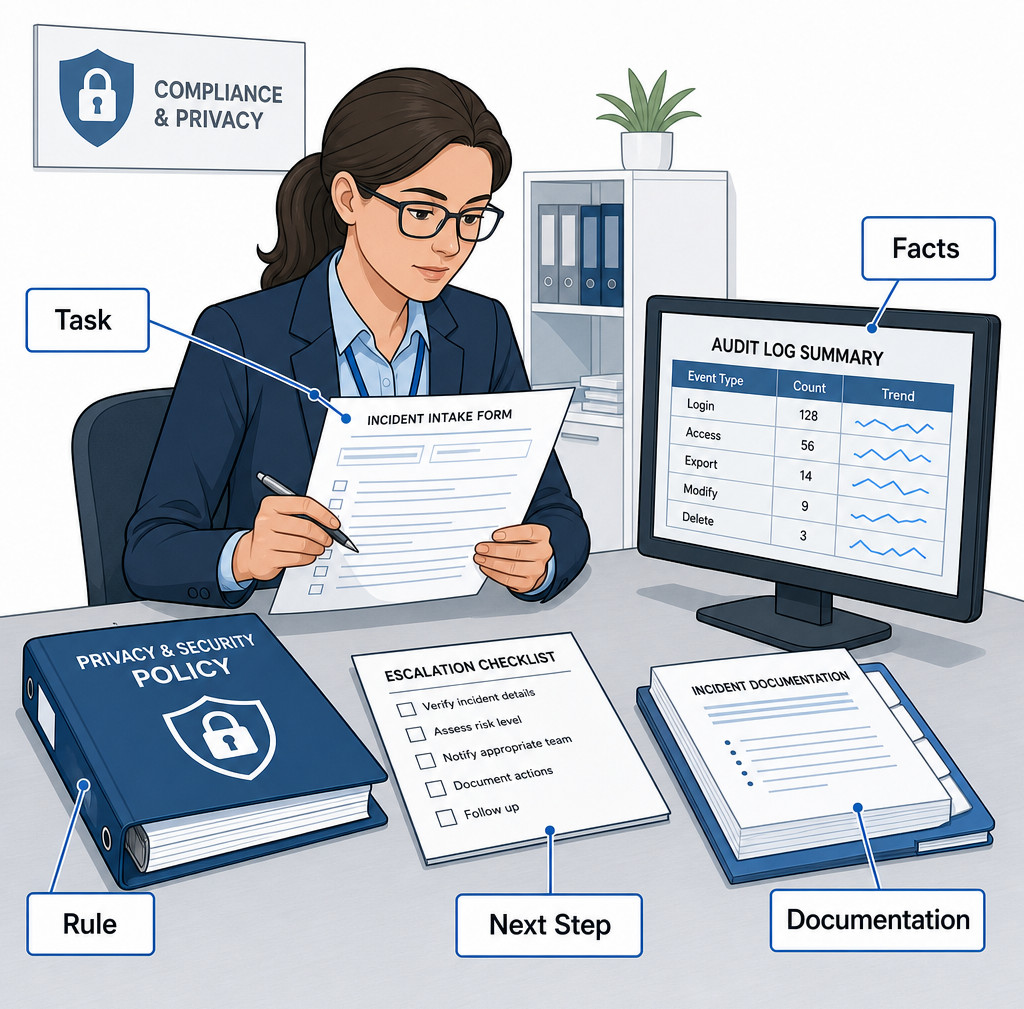
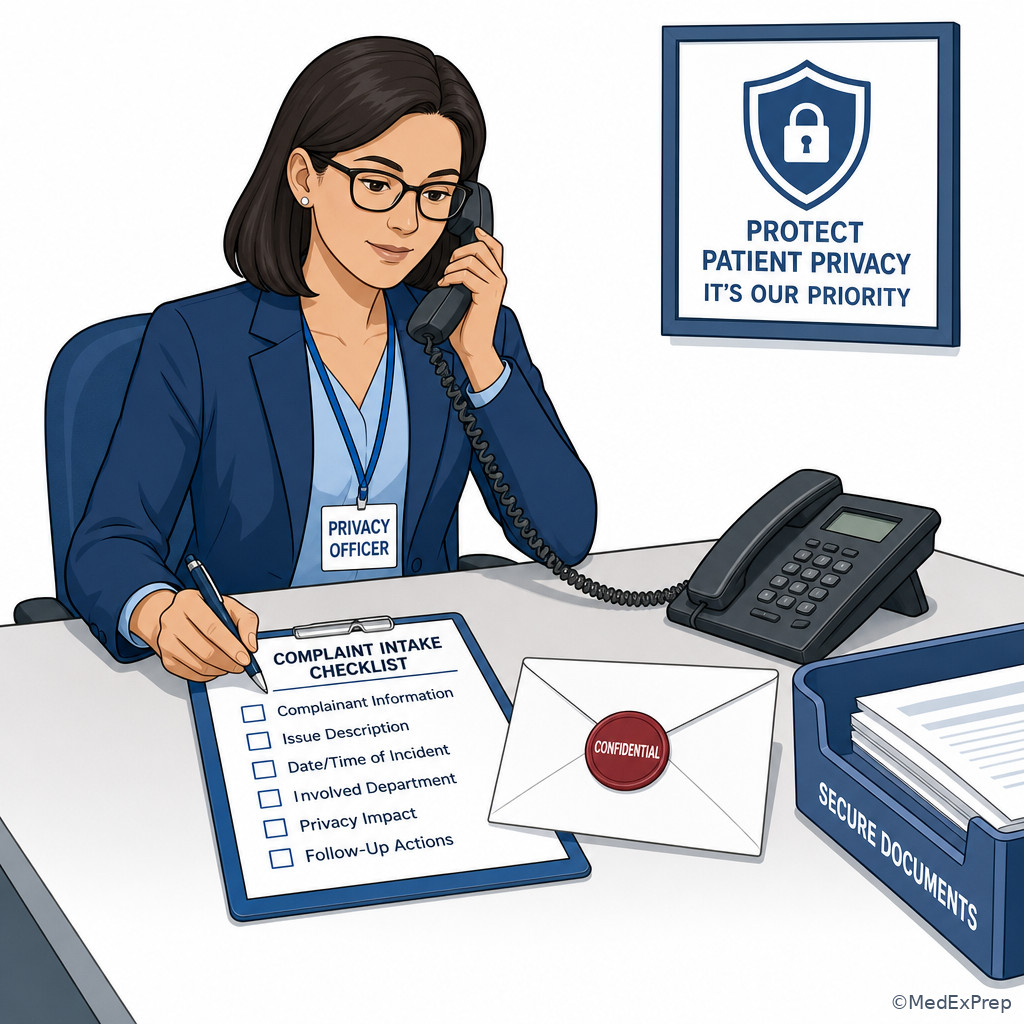
A 64-year-old patient with diabetes and chronic kidney disease calls the privacy office after receiving another patient's discharge instructions in the mail. The patient is angry because the envelope also contained a reminder card for a cardiology appointment. A distracting detail is that the caller's creatinine was abnormal at discharge. A tempting-but-wrong clue is that the document involved clinical care, so a learner may think the treating physician must decide the privacy response. The question asks: What is the most appropriate initial response by the privacy professional?
Identify task: Complaint and possible misdirected disclosure intake. Extract key facts: wrong recipient, another patient's discharge instructions, mailed information, caller report, possible protected health information exposure. The creatinine value is clinical noise. Apply principle: intake, preserve facts, retrieve or secure misdirected information if possible, document, and initiate the organization's investigation process. Eliminate distractors: Do not immediately declare a reportable breach without analysis; do not ask the treating physician to resolve the privacy complaint alone; do not ignore the event because it was accidental. Verify: document the complaint, start investigation, coordinate mitigation, and follow policy for escalation.
Misdirected mail intake scene
Exam takeaway: The initial privacy response is to document, secure facts, and begin investigation rather than make a premature final breach conclusion.
C Exam trap
Common wrong answer: Immediately notify all potentially affected parties and report externally. Why it is tempting: The stem clearly suggests information went to the wrong person. Single clue that eliminates it: The question asks for the initial response, and the facts have not yet been investigated or risk-assessed.
D Checkpoint MCQ
A clinic manager reports that a registration employee may have looked up a neighbor's record after a local social event. The employee says she only wanted to confirm the appointment time because the neighbor asked about it socially. What is the best initial action for the privacy/security professional?
Terminate the employee immediately for intentional snooping.
Open and document an investigation, preserve relevant audit information, and assess role, purpose, and policy.
Tell the neighbor that the employee accessed the record because the neighbor mentioned the appointment socially.
Disable all registration staff access until the investigation is complete.
Answer: B. A is tempting because inappropriate access may warrant sanctions, but HR action requires policy-grounded investigation. B is correct because the initial task is investigation and preservation of facts. C is tempting because the neighbor is involved, but disclosure details require policy-guided handling and minimum necessary. D is tempting as a containment reflex, but it is overbroad without facts showing a system-wide risk.
If you missed this: Review 1. Start with the task, not the topic label - focus on the difference between initial investigation and final sanction.
1.1.2.3 2. Extract key facts, then apply the governing rule or principle
A Explanation
Decision conflict: CHPS stems frequently include realistic noise: clinical diagnoses, angry callers, technical jargon, executive pressure, or irrelevant lab values. Your job is to sort facts that change the privacy/security decision from facts that merely make the story feel real.
WHY THIS IS TESTED: Privacy and security professionals must make defensible decisions without being distracted by clinical complexity or emotional pressure. The exam rewards candidates who can connect the decisive fact to the correct principle: minimum necessary, role-based access, verification of requester identity, incident containment, policy-based escalation, or documentation.
Key facts usually answer five questions: Who is requesting or acting? What information is involved? Why is it being used or disclosed? What policy or relationship supports the action? What risk or follow-up is created? If one of those facts is missing, the safest next step is often to verify rather than conclude.
1. Identify actor, information, purpose, channel, and risk.
2. Remove facts that do not change privacy, security, risk, or governance duties.
3. Match the remaining facts to a governing principle or organizational policy.
4. Choose the action that fits the missing or confirmed fact.
Fact category
Question to ask
Likely principle
Best next-step cue
Actor
Who wants access or action?
Authorization, role-based access, verification
Confirm identity, role, and authority.
Information
What data is involved?
Protected health information, sensitive health information, classification
Limit scope and handling.
Purpose
Why is the information needed?
Minimum necessary, permitted use/disclosure
Confirm purpose before release or access.
Channel
How is information moved or exposed?
Safeguards, security incident, media control
Contain channel risk and document.
Risk
What harm, exposure, or control gap exists?
Mitigation, risk analysis, escalation
Prioritize containment and follow-up.
Fig 3. Relevant-fact filter Exam takeaway: A fact matters when it changes authority, purpose, information scope, risk, mitigation, or documentation.
flowchart TD
A[All stem facts]-->B{Changes decision?}
B--Actor or authority-->C[Keep]
B--Information scope-->C
B--Purpose or role-->C
B--Risk or exposure-->C
B--Clinical color only-->D[Set aside]
B--Emotional pressure only-->D
C-->E[Apply principle]
D-->E
The filter in Fig 3 helps you avoid overreacting to noisy clinical details that do not change the privacy/security decision.
B Worked example
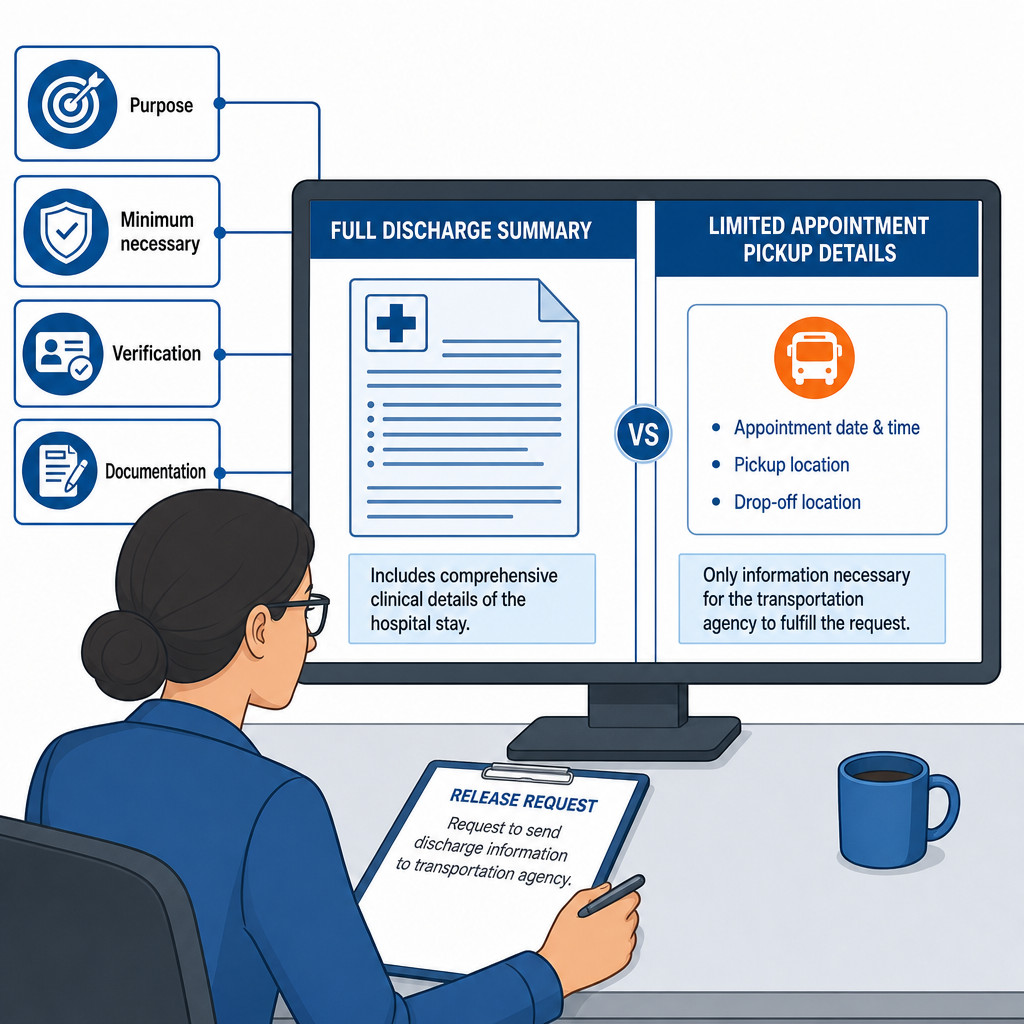
A 72-year-old patient with heart failure and depression is being discharged. A social worker asks the privacy office whether a full discharge summary can be faxed to a community transportation agency because the patient needs rides to follow-up appointments. The chart contains oncology history, psychiatric medication history, and a recent potassium value of 3.2. The agency only coordinates ride times and pickup locations. The question asks for the best application of policy and governing principles.
Identify task: Use/disclosure decision and scope review. Extract key facts: non-care community transportation agency, purpose is rides, requested full discharge summary, data includes sensitive content beyond transportation need. Heart failure and potassium are clinical noise unless they affect transportation safety under policy. Apply principle: minimum necessary and purpose-based disclosure. Eliminate alternatives: Do not send the full summary solely for convenience; do not deny all coordination if policy permits limited disclosure; do not let the social worker decide alone without applying disclosure rules. Verify: confirm identity, authority, required consent/authorization or applicable permission under local policy, disclose only necessary scheduling/location information if permitted, and document the decision.
Minimum necessary disclosure review
Exam takeaway: The purpose of the request determines the minimum information needed, not the convenience of sending the whole record.
C Exam trap
Common wrong answer: Send the entire discharge summary because discharge planning involves patient care. Why it is tempting: The request is connected to follow-up care logistics. Single clue that eliminates it: The receiving party only needs transportation details, so the full summary exceeds the purpose.
D Checkpoint MCQ
A payer representative asks for an entire psychiatric hospitalization record to verify whether a single billed service was medically necessary. The representative is verified as a payer contact. What should the privacy professional recommend first?
Release the full record because the requester is verified.
Deny the request because psychiatric information can never be disclosed.
Confirm the scope needed for the payment-related review and apply minimum necessary and policy requirements before disclosure.
Ask the treating psychiatrist to make the final legal decision without privacy review.
Answer: C. A is tempting because the requester is verified, but verification does not automatically justify full-record scope. B is tempting because psychiatric information is sensitive, but the stem does not support an absolute rule. C is correct because purpose and minimum necessary must be applied. D is tempting because the content is clinical, but the decision is privacy/compliance oriented.
If you missed this: Review 2. Extract key facts, then apply the governing rule or principle - focus on why verified identity is not the same as unlimited disclosure authority.
Quick Recall:
Fill in the blank: The best first filter is not the topic label; it is the requested ______.
True or false: Verified identity always means the full record may be released. Answer: False.
One-liner: If the purpose is narrow, the information scope should usually be narrow.
1.1.2.4 3. Choose the policy-grounded best next step
A Explanation
Decision conflict: Many answer choices sound responsible: notify, sanction, report, lock accounts, disclose, deny, educate, or escalate. The correct choice is the one that fits the stage of the case and the privacy/security professional's authority.
WHY THIS IS TESTED: CHPS work is operational. The exam therefore tests sequencing: what must happen first, what can happen only after analysis, and what requires escalation to a designated stakeholder. A policy-grounded answer is neither passive nor reckless. It moves the issue forward while preserving defensibility.
A strong next step usually has three traits. First, it addresses the immediate risk or missing fact. Second, it stays within the privacy/security role. Third, it creates or preserves documentation. A weak answer may be dramatic but unsupported, such as declaring a breach, firing an employee, writing a technical configuration, or releasing broad information without authorization.
1. Decide whether the immediate need is containment, verification, investigation, escalation, or communication.
2. Match the action to privacy/security authority.
3. Avoid final conclusions before required analysis.
4. Document the rationale and follow-up owner.
Fig 4. Next-step decision tree Exam takeaway: Best-next-step questions reward the action that fits the current stage of the operational process.
flowchart TD
A[Scenario question]-->B{Immediate risk active?}
B--Yes-->C[Contain and mitigate]
B--No-->D{Facts incomplete?}
D--Yes-->E[Verify and investigate]
D--No-->F{Authority clear?}
F--No-->G[Escalate or consult]
F--Yes-->H[Implement policy action]
C-->I[Document]
E-->I
G-->I
H-->I
See Fig 4 for the board-style sequence: active risk first, missing facts second, authority third, documentation throughout.
Policy-grounded sequencing board
Exam takeaway: The best next step is chosen by stage, not by which answer sounds most severe.
B Worked example
A business associate emails a security officer that a laptop used for claims processing was stolen from an employee's car. The employee has hypertension and the email mentions that the laptop brand was recently recalled for a battery issue. The vendor says it is not yet sure whether the laptop contained local files or whether encryption was enabled. The vendor asks whether your organization wants to send breach notifications today. The question asks for the most appropriate next step.
Identify task: Third-party incident intake and initial escalation/containment. Extract key facts: business associate, stolen device, claims processing, unknown local data, unknown encryption, request for immediate notification. Hypertension and battery recall are noise. Apply principle: do not make a breach notification conclusion before essential facts and contractual/policy processes are reviewed. Eliminate distractors: Do not send notification today solely because a laptop was stolen; do not ignore because the vendor owns the laptop; do not perform forensic imaging personally if that is outside role. Verify: activate vendor incident coordination, request facts, preserve documentation, coordinate with security/IT, legal, vendor management, and leadership as policy requires, and determine mitigation and notification analysis after facts are available.
C Exam trap
Common wrong answer: Conclude reportable breach immediately because a device was stolen. Why it is tempting: Stolen devices are high-risk and time-sensitive. Single clue that eliminates it: The encryption and data-content facts are unknown, so the next step is coordinated investigation and documentation.
D Checkpoint MCQ
An employee emails a spreadsheet containing patient names and appointment dates to the wrong internal department. The recipient immediately reports it and confirms the file was deleted without forwarding. What is the best next step?
Document the event, verify containment, assess the nature and scope under policy, and determine any further mitigation.
Notify external regulators immediately because any wrong recipient is automatically reportable.
Take no action because the recipient was internal.
Ask IT to permanently remove email access for all staff in both departments.
Answer: A. A is correct because the response requires documentation, containment verification, policy analysis, and mitigation. B is tempting because the disclosure was misdirected, but automatic reporting is premature. C is tempting because the recipient was internal, but internal misdirection may still require analysis and documentation. D is tempting as a security control reaction, but it is disproportionate and not policy-grounded from the facts given.
If you missed this: Review 3. Choose the policy-grounded best next step - focus on why containment and assessment come before final notification decisions.
1.1.2.5 4. Close the loop: minimum necessary, documentation, mitigation, escalation, and follow-up
A Explanation
Decision conflict: Learners often choose an answer that solves the visible issue but fails to close the operational loop. A staff member is counseled but the case is not documented. A disclosure is narrowed but the requester is not verified. A device is recovered but no risk assessment is recorded. A vendor promises remediation but no follow-up owner is assigned.
WHY THIS IS TESTED: CHPS practice is accountable. The privacy/security professional must support defensible decisions by documenting facts, rationale, actions, mitigation, escalation, and monitoring. The loop is especially important when facts are incomplete or when multiple stakeholders share responsibility.
Use the close-the-loop checks after every scenario. Did the action apply minimum necessary? Was access or requester authority verified? Was the incident or request documented? Was mitigation considered? Was escalation needed? Was there a follow-up plan to confirm completion?
1. Confirm minimum necessary or role-based scope.
2. Document facts, analysis, decision, and owner.
3. Mitigate harm or control gap.
4. Escalate to designated stakeholders when authority or risk requires it.
5. Track follow-up and trend recurring issues.
Fig 5. Close-the-loop governance checks Exam takeaway: Documentation, mitigation, escalation, and follow-up make the decision defensible after the immediate action is chosen.
graph LR
A[Decision made]-->B[Minimum necessary or role scope]
B-->C[Documentation]
C-->D[Mitigation]
D-->E[Escalation if needed]
E-->F[Follow-up and trend review]
See Fig 5. In exam language, an answer that includes documentation and follow-up is often stronger than an answer that merely tells someone to be careful next time.
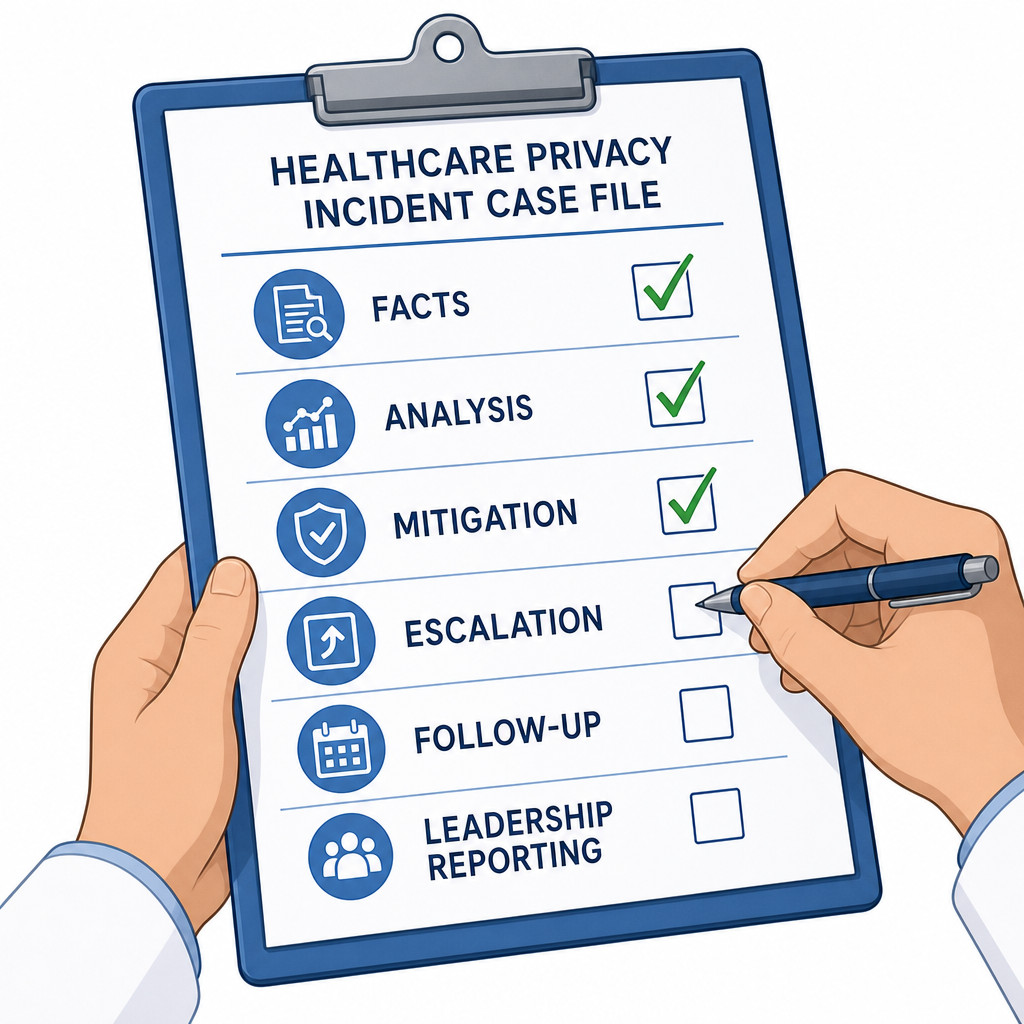
Case file closure checklist
Exam takeaway: A privacy/security matter is not complete until facts, analysis, action, mitigation, escalation, and follow-up are recorded.
B Worked example
A monthly audit shows that a nurse accessed records of three patients on a unit where she was not assigned. The nurse also has asthma and recently transferred from another department, which creates noise in the stem. Her manager says she is helpful and may have been answering questions for coworkers. The question asks for the most appropriate privacy/security response.
Identify task: Audit finding and possible inappropriate access investigation. Extract key facts: access outside assignment, three records, manager explanation is unverified, role transition may affect access provisioning. Asthma is irrelevant. Apply principle: role-based access, audit investigation, documentation, potential provisioning review, workforce accountability. Eliminate distractors: Do not assume innocence solely because the employee is helpful; do not terminate immediately without investigation; do not ignore because a manager offered a possible explanation. Verify: review access purpose, assignments, role provisioning, policy, employee explanation, manager facts, and apply corrective action or sanctions consistently if supported.
C Exam trap
Common wrong answer: Close the matter because the manager says the nurse may have been helping coworkers. Why it is tempting: The explanation sounds operationally plausible. Single clue that eliminates it: The explanation is unverified and access outside assignment requires documented review.
D Checkpoint MCQ
A privacy analyst confirms that a limited misdirected fax was retrieved, the unintended recipient signed a destruction attestation, and the sending department has a repeated pattern of wrong-number faxes. What follow-up is most appropriate?
Close the case because the specific fax was retrieved.
Document retrieval and mitigation, then recommend corrective action or workflow control review for the repeated pattern.
Publish the department's error rate to all staff to shame future compliance.
Disable all faxing immediately across the organization.
Answer: B. A is tempting because the immediate exposure was mitigated, but repeated pattern requires follow-up. B is correct because it closes the individual case and addresses the control gap. C is tempting as a deterrent but is punitive and inappropriate without policy basis. D is tempting as a risk-elimination action but is overbroad without analysis.
If you missed this: Review 4. Close the loop: minimum necessary, documentation, mitigation, escalation, and follow-up - focus on why mitigation of one event does not end a recurring control problem.
Quick Recall:
True or false: Mitigation and notification are the same step. Answer: False.
Fill in the blank: A defensible case file should record facts, analysis, action, and ______.
One-liner: A repeated pattern turns an isolated event into a control and monitoring issue.
1.1.2.6 5. Avoid unsupported conclusions when facts are incomplete
A Explanation
Decision conflict: Some stems give a dramatic event but withhold a decisive fact. The wrong answer converts uncertainty into certainty: this is definitely a breach, the employee definitely violated policy, the vendor definitely failed, the disclosure is definitely permitted, or legal counsel is not needed. The correct answer recognizes uncertainty and chooses verification, containment, consultation, documentation, or escalation.
WHY THIS IS TESTED: CHPS professionals operate in regulated environments where premature conclusions can create compliance, legal, operational, and trust risks. The exam expects a safe, defensible next step when applicable law, local policy, technical details, or factual scope is not yet clear.
When the stem lacks essential facts, do not invent them. State or choose the next operational step that obtains them. If legal interpretation is uncertain, the privacy/security professional should coordinate with organizational legal counsel or designated leadership rather than acting as outside counsel.
1. Identify the missing decisive fact.
2. Protect information and preserve evidence while facts are gathered.
3. Consult policy, legal, IT/security, HR, vendor, or leadership as appropriate.
4. Document uncertainty, actions taken, and the basis for the final decision.
Fig 6. Uncertainty-safe pathway Exam takeaway: When facts are incomplete, the best answer usually verifies, contains, documents, and consults rather than declares.
flowchart LR
A[Incomplete facts]-->B[Identify missing fact]
B-->C[Contain or preserve]
C-->D[Consult policy and stakeholders]
D-->E[Document analysis]
E-->F[Decide after facts]
See Fig 6. This is the safest pattern for questions involving uncertain encryption, unknown recipient identity, unclear authority, disputed access purpose, or jurisdictional variation.
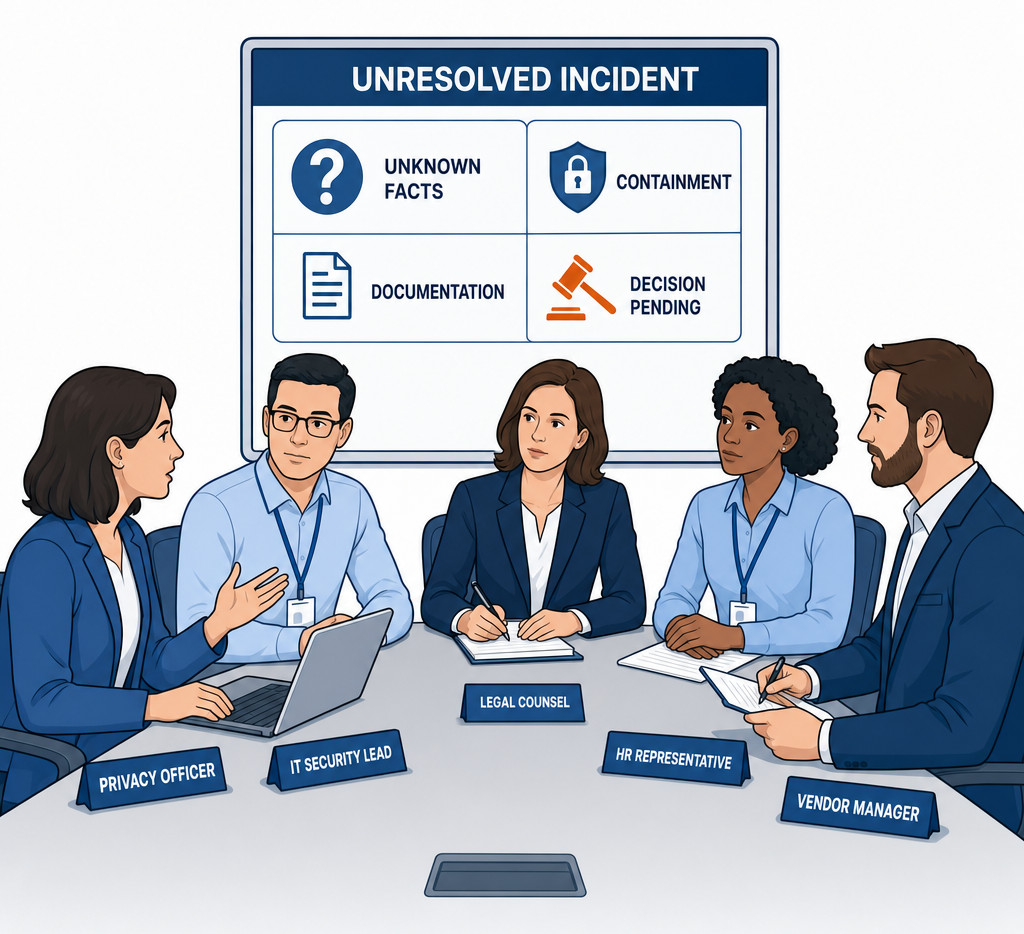
Uncertainty escalation huddle
Exam takeaway: Consultation is appropriate when the privacy/security professional needs legal, technical, HR, vendor, or leadership input to complete the analysis.
B Worked example
A public health agency requests identifiable patient information related to a suspected outbreak. The request is urgent, and the hospital's infection prevention team supports cooperation. The requesting official's identity has not yet been verified, and the request asks for more data elements than the infection prevention note appears to require. The patient population includes pregnant patients and older adults with chronic lung disease, but those clinical facts do not by themselves decide the disclosure scope. The question asks for the best next step by the privacy professional.
Identify task: Request intake and verification before disclosure. Extract key facts: public health request, urgency, identifiable data, unverified official identity, potentially overbroad data elements. Apply principle: permitted disclosures may exist, but requester verification and scope/minimum necessary or policy requirements still matter. Eliminate distractors: Do not refuse all cooperation solely because identifiable data is involved; do not send all requested data before verifying authority and scope; do not make the infection prevention team solely responsible for privacy analysis. Verify: confirm identity/authority and applicable policy, coordinate with legal or leadership if needed, limit disclosure to appropriate scope, and document.
C Exam trap
Common wrong answer: Release all requested information immediately because public health requests are important. Why it is tempting: The request appears urgent and tied to population safety. Single clue that eliminates it: The requester's identity and requested scope have not yet been verified.
D Checkpoint MCQ
A senior executive asks the privacy officer to confirm that a controversial disclosure was lawful before the facts are gathered, because the board meeting starts in 30 minutes. What is the best response?
Confirm it was lawful because leadership needs reassurance.
Refuse to discuss the matter with leadership.
Provide a preliminary process update, explain that a definitive conclusion requires fact gathering and policy/legal review, and document the next steps.
Send the executive the entire patient record so leadership can decide.
Answer: C. A is tempting because executive pressure is high, but it creates an unsupported conclusion. B is tempting to avoid legal risk, but privacy/security leaders must communicate appropriately. C is correct because it supports leadership with a defensible process update. D is tempting as transparency, but it risks overbroad disclosure and role confusion.
If you missed this: Review 5. Avoid unsupported conclusions when facts are incomplete - focus on the difference between process update and final legal conclusion.
TRAPS
Exam Traps & Differentiators
Most common wrong answer: The dramatic final action: external notification, employee termination, full disclosure, total access shutdown, or definitive legal conclusion. Why it is tempting: It feels decisive and protective. Why it fails: CHPS questions usually test the next defensible operational step, not the most severe possible action.
Looks similar
But is not
Discriminator
Best action pattern
Incident
Reportable breach conclusion
Facts and risk analysis may be incomplete.
Intake, contain, investigate, document.
Verified requester
Unlimited disclosure authority
Purpose and scope still matter.
Apply minimum necessary and policy.
Manager explanation
Confirmed access justification
Explanation must be verified.
Review audit facts and role/purpose.
Mitigation completed
Case fully closed
Documentation, follow-up, and trends may remain.
Record analysis and monitor recurrence.
Legal uncertainty
Privacy officer acting as outside counsel
Role is operational coordination and escalation.
Consult legal/policy stakeholders.
1.1.2.7 If the stem says...
Best initial response -> think intake, containment, verification, preservation, and documentation.
Facts are unclear -> think investigate and consult before final conclusion.
Wrong recipient -> think containment, retrieval/destruction if appropriate, documentation, and risk analysis.
Full record requested for narrow purpose -> think minimum necessary and scope limitation.
Vendor incident -> think business associate coordination, contract/policy escalation, facts, mitigation, and documentation.
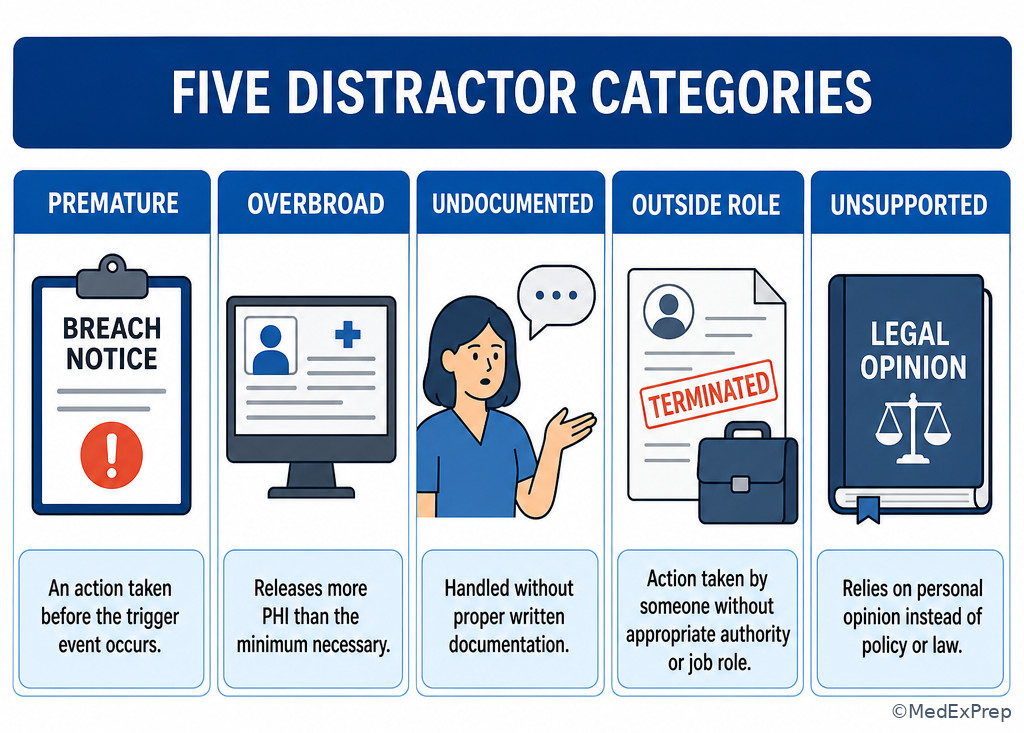
Wrong-answer distractor board
Exam takeaway: CHPS distractors often fail because they are premature, overbroad, undocumented, outside role, or unsupported by facts.
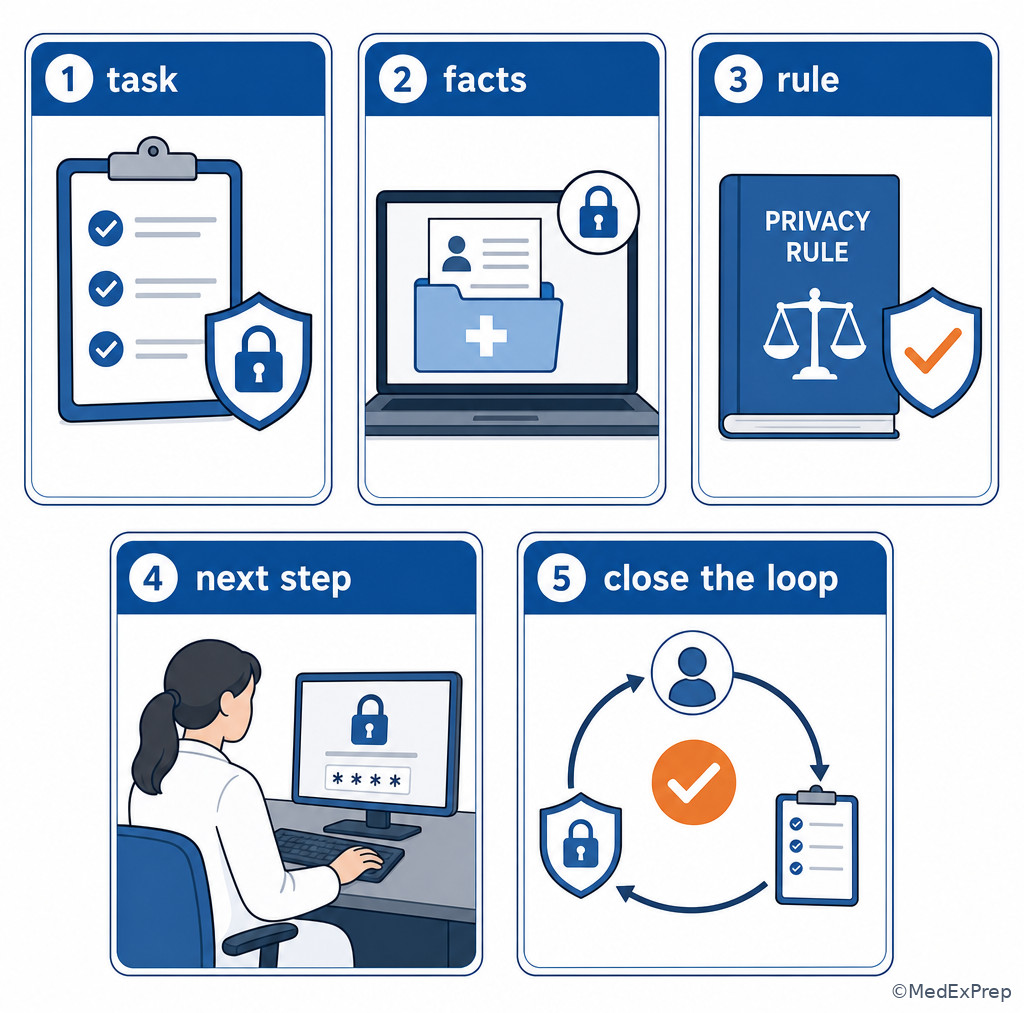
Use this mini-algorithm for any CHPS operational scenario. It is intentionally short enough to apply during timed questions.
1. Task: Identify the exact action requested by the question.
2. Facts: Keep only facts that affect actor, information, purpose, authority, risk, mitigation, or documentation.
3. Rule: Apply the governing principle or organizational policy direction.
4. Step: Choose the next action that fits the current stage and your role.
5. Loop: Confirm minimum necessary, documentation, mitigation, escalation, and follow-up.
Operational answer algorithm Exam takeaway: A five-step algorithm prevents premature conclusions and keeps the answer within CHPS scope.
graph TD
A[Task]-->B[Facts]
B-->C[Rule or policy]
C-->D[Best next step]
D-->E[Minimum necessary]
E-->F[Documentation]
F-->G[Mitigation and follow-up]
QUIZ
Self-check quiz
1.1.2.8 Question 1
A hospital volunteer reports that a printed patient list was found in a public waiting area. The list includes names, room numbers, and procedure times. The volunteer has already placed the list face down at the front desk. What is the best initial response by the privacy/security professional?
Announce the event to all patients in the waiting area.
Secure the list, document the report, determine who created it and who may have viewed it, and begin policy-based investigation.
Discard the list because it is now face down.
Terminate the employee who printed the list.
1.1.2.9 Question 2
A department director asks for full access to all employee health records to identify staff who may need wellness outreach. What principle most directly limits the request?
Role-based access and minimum necessary.
Clinical autonomy of the treating physician.
Automatic breach notification.
Downtime planning.
1.1.2.10 Question 3
A vendor reports possible exposure of appointment reminder files but cannot yet confirm whether protected health information was included. Which response is most appropriate?
Conclude it is not reportable because the vendor is unsure.
Conclude it is reportable because any vendor issue is a breach.
Activate vendor incident coordination, request essential facts, document containment and mitigation steps, and follow policy for escalation.
Ask the vendor to delete all records and stop communicating.
1.1.2.11 Question 4
An audit shows a billing employee accessed a celebrity patient's laboratory results. The employee states the account appeared on a work queue, but the queue assignment is unclear. What is the best next step?
Declare intentional snooping and finalize sanctions immediately.
Ignore the access because billing staff sometimes need records.
Verify queue assignment, job duties, access purpose, audit details, and policy before determining corrective action.
Send the lab results to the employee's manager for review.
1.1.2.12 Question 5
A clinic receives a request from a verified attorney asking for the complete record of a patient. The request does not include enough information to determine whether authorization, subpoena, court order, or another basis applies. What should the privacy professional do first?
Release the complete record because the attorney is verified.
Verify the legal or policy basis and required documentation before disclosure, consult legal if needed, and document the intake.
Reject all attorney requests as prohibited.
Ask the treating physician to release whatever seems clinically relevant.
ANSWERS
Answer key & explanations
1.1.2.13 Question 1: Answer B
A: Tempting because patients may be affected, but public announcement is premature and may create additional disclosure. B: Correct because the initial task is to secure information, document, investigate exposure, and follow policy. C: Tempting because the list is no longer openly visible, but discarding destroys facts and fails documentation. D: Tempting because a printed list in public is serious, but sanctions require investigation and consistent process.
If you missed this: Review 1. Start with the task, not the topic label — focus on why initial containment and documentation precede conclusions.
1.1.2.14 Question 2: Answer A
A: Correct because access must align with role, purpose, policy, and minimum necessary scope. B: Tempting because the records are clinical, but the conflict is an access and privacy governance issue. C: Tempting if the learner sees risk, but no incident has occurred yet. D: Tempting because it sounds security-related, but downtime planning is not the access-limiting principle.
If you missed this: Review 2. Extract key facts, then apply the governing rule or principle — focus on purpose and scope.
1.1.2.15 Question 3: Answer C
A: Tempting because the vendor lacks confirmation, but uncertainty does not close the matter. B: Tempting because vendor incidents can be serious, but automatic breach conclusions are premature. C: Correct because the response should coordinate, gather facts, document, contain, mitigate, and escalate under policy. D: Tempting as containment, but it is reckless, destroys continuity, and avoids required coordination.
If you missed this: Review 5. Avoid unsupported conclusions when facts are incomplete — focus on verifying decisive facts before deciding.
1.1.2.16 Question 4: Answer C
A: Tempting because celebrity access is high-risk, but intent and authorization require review. B: Tempting because billing access can be legitimate, but a celebrity record and unclear queue require investigation. C: Correct because role, assignment, purpose, audit data, and policy determine the next action. D: Tempting because the manager is involved, but sending lab results may create overbroad disclosure.
If you missed this: Review 4. Close the loop: minimum necessary, documentation, mitigation, escalation, and follow-up — focus on verified role-based access before sanction or closure.
1.1.2.17 Question 5: Answer B
A: Tempting because the requester is verified, but verified identity is not the same as authority to receive a full record. B: Correct because the legal or policy basis and required documentation must be verified before disclosure. C: Tempting as a protective response, but it overstates the rule and ignores valid request pathways. D: Tempting because the record is clinical, but the issue is release authority and privacy process.
If you missed this: Review 5. Avoid unsupported conclusions when facts are incomplete — focus on verification before release.
RAPID
Rapid review / cheat-sheet
Task first -> The last sentence tells you what stage the answer must address.
Key facts -> Keep facts that change actor, authority, information scope, purpose, risk, mitigation, or documentation.
Verified identity -> Confirms who is asking, not how much they may receive.
Minimum necessary -> Scope follows purpose; convenience does not justify full-record release.
Incident language -> Does not automatically equal reportable breach.
Best initial response -> Usually intake, contain, verify, investigate, preserve, or document.
Audit anomaly -> Review role, assignment, purpose, access pattern, and policy before sanction.
Vendor incident -> Coordinate through business associate/vendor process and request decisive facts.
Mitigation -> Reduces harm or control gaps; it is not the same as notification.
Incomplete facts -> Verify, consult, and document instead of declaring.
Role boundary -> Recommend, coordinate, audit, educate, document, and escalate; do not act as clinician, outside counsel, HR, law enforcement, or engineer unless the role is given.