1.1.1 - Baseline Patient Assessment
Why it matters
- Baseline assessment is the first safety filter before positioning, imaging, and dose delivery.
- Many exam stems test the same core conflict: proceed with routine workflow versus hold and clarify because one key finding changes safety.
- A brief, structured assessment improves reproducibility, prevents setup failure, and catches urgent symptoms before the patient is immobilized on the table.
- Therapists are not expected to diagnose or prescribe, but they are expected to recognize abnormal findings, document them, and escalate appropriately.
Key Terms & Must-Know Facts
1.1.1.1 Key terms
- Baseline assessment — therapist-level starting snapshot of the patient's current condition before simulation or treatment.
- Readiness to proceed — whether the patient can safely tolerate and complete the planned step.
- Focused symptom screen — brief targeted questions about pain, breathing, dizziness, nausea, bowel/bladder status, and ability to lie still.
- Objective finding — observable or measurable fact, such as difficulty transferring or visible respiratory distress.
- Subjective symptom — patient-reported problem, such as pain or worsening fatigue.
- Hold treatment condition — a discrepancy or patient-status issue serious enough that treatment should not continue until clarified.
- Escalation — notifying the supervising therapist, nurse, radiation oncologist, physicist, or other appropriate team member per protocol.
- Reproducibility — ability to achieve the same setup position consistently across fractions.
- Tolerance — patient ability to remain in required position for the needed time.
- Performance status clue — therapist-observed functional limitation suggesting the patient may not tolerate setup as expected.
- Baseline pain level — starting symptom burden that can affect motion and setup accuracy.
- Variance note — documentation of an unexpected finding, change, or action taken.
1.1.1.2 Must-know facts
- The therapist's question is not “What is the diagnosis?” but “Is it safe and appropriate to proceed?”
- A single new alarming symptom can outweigh otherwise normal workflow timing.
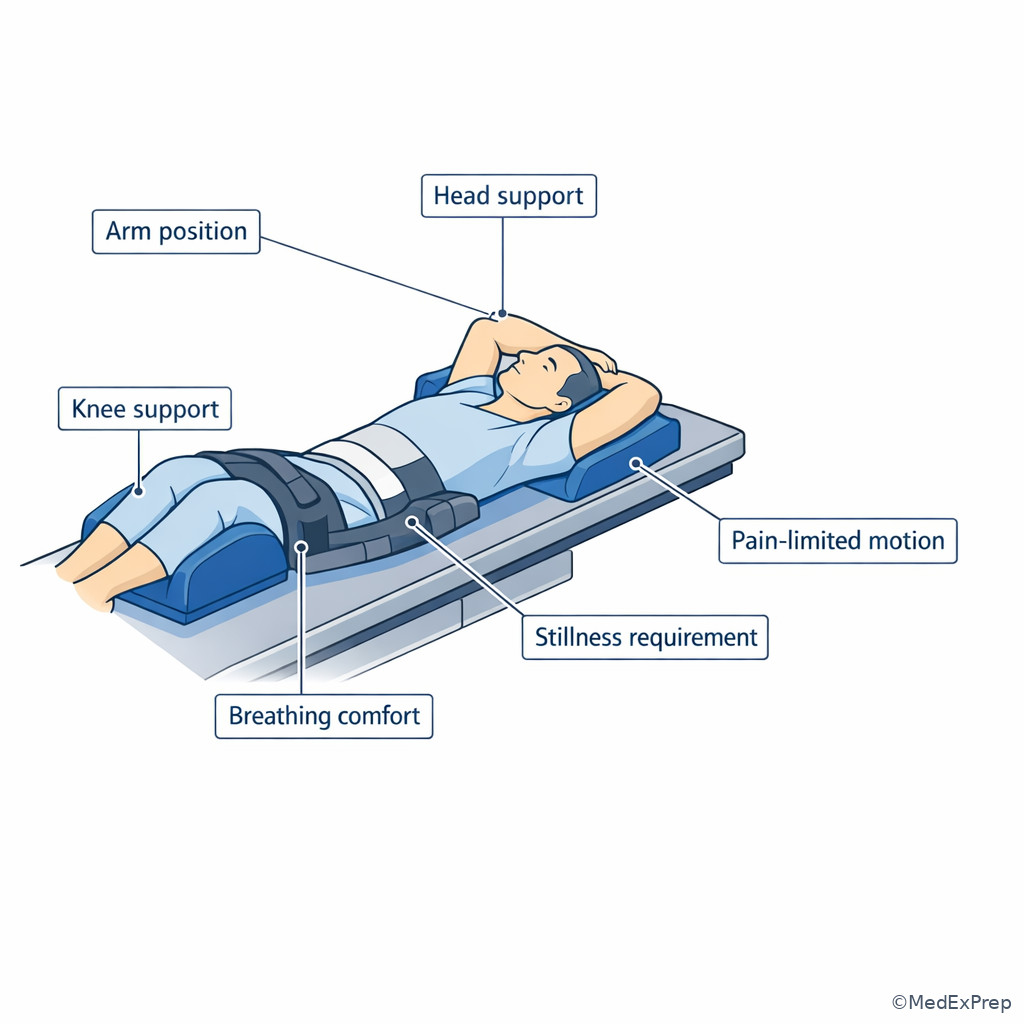
- Ability to lie flat, remain still, and follow commands directly affects setup accuracy.
- Objective documentation beats vague wording; chart what you observed and what you did.
- Routine chronic symptoms may still require action if they are worse than baseline.
- If the patient condition conflicts with the planned procedure, stop and clarify before proceeding.
- Immediate therapist priorities are assess, protect safety, communicate, and document.
- Local protocols vary; confirm institution-specific thresholds, but unstable or concerning changes always require escalation.
| Assessment element | What the therapist checks | Why it matters |
|---|---|---|
| General appearance | Alertness, distress, skin color, work of breathing | Identifies immediate instability before transfer or setup |
| Pain | Location, severity, positional trigger | Predicts movement and setup intolerance |
| Mobility | Walking, transfer needs, weakness | Impacts safe movement and immobilization planning |
| Breathing status | Dyspnea, cough, inability to lie flat | May require hold and urgent evaluation |
| Neurologic change | Dizziness, confusion, new weakness | Possible urgent condition; unsafe to proceed without clarification |
| Position tolerance | Can remain still in treatment position | Critical for reproducibility and delivery accuracy |
| Recent change | Symptoms worse than usual today | New change often matters more than chronic stable issues |
Core content
1.1.1.3 Foundational screening: what counts as a baseline patient assessment?
A Explanation
The main decision conflict is routine intake versus safety-critical screening. On exam stems, you must choose between moving efficiently into setup and pausing long enough to gather the minimum information that affects safe treatment. The single rule that resolves this conflict is: if a finding could change ability to tolerate, reproduce, or safely receive the planned procedure, it belongs in the baseline assessment. This is not a full nursing or physician history. It is a therapist-level readiness screen.
WHY THIS IS TESTED: Candidates often either under-assess (“just get the patient on the table”) or overreach into diagnosis. The exam rewards a focused approach: observe, ask targeted questions, compare with expected baseline, then decide proceed versus hold.
At the start of simulation or treatment, obtain a brief snapshot of current condition: general appearance, orientation/ability to follow commands, pain, breathing comfort, mobility/transfer needs, and ability to tolerate the required position. The key is operational relevance. For example, a patient with back pain may still proceed if pain is controlled and position is reproducible. A patient with new severe shortness of breath may not proceed even if everything else is on time.
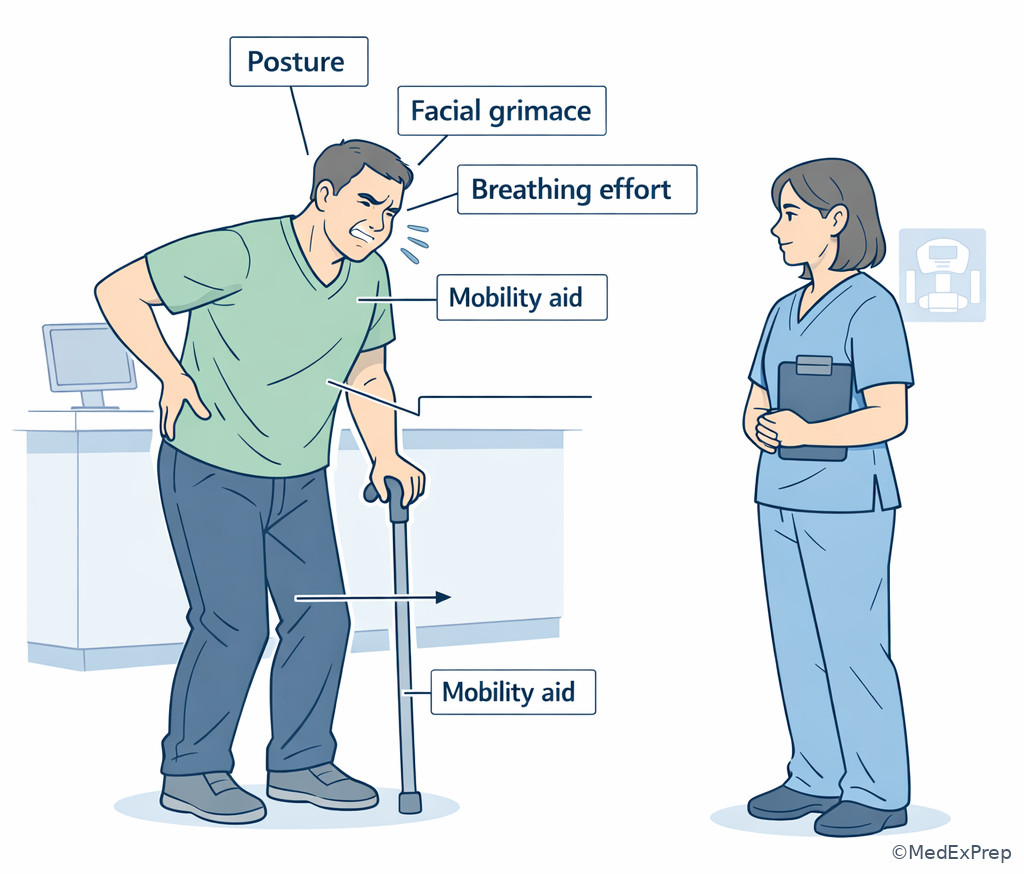
See Fig 1 for the baseline screen sequence. The therapist should also look for visible issues before asking questions: accessory muscle use, guarding, diaphoresis, confusion, inability to transfer, or obvious distress. These objective findings may be more important than a casual “I’m okay” response.
Exam takeaway: Start with visible safety cues, then ask focused tolerance questions before deciding whether to proceed or hold.
flowchart TD
A[Patient arrives] --> B[Observe appearance and distress]
B --> C[Ask focused symptom questions]
C --> D[Assess mobility and position tolerance]
D --> E{Any concerning change or unsafe finding?}
E -->|No| F[Proceed with setup and document baseline]
E -->|Yes| G[Hold workflow and escalate per protocol] B Worked example
A 67-year-old man arrives for first pelvic treatment. He has hypertension, type 2 diabetes, and chronic low back pain. He jokes with staff and says he is “fine,” but he grimaces while sitting, needs both armrests to stand, and reports his back pain is 8/10 when lying flat. His fasting glucose that morning was mildly elevated, which catches the learner's eye, and he also mentions longstanding constipation. The task is to determine the most appropriate therapist response before setup.
Reasoning chain: Identify task — baseline readiness, not medical diagnosis. Extract key facts — severe positional pain, impaired transfer, likely inability to maintain reproducible position. Apply rule — symptoms that affect tolerance and stillness matter immediately. Eliminate distractors — mild hyperglycemia and chronic constipation are not the primary issue in this setup moment. Verify — proceeding without addressing positional intolerance risks motion and failed reproducibility. The safest response is to pause normal flow, communicate the issue, and seek guidance for positioning/support adjustments per protocol before treatment continues.
C Exam trap
D Checkpoint
Question: Before CT simulation, which finding most strongly requires the therapist to clarify readiness before continuing routine setup?
- A. Chronic fatigue that has been stable for several weeks
- B. Mild anxiety about the first treatment
- C. New inability to lie flat without marked shortness of breath
- D. A request to use an extra blanket because the room feels cold
Answer: C.
- A: Tempting because fatigue affects treatment tolerance, but stable chronic fatigue alone does not usually prevent setup; it lacks the immediate safety trigger.
- B: Tempting because anxiety can cause movement, but reassurance and coaching are usually appropriate unless distress is extreme; no red-flag physiologic limitation is given.
- C: Correct because new orthopnea-like symptoms directly affect ability to assume treatment position and may signal acute instability requiring hold and escalation.
- D: Tempting because comfort matters for reproducibility, but a blanket request is routine and manageable unless it interferes with setup.
1.1.1.4 What to observe, ask, and compare: the high-yield therapist data set
A Explanation
The decision conflict here is collect everything versus collect only what changes action. The exam-tested rule is simple: the best baseline questions are the ones that influence setup, verification, comfort, reproducibility, or need for escalation today. This produces a compact data set rather than a broad unfocused interview.
WHY THIS IS TESTED: Stems often hide the key clue inside “noise” such as chronic comorbidities or old symptoms. The correct therapist response depends on identifying which observation is operationally relevant now.
The highest-yield questions include: How are you feeling compared with usual? Any new pain? Any trouble breathing? Any dizziness, weakness, confusion, nausea, or bowel/bladder urgency that would affect remaining in position? Can you lie flat? Can you raise your arms if needed? Can you hold still? If speech is limited or the patient seems uncomfortable, the therapist's visual assessment becomes even more important.
Comparison matters. Stable chronic neuropathy is different from new unilateral weakness. Expected fatigue near the end of a course is different from sudden collapse in functional ability. See Fig 2 for a decision map that separates routine from concerning findings.
Exam takeaway: New change, position intolerance, or acute distress should outweigh chronic stable symptoms when deciding whether to proceed.
flowchart LR
A[Finding noted] --> B{Stable and expected?}
B -->|Yes| C[Document and proceed if setup remains safe]
B -->|No or worse today| D{Affects breathing, neuro status, transfer, or position?}
D -->|Yes| E[Hold and escalate]
D -->|No| F[Adjust routine support and document] Exam takeaway: Visible distress, guarded posture, and transfer difficulty can be more important than a brief verbal reassurance.
| Question or observation | If normal/stable | If abnormal/new |
|---|---|---|
| Can you lie flat? | Proceed with routine positioning | Pause and clarify need for support or hold |
| Any new pain today? | Document baseline discomfort | Assess whether motion or transfer safety is compromised |
| Any trouble breathing? | Continue with observation | Escalate if significant or worsening |
| Any dizziness or confusion? | Proceed if orientation and safety intact | Consider unsafe transfer or urgent evaluation |
| Can you hold your arms up? | Routine setup | May require setup change or clarification |
| Need help transferring? | Routine assistance as planned | Coordinate safe transfer support |
B Worked example
A 54-year-old woman presents for breast simulation. She has rheumatoid arthritis and obesity, and she takes medication for reflux. She reports “same old shoulder stiffness,” but when asked to place both arms overhead she can only maintain the position for a few seconds before severe pain develops. A recent mildly low hemoglobin value is listed in the chart, which may distract the learner. The task is to identify the most appropriate next step.
Reasoning chain: Identify task — determine readiness for planned positioning. Extract key facts — limited arm tolerance directly affects simulation reproducibility. Apply rule — the relevant baseline finding is the one that changes setup. Eliminate distractors — mild anemia may matter clinically but does not explain immediate failure of arm positioning. Verify — proceeding without addressing the limitation risks unusable simulation geometry and poor reproducibility. The correct therapist action is to pause, communicate the limitation, and follow protocol for alternative support or clarification rather than forcing the planned position.
C Exam trap
D Checkpoint
Question: Which therapist question is most directly tied to setup reproducibility for many simulation and treatment positions?
- A. “Did you sleep well last night?”
- B. “Can you remain in this position without moving?”
- C. “What pharmacy do you use?”
- D. “How long have you had your cancer diagnosis?”
Answer: B.
- A: Tempting because sleep affects fatigue and comfort, but it does not directly test treatment-position tolerance.
- B: Correct because stillness and position tolerance directly affect imaging match and dose delivery accuracy.
- C: Tempting because medication history can matter in broader care, but pharmacy choice is not the immediate setup discriminator.
- D: Tempting because disease timeline sounds clinically relevant, but it does not answer whether today’s procedure can be done safely and reproducibly.
- The most useful first comparison question is: “How are you compared with your usual today?”
- True or False: A stable chronic symptom is always less important than a new mild symptom. False; the issue is whether it changes safe treatment delivery today.
- Name the 3 operational domains baseline questions should target: tolerance, reproducibility, safety.
1.1.1.5 Red flags and hold conditions: when the safest answer is stop and escalate
A Explanation
This section tests the highest-yield exam conflict: continue with caution versus hold immediately. The single rule is: if the patient has a new or worsening condition that threatens immediate safety, positioning, cooperation, or treatment accuracy, the therapist should stop and escalate rather than improvise independently.
WHY THIS IS TESTED: The ARRT RT perspective emphasizes therapist recognition and escalation, not unsupervised management. Many distractors ask you to continue, coach, or document only. The correct answer is often the safest therapist action, especially when a symptom is new, significant, or inconsistent with expected baseline.
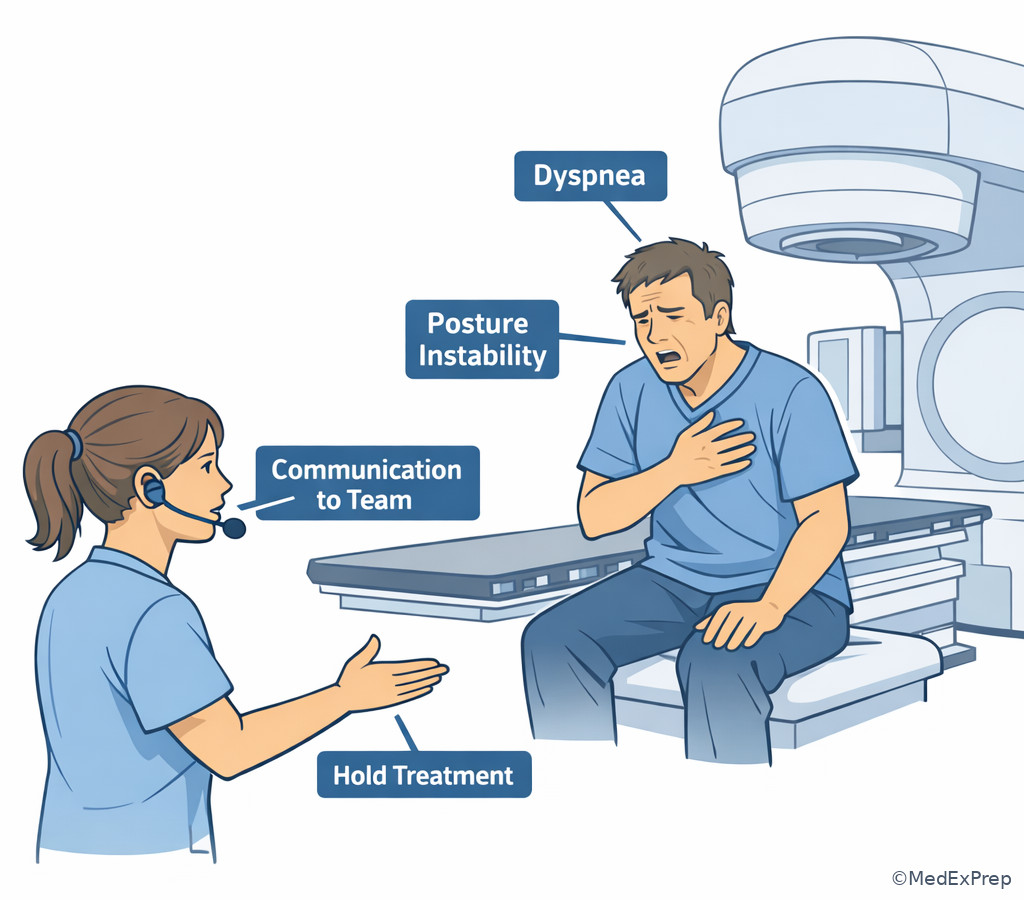
High-yield hold triggers include marked shortness of breath, chest pain, new confusion, syncope or near-syncope, sudden weakness, uncontrolled pain preventing position, active vomiting during preparation, unsafe transfer ability, or any condition making the patient unable to remain still or follow commands. See Fig 3 for a safety-focused escalation algorithm.
The therapist should not try to solve physician-level problems. If a patient reports a new severe headache with focal weakness before cranial treatment, your role is not to diagnose intracranial progression. Your role is to recognize a potentially urgent change, hold, notify the right team members, and document the events accurately.
Exam takeaway: New instability, acute distress, or inability to safely complete setup should trigger hold and escalation rather than workaround thinking.
flowchart TD
A[Assessment finding] --> B{Routine and manageable?}
B -->|Yes| C[Proceed with standard support and document]
B -->|No| D{Immediate safety or setup risk?}
D -->|Yes| E[Stop process]
E --> F[Notify supervising therapist / nurse / physician per protocol]
F --> G[Document finding and actions]
D -->|Unclear but significant| H[Clarify before proceeding] Exam takeaway: Visible respiratory distress or sudden weakness is a therapist-level stop-and-escalate finding, not a routine setup issue.
| Finding | Proceed? | Therapist response |
|---|---|---|
| Stable mild fatigue | Usually yes | Document and continue observation |
| New severe dyspnea lying flat | No | Hold and escalate immediately |
| Controlled chronic pain with tolerable position | Usually yes | Proceed with comfort support per protocol |
| Sudden confusion | No | Stop and notify appropriate team |
| Unsafe transfer from wheelchair | Not until addressed | Obtain assistance and reassess safety |
| Vomiting during setup | Usually no for routine flow | Pause, protect patient, and escalate per protocol |
B Worked example
A 72-year-old woman with lung cancer arrives for treatment. She has COPD, atrial fibrillation, and chronic fatigue. Today she is more short of breath than usual and says she could not sleep lying flat last night. Her oxygen tubing is present, and she insists she does not want to “miss a day.” A minor chart note about poor appetite may tempt the learner to focus on nutrition. The question is the best therapist action now.
Reasoning chain: Identify task — determine safe readiness, not adherence counseling. Extract key facts — worsened dyspnea, orthopnea, change from baseline. Apply rule — new respiratory compromise affecting position tolerance is a hold condition. Eliminate distractors — patient preference to continue does not override safety; appetite note is not the critical clue. Verify — treatment positioning may worsen symptoms and compromise safety. Therefore, stop routine flow, keep the patient safe, and notify the appropriate team per protocol.
C Exam trap
D Checkpoint
Question: Which finding most strongly supports holding the treatment workflow and escalating rather than continuing routine setup?
- A. Chronic mild nausea that is unchanged from yesterday
- B. New confusion and difficulty following simple instructions
- C. Concern about transportation home after therapy
- D. A request to reposition the headrest for comfort
Answer: B.
- A: Tempting because nausea matters for comfort, but unchanged mild symptoms do not automatically require a hold.
- B: Correct because new altered mental status directly affects safety, cooperation, and potential urgent evaluation needs.
- C: Tempting because psychosocial issues deserve attention, but they do not usually determine immediate physiologic readiness for setup.
- D: Tempting because positioning details matter, but a routine comfort adjustment is not itself a red flag.
1.1.1.6 Documentation and communication: chart what matters, say what matters
A Explanation
The decision conflict is minimal note versus useful note. The rule that resolves it: document enough objective detail that another team member can understand what you found, what action you took, and why. Good therapist documentation supports continuity, safety, and legal defensibility.
WHY THIS IS TESTED: Exam questions often ask what to document, whom to notify, or which note best supports safe care. Vague phrases such as “patient tolerated okay” or “doctor aware” are weaker than concise factual entries.
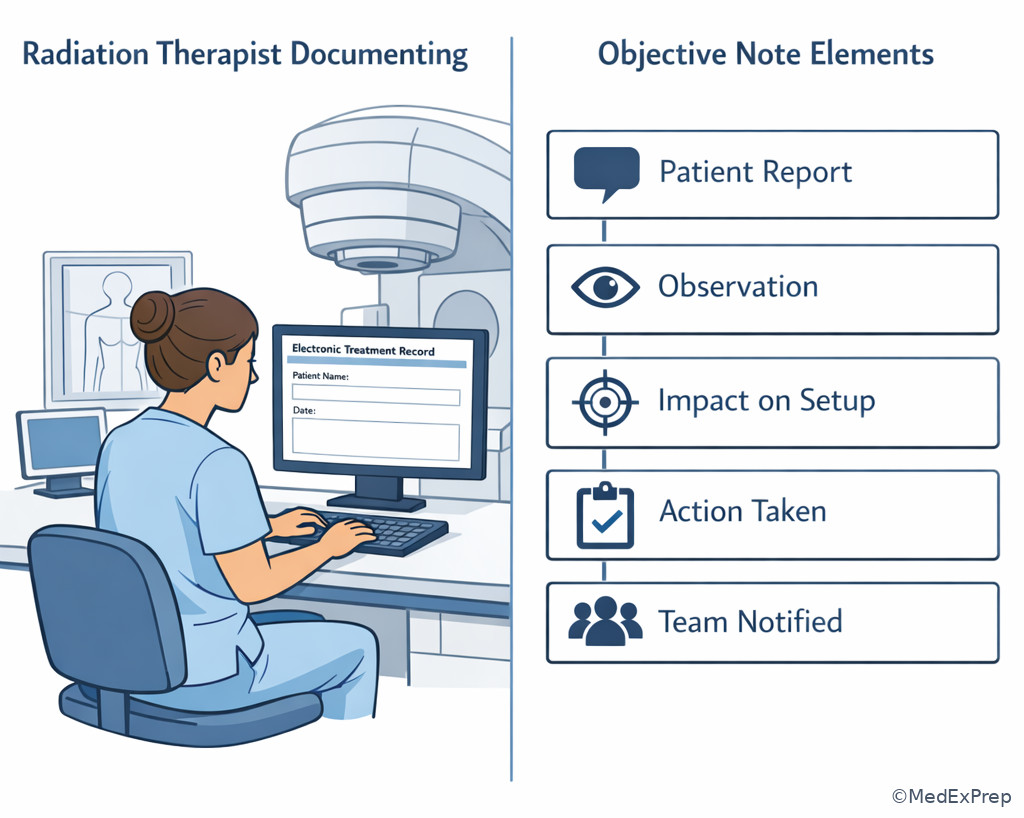
Strong documentation includes the patient-reported symptom, your observed finding, impact on workflow, action taken, and communication pathway. Example: “Patient reports new dizziness on standing; required seated pause before transfer; treatment held and supervising therapist/nurse notified.” This is better than “patient not feeling well.” Similarly, if the patient proceeds with routine care, chart relevant baseline findings briefly: “Ambulated with cane, baseline low back pain 3/10, tolerated supine setup.”
Communication should be closed-loop and role-appropriate. You communicate concern; you do not independently redefine medical management. See Fig 4 for a documentation structure that compresses the key elements.
Exam takeaway: The strongest note states the finding, its impact on readiness, the action taken, and who was notified.
flowchart LR
A[Patient report] --> B[Objective observation]
B --> C[Impact on setup or safety]
C --> D[Action taken]
D --> E[Who was notified / outcome]
Exam takeaway: Chart observable findings and workflow actions rather than vague impressions.
| Weak documentation | Stronger documentation | Why stronger |
|---|---|---|
| Patient not well | Patient reports new dizziness when standing | States specific symptom |
| Needed help | Required two-person assist from wheelchair to couch | Describes functional limitation |
| Doctor notified | Supervising therapist and nurse notified; treatment held pending evaluation | Shows communication chain and action |
| Tolerated treatment | Tolerated supine position for setup without increased pain or movement | Connects tolerance to reproducibility |
| Pain noted | Baseline right shoulder pain 4/10; worsens with arm elevation | Links symptom to positioning task |
B Worked example
A 61-year-old man with prostate cancer presents for treatment. He has osteoarthritis and chronic urinary urgency. Today he reports “about the same,” transfers slowly with a walker, and completes supine setup without increased discomfort. A distracting note in the chart mentions poor sleep due to family stress. The therapist must choose the best documentation entry.
Reasoning chain: Identify task — document baseline assessment objectively. Extract key facts — walker use, slow transfer, stable urgency, tolerated supine setup. Apply rule — include findings relevant to readiness and workflow. Eliminate distractors — family stress may matter broadly but is not the key treatment-readiness issue here. Verify — the best note states baseline functional status and tolerance in concise operational language.
C Exam trap
D Checkpoint
Question: Which note best documents a baseline assessment before treatment?
- A. “Patient okay. No issues.”
- B. “Patient anxious, but treatment done.”
- C. “Patient reports baseline low back pain 3/10, ambulates with cane, tolerated supine position without increased pain.”
- D. “Patient has many chronic conditions; physician aware.”
Answer: C.
- A: Tempting because brevity is attractive, but it lacks objective content and is not useful for continuity or legal documentation.
- B: Tempting because it notes an emotion and outcome, but it omits the concrete readiness elements affecting setup.
- C: Correct because it gives specific symptom level, functional status, and positional tolerance.
- D: Tempting because chronic disease burden feels clinically important, but it is nonspecific and shifts responsibility without describing the therapist assessment.
- Fill in the blank: The strongest baseline note links the symptom to its impact on readiness.
- True or False: “Physician aware” is adequate stand-alone documentation. False.
- Name the four parts of F-I-A-N: Finding, Impact, Action, Notification.
1.1.1.7 Integration: building the therapist decision framework for proceed, adapt, or hold
A Explanation
This final section integrates the lesson into the most common exam format: a board-style vignette asking for the most appropriate next step. The decision conflict is between three options: proceed routinely, adapt support and proceed, or hold and escalate. The resolving rule is: base your choice on whether the finding changes safety, reproducibility, or protocol compliance today.
WHY THIS IS TESTED: This is the core of therapist judgment. Two or more answers often seem plausible, but one best protects patient safety while staying within therapist scope.
Proceed routinely when findings are stable, expected, and do not impair setup. Adapt and proceed when the issue is manageable within protocol, such as adding routine assistance or allowing extra setup time. Hold and escalate when the patient has new significant symptoms, cannot safely transfer or position, cannot follow instructions, or when the assessment creates uncertainty that matters for safe delivery.
See Fig 5 for the integrated decision tree. This framework sets up the next two neighboring topics: Medical History Relevance will add chart-based risk factors like implants, allergies, and prior radiation; Functional Status And Transfer Safety will deepen the movement and assistance side of what you screened here.
Exam takeaway: Choose the option that best protects safety and setup accuracy while staying within therapist scope.
flowchart TD
A[Baseline finding] --> B{Stable and safe?}
B -->|Yes| C[Proceed routinely]
B -->|No| D{Manageable within therapist protocol?}
D -->|Yes| E[Adapt support and proceed]
D -->|No or uncertain| F[Hold and escalate]
E --> G[Document adaptation]
F --> H[Document finding and notification] Exam takeaway: Therapist decisions cluster into proceed, adapt, or hold based on symptom severity and positional safety.
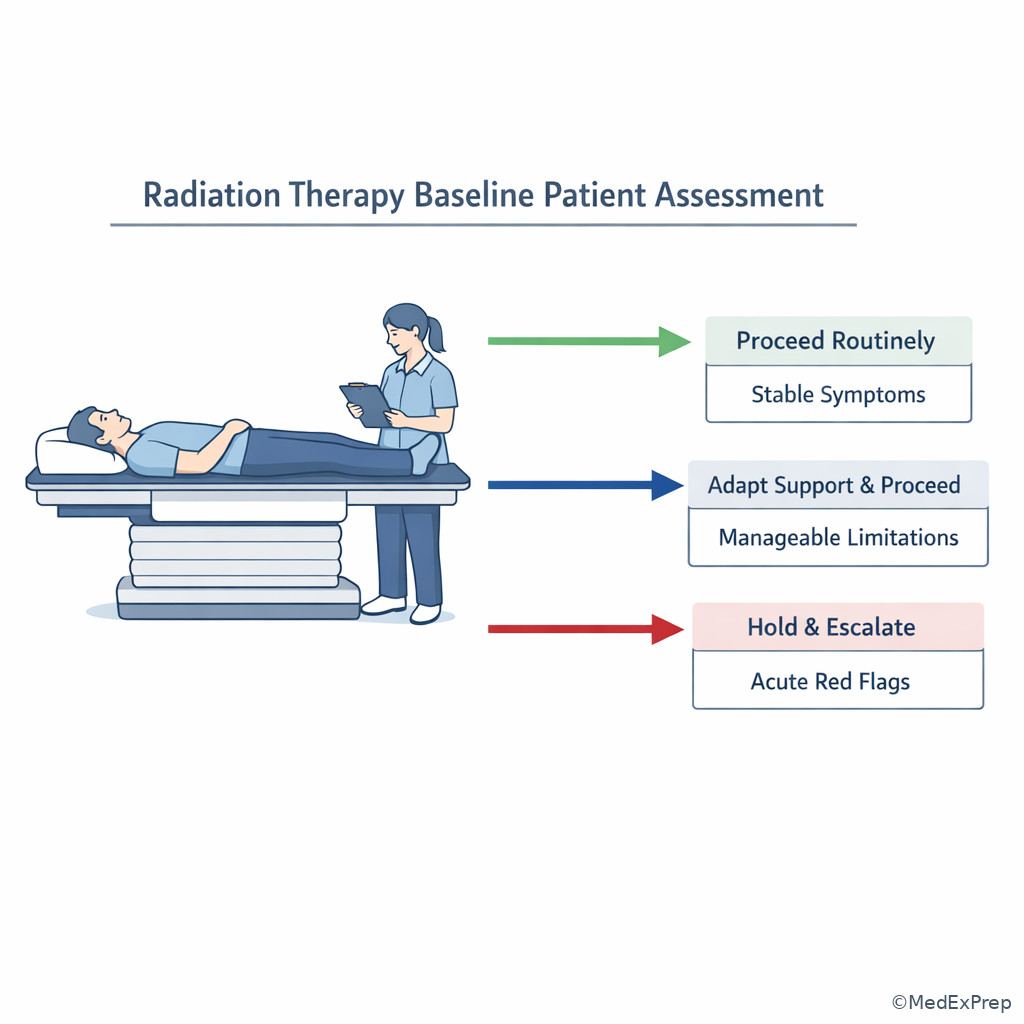
Exam takeaway: Baseline assessment should predict whether the patient can maintain the required treatment position long enough for accurate delivery.
B Worked example
A 59-year-old woman presents for head-and-neck treatment. She has diabetes, anxiety, and a history of chronic neck stiffness. Today she reports stable mild stiffness, but after the mask is placed she becomes panicky and says she feels she cannot breathe. Her oxygen saturation is not provided, a deliberate exam distraction that may tempt overfocus on missing data. She remains alert and reports the sensation begins only with mask placement. What is the most appropriate therapist response?
Reasoning chain: Identify task — decide proceed, adapt, or hold. Extract key facts — symptom is triggered by immobilization, affects ability to remain still, and may prevent safe completion. Apply rule — if setup cannot be completed safely and reproducibly, do not force progression. Eliminate distractors — chronic neck stiffness is stable and not the main issue; lack of a numeric saturation does not permit ignoring the observed intolerance. Verify — the therapist should stop the attempt, support the patient, and escalate/clarify per protocol rather than repeatedly trying without a plan.
C Exam trap
D Checkpoint
Question: A patient arrives with stable chronic fatigue, transfers safely with usual assistance, and tolerates the planned position after an extra minute of coaching. Which is the most appropriate therapist action?
- A. Hold treatment and request physician evaluation for every chronic symptom
- B. Proceed routinely without documentation because the issue is chronic
- C. Adapt support as needed, proceed if safe, and document the baseline/assistance provided
- D. Independently change the treatment setup prescription to shorten the session
Answer: C.
- A: Tempting because it prioritizes caution, but it overuses escalation when the finding is stable, expected, and manageable.
- B: Tempting because no hold is needed, but chronic findings still belong in baseline documentation when they affect workflow.
- C: Correct because this is the classic “adapt and proceed” scenario within therapist scope.
- D: Tempting because shortening setup sounds practical, but changing prescription-related setup parameters independently is outside therapist authority.
Exam Traps & Differentiators
Most common wrong answer and why: proceeding with routine setup because the patient verbally minimizes symptoms. This is tempting because the workflow appears intact and the patient may not want delays. It is wrong when objective observation shows distress, positional intolerance, new confusion, or unsafe transfer status.
| Looks similar | Actually different | Discriminator |
|---|---|---|
| Stable chronic pain | New severe pain preventing position | Change from baseline plus setup impact |
| Anxiety with reassurance | Inability to tolerate immobilization | Whether the patient can safely remain in position |
| Slow routine transfer | Unsafe transfer needing hold/support escalation | Actual fall/safety risk during movement |
| Expected fatigue | New confusion or near-syncope | Neurologic safety signal, not just low energy |
| Chart abnormality | Observed bedside problem | Immediate operational relevance today |
| Therapist assistance within protocol | Independent change to treatment parameters | Scope boundary |
1.1.1.8 If the stem says ___, think ___
- If the stem says “new shortness of breath when lying flat”, think hold and escalate before setup.
- If the stem says “stable chronic symptom, tolerated position”, think proceed with documentation.
- If the stem says “cannot hold arms up / cannot tolerate mask / cannot stay still”, think reproducibility problem, not just comfort issue.
- If the stem says “patient says fine, but appears distressed”, think objective observation can override reassuring words.
- If the stem says “team is busy and treatment is already delayed”, think safety still comes first.
- If the stem says “best therapist response”, think assess, protect, communicate, document—do not independently prescribe or redesign care.
Algorithm / Approach
Use this on exam day:
- Identify the task: readiness assessment, not diagnosis.
- Extract the key fact: the one symptom or observation that changes safety or reproducibility.
- Select the governing rule: stable/manageable findings may proceed; new unsafe or uncertain findings require hold and escalation.
- Execute within scope: support, communicate, document.
- Verify: ask whether your choice best protects patient safety and treatment accuracy.
Rapid Review
- Baseline assessment → therapist-level readiness snapshot, not full diagnostic workup
- New dyspnea lying flat → hold before setup
- Stable chronic symptom + tolerable position → usually proceed with documentation
- Observed distress despite “I’m fine” → trust objective cues
- Position-specific pain → matters more than unrelated chart noise
- Cannot remain still → reproducibility problem, not just comfort complaint
- New confusion → safety/escalation issue
- Unsafe transfer ability → do not force routine movement
- Best note → finding + impact + action + notification
- Correct therapist response → proceed, adapt, or hold; never independently alter prescription intent
- Chart abnormality alone → less urgent than a bedside operational change today
- Patient preference to continue → does not override safety trigger
- Baseline comparison question → “What is different from your usual today?”
- Scope-aware distractor → correct medical idea by wrong provider is still wrong for the therapist
Self-check quiz
1.1.1.9 Question 1
A 68-year-old man with chronic osteoarthritis and hypertension arrives for treatment. He reports his usual knee pain, transfers safely with his cane, and tolerates the planned supine position. Which is the most appropriate therapist action?
- A. Proceed with treatment, document the stable baseline findings, and continue routine observation
- B. Hold treatment for immediate physician evaluation because any pain before treatment is unsafe
- C. Independently change the setup to avoid all supine positioning
- D. Skip documentation because the symptom is chronic and expected
1.1.1.10 Question 2
A patient presents for simulation and says she feels “about the same as usual.” Which focused therapist question is most important for determining immediate setup readiness?
- A. “Can you remain in the required position without moving?”
- B. “What year were you first diagnosed?”
- C. “Which family member drove you today?”
- D. “What time did you wake up this morning?”
1.1.1.11 Question 3
A 74-year-old woman with COPD and heart failure arrives for thoracic treatment. She normally ambulates short distances with a walker. Today she reports worsening shortness of breath and says she had to sleep upright last night. She also mentions mild chronic ankle swelling that is unchanged. What is the most appropriate next step?
- A. Proceed with treatment because ankle swelling is chronic and the patient arrived on time
- B. Hold treatment and notify the appropriate team because worsening dyspnea and inability to lie flat change immediate safety
- C. Coach the patient to tolerate the position first, then reassess only if she fails on the table
- D. Independently reduce treatment time by altering setup parameters
1.1.1.12 Question 4
A 57-year-old woman with breast cancer, obesity, and rheumatoid arthritis presents for simulation. She denies new breathing problems but can raise her arms overhead for only 5 seconds because of shoulder pain. A recent mildly abnormal thyroid lab is listed in her chart. Which finding should most strongly drive the therapist's decision now?
- A. The thyroid lab because any abnormal laboratory value overrides setup concerns
- B. The arm-position intolerance because it directly affects simulation reproducibility
- C. Her obesity because body habitus alone usually determines whether to hold
- D. Her cancer diagnosis because all patients with cancer should be escalated before simulation
1.1.1.13 Question 5
A 63-year-old patient with head-and-neck cancer, diabetes, and chronic neck stiffness becomes panicky when the immobilization mask is placed. He says he feels unable to breathe, removes his hands from his sides, and starts moving. He is alert and speaking clearly. What is the most appropriate therapist response?
- A. Continue because the symptom is probably psychological rather than physical
- B. Stop the attempt, support the patient, and escalate per protocol because accurate immobilization cannot be safely maintained
- C. Tighten the mask more quickly so treatment can begin before movement worsens
- D. Prescribe a medication to reduce anxiety before continuing
1.1.1.14 Question 6
A 70-year-old man with prostate cancer, chronic urinary urgency, and lumbar stenosis arrives for treatment. He reports baseline urgency but no worsening, transfers with one-person assist as usual, and can lie still after a pillow is placed under his knees. A note mentions he argued with family this morning. Which is the most appropriate therapist action?
- A. Hold treatment because psychosocial stress may indicate inability to cooperate
- B. Proceed after adapting support, document the baseline findings and positioning aid, and continue observation
- C. Escalate solely because he requires any transfer assistance
- D. Remove the pillow because comfort devices should never be used if not physician-prescribed
1.1.1.15 Question 7
A 65-year-old woman with metastatic disease, chronic fatigue, and mild baseline nausea arrives for treatment. Today she is newly confused about where she is, answers slowly, and needs repeated redirection. Her husband says she “didn’t sleep well,” which makes fatigue seem appealing as the explanation. What is the most appropriate therapist response?
- A. Proceed because sleep deprivation commonly explains temporary confusion
- B. Hold treatment and escalate because new confusion changes safety and ability to follow instructions
- C. Continue only if the spouse remains in the room to reassure her
- D. Ask the dosimetrist to approve a simplified setup and continue
1.1.1.16 Question 8
A 60-year-old man with lung cancer, COPD, and chronic back pain presents for treatment. He states his back pain is unchanged, but today he becomes markedly short of breath when moved from seated to supine and asks to sit back up immediately. He insists he wants to continue because he already missed one visit. Which is the most appropriate therapist action?
- A. Proceed rapidly before symptoms worsen because treatment adherence is the top priority
- B. Hold treatment and notify the appropriate team because new position-related dyspnea is a red-flag readiness change
- C. Document the complaint and let the patient decide whether to continue
- D. Independently switch to an alternate beam arrangement requiring less time supine
Answer key
1.1.1.17 Question 1: A
A. Correct. This is tempting because it seems almost too simple, and that is exactly why learners sometimes miss it. The patient has a stable chronic symptom, safe transfer, and successful position tolerance. The single discriminating clue is he tolerates the planned supine position, so the therapist should proceed, document, and monitor. This matches therapist-level readiness screening and documentation standards in radiation therapy workflows.
B. Incorrect. Tempting because pain sounds safety-related, but the rule is not “any pain means hold.” The symptom is chronic and does not prevent safe positioning. The discriminating clue is usual knee pain with safe transfer and tolerance.
C. Incorrect. Tempting because changing setup could reduce discomfort, but independently altering setup intent or prescription-related parameters exceeds therapist authority unless already allowed by protocol. The discriminating clue is no evidence that the current setup is unsafe or intolerable.
D. Incorrect. Tempting because chronic findings may feel routine, but relevant baseline factors that affect workflow or future comparison should still be documented. The discriminating clue is use of a cane and baseline pain are part of the operational baseline.
Reference: Washington, Charles M., and Dennis T. Leaver. Principles and Practice of Radiation Therapy. Elsevier; ARRT content specifications and therapist role expectations; ASRT practice standards.
1.1.1.18 Question 2: A
A. Correct. Tempting because it is narrow and practical, which is exactly why it is right. Baseline assessment should prioritize what changes immediate setup success. The discriminating clue is immediate setup readiness, and stillness in position is central to reproducibility.
B. Incorrect. Tempting because disease timeline sounds clinically meaningful, but it does not determine whether the patient can safely complete today's procedure. The discriminating clue is the question asks immediate readiness.
C. Incorrect. Tempting because transportation matters for patient support, but it does not directly assess treatment position tolerance. The discriminating clue is this is a logistical issue, not a setup criterion.
D. Incorrect. Tempting because sleep can affect fatigue, but it is indirect and less useful than asking directly about ability to remain still in position. The discriminating clue is one fact separates the answers: direct versus indirect relevance to setup reproducibility.
Reference: Podgorsak, Ervin B., ed. Radiation Oncology Physics: A Handbook for Teachers and Students; Washington and Leaver; ASRT Radiation Therapist Practice Standards.
1.1.1.19 Question 3: B
A. Incorrect. Tempting because one chronic symptom is unchanged and the patient made it to clinic, but schedule success does not override acute respiratory change. The discriminating clue is worsening shortness of breath and sleeping upright, not the stable ankle swelling.
B. Correct. This choice matches therapist scope: recognize a significant change, hold, and notify the team. The discriminating clue is new inability to tolerate lying flat due to dyspnea, which directly affects safety and treatment readiness.
C. Incorrect. Tempting because a trial on the table feels efficient, but it is unsafe when the red flag is already present before setup. The discriminating clue is the respiratory problem is known before positioning.
D. Incorrect. Tempting because shortening treatment seems practical, but independently altering parameters is outside therapist scope. The discriminating clue is scope boundary, not just symptom severity.
Reference: ARRT Radiation Therapy task expectations; ASRT practice standards; Washington and Leaver. Therapist duty is recognition, safe pause, and escalation rather than independent plan modification.
1.1.1.20 Question 4: B
A. Incorrect. Tempting because chart abnormalities can feel exam-important, but not every abnormal value determines immediate therapist action. The discriminating clue is the arm-position failure directly affects the simulation task.
B. Correct. This is the operationally relevant finding. The patient cannot maintain the required position long enough for reproducible simulation. The discriminating clue is overhead arm tolerance lasts only 5 seconds.
C. Incorrect. Tempting because body habitus may complicate setup, but obesity alone does not dictate hold status. The discriminating clue is the actual limiting factor is pain-related arm tolerance.
D. Incorrect. Tempting because oncologic seriousness sounds important, but diagnosis alone does not answer the therapist workflow question. The discriminating clue is today’s setup limitation, not disease label.
Reference: Washington and Leaver; Khan, Faiz M., and John P. Gibbons. Khan’s The Physics of Radiation Therapy for setup reproducibility concepts; ASRT practice standards.
1.1.1.21 Question 5: B
A. Incorrect. Tempting because the patient is alert and the symptom may reflect anxiety, but cause does not matter as much as operational impact. The discriminating clue is accurate immobilization cannot be maintained safely.
B. Correct. The therapist should stop the attempt, support the patient, and escalate per protocol. The discriminating clue is movement and inability to tolerate the mask, which threatens setup accuracy and safety.
C. Incorrect. Tempting because faster completion may seem to minimize distress, but forcing progression increases risk and violates patient-centered safety practice. The discriminating clue is the patient is already signaling inability to tolerate the immobilization.
D. Incorrect. Tempting because medication could theoretically help, but prescribing medication is outside therapist scope. The discriminating clue is scope-of-practice boundary.
Reference: ASRT Radiation Therapist Practice Standards; ARRT therapist role framework; Washington and Leaver. Therapist responsibility is safe recognition and escalation, not independent pharmacologic management.
1.1.1.22 Question 6: B
A. Incorrect. Tempting because psychosocial stress can affect cooperation, but nothing in the stem shows acute inability to proceed. The discriminating clue is he still transfers as usual and lies still once supported.
B. Correct. This is a classic adapt-and-proceed case. The patient's symptoms are baseline, the pillow improves tolerance, and the setup remains safe and reproducible. The discriminating clue is baseline urgency unchanged plus successful stillness with support.
C. Incorrect. Tempting because transfer assistance sounds serious, but the key issue is whether the assistance is usual and safe versus newly unsafe. The discriminating clue is one-person assist as usual.
D. Incorrect. Tempting because some learners confuse comfort aids with unauthorized setup changes. In routine practice, therapist-applied comfort/support within protocol is appropriate when it preserves safe reproducibility. The discriminating clue is pillow placement improves safe position tolerance rather than altering prescription intent.
Reference: Washington and Leaver; ASRT practice standards; standard radiation therapy setup reproducibility principles. Local protocols govern exact accessory use, but routine supportive positioning within approved practice is therapist-facing.
1.1.1.23 Question 7: B
A. Incorrect. Tempting because poor sleep is common and can cause sluggishness, but new confusion is a red flag until clarified. The discriminating clue is new confusion and repeated redirection, not simple fatigue.
B. Correct. New altered mental status changes safety and the ability to follow instructions. The therapist should hold and escalate. The discriminating clue is new confusion compared with baseline.
C. Incorrect. Tempting because family support may calm a patient, but it does not resolve the core safety issue of new confusion. The discriminating clue is cognitive change, not lack of reassurance.
D. Incorrect. Tempting because simplifying setup sounds like a workaround, but asking another provider to approve a workaround does not replace patient-status evaluation when new confusion is present. The discriminating clue is the problem is patient safety, not technical complexity.
Reference: ASRT practice standards; ARRT therapist role expectations; Washington and Leaver. New neurologic or cognitive change requires recognition and appropriate escalation within therapist scope.
1.1.1.24 Question 8: B
A. Incorrect. Tempting because maintaining treatment schedule matters, but adherence never outranks immediate respiratory safety. The discriminating clue is marked shortness of breath when moved supine.
B. Correct. This is the safest therapist response. The patient has new position-related dyspnea, which directly affects safety and readiness. The discriminating clue is symptoms worsen specifically with the treatment position today.
C. Incorrect. Tempting because patient autonomy matters, but the therapist cannot delegate a safety decision to the patient when a red flag is present. The discriminating clue is red-flag symptom requiring clinical escalation.
D. Incorrect. Tempting because an alternate arrangement might seem efficient, but the therapist must not independently alter beam arrangement or prescription-related delivery parameters. The discriminating clue is outside therapist scope.
Reference: ARRT Radiation Therapy role expectations; ASRT practice standards; Washington and Leaver. Safe practice requires stopping and escalating significant readiness changes rather than improvising technical modifications.
Keep going with the full ARRT Radiation Therapy Prep Course (ARRT RT)
You just studied the way members do, in the same lesson interface. Full access unlocks every lesson, the question bank and flashcards for a full year.
One payment · 1 year of access · No auto-renewal