1.1.1 - Focused Podiatric History Elements
Why it matters A strong history often separates benign overuse pain from fractu…
- 1 Why it matters A strong history often separates benign overuse pain from fractu… 1:42
- 2 Key Terms & Must-Know Facts Key terms Chief complaint: the patient’s main probl… 4:36
- 3 History of previous surgery changes anatomy, complication risk, and imaging int… 3:58
- 4 Body 1:19
- 5 Core content 1.1.1.1 Build the history in the right order A. 3:26
- 6 Memory anchor: Think “MOLTS-RF” for the first pass: Mechanism, Onset, Location,… 3:32
- 7 Eliminate distractors: chronic heel pain history is noise; recent increased wal… 3:22
- 8 If you missed this: Review 1.1.1.1 Build the history in the right order — focus… 3:23
- 9 Body 3:13
- 10 She also mentions recently changing shoes, a tempting clue toward a simple mech… 3:15
- 11 If you missed this: Review 1.1.1.2 Use symptom pattern to localize the likely p… 3:31
- 12 Body 3:20
- 13 High-Yield Connection: This concept is tested alongside later topics on Diabeti… 3:33
- 14 Exam trap Common wrong answer: “Low concern because the patient denies signific… 3:02
- 15 A patient who has had symptoms for one week without treatment is different from… 2:51
- 16 Body 3:26
- 17 Apply rule: duration alone does not equal failed appropriate care; treatment ad… 3:21
- 18 Quick Recall: Failure of conservative care requires both appropriate treatment… 4:02
- 19 Body 3:29
- 20 Refer/Escalate: acute ischemia, systemic infection, severe postoperative compli… 3:47
- 21 Tempting because footwear-related pain is common, but this remains mechanical. 1:18
- 22 Exam Traps & Differentiators Most common wrong answer and why: Candidates often… 3:18
- 23 If the stem says ___, think ___ “Stepped on a nail through a sneaker” → penetra… 2:03
- 24 Tables High-Yield History Clue Most Likely Process Category Immediate Board Imp… 4:06
- 25 possible urgent escalation Differential/Classification by History Pattern Class… 2:20
- 26 Algorithm / Approach Concept flow: Focused podiatric history algorithm 1 Define… 2:00
- 27 Rapid Review Sudden onset after twist → think trauma pathway, not chronic overl… 2:25
- 28 Self-check quiz Question 1 A 34-year-old woman presents with plantar heel pain… 4:33
- 29 Routine chronic overuse pathway because she already had foot pain before this e… 5:00
- 30 He has failed adequate conservative care because symptom duration is long He ha… 2:47
- 31 Answer key Question 1 Answer: B A. 2:17
- 32 The discriminating clue is sensory symptoms. 2:31
- 33 Source: IWGDF Guidelines; McGlamry's. 2:45
- 34 Inflammatory pathway because arch pain can indicate a systemic process: Temptin… 2:06
- 35 It is incorrect because bilateral involvement often supports systemic or inflam… 2:18
- 36 Routine inflammatory arthropathy pathway: Tempting because rest pain can be mis… 2:26
- 37 It is incorrect because functional limitation informs severity but does not byp… 2:50
- 38 The discriminator is mechanism plus systemic progression. 1:00
Why it matters
- A strong history often separates benign overuse pain from fracture, infection, ischemia, neuropathy, or postoperative complication before you ever touch the patient.
- On boards, the “best next step” is frequently determined by one history clue: sudden onset, fever, diabetes, anticoagulant use, puncture wound, night pain, or inability to bear weight.
- Entry-level podiatric decision-making begins with localization and risk stratification; missing the right question leads to the wrong imaging, wrong urgency, or unsafe treatment.
- History is the bridge between complaint and exam: the next lessons on physical exam and neurovascular assessment build directly on the symptom patterns learned here.
Key Terms & Must-Know Facts
1.1.1.1 Key terms
- Chief complaint: the patient’s main problem in their own words.
- Onset: when the symptom began and how quickly it appeared.
- Provocative factors: activities, shoes, surfaces, or motions that worsen symptoms.
- Palliative factors: rest, immobilization, shoe removal, elevation, NSAIDs, offloading.
- Mechanical pain: worsens with load/activity; improves with rest.
- Inflammatory pain: morning stiffness, rest pain, prolonged stiffness, swelling.
- Neuropathic pain: burning, tingling, numbness, electric quality.
- Claudiation history: exertional pain relieved by rest, suggesting vascular insufficiency.
- Red flag: history element that raises concern for emergency, limb threat, or serious systemic disease.
- Treatment chronology: what has already been tried, for how long, and with what result.
- Functional limitation: what the patient can no longer do.
- Constitutional symptoms: fever, chills, weight loss, malaise.
- Trauma mechanism: twisting, axial load, crush, puncture, laceration, inversion/eversion.
- Risk factor screening: diabetes, neuropathy, smoking, anticoagulation, steroid use, immunosuppression.
1.1.1.2 Must-know facts
- Sudden severe pain after trauma plus inability to bear weight should push fracture/dislocation higher than “sprain.”
- Puncture wounds through shoes raise concern for retained foreign body and infection risk.
- Night pain, unexplained weight loss, or constant unremitting pain are not classic simple mechanical overuse clues.
- Diabetes history changes the threshold for concern about ulceration, infection, neuropathy, and Charcot patterns.
- Anticoagulants increase concern for hematoma and perioperative bleeding issues.
- Smoking, steroid use, and peripheral vascular disease worsen healing risk.
- History of previous surgery changes anatomy, complication risk, and imaging interpretation.
- Bilaterality and morning stiffness suggest systemic/inflammatory processes more than isolated acute trauma.
- A “popping” sensation with plantarflexion weakness suggests tendon rupture until proven otherwise.
| History Domain | Question to Ask | Why It Matters on Boards |
|---|---|---|
| Onset | When did this start, and was it sudden or gradual? | Separates trauma, rupture, infection, and acute ischemia from chronic overload. |
| Mechanism | Was there a twist, fall, crush, puncture, or new activity? | Directs fracture, sprain, tendon, foreign-body, and compartment concerns. |
| Location | Point with one finger to the worst spot. | Precise localization narrows anatomy before exam. |
| Quality | Sharp, aching, burning, throbbing, numb? | Suggests mechanical, inflammatory, vascular, or neuropathic patterns. |
| Timing | First-step pain, end-of-day pain, night pain, constant pain? | Classic stem clue for plantar fasciitis, arthritis, stress injury, infection, or tumor. |
| Aggravating factors | Worse with walking, shoes, stairs, barefoot, uneven ground? | Identifies load-dependent and footwear-dependent pathology. |
| Associated symptoms | Swelling, redness, warmth, drainage, numbness, weakness? | Raises infection, neuropathy, vascular compromise, tendon injury. |
| Risk screen | Diabetes, smoking, anticoagulants, steroids, neuropathy? | Changes urgency, healing risk, and treatment safety. |
Exam takeaway: Ask in a structured order so the single red-flag clue is not missed in a noisy board stem.
flowchart TD
A[Chief complaint] --> B[Onset and mechanism]
B --> C[Exact location and radiation]
C --> D[Quality and timing]
D --> E[Aggravating and relieving factors]
E --> F[Associated symptoms and red flags]
F --> G[Comorbidities meds prior treatment function]
Exam takeaway: A labeled interview framework helps you prioritize onset, location, risk factors, and urgency cues in the first minute.
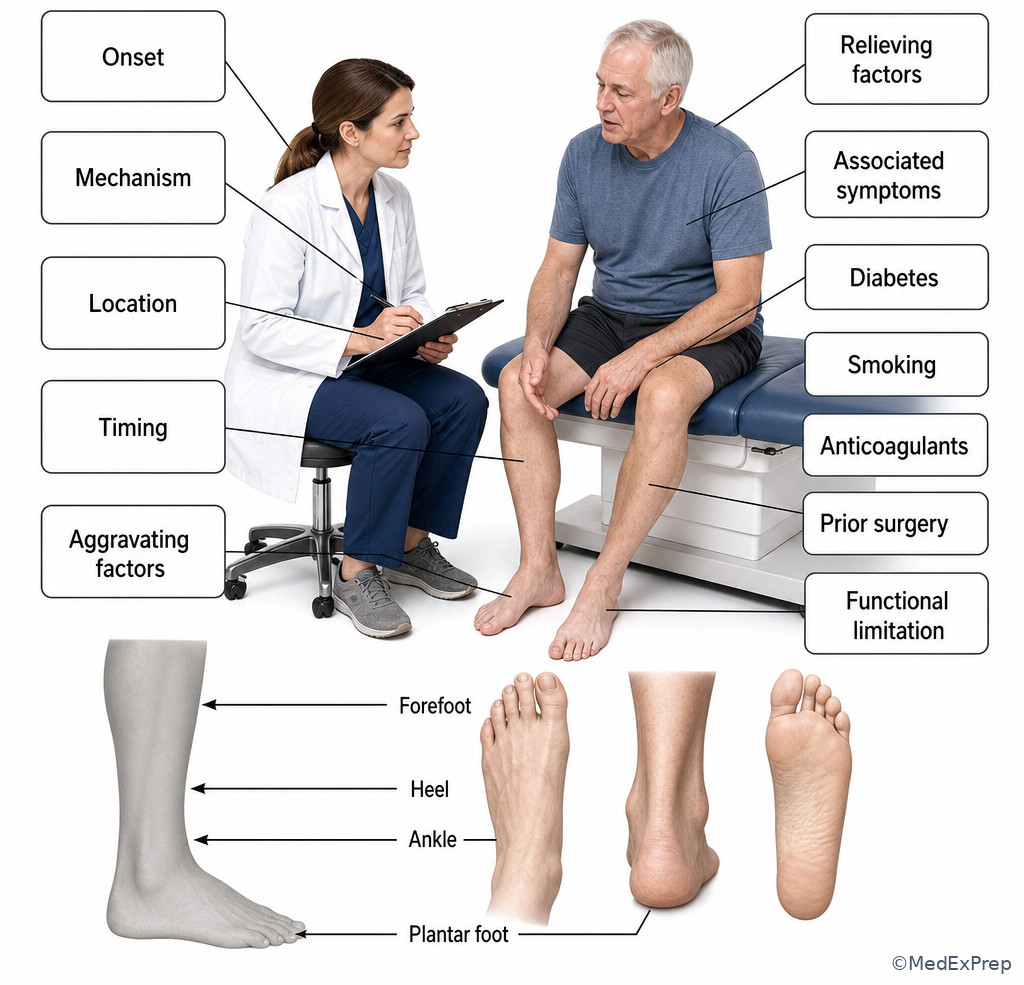
Core content
1.1.1.3 Build the history in the right order
A Explanation
On exam day, the first decision conflict is not “What is the diagnosis?” but “What must I ask first so I do not miss urgency?” The safest sequence is chief complaint → onset/mechanism → exact location → pain pattern → associated symptoms → comorbidities/medications → prior treatment → function. See Fig 1. This order works because the earliest answers often determine whether you continue a routine podiatric workup or immediately escalate.
The single rule that resolves many stems is this: if onset is sudden, mechanism is significant, or symptoms are systemic, reject the assumption of simple overuse. A patient with “ankle pain” after a twist and immediate inability to bear weight belongs in a trauma pathway; a patient with redness, drainage, and fever belongs in an infection pathway; a patient with burning plantar numbness without trauma belongs in a neurologic/entrapment pathway. History is your first triage tool.
WHY THIS IS TESTED: board stems intentionally include extra details, but one early history element determines urgency and the correct next step. If you miss that discriminator, every later finding looks misleading.
B Worked example
A 52-year-old man presents with “heel pain” for 3 days. He has type 2 diabetes, obesity, and chronic tobacco use. He says it began after “walking more at work,” but also reports a puncture wound from stepping on a nail through his sneaker 2 days before the pain became severe. He mentions mild chronic plantar fasciitis in the past, which makes that answer tempting. He now has progressive swelling and pain with walking; he is unsure about fever.
Reasoning chain: Identify task: what history element changes the next step? Extract key facts: diabetes, puncture through shoe, worsening pain over days, swelling. Apply rule: puncture wound through footwear with diabetes should shift concern away from routine plantar fasciitis and toward retained foreign body/infection risk. Eliminate distractors: chronic heel pain history is noise; recent increased walking is also noise because the penetrating mechanism is the stronger discriminator. Verify: this patient needs targeted exam, imaging for foreign body if indicated, and infection-focused risk assessment rather than default stretching advice.
C Exam trap
D Checkpoint
Question: A 43-year-old woman presents with new midfoot pain. Which history detail most strongly requires you to reject a routine overuse pathway and prioritize a higher-acuity evaluation?
- She has pain that worsens at the end of a long workday. Tempting because load-related pain is common, but this supports a mechanical process rather than high acuity.
- She notes gradual discomfort after starting a new walking program. Tempting because stress injury can matter, but gradual onset alone is less urgent than red-flag trauma/systemic clues.
- She felt a sudden pop and cannot bear weight after a twisting injury. Correct because immediate traumatic onset with inability to bear weight raises fracture/dislocation/severe soft-tissue injury concern.
- She says supportive shoes partially improve her symptoms. Tempting because shoe response can inform diagnosis, but it does not override urgent traumatic features.
1.1.1.4 Use symptom pattern to localize the likely process
A Explanation
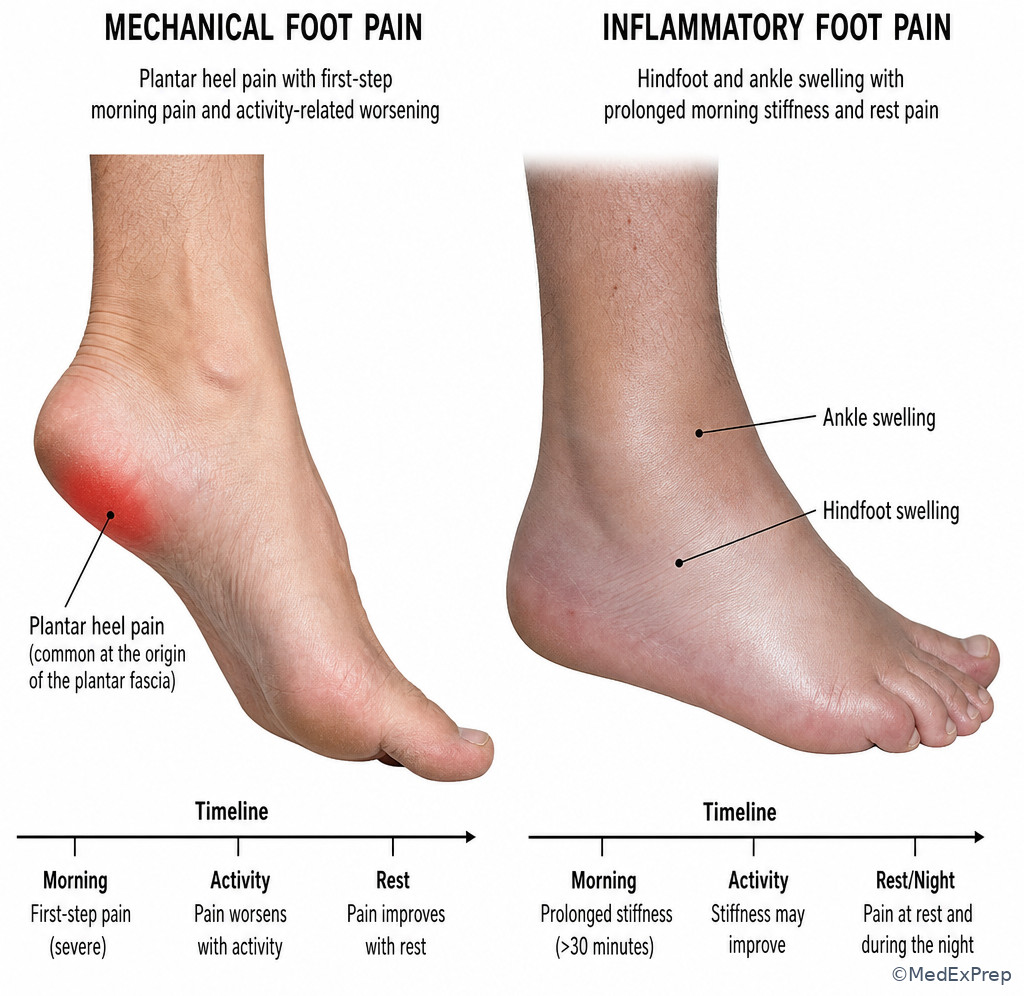
Once urgency is screened, the second decision conflict is choosing between competing process categories: mechanical overload, inflammatory disease, infection, neuropathy, vascular insufficiency, or rupture. The single finding that often resolves the conflict is timing plus quality. Mechanical pain is typically activity-dependent; inflammatory pain often includes morning stiffness or pain after rest; infection adds warmth, redness, drainage, or systemic symptoms; neuropathic pain burns, tingles, or radiates; vascular pain is exertional or ischemic and may be accompanied by coldness or color change.
Boards love “first-step pain,” end-of-day pain, night pain, and rest pain. First-step plantar heel pain points you toward a mechanical plantar fascia pattern; diffuse bilateral morning stiffness points away from isolated focal mechanical disease; constant night pain or unremitting pain raises concern beyond common overuse; numbness or burning shifts attention to nerve involvement. See Fig 2.
WHY THIS IS TESTED: candidates often overvalue location and undervalue timing. Two diagnoses can share the same location but differ completely by timing and symptom quality.
Exam takeaway: Timing and quality often separate mechanical, inflammatory, infectious, neuropathic, and vascular causes faster than anatomy alone.
flowchart TD
A[Foot or ankle pain] --> B{Timing or quality clue}
B --> C[First-step pain -> mechanical plantar pattern]
B --> D[Morning stiffness or rest pain -> inflammatory pattern]
B --> E[Burning numbness tingling -> neuropathic pattern]
B --> F[Warm red draining painful -> infection pattern]
B --> G[Exertional or ischemic rest pain -> vascular pattern]
B --> H[Sudden pop weakness -> rupture pattern] B Worked example
A 61-year-old woman presents with medial ankle and hindfoot pain for 4 months. She has obesity, hypertension, and rheumatoid arthritis. She reports stiffness in the morning for 45 minutes and swelling that improves somewhat with movement. She also mentions recently changing shoes, a tempting clue toward a simple mechanical cause. There is no trauma.
Reasoning chain: Identify task: determine which symptom pattern dominates. Extract key facts: prolonged morning stiffness, known inflammatory disease, swelling, no trauma, partial improvement with movement. Apply rule: prolonged stiffness after rest is more inflammatory than purely mechanical. Eliminate distractors: shoe change is plausible noise, but it does not explain systemic inflammatory timing. Verify: the history should push you toward inflammatory involvement and a targeted exam rather than defaulting to shoe modification alone.
C Exam trap
D Checkpoint
Question: Which history pattern most strongly supports a neuropathic rather than mechanical source of forefoot symptoms?
- Sharp pain only after long-distance running that resolves with rest. Tempting because overuse forefoot pain is common, but the load-only pattern is more mechanical.
- Burning pain with tingling and intermittent numbness radiating into the toes. Correct because paresthesias and burning quality point to nerve involvement.
- Stiffness that is worst in the morning and eases after walking. Tempting because nonmechanical timing matters, but this is more inflammatory than neuropathic.
- Throbbing pain with redness and drainage near a wound. Tempting because severe pain can distract, but drainage and erythema point toward infection.
- The most useful pair for early pattern recognition is timing + quality.
- True or False: First-step heel pain is more suggestive of an inflammatory systemic disease than a mechanical plantar pattern. False.
- Name the 3 broad nonmechanical pattern groups commonly tested from history alone: infectious, neuropathic, vascular/inflammatory.
1.1.1.5 Screen red flags, comorbidities, and medications that change urgency
A Explanation
The next decision conflict is whether the patient has a routine podiatric complaint or a complaint made dangerous by context. The single rule: comorbidity and red-flag history can upgrade the same symptom into a high-risk problem. A blister in a healthy runner is not the same as a blister in a patient with diabetes, neuropathy, and peripheral arterial disease. Mild swelling after surgery is not the same as swelling plus calf pain and dyspnea. Heel pain in a healthy patient is not the same as heel pain plus puncture wound, fever, and immunosuppression.
Key red-flag screens include diabetes, neuropathy, peripheral vascular disease, smoking, anticoagulants, steroid use, immunosuppression, renal disease, prior ulceration or amputation, fever/chills, drainage, rapidly progressive swelling, severe night pain, and inability to bear weight. Medication history matters because anticoagulants raise bleeding concerns, chronic steroids impair healing and infection resistance, and immunosuppressants blunt typical inflammatory responses. See Fig 3.
WHY THIS IS TESTED: in podiatric medicine, the same local complaint behaves differently when perfusion, sensation, infection risk, or healing capacity is impaired. Boards test whether you recognize when “common” is no longer safe.
Exam takeaway: Diabetes, infection clues, trauma, ischemic symptoms, and medication risks are the major history triggers that change urgency.
flowchart TD
A[Foot complaint] --> B{High-risk context?}
B -->|Diabetes neuropathy PAD| C[Upgrade concern for ulcer infection Charcot ischemia]
B -->|Puncture crush or open injury| D[Upgrade concern for retained foreign body infection fracture]
B -->|Fever chills drainage| E[Upgrade concern for infection]
B -->|Anticoagulant steroid immunosuppression| F[Upgrade concern for bleeding healing or atypical presentation]
B -->|None| G[Proceed routine focused workup] Exam takeaway: Diabetes plus neuropathy, prior ulcer, drainage, or rapid swelling should immediately raise your risk threshold.
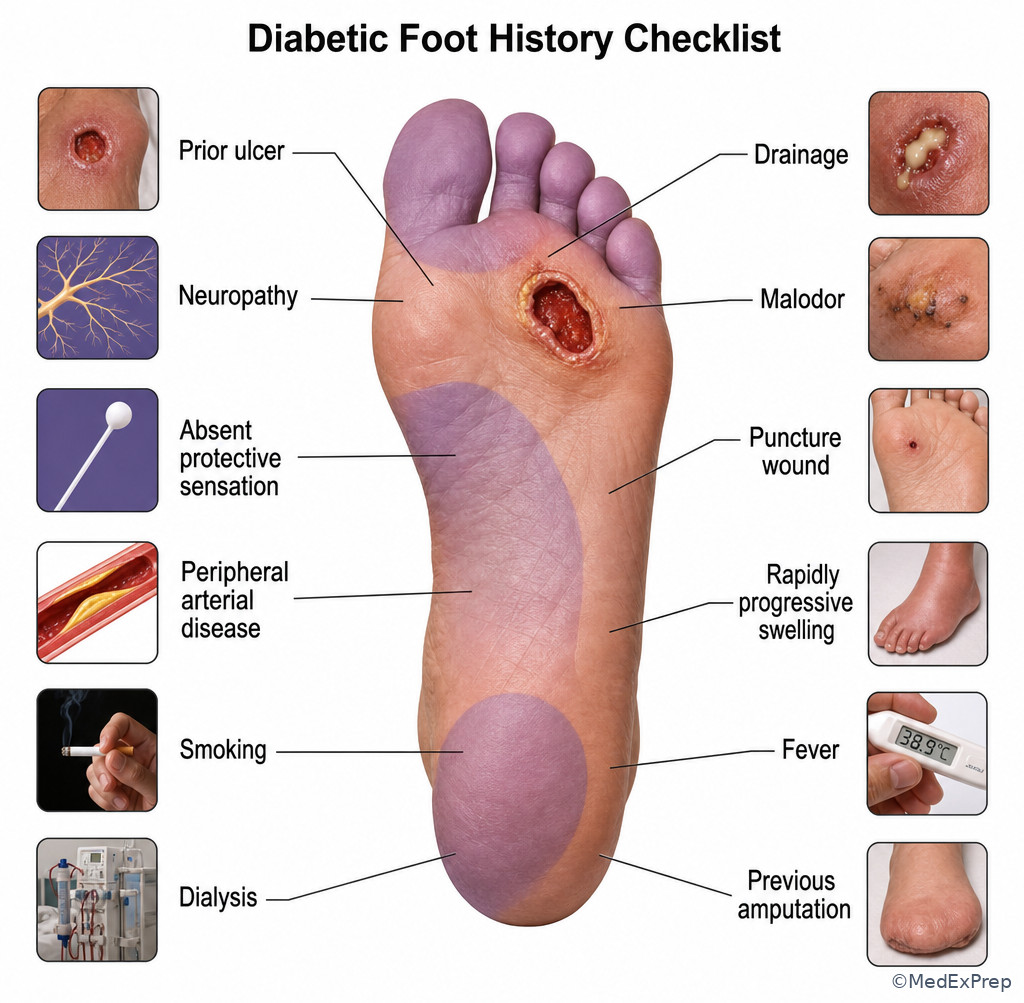
B Worked example
A 68-year-old man presents with a “minor” plantar blister under the first metatarsal head. He has diabetes, chronic kidney disease, peripheral neuropathy, and a 40-pack-year smoking history. He denies much pain, a distracting clue that might falsely reassure you. His daughter reports foul odor and drainage for 2 days, and he had a prior hallux amputation on the same foot.
Reasoning chain: Identify task: determine whether this is low-risk skin irritation or high-risk diabetic foot pathology. Extract key facts: diabetes, neuropathy, CKD, smoking, prior amputation, drainage, foul odor. Apply rule: lack of pain does not lower concern in neuropathic patients; multiple healing/infection risk factors upgrade urgency. Eliminate distractors: “minor blister” wording is noise because neuropathy can hide severe disease. Verify: this history mandates a high-risk diabetic foot approach with neurovascular and infection evaluation.
C Exam trap
D Checkpoint
Question: Which additional history element most strongly increases concern that a plantar wound requires urgent infection-focused evaluation rather than routine local care?
- The patient recently bought new work boots. Tempting because footwear commonly causes pressure lesions, but it does not by itself raise systemic or limb-threat concern.
- The patient has foul-smelling drainage and subjective chills. Correct because drainage plus constitutional symptoms strongly suggests infection requiring escalation.
- The patient says the area is tender only when walking barefoot. Tempting because load-related symptoms help localize pressure points, but this remains a lower-acuity clue.
- The patient prefers athletic shoes to dress shoes. Tempting because shoe history matters for mechanics, but it does not risk-upgrade a wound.
1.1.1.6 Ask treatment history and function questions that change management
A Explanation
After you know what the likely process is and how risky it may be, the next decision conflict is conservative continuation versus workup escalation versus operative planning. The history element that resolves this is often what has already been tried, for how long, and what function is lost. A patient who has had symptoms for one week without treatment is different from a patient with six months of persistent pain despite appropriate shoe changes, immobilization, therapy, orthoses, and activity modification.
Board stems use treatment chronology to test readiness for next-step decisions. “Failure of conservative therapy” is not vague; it means the patient received an appropriate treatment for an adequate duration without meaningful improvement. Functional history matters just as much. Ask what the patient cannot do: work, stairs, sports, prolonged standing, shoe wear, transfers, sleep. Pain severity alone is a weak guide; functional loss is often the more board-relevant discriminator. See Fig 4.
WHY THIS IS TESTED: many choices are technically reasonable, but only one fits the timeline. Exams reward the candidate who notices whether the stem describes an untreated, undertreated, improving, failed, or postoperative state.
Exam takeaway: The correct management answer depends on whether the patient is untreated, partially treated, or has failed appropriate conservative care.
flowchart LR
A[New symptom no treatment] --> B[Start diagnosis-matched conservative care]
B --> C{Improving?}
C -->|Yes| D[Continue and monitor function]
C -->|No after adequate trial| E[Escalate workup or consider procedural options]
A --> F[If red flags present]
F --> G[Bypass routine conservative pathway] B Worked example
A 39-year-old teacher presents with 8 months of forefoot pain. She has obesity and mild hypothyroidism. She reports she “tried inserts,” a tempting phrase that sounds like treatment failure, but on clarification the inserts were over-the-counter foam pads used inconsistently for one week. She can still walk but no longer tolerates dress shoes and cannot stand through a full workday.
Reasoning chain: Identify task: determine whether this is true conservative failure. Extract key facts: long symptom duration, minimal inconsistent treatment, significant shoe and standing limitations. Apply rule: duration alone does not equal failed appropriate care; treatment adequacy matters. Eliminate distractors: “8 months” may make surgery sound attractive, but the prior therapy was not diagnosis-matched or sustained. Verify: the best next step would remain a structured workup and appropriate first-line conservative plan before concluding failure.
C Exam trap
D Checkpoint
Question: Which history answer most strongly supports that conservative management has not yet been adequately tested?
- “I used an immobilization boot daily for 6 weeks with no improvement.” Tempting because it describes a true treatment trial, so this does not support inadequate testing.
- “I stopped all impact activity and completed physical therapy, but symptoms persist.” Tempting because persistent symptoms may justify escalation, not continued first-line care.
- “I tried an insert from the pharmacy twice and then stopped because it felt strange.” Correct because the intervention was too limited and inconsistent to count as adequate conservative treatment.
- “My pain is still limiting work after months of stretching and shoe modification.” Tempting because functional loss matters, but this history suggests more substantial treatment exposure than option C.
- Failure of conservative care requires both appropriate treatment and adequate duration.
- True or False: Pain severity alone is a better management guide than functional limitation. False.
- Name 3 function questions worth asking: walking tolerance, shoe wear tolerance, work/activity limitation.
1.1.1.7 Integrate the history into board-style next-step reasoning
A Explanation
Final integration means turning history into action. The decision conflict is usually between four broad next steps: routine conservative pathway, focused imaging/workup, urgent infection/vascular/trauma escalation, or referral/co-management because the problem exceeds isolated podiatric management. The single resolving question is: what category does the history place this patient in right now? Not “What is every possible diagnosis?” but “Which pathway is safest and most board-correct?” See Fig 5.
History-driven next-step logic works like this: a sudden traumatic mechanism plus inability to bear weight favors imaging/trauma evaluation; a puncture wound, drainage, or fever favors infection-focused workup; burning numbness favors a neurologic pathway; claudication or ischemic rest pain favors neurovascular assessment and possible vascular escalation; chronic activity-related symptoms without red flags favor a routine mechanical pathway. This is where podiatric scope matters: if the history points to acute systemic illness or limb-threatening ischemia, the correct board answer is to stabilize and escalate, not to manage the whole systemic problem independently.
WHY THIS IS TESTED: APMLE-style questions reward safe sequencing. Many wrong answers are not absurd—they are simply premature because they ignore the urgency category established by the history.
Exam takeaway: The right management pathway follows the history category first, then the exam and tests refine the diagnosis.
flowchart TD
A[History collected] --> B{Category?}
B --> C[Traumatic]
B --> D[Infectious]
B --> E[Mechanical]
B --> F[Neurologic]
B --> G[Vascular or ischemic]
C --> H[Trauma imaging or urgent stabilization]
D --> I[Wound infection workup and escalation if systemic]
E --> J[Routine focused exam and conservative plan]
F --> K[Targeted neuro exam and entrapment differential]
G --> L[Immediate neurovascular assessment and vascular escalation when indicated] Exam takeaway: Visual grouping of traumatic, infectious, mechanical, neurologic, and vascular pathways helps you choose the safest next step in mixed stems.
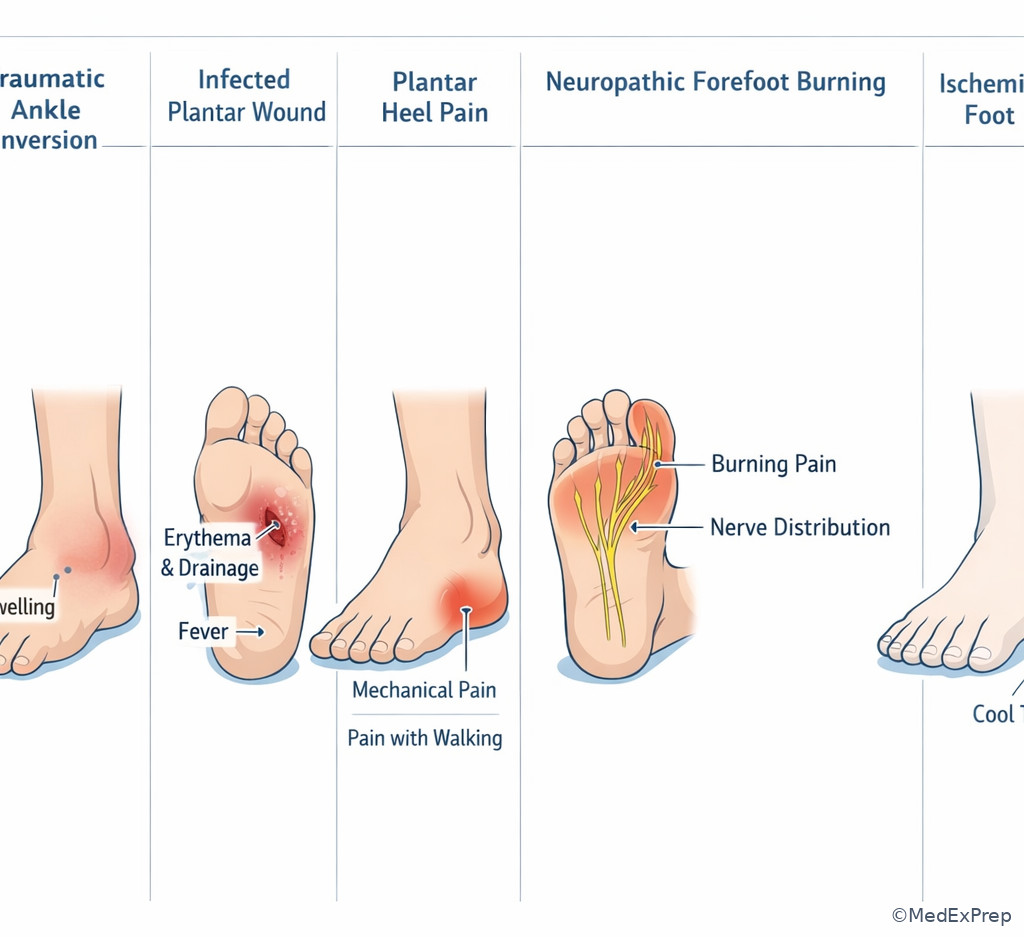
B Worked example
A 57-year-old woman presents with forefoot pain and swelling for 2 weeks. She has diabetes and atrial fibrillation treated with anticoagulation. She says the foot “just started hurting” without a fall, and she recently attended a wedding in tight shoes, a tempting mechanical clue. She also reports progressive bluish discoloration of the toes and pain at rest that is worse at night.
Reasoning chain: Identify task: determine the safest next pathway. Extract key facts: rest pain, nighttime worsening, discoloration, anticoagulation history, diabetes. Apply rule: ischemic-sounding history and color change should move the case into a vascular/neurovascular pathway, not a routine shoe-related forefoot pain pathway. Eliminate distractors: tight shoes may worsen symptoms but do not explain ischemic rest pain and discoloration. Verify: the board-correct action is urgent neurovascular assessment and appropriate escalation rather than orthotic advice.
C Exam trap
D Checkpoint
Question: A patient presents with foot pain. Which history pattern most strongly places the patient in an urgent vascular pathway rather than a routine mechanical pathway?
- Pain with prolonged standing that improves after removing tight shoes. Tempting because footwear-related pain is common, but this remains mechanical.
- Burning pain and numbness in the toes that worsens at night. Tempting because night symptoms sound severe, but numbness and burning alone are more neuropathic than vascular.
- Exertional calf discomfort relieved by rest plus new foot rest pain and color change. Correct because claudication history with ischemic rest pain and color change suggests vascular compromise.
- First-step plantar heel pain that eases after several minutes. Tempting because timing matters, but this is classic for a mechanical plantar pattern.
Exam Traps & Differentiators
| Looks Similar | Tempting Overlap | Single Differentiator from History | What to Think |
|---|---|---|---|
| Plantar fasciitis vs puncture-related heel problem | Both can present as heel pain | Recent puncture wound or foreign-body mechanism | Penetrating injury/infection pathway |
| Simple ankle sprain vs fracture/dislocation | Both follow inversion trauma | Immediate inability to bear weight or major deformity history | Trauma imaging/urgent evaluation |
| Mechanical forefoot pain vs neuropathic pain | Both may worsen in shoes | Burning, tingling, or numbness radiation | Neurologic/entrapment pathway |
| Shoe irritation vs diabetic foot infection | Both may begin from pressure | Drainage, foul odor, chills, prior ulcer, neuropathy | High-risk wound/infection pathway |
| Chronic overload vs inflammatory disease | Both may swell and ache | Prolonged morning stiffness or bilateral symptoms | Inflammatory/systemic consideration |
| Forefoot shoe pain vs ischemic pain | Both may limit walking | Rest pain, color change, or prior claudication | Vascular escalation pathway |
Exam takeaway: Location alone misleads; symptom timing often separates common podiatric differentials.
Exam takeaway: Burning numbness suggests nerve involvement, whereas color change and rest pain push you toward vascular compromise.
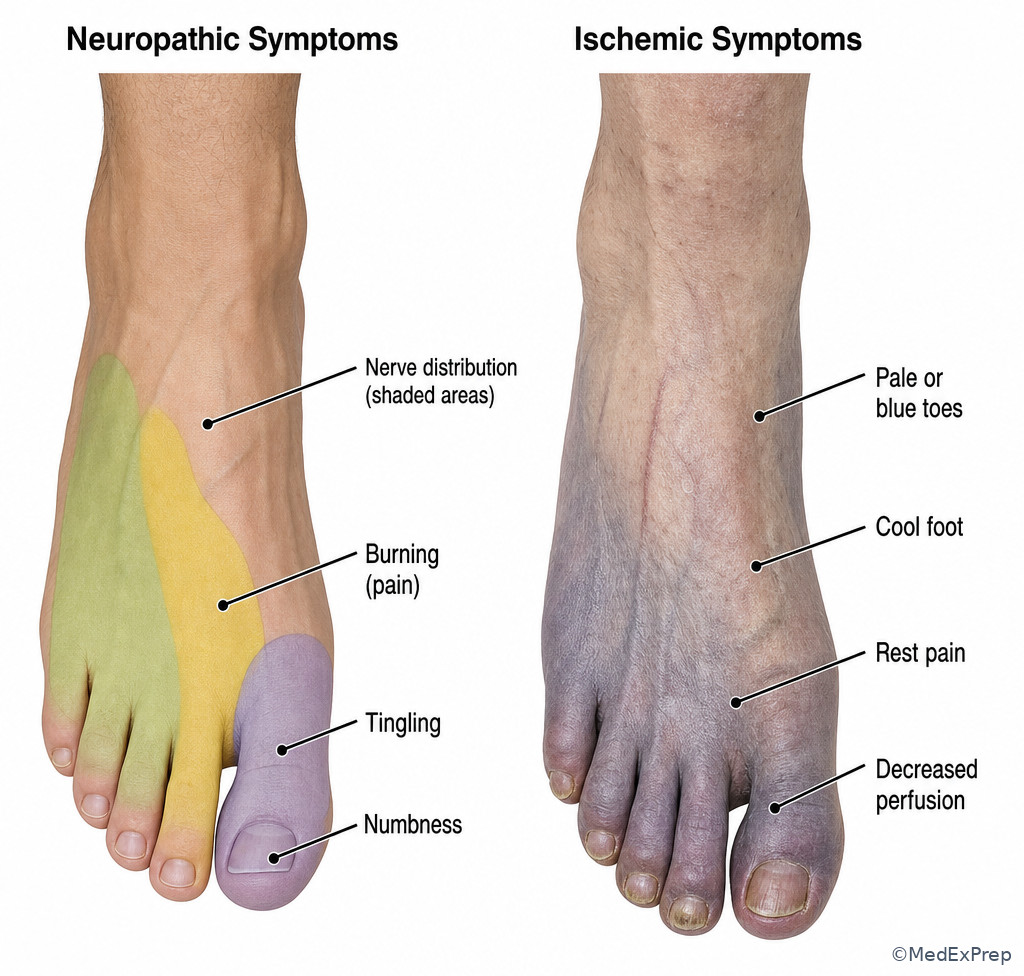
1.1.1.8 If the stem says ___, think ___
- “Stepped on a nail through a sneaker” → penetrating injury/foreign-body and infection risk, not routine heel pain.
- “Sudden pop with weakness” → tendon rupture pathway until proven otherwise.
- “Morning stiffness for 45 minutes” → inflammatory pattern more than isolated mechanical overuse.
- “Burning with numb toes” → neuropathic/nerve involvement.
- “Rest pain with discoloration” → vascular compromise/urgent neurovascular concern.
- “No pain, but diabetic with drainage and foul odor” → neuropathy can mask serious infection.
Tables
| High-Yield History Clue | Most Likely Process Category | Immediate Board Implication |
|---|---|---|
| Sudden traumatic onset | Fracture/sprain/dislocation/tendon injury | Do not default to chronic overuse management |
| Puncture wound | Penetrating injury, foreign body, infection risk | Escalate wound-focused assessment |
| Burning/tingling/numbness | Neuropathic or nerve entrapment | Target neuro pathway |
| Morning stiffness | Inflammatory arthropathy/systemic process | Do not label as purely mechanical too quickly |
| Rest pain with color change | Vascular compromise | Urgent neurovascular assessment |
| Drainage/foul odor/fever | Infection | Move to infection-focused workup |
| No pain in diabetic neuropathy | Masked serious pathology | Absence of pain is unreliable |
| Prior surgery | Altered anatomy or postoperative issue | Interpret symptoms differently than a native foot |
| Comparison | Mechanical Pattern | Inflammatory/Infectious Pattern | Neuropathic/Vascular Pattern |
|---|---|---|---|
| Typical timing | During or after load | Morning stiffness, rest pain, constant pain, fever-related course | Night burning or exertional/rest ischemic pain |
| Quality | Aching, sharp with motion/load | Throbbing, stiff, hot, deep aching | Burning, numb, electric, cramping ischemic pain |
| Associated features | Activity link, shoe/surface link | Warmth, swelling, erythema, drainage, systemic symptoms | Paresthesia, color change, coldness, claudication |
| Board next step bias | Focused exam and conservative pathway | Labs, infection or inflammatory workup, escalation if systemic | Neurovascular assessment, possible urgent escalation |
| Differential/Classification by History Pattern | Classic Stem Clue | Reject This Common Distractor |
|---|---|---|
| Traumatic structural injury | Twist/fall/crush with immediate symptoms | “Chronic overuse” when onset is sudden |
| Stress/overload injury | Gradual pain after training increase | “Acute rupture” when no abrupt pop/weakness exists |
| Infectious wound problem | Drainage, odor, puncture, fever | “Simple callus/blister” when systemic or wound clues exist |
| Inflammatory arthropathy | Morning stiffness, bilateral symptoms, known rheumatologic disease | “Shoe irritation only” when stiffness dominates |
| Neuropathic process | Burning, tingling, numbness, altered sensation | “Pure tendinitis” when paresthesia dominates |
| Vascular compromise | Claudication, rest pain, color change | “Routine forefoot pain” when perfusion clues appear |
Algorithm / Approach
Exam takeaway: The questions you ask should directly determine the physical exam maneuvers and urgency of evaluation.
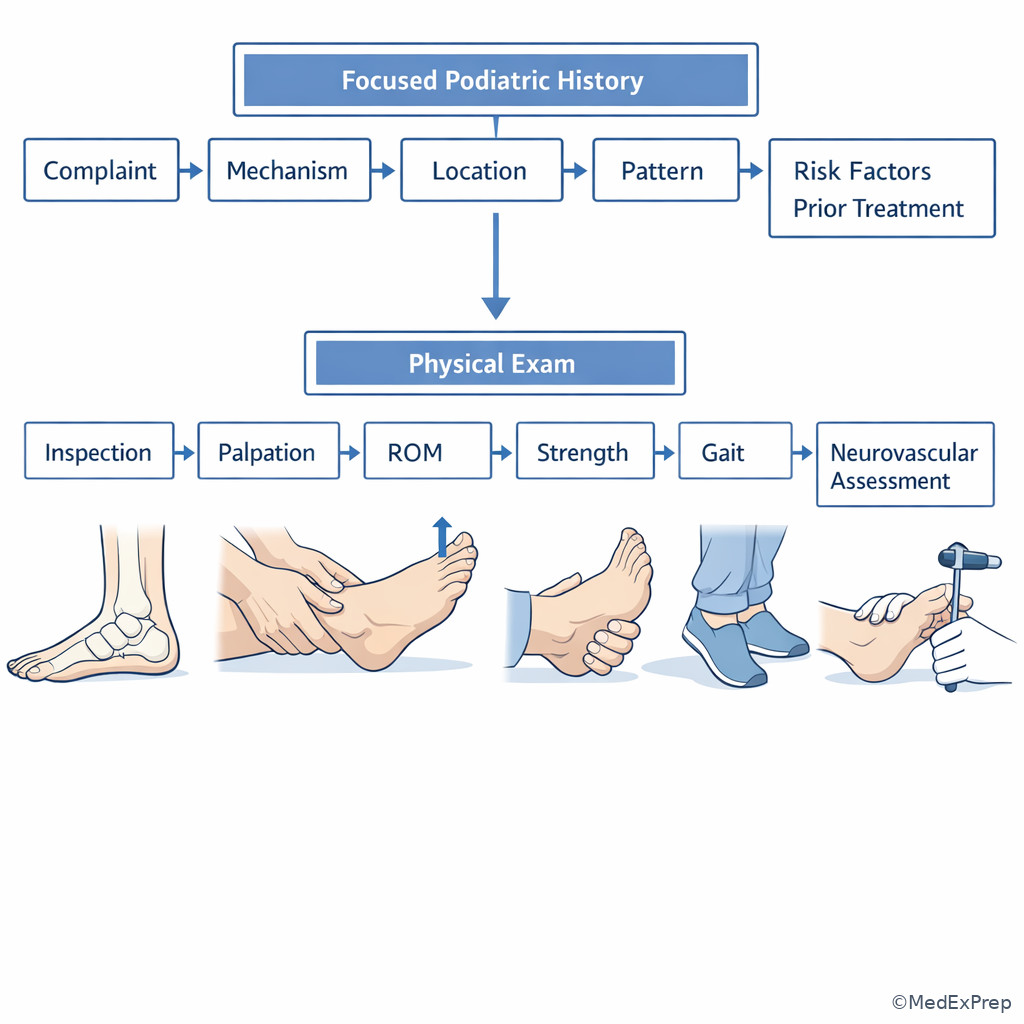
Rapid Review
- Sudden onset after twist → think trauma pathway, not chronic overload.
- Puncture through shoe → think penetrating injury/foreign body risk.
- Burning + numbness → think neuropathic process over tendinitis.
- Morning stiffness → think inflammatory more than isolated shoe-related pain.
- Fever + drainage → think infection escalation, not routine wound care.
- Rest pain + color change → think vascular compromise.
- No pain in diabetic foot complaint → neuropathy may mask severity.
- “Tried inserts” → verify what, how long, and how consistently.
- Prior ulcer/amputation → high-risk foot until proven otherwise.
- Pop + weakness → think tendon rupture pathway.
- Functional loss > pain score → stronger guide for next-step management.
- Night pain without clear mechanics → do not assume benign overuse.
Self-check quiz
1.1.1.9 Question 1
A 34-year-old woman presents with plantar heel pain for 3 weeks after increasing her daily step count. She has no diabetes and no trauma. Which history feature most strongly supports a mechanical plantar pain pattern rather than inflammatory or neuropathic disease?
- Burning with toe numbness at night
- Pain with the first few steps after rest
- Fever and progressive redness
- Rest pain with bluish discoloration
1.1.1.10 Question 2
A 48-year-old man presents with forefoot discomfort. Which additional history detail most strongly suggests a neuropathic source?
- Tingling and numbness radiating into the toes
- Pain only after long hikes
- Stiffness that is worst in the morning
- Redness with foul-smelling drainage
1.1.1.11 Question 3
A 56-year-old man with diabetes and peripheral neuropathy presents with a plantar wound present for 5 days. He denies significant pain. His wife reports new malodor and drainage. He also mentions buying tighter shoes last month. What is the most appropriate next step in reasoning?
- Reassure because absence of pain lowers concern for serious infection
- Prioritize infection-focused evaluation because neuropathy can mask severity
- Assume the wound is mechanical shoe irritation and defer further workup
- Focus only on offloading because drainage is common in superficial blisters
1.1.1.12 Question 4
A 27-year-old woman presents after an inversion injury while playing tennis. She has immediate lateral ankle pain and cannot bear weight. She has asthma and takes oral contraceptives; she also notes occasional chronic arch pain from standing at work. What is the most appropriate history-based pathway choice?
- Routine chronic overuse pathway because she already had foot pain before this event
- Trauma-focused pathway because sudden onset with inability to bear weight overrides chronic background symptoms
- Inflammatory pathway because arch pain can indicate a systemic process
- Neuropathic pathway because foot pain may radiate after sports injuries
1.1.1.13 Question 5
A 63-year-old woman with rheumatoid arthritis, obesity, and hypertension presents with bilateral ankle and hindfoot pain. Symptoms are worst upon waking and improve after she moves around. She recently bought new shoes. What is the most appropriate history interpretation?
- The shoe change is the primary clue, so a purely mechanical explanation is most likely
- Prolonged morning stiffness favors an inflammatory process over isolated shoe-related overload
- Bilateral symptoms exclude inflammatory disease and suggest neuropathy
- Improvement with movement makes serious pathology unlikely
1.1.1.14 Question 6
A 59-year-old woman with diabetes, hyperlipidemia, and prior tobacco use presents with forefoot pain. She wore tight heels to a wedding 3 days ago, but also reports calf discomfort with walking for months, new toe discoloration, and pain that now occurs at rest at night. Which is the most appropriate next-step category?
- Mechanical shoe-pressure syndrome
- Neuropathic forefoot pain syndrome
- Urgent vascular/neurovascular evaluation pathway
- Routine inflammatory arthropathy pathway
1.1.1.15 Question 7
A 41-year-old warehouse worker presents with 7 months of metatarsal pain. He has obesity and smokes. He says he “failed orthotics,” but on questioning he used a store-bought insert for 4 days and stopped because it felt awkward. He now cannot finish a full shift standing. Which is the most appropriate interpretation of his treatment history?
- He has failed adequate conservative care because symptom duration is long
- He has not yet completed an adequate diagnosis-matched conservative trial
- He requires urgent vascular referral because smoking changes every chronic pain case into an ischemic emergency
- His functional limitation proves that surgery is now the only reasonable option
1.1.1.16 Question 8
A 66-year-old man with chronic kidney disease, diabetes, and long-term prednisone use presents with heel pain. He reports stepping on a nail through his work boot 4 days ago. He thought it was minor, but now has worsening swelling and subjective chills. He had plantar fasciitis years ago and says this “feels sort of similar.” What history element most strongly requires immediate clarification and pathway change?
- Remote history of plantar fasciitis
- Pain located in the heel
- Penetrating injury with progressive symptoms and systemic features in a high-risk host
- Use of work boots
Answer key
1.1.1.17 Question 1 Answer: B
A. Burning with toe numbness at night: Tempting because heel and forefoot complaints can overlap in board stems. It is incorrect here because burning and numbness are neuropathic clues, not the classic mechanical plantar pattern. The single stem clue that discriminates is burning/numbness. Source: Jameson et al.; Current Medical Diagnosis & Treatment.
B. Pain with the first few steps after rest: Tempting because it seems almost too classic, but it is correct because first-step pain is a key mechanical pattern clue for plantar heel pain. The single discriminating clue is pain after rest/start-up pain. Source: McGlamry's Comprehensive Textbook of Foot and Ankle Surgery; First Aid for the USMLE Step-style musculoskeletal pattern recognition.
C. Fever and progressive redness: Tempting because inflamed tissue can be painful, but these findings point toward infection rather than a simple mechanical pattern. The discriminator is constitutional/infectious features. Source: Harrison's Principles of Internal Medicine.
D. Rest pain with bluish discoloration: Tempting because severe foot pain may be overinterpreted as inflammation, but this is incorrect because rest pain plus color change suggests vascular compromise. The discriminator is ischemic rest pain. Source: AHA/ACC Peripheral Artery Disease guideline framework.
1.1.1.18 Question 2 Answer: A
A. Tingling and numbness radiating into the toes: Tempting because several forefoot disorders can radiate discomfort, and it is correct because paresthesia strongly favors neuropathic or nerve-entrapment pathology. The discriminating clue is sensory symptoms. Source: Harrison's Principles of Internal Medicine; McGlamry's.
B. Pain only after long hikes: Tempting because activity-related symptoms are common in forefoot disease, but it is incorrect because this is more consistent with mechanical overload. The discriminator is load dependence without paresthesia. Source: Current Medical Diagnosis & Treatment.
C. Stiffness that is worst in the morning: Tempting because nonmechanical timing matters, but this points more toward inflammatory disease than neuropathy. The discriminator is morning stiffness. Source: Harrison's.
D. Redness with foul-smelling drainage: Tempting because severe painful lesions can produce altered sensation, but these are infectious wound clues. The discriminator is drainage/odor. Source: IDSA diabetic foot infection principles and Harrison's.
1.1.1.19 Question 3 Answer: B
A. Reassure because absence of pain lowers concern for serious infection: Tempting because severe infection is often painful in patients without neuropathy. It is incorrect because diabetic neuropathy can blunt pain and falsely reassure the clinician. The single discriminating clue is diabetes with peripheral neuropathy. Source: IDSA/IWGDF diabetic foot infection guidance; Harrison's.
B. Prioritize infection-focused evaluation because neuropathy can mask severity: Tempting because the stem includes shoe irritation as noise, and it is correct because drainage and malodor in a neuropathic diabetic foot should trigger high concern regardless of pain level. The discriminating clue is drainage + malodor + neuropathy. Source: IWGDF Guidelines; McGlamry's.
C. Assume the wound is mechanical shoe irritation and defer further workup: Tempting because tight shoes do cause pressure lesions. It is incorrect because the wound has infection clues and occurs in a high-risk host. The discriminator is malodor and drainage. Source: IWGDF Guidelines.
D. Focus only on offloading because drainage is common in superficial blisters: Tempting because offloading is often part of wound care. It is incorrect because offloading alone ignores evidence of infection in a high-risk patient. The discriminator is possible infected wound rather than a sterile pressure lesion. Source: Harrison's; IWGDF.
1.1.1.20 Question 4 Answer: B
A. Routine chronic overuse pathway because she already had foot pain before this event: Tempting because the stem includes background arch pain to pull you toward a chronic diagnosis. It is incorrect because sudden inversion with immediate inability to bear weight defines a trauma-first pathway. The discriminator is acute traumatic onset with inability to bear weight. Source: McGlamry's; standard trauma evaluation principles.
B. Trauma-focused pathway because sudden onset with inability to bear weight overrides chronic background symptoms: Tempting because it asks you to ignore distracting comorbid/background details, and it is correct for that reason. The discriminating clue is immediate post-injury inability to bear weight. Source: McGlamry's Comprehensive Textbook; emergency musculoskeletal assessment principles.
C. Inflammatory pathway because arch pain can indicate a systemic process: Tempting because chronic bilateral or recurrent pain sometimes raises inflammatory questions. It is incorrect because the current complaint is anchored by a discrete acute inversion injury. The discriminator is clear mechanism. Source: Harrison's.
D. Neuropathic pathway because foot pain may radiate after sports injuries: Tempting because nerve symptoms can occur after injury. It is incorrect because the stem provides no paresthesias and instead emphasizes acute trauma. The discriminator is lack of neuropathic sensory descriptors. Source: Current Medical Diagnosis & Treatment.
1.1.1.21 Question 5 Answer: B
A. The shoe change is the primary clue, so a purely mechanical explanation is most likely: Tempting because footwear changes commonly provoke symptoms. It is incorrect because prolonged morning stiffness and known rheumatoid arthritis more strongly favor an inflammatory process. The discriminator is stiffness after rest. Source: Harrison's Principles of Internal Medicine.
B. Prolonged morning stiffness favors an inflammatory process over isolated shoe-related overload: Tempting because board stems often hide the right answer behind a familiar mechanical clue, and it is correct because timing is more diagnostically powerful here than the shoe change. The discriminating clue is morning stiffness improving with movement. Source: Harrison's; rheumatologic symptom-pattern principles.
C. Bilateral symptoms exclude inflammatory disease and suggest neuropathy: Tempting because bilateral symptoms can occur in neuropathy. It is incorrect because bilateral involvement often supports systemic or inflammatory disease rather than excluding it. The discriminator is context of rheumatoid arthritis and stiffness. Source: Harrison's.
D. Improvement with movement makes serious pathology unlikely: Tempting because improvement can seem reassuring. It is incorrect because inflammatory arthropathy often improves somewhat with movement, so that pattern does not exclude disease. The discriminator is classic inflammatory timing. Source: Harrison's.
1.1.1.22 Question 6 Answer: C
A. Mechanical shoe-pressure syndrome: Tempting because the wedding-shoe detail is realistic and common. It is incorrect because months of exertional calf pain plus new rest pain and discoloration suggest vascular disease, not simple pressure. The discriminator is claudication history progressing to ischemic rest pain. Source: AHA/ACC PAD guideline; Harrison's.
B. Neuropathic forefoot pain syndrome: Tempting because diabetes can cause neuropathy. It is incorrect because the stem emphasizes color change and ischemic night/rest pain rather than burning/numbness. The discriminator is toe discoloration. Source: AHA/ACC PAD guideline.
C. Urgent vascular/neurovascular evaluation pathway: Tempting because this answer forces prioritization over common shoe-related explanations, and it is correct because the vascular features dominate the stem. The discriminating clue is rest pain at night with discoloration and prior claudication. Source: AHA/ACC PAD guideline framework; Harrison's.
D. Routine inflammatory arthropathy pathway: Tempting because rest pain can be misread as inflammatory. It is incorrect because color change and claudication are vascular, not classic inflammatory clues. The discriminator is vascular symptom pattern. Source: Harrison's.
1.1.1.23 Question 7 Answer: B
A. He has failed adequate conservative care because symptom duration is long: Tempting because chronic symptoms often lead to escalation on exams. It is incorrect because duration alone does not prove an adequate diagnosis-matched trial. The discriminator is only 4 days of inconsistent over-the-counter insert use. Source: McGlamry's; conservative management principles.
B. He has not yet completed an adequate diagnosis-matched conservative trial: Tempting because the patient claims he “failed orthotics,” and it is correct because the actual treatment exposure was too brief and nonspecific. The discriminating clue is inadequate prior treatment chronology. Source: McGlamry's; podiatric management principles.
C. He requires urgent vascular referral because smoking changes every chronic pain case into an ischemic emergency: Tempting because smoking is a real risk factor. It is incorrect because there are no ischemic history clues such as rest pain, claudication, or color change. The discriminator is absence of vascular pattern. Source: AHA/ACC PAD framework.
D. His functional limitation proves that surgery is now the only reasonable option: Tempting because inability to complete a work shift reflects meaningful disability. It is incorrect because functional limitation informs severity but does not bypass the need for an adequate conservative trial when no red flags exist. The discriminator is untested appropriate first-line care. Source: McGlamry's.
1.1.1.24 Question 8 Answer: C
A. Remote history of plantar fasciitis: Tempting because it offers a familiar prior diagnosis that fits heel pain. It is incorrect because remote similar pain does not explain a recent penetrating injury with systemic symptoms. The discriminator is current high-risk mechanism. Source: Harrison's; wound/infection assessment principles.
B. Pain located in the heel: Tempting because location is always relevant. It is incorrect because location alone is weaker than mechanism and systemic context. The discriminator is penetrating injury plus progression. Source: McGlamry's.
C. Penetrating injury with progressive symptoms and systemic features in a high-risk host: Tempting because it reframes the entire case away from a common heel diagnosis, and it is correct for exactly that reason. Diabetes, CKD, prednisone use, puncture wound, worsening swelling, and chills require urgent clarification and pathway change. The discriminating clue is high-risk host + puncture + systemic symptoms. Source: IDSA/IWGDF diabetic foot and infection principles; Harrison's.
D. Use of work boots: Tempting because footwear contributes to pressure and puncture scenarios. It is incorrect because boot use alone is nonspecific; the critical issue is the nail puncture and evolving infectious history. The discriminator is mechanism plus systemic progression. Source: Harrison's.
Keep going with the full APMLE Part II Prep Course (APMLE II)
You just studied the way members do, in the same lesson interface. Full access unlocks every lesson, the question bank and flashcards for a full year.
One payment · 1 year of access · No auto-renewal