Description
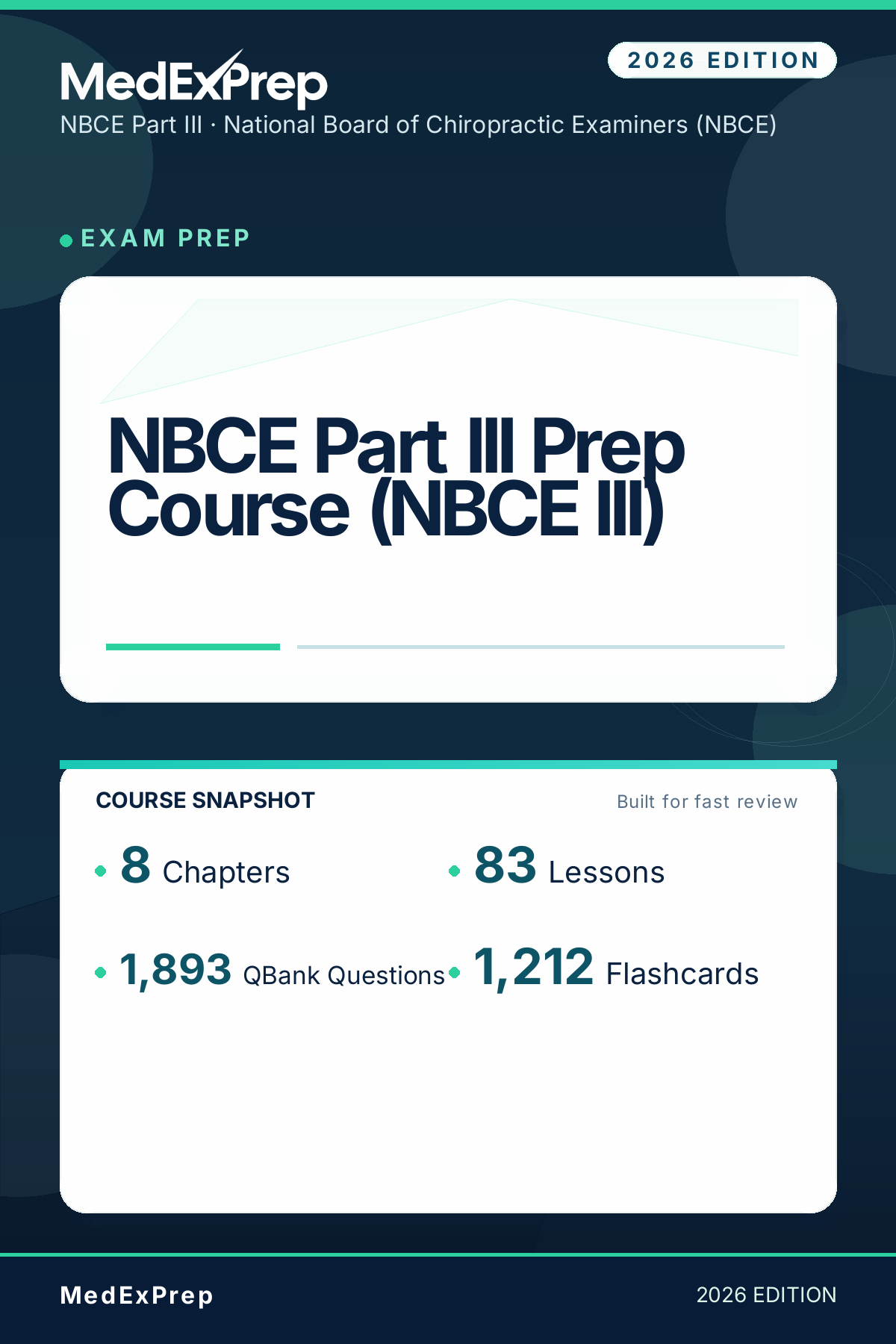
NBCE Part III Prep Course (NBCE III)
Chiropractic students and recent graduates preparing for the NBCE Part III examination; entry-level chiropractic candidates studying for a written board-style exam focused on clinical reasoning, diagnosis, case management, imaging interpretation, supportive care, contraindications, red flags, and next-best-step decision-making. Key goals: By the end of this course, learners will be able to:; Explain the published NBCE Part III content areas/competency domains and any available weighting guidance without inventing unpublished blueprint details..
Exam: NBCE Part III · Organization: National Board of Chiropractic Examiners (NBCE)
Includes: Lessons + Flashcards + QBank
Audience: Chiropractic students and recent graduates preparing for the NBCE Part III examination; entry-level chiropractic candidates studying for a written board-style exam focused on clinical reasoning, diagnosis, case management, imaging interpretation, supportive care, contraindications, red flags, and next-best-step decision-making.
Goals:
- By the end of this course, learners will be able to:
- Explain the published NBCE Part III content areas/competency domains and any available weighting guidance without inventing unpublished blueprint details.
- Master the high-yield concepts, definitions, clinical rules, contraindications, and red-flag patterns relevant to each mapped NBCE Part III domain.
- Apply concepts in realistic NBCE Part III-style clinical vignettes involving history, physical examination, diagnosis, differential diagnosis, imaging selection/interpretation, case management, supportive care, referral, and follow-up decisions.
- Use a consistent board-style reasoning framework: identify the task → extract key clinical facts → select the governing principle/rule → execute the next-best-step reasoning → verify against safety, contraindications, and likely exam intent.
- Distinguish common distractors, misconceptions, look-alike conditions, and boundary cases frequently tested in chiropractic board-prep scenarios.
- Solve applicable clinical logic, interpretation, and calculation tasks accurately when relevant, showing steps and checking plausibility rather than relying on hidden shortcuts.
- Build retrieval-ready memory using concise differential tables, management algorithms, checklists, imaging cues, contraindication summaries, and spaced-review rapid reviews.
- Demonstrate readiness through self-check questions and mini-assessments mapped to each blueprint area/content domain.
- Coverage & Blueprint Mapping Requirements:
- Every chapter/section/subsection/topic must map to at least one NBCE Part III content area, competency, or teachable subskill.
- Use consistent tags in the format DOMAIN: Objective → Subskill.
- Because publicly available blueprint detail may be broad, translate broad language into teachable subskills while staying within published NBCE Part III scope.
- Ensure complete coverage: no content domain/objective is left unmapped.
- Prioritize the following recurring domain families across the course as applicable: Clinical Sciences and Foundational Applied Knowledge; History and Physical Examination; Diagnosis and Differential Diagnosis; Case Management and Clinical Decision-Making; Imaging and Diagnostic Studies; Supportive Care, Prevention, and Patient Guidance; Contraindications, Red Flags, and Safety; Calculations, Interpretation, and Clinical Logic.
- Keep content aligned to the written-exam candidate role: safe clinical reasoning, recognition of urgent findings, appropriate management or referral, and exam-focused next-best-step decisions.
- Do not invent unpublished NBCE weighting, jurisdiction-specific requirements, or unsupported procedural expectations. If emphasis is uncertain, state: "Scope and local requirements may vary; confirm with your institution, jurisdiction, or current NBCE materials."
Access is granted immediately after purchase.