Description
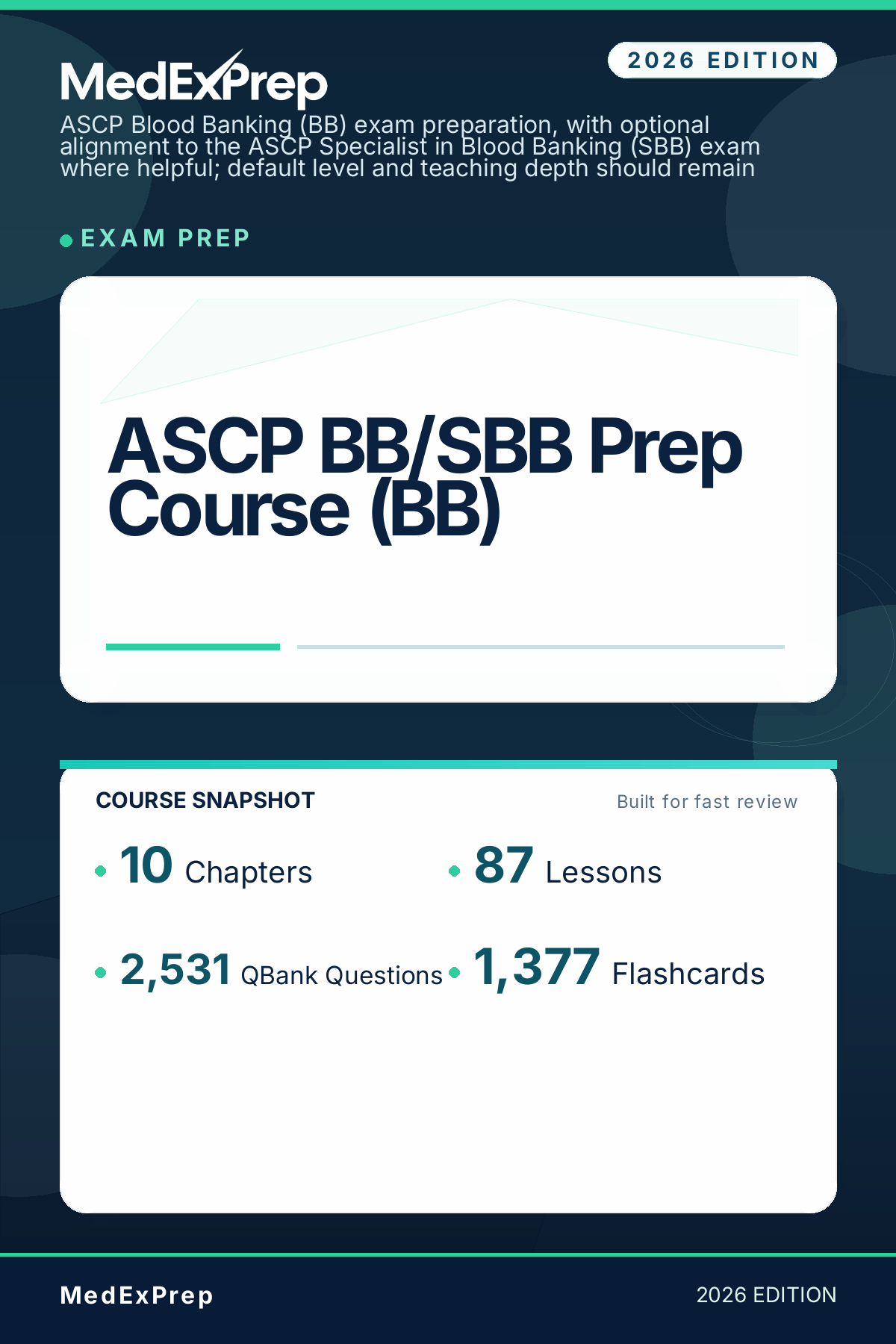
ASCP BB/SBB Prep Course (BB)
Candidates preparing for the ASCP BB/SBB examination, especially blood bank and transfusion medicine laboratory professionals seeking BB-level preparation; appropriate for MLS/MT professionals, transfusion service staff, and advanced learners who want structured review of immunohematology, compatibility testing, component selection, transfusion safety, and blood bank problem-solving. Key goals: By the end of this course, learners will be able to:; Explain the major competency areas relevant to ASCP BB/SBB blood banking preparation and how each lesson maps to explicit domain/objective/subskill tags, without assuming unverified official weighting..
Exam: ASCP Blood Banking (BB) exam preparation, with optional alignment to the ASCP Specialist in Blood Banking (SBB) exam where helpful; default level and teaching depth should remain BB-focused unless explicitly marked as SBB enrichment. · Organization: ASCP Board of Certification (BOC)
Includes: Lessons + Flashcards + QBank
Audience: Candidates preparing for the ASCP BB/SBB examination, especially blood bank and transfusion medicine laboratory professionals seeking BB-level preparation; appropriate for MLS/MT professionals, transfusion service staff, and advanced learners who want structured review of immunohematology, compatibility testing, component selection, transfusion safety, and blood bank problem-solving.
Goals:
- By the end of this course, learners will be able to:
- Explain the major competency areas relevant to ASCP BB/SBB blood banking preparation and how each lesson maps to explicit domain/objective/subskill tags, without assuming unverified official weighting.
- Master the high-yield concepts, definitions, rules, and laboratory decision principles across BB-level blood banking, including immunohematology foundations, blood group systems, pretransfusion testing, antibody identification, component therapy, transfusion reactions, perinatal testing, donor/product safety, and quality/regulatory essentials.
- Apply blood bank concepts in realistic, exam-style scenarios involving serologic interpretation, compatibility decisions, reaction workups, product selection, inventory constraints, and multi-step laboratory reasoning.
- Solve common blood-bank calculations and logic tasks accurately when applicable, showing steps clearly and verifying units, assumptions, and safety implications.
- Distinguish common distractors, misconceptions, and edge cases frequently tested in BB/SBB-style prep, such as rouleaux vs agglutination, cold interference, dosage, mixed-field reactions, recent transfusion effects, positive DAT interpretation, D variant concepts, and emergency-release tradeoffs.
- Use a consistent blood bank problem-solving framework: identify the task -> extract key serologic and clinical facts -> select the governing compatibility rule, testing principle, or safety constraint -> execute the interpretation or decision -> verify against transfusion safety and appropriateness.
- Build retrieval-ready memory using concise tables, antigen/antibody comparison charts, compatibility matrices, workup checklists, and spaced review summaries.
- Demonstrate readiness through self-checks and mini-assessments mapped to each domain/subskill, with broad BB-level coverage and explicit gap flags where official blueprint specificity is unavailable.
- Coverage and blueprint mapping requirements:
- Every chapter, section, subsection, and topic must map to at least one competency tag using the format DOMAIN: Objective -> Subskill.
- Use broad, exam-relevant blood banking domains when official blueprint wording is vague, and translate them into teachable subskills rather than inventing official language or percentages.
- Ensure no major blood banking competency area is left unmapped, including immunohematology foundations; blood group systems; ABO/Rh and discrepancy resolution; antibody screen and identification logic; compatibility and crossmatch decisions; component/product selection and modifications; transfusion practice and adverse event workups; donor/product safety; perinatal/neonatal concepts; and quality, regulatory, documentation, inventory, and utilization reasoning.
- Keep the course strictly within BB-level preparation unless a topic is explicitly labeled as enrichment. If institutional practice varies, state learner-safe guidance such as: local protocols vary; confirm with your institution.
Access is granted immediately after purchase.