Description
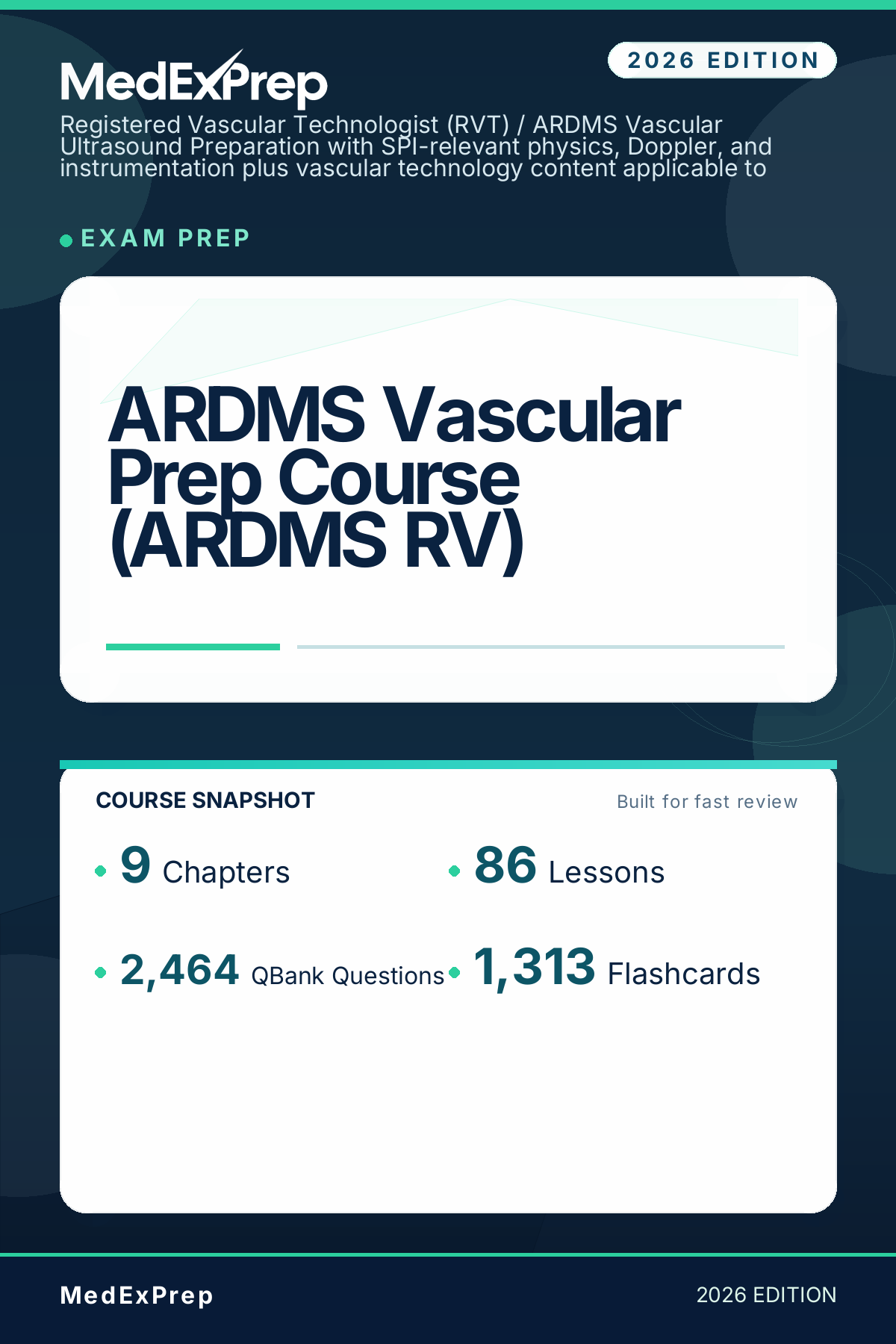
ARDMS Vascular Prep Course (ARDMS RV)
Sonography learners and clinical candidates preparing for ARDMS vascular ultrasound/vascular technology certification, including RVT-focused examinees, practicing sonographers seeking credentialing, and trainees who need exam-focused review of vascular anatomy, hemodynamics, Doppler principles, protocols, waveform interpretation, pathology recognition, instrumentation optimization, artifact differentiation, and case-based decision-making within vascular ultrasound practice. Key goals: By the end of this course, learners will be able to:; Explain the ARDMS-relevant exam framework for RVT/vascular ultrasound preparation, using current official ARDMS materials when available, and describe major content areas without inventing unpublished weights or confidential details..
Exam: Registered Vascular Technologist (RVT) / ARDMS Vascular Ultrasound Preparation with SPI-relevant physics, Doppler, and instrumentation plus vascular technology content applicable to ARDMS vascular candidates · Organization: ARDMS
Includes: Lessons + Flashcards + QBank
Audience: Sonography learners and clinical candidates preparing for ARDMS vascular ultrasound/vascular technology certification, including RVT-focused examinees, practicing sonographers seeking credentialing, and trainees who need exam-focused review of vascular anatomy, hemodynamics, Doppler principles, protocols, waveform interpretation, pathology recognition, instrumentation optimization, artifact differentiation, and case-based decision-making within vascular ultrasound practice.
Goals:
- By the end of this course, learners will be able to:
- Explain the ARDMS-relevant exam framework for RVT/vascular ultrasound preparation, using current official ARDMS materials when available, and describe major content areas without inventing unpublished weights or confidential details.
- Master high-yield vascular ultrasound concepts, definitions, normal findings, abnormal patterns, and governing rules across anatomy, physiology, hemodynamics, Doppler physics, instrumentation, protocols, waveform analysis, pathology recognition, and post-intervention surveillance concepts.
- Apply concepts in realistic exam-style scenarios, including procedural reasoning, waveform/velocity interpretation, artifact-vs-pathology differentiation, protocol sequencing, and best-next-step sonographic decision-making within candidate scope.
- Solve common Doppler and vascular logic tasks accurately when applicable, including angle-related reasoning, velocity comparison, ratio interpretation, waveform analysis, and hemodynamic consequence reasoning; show steps and avoid shortcuts that hide reasoning.
- Distinguish common distractors, misconceptions, and boundary cases frequently tested in vascular ultrasound, especially technical error vs disease, stenosis vs occlusion, acute vs chronic venous findings, high-resistance vs low-resistance flow, tortuosity vs true stenosis, aliasing vs true high velocity, and collateralization vs primary pathology.
- Use a consistent problem-solving framework: identify the vascular territory and task → extract key grayscale/color/spectral findings and clinical clues → select the governing hemodynamic or interpretation rule → execute the interpretation or next exam step → verify against expected physiology and likely pathology.
- Build retrieval-ready memory using concise tables, vessel/protocol checklists, waveform comparison charts, artifact differentiation guides, and spaced review summaries.
- Demonstrate readiness through self-check questions and mini-assessments mapped to explicit domain/subskill tags such as: DOMAIN: Physics, Doppler Principles, and Hemodynamics; DOMAIN: Instrumentation, Optimization, Artifacts, and Quality; DOMAIN: Examination Protocols and Patient Positioning; DOMAIN: Extracranial Cerebrovascular Testing; DOMAIN: Peripheral Arterial Testing; DOMAIN: Peripheral Venous Testing; DOMAIN: Abdominal Vasculature; DOMAIN: Post-Intervention, Grafts, and Stents; DOMAIN: Integrated Case-Based Reasoning.
- Coverage and blueprint-mapping requirements:
- Every chapter, section, subsection, and topic must map to at least one domain and one subskill tag using a consistent format such as 'DOMAIN: Objective -> Subskill'.
- If the official blueprint language is broad or not provided, translate it into teachable vascular ultrasound subskills and clearly label each lesson objective with its domain/subskill mapping.
- Ensure complete coverage across foundational SPI-style physics/instrumentation and vascular technology content areas relevant to ARDMS vascular candidates; no major domain/objective should be left unmapped.
- Do not invent official ARDMS percentages, scoring rules, or confidential exam details. If emphasis is uncertain, distribute coverage broadly and note that learners should confirm priorities with the current ARDMS outline.
- Stay within vascular sonography candidate scope: focus on image acquisition principles, Doppler interpretation, exam performance, technical quality, pathology recognition, documentation, safety, and appropriate sonographic reasoning; avoid physician-level treatment planning.
- When criteria or protocols vary by institution, phrase this as learner-safe guidance such as 'Local protocols vary; confirm with your institution' rather than guessing specifics.
Access is granted immediately after purchase.