Description
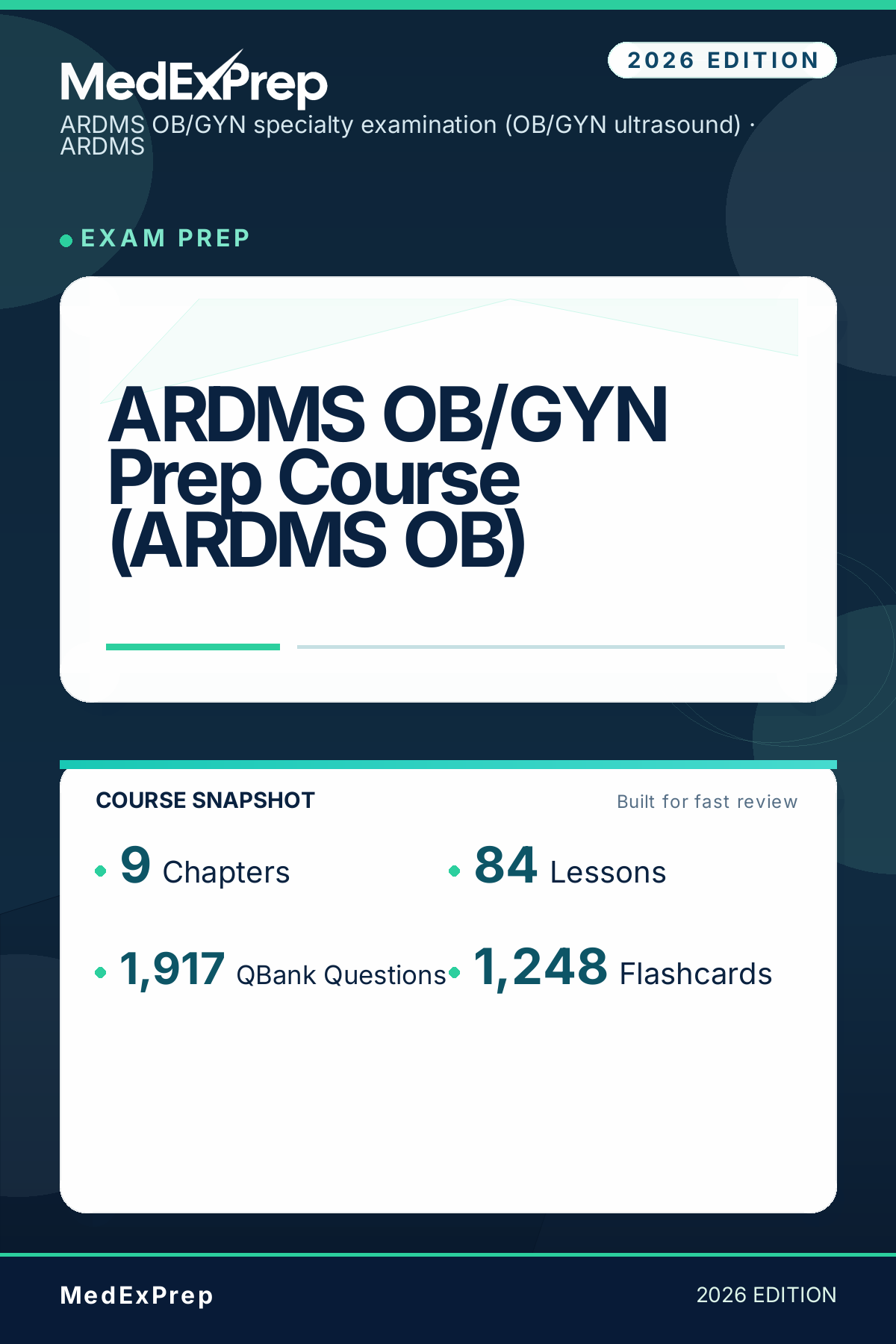
ARDMS OB/GYN Prep Course (ARDMS OB)
Sonography learners and practitioners preparing for the ARDMS OB/GYN specialty exam, including new candidates, registry-eligible examinees, and working sonographers seeking structured, exam-focused review within the sonographer scope of practice. Key goals: By the end of this course, learners will be able to:; Explain the major content domains tested on the ARDMS OB/GYN specialty examination and use a clear blueprint map for obstetric sonography, fetal anatomy/abnormalities, maternal-fetal complications, gynecologic sonography, infertility/reproductive medicine, and instrumentation/scanning technique/safety/quality..
Exam: ARDMS OB/GYN specialty examination (OB/GYN ultrasound) · Organization: ARDMS
Includes: Lessons + Flashcards + QBank
Audience: Sonography learners and practitioners preparing for the ARDMS OB/GYN specialty exam, including new candidates, registry-eligible examinees, and working sonographers seeking structured, exam-focused review within the sonographer scope of practice.
Goals:
- By the end of this course, learners will be able to:
- Explain the major content domains tested on the ARDMS OB/GYN specialty examination and use a clear blueprint map for obstetric sonography, fetal anatomy/abnormalities, maternal-fetal complications, gynecologic sonography, infertility/reproductive medicine, and instrumentation/scanning technique/safety/quality.
- Master high-yield concepts, definitions, image-recognition patterns, measurements, protocols, and sonographer-scope decision rules across OB/GYN ultrasound topics.
- Apply concepts in realistic exam-style scenarios, including image-based interpretation, protocol selection, measurement choice, dating/growth reasoning, artifact recognition, and best-next-step actions appropriate to the sonographer role.
- Perform common OB/GYN ultrasound calculations and logic tasks accurately when applicable, showing steps and verifying results against expected sonographic context.
- Distinguish commonly tested distractors, misconceptions, look-alike findings, artifacts, normal variants, and boundary cases in obstetric and gynecologic ultrasound.
- Use a consistent problem-solving framework: identify the task → extract key clinical and sonographic facts → select the governing rule/measurement/protocol → execute → verify.
- Build retrieval-ready memory using concise tables, checklists, differential grids, anatomy/measurement summaries, and spaced review recaps.
- Demonstrate readiness through self-checks and mini-assessments mapped to each major content area.
- Coverage & Blueprint Mapping Requirements:
- Every chapter, section, subsection, and topic must map to at least one ARDMS OB/GYN content domain or a consistent learner-safe tag in the format 'DOMAIN: Objective -> Subskill'.
- Do not invent unpublished ARDMS blueprint details or exact weighting percentages. If official weighting is not explicitly provided, describe emphasis qualitatively (for example: high, medium, lower) rather than claiming exact percentages.
- Ensure complete coverage across these broad areas: obstetric sonography; fetal anatomy and abnormalities; maternal/fetal complications; gynecologic anatomy and pathology; infertility/reproductive medicine; scanning protocols; instrumentation and image optimization; measurements and calculations; patient safety and quality concepts.
- When official domain wording is broad, translate it into teachable subskills and label them consistently.
- Keep all content within sonographer scope: emphasize image acquisition, anatomy recognition, measurements, protocol adherence, documentation, image optimization, and identification of findings requiring escalation; avoid physician-level treatment or prescribing.
- If a detail depends on institution or protocol variation, use learner-safe wording such as 'Local protocols vary; confirm with your institution.' rather than guessing.
Access is granted immediately after purchase.