Description
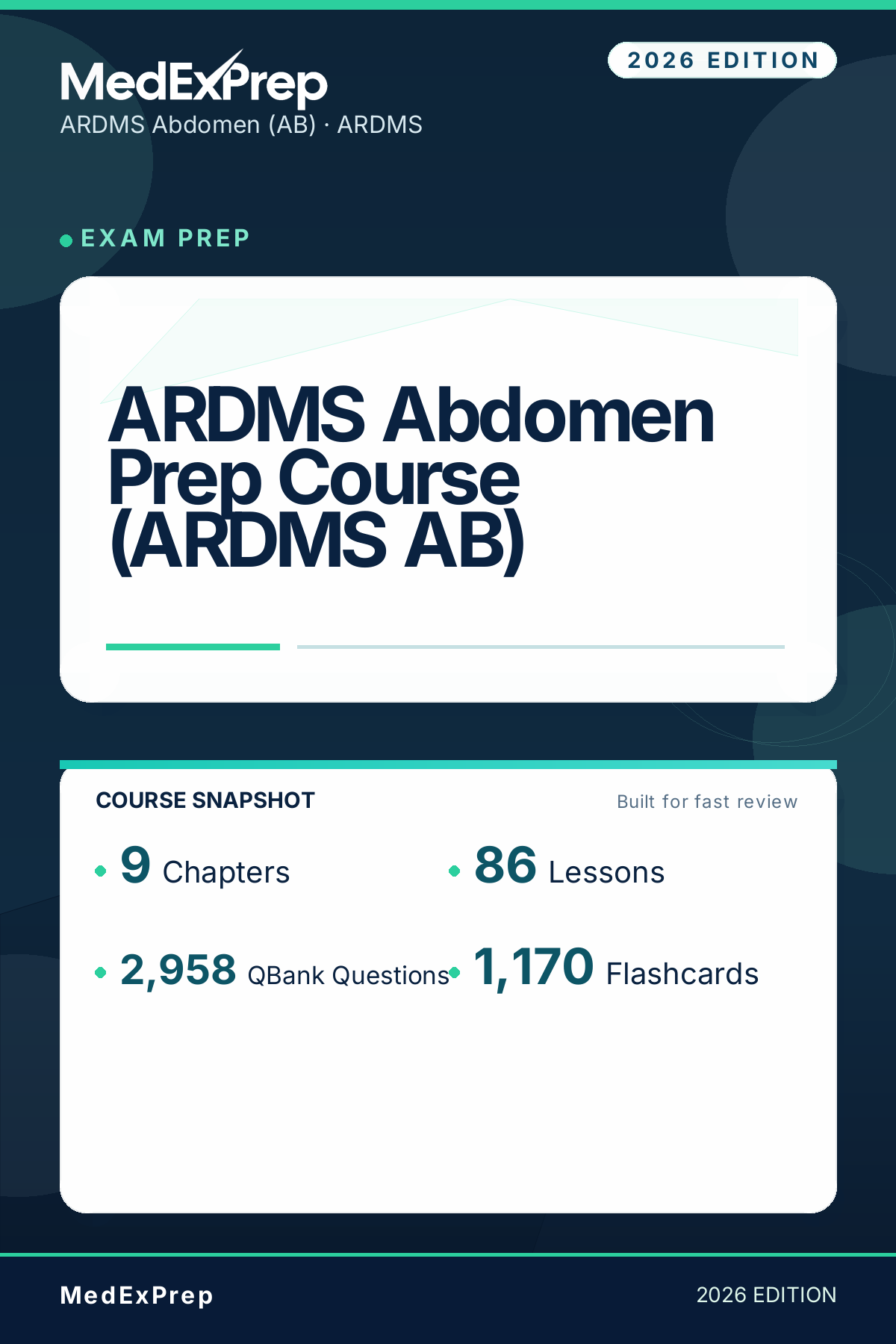
ARDMS Abdomen Prep Course (ARDMS AB)
Sonography learners and credential candidates preparing for the ARDMS Abdomen (AB) specialty exam, including current ultrasound students, recent graduates in diagnostic medical sonography, and practicing sonographers seeking focused abdomen exam preparation. Key goals: By the end of this course, learners will be able to:; Explain the publicly available ARDMS Abdomen exam framework and organize study by domain/subskill without relying on unpublished blueprint details..
Exam: ARDMS Abdomen (AB) · Organization: ARDMS
Includes: Lessons + Flashcards + QBank
Audience: Sonography learners and credential candidates preparing for the ARDMS Abdomen (AB) specialty exam, including current ultrasound students, recent graduates in diagnostic medical sonography, and practicing sonographers seeking focused abdomen exam preparation.
Goals:
- By the end of this course, learners will be able to:
- Explain the publicly available ARDMS Abdomen exam framework and organize study by domain/subskill without relying on unpublished blueprint details.
- Master high-yield abdomen sonography concepts, definitions, normal anatomy, normal variants, pathology patterns, and commonly tested criteria relevant to the ARDMS Abdomen (AB) exam.
- Apply abdomen ultrasound knowledge in realistic exam-style scenarios involving anatomy identification, protocol/view selection, image interpretation, technical optimization, artifact recognition, measurement use, and clinical correlation within the sonographer’s role.
- Distinguish common distractors, look-alikes, artifacts, pitfalls, and boundary cases that frequently appear in abdomen sonography questions.
- Use a consistent reasoning framework: identify the imaging task → extract key sonographic and clinical clues → select the governing anatomy/principle/criterion → eliminate close distractors → verify the best answer within exam scope.
- Build retrieval-ready memory using concise tables, organ-based checklists, comparison charts, flow diagrams, and spaced review summaries.
- Demonstrate readiness through self-checks and mini-assessments mapped to ARDMS Abdomen domains or learner-facing subskills.
- Coverage & Blueprint Mapping Requirements:
- Every chapter, section, subsection, and topic must map to at least one ARDMS Abdomen domain/objective or, when the public framework is broad, to a transparent learner-facing subskill tag in the format DOMAIN: Objective → Subskill.
- Ensure complete coverage across the available ARDMS Abdomen framework using teachable subskills such as abdominal anatomy and sonographic evaluation; liver; biliary system and gallbladder; pancreas; spleen; kidneys and urinary tract; abdominal vasculature; retroperitoneum and related abdominal structures; gastrointestinal and superficial abdominal findings commonly assessed by ultrasound; transplant-related abdomen topics when included; and instrumentation, optimization, and artifacts applied to abdomen ultrasound.
- Do not invent official domain weights, percentages, hidden subdomains, or unpublished scoring details.
- When framework language is broad or institution-dependent, translate it into learner-safe subskills and use notes such as “local protocols vary; confirm with your institution” rather than guessing.
- Keep all content within the ARDMS Abdomen candidate role: acquire, optimize, recognize, document, correlate, and communicate/escalate appropriately; avoid physician-level treatment framing except when recognizing urgency or the appropriate next sonographer action is relevant.
Access is granted immediately after purchase.