Description
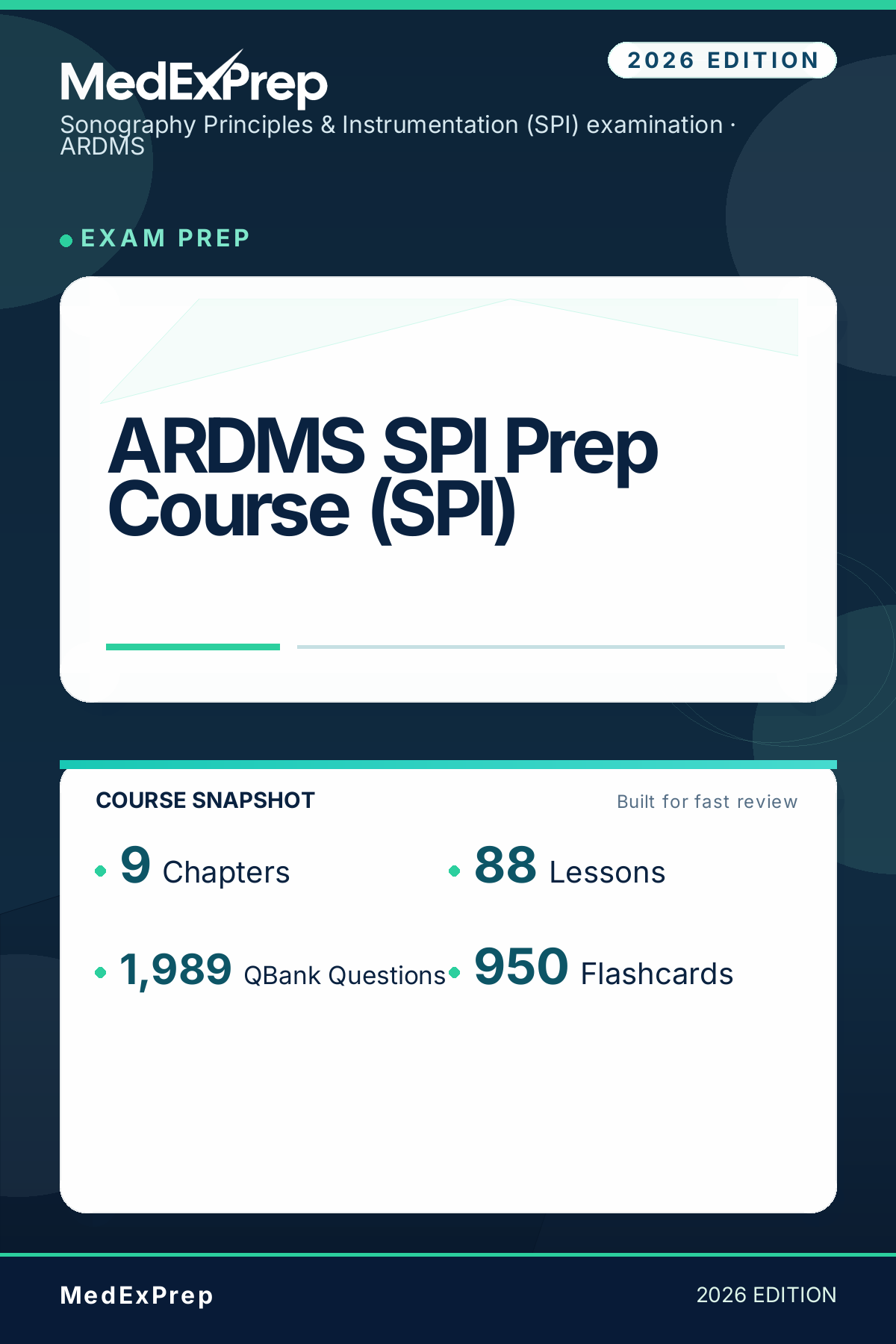
ARDMS SPI Prep Course (SPI)
Learners preparing for the ARDMS SPI exam, including sonography students, recent graduates, and working ultrasound professionals seeking to pass the physics and instrumentation exam. Key goals: By the end of this course, learners will be able to:; Explain the exam framework for the ARDMS Sonography Principles & Instrumentation (SPI) examination and organize study topics into clear, teachable domains and subskills, with explicit mapping of every lesson topic to at least one domain/objective or derived subskill tag..
Exam: Sonography Principles & Instrumentation (SPI) examination · Organization: ARDMS
Includes: Lessons + Flashcards + QBank
Audience: Learners preparing for the ARDMS SPI exam, including sonography students, recent graduates, and working ultrasound professionals seeking to pass the physics and instrumentation exam.
Goals:
- By the end of this course, learners will be able to:
- Explain the exam framework for the ARDMS Sonography Principles & Instrumentation (SPI) examination and organize study topics into clear, teachable domains and subskills, with explicit mapping of every lesson topic to at least one domain/objective or derived subskill tag.
- Master the high-yield physics and instrumentation concepts tested on SPI, including wave mechanics, pulse and beam properties, transducer function, image formation, resolution, display modes, Doppler principles, hemodynamics-related technical reasoning, artifacts, quality assurance, and bioeffects/safety.
- Apply core formulas, units, and proportional relationships accurately in exam-style problems; show steps clearly, use correct terminology, and verify whether the result is physically and clinically reasonable.
- Analyze realistic sonography operator scenarios and choose the most appropriate technical adjustment based on first principles, including changes to frequency, gain, power, depth, focus, PRF/scale, wall filter, sample volume, angle, persistence, and other image optimization controls within the sonographer’s scope.
- Distinguish commonly confused concepts and competitive distractors, such as amplitude vs intensity, power vs gain, axial vs lateral resolution, aliasing vs mirror/image duplication, focusing vs steering, attenuation vs absorption, sensitivity vs specificity of a control, and QA failure patterns vs operator error.
- Use a consistent problem-solving framework: identify the task -> extract the key technical facts -> select the governing rule, formula, or control relationship -> execute the reasoning -> verify the outcome against expected ultrasound behavior.
- Build retrieval-ready memory using concise comparison tables, parameter-effect grids, formulas with variable definitions and units, artifact recognition checklists, and spaced-review summaries.
- Demonstrate readiness through self-checks and mini-assessments mapped across all course domains, including physics calculations, Doppler reasoning, image optimization decisions, artifact identification, QA interpretation, and safety/ALARA judgment.
- Coverage & Blueprint Mapping Requirements:
- Every chapter, section, subsection, and topic must map to at least one ARDMS SPI domain/objective if provided, or to a transparent derived tag when the public blueprint wording is broad or incomplete.
- Use consistent mapping labels such as DOMAIN: Objective -> Subskill, and translate broad exam areas into teachable subskills without claiming unofficial weighting or hidden blueprint details.
- Ensure complete coverage across the practical SPI content space suggested by the exam title and provided exam spec: ultrasound physics relationships, instrumentation, transducer operation, image formation, image optimization, Doppler principles, artifacts, quality assurance, and bioeffects/safety.
- If official blueprint detail is unavailable or ambiguous, do not invent precise percentages or proprietary objective wording; instead, state learner-safe guidance and flag broad areas by teaching the full tested concept set with explicit mapping and gap-aware structure.
- Keep all teaching and questions within the role of the entry-level sonography practitioner or student as equipment operator and image-acquisition professional; when a scenario drifts into diagnosis, treatment, advanced physicist testing, or equipment repair, teach the appropriate escalation pathway rather than answering out of role.
Access is granted immediately after purchase.