Description
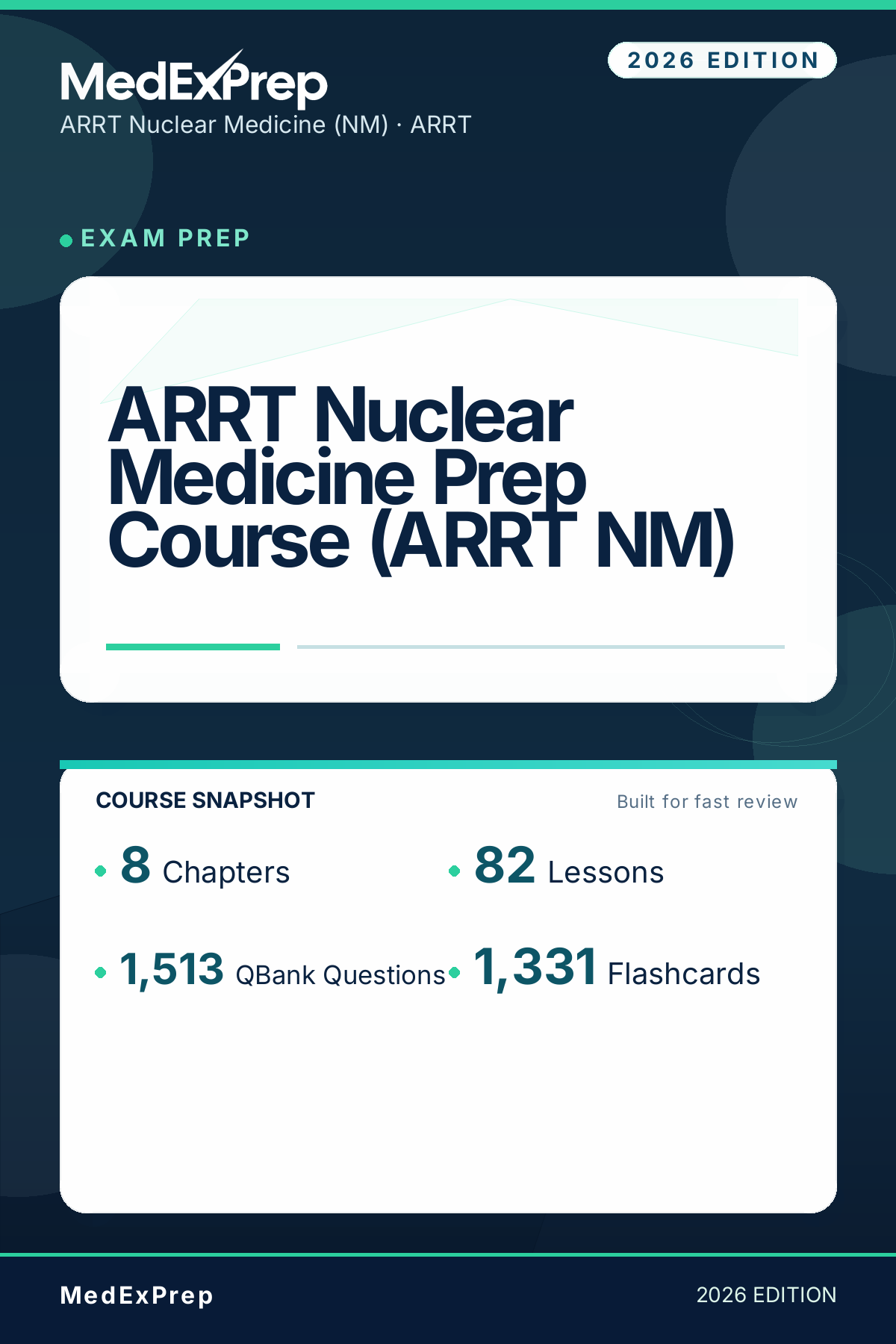
ARRT Nuclear Medicine Prep Course (ARRT NM)
ARRT Nuclear Medicine certification candidates, including first-time test takers, recent graduates of nuclear medicine technology programs, and imaging professionals seeking structured ARRT NM exam preparation. Key goals: By the end of this course, learners will be able to:; Explain the ARRT Nuclear Medicine exam scope using a learner-safe competency map and describe how major content areas connect, without claiming unpublished official weightings..
Exam: ARRT Nuclear Medicine (NM) · Organization: ARRT
Includes: Lessons + Flashcards + QBank
Audience: ARRT Nuclear Medicine certification candidates, including first-time test takers, recent graduates of nuclear medicine technology programs, and imaging professionals seeking structured ARRT NM exam preparation.
Goals:
- By the end of this course, learners will be able to:
- Explain the ARRT Nuclear Medicine exam scope using a learner-safe competency map and describe how major content areas connect, without claiming unpublished official weightings.
- Master high-yield concepts, definitions, rules, and comparisons across patient care, radiation safety, radiopharmacy, instrumentation, QC/QA, image acquisition/processing/evaluation, common diagnostic procedures, therapy-related safety concepts, and calculations.
- Apply concepts in realistic ARRT NM-style scenarios involving patient preparation, radiopharmaceutical selection, biodistribution, acquisition choices, image-quality issues, QC troubleshooting, and safe technologist actions.
- Solve common nuclear medicine calculation and logic tasks accurately when applicable, including decay, dose/timing reasoning, count/statistics concepts, and imaging parameter tradeoffs, showing steps and verifying reasonableness.
- Distinguish common distractors, misconceptions, and boundary cases frequently tested in nuclear medicine, including confusion between contamination vs attenuation vs motion, sensitivity vs resolution, contraindication vs precaution, and technical artifact vs physiologic explanation.
- Use a consistent problem-solving framework: identify the task → extract key patient/procedure/dose/timing/instrument facts → select the governing rule or physics/protocol principle → execute → verify safety, image quality, and exam logic.
- Build retrieval-ready memory using concise tables, checklists, isotope/radiopharmaceutical summaries, procedure comparisons, instrumentation/QC frameworks, and spaced review summaries.
- Demonstrate readiness through self-check questions and mini-assessments mapped to explicit competency tags.
- Coverage & Blueprint Mapping Requirements:
- Every chapter/section/subsection/topic must map to at least one competency domain and one explicit subskill tag.
- Use consistent tags in the format: DOMAIN: Topic → Subskill.
- Organize content using a learner-safe ARRT NM competency map when official blueprint wording is broad or unspecified. At minimum, ensure coverage across: Patient Care; Radiation Protection and Safety; Radiopharmacy and Radiopharmaceuticals; Instrumentation; Quality Control and Quality Assurance; Image Acquisition, Processing, and Evaluation; Diagnostic Procedures; Therapy-Related Nuclear Medicine Concepts; and Calculations and Quantitative Reasoning.
- Translate broad competencies into teachable subskills such as patient screening and prep, biodistribution recognition, radiopharmaceutical-procedure matching, collimation and detector principles, SPECT/PET basics, QC troubleshooting, artifact recognition, protocol/timing logic, and calculation workflows.
- Ensure complete coverage: no major competency area is left unmapped. If a detail is uncertain or institution-dependent, use learner-safe guidance such as “local protocols vary; confirm with your institution” rather than guessing.
- Keep all teaching and assessment aligned to the role of an entry-level nuclear medicine technologist; emphasize safe technologist actions and appropriate escalation to interpreting physicians, authorized users, physicists, or supervisors when indicated.
Access is granted immediately after purchase.