Description
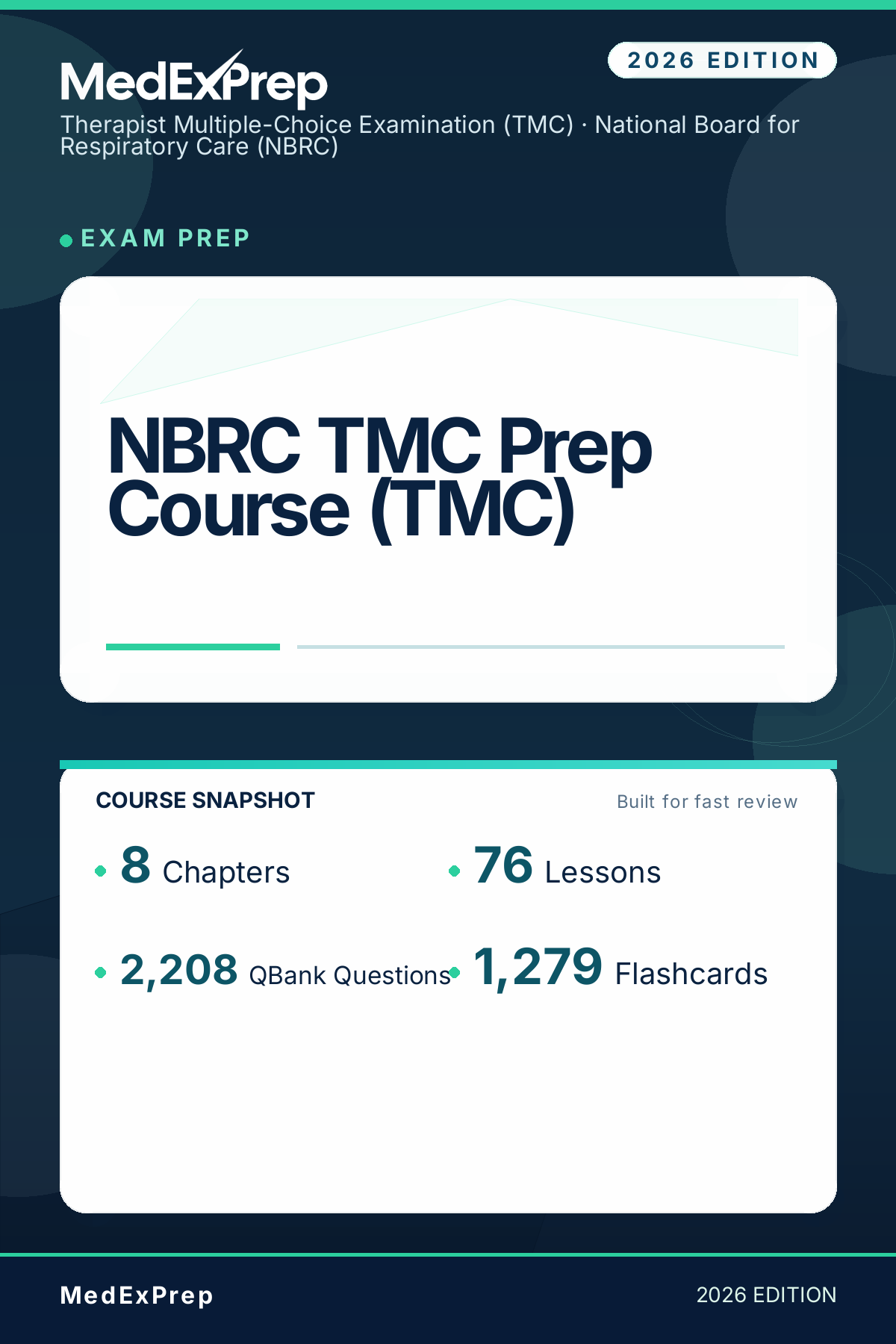
NBRC TMC Prep Course (TMC)
Respiratory therapy candidates preparing for the NBRC Therapist Multiple-Choice Examination (TMC), including recent graduates and examinees seeking CRT/RRT pathway readiness through strong TMC performance. Key goals: By the end of this course, learners will be able to:; Explain the broad competency areas relevant to the NBRC TMC and organize study using explicit domain/subskill tags rather than assumed unpublished weighting..
Exam: Therapist Multiple-Choice Examination (TMC) · Organization: National Board for Respiratory Care (NBRC)
Includes: Lessons + Flashcards + QBank
Audience: Respiratory therapy candidates preparing for the NBRC Therapist Multiple-Choice Examination (TMC), including recent graduates and examinees seeking CRT/RRT pathway readiness through strong TMC performance.
Goals:
- By the end of this course, learners will be able to:
- Explain the broad competency areas relevant to the NBRC TMC and organize study using explicit domain/subskill tags rather than assumed unpublished weighting.
- Master high-yield respiratory care concepts, definitions, normal values, device principles, and safety rules commonly tested at the entry-level respiratory therapist scope.
- Apply patient assessment findings, chart data, vital signs, ABGs, pulmonary function data, imaging clues, and equipment data to select the most appropriate respiratory care action, interpretation, or next step.
- Perform common respiratory care calculations accurately when applicable, showing steps and interpreting the result in clinical context.
- Make safe, protocol-guided decisions about oxygen therapy, aerosol/humidity therapy, airway care, bronchial hygiene, lung expansion therapy, noninvasive support, invasive ventilation, ventilator adjustment, liberation readiness, and emergency response within exam scope.
- Troubleshoot respiratory equipment, ventilator alarms, gas delivery systems, leaks, pressure problems, and patient-ventilator issues using a consistent framework: identify the task -> extract key facts -> select the governing rule -> execute -> verify.
- Distinguish common distractors, misconceptions, boundary cases, and unsafe-but-plausible answer choices frequently seen in respiratory care multiple-choice items.
- Build retrieval-ready memory using concise tables, device comparisons, ventilator mode comparisons, normal-value summaries, algorithms, checklists, and spaced review prompts.
- Demonstrate readiness through self-check questions and mini-assessments mapped to explicit TMC-relevant tags in the form DOMAIN: Objective -> Subskill.
- Coverage & Blueprint Mapping Requirements:
- Every chapter, section, subsection, and topic must map to at least one TMC-relevant domain/objective/subskill tag.
- Use teachable tags when blueprint wording is broad, in the format DOMAIN: Objective -> Subskill.
- Ensure complete practical coverage across: patient data evaluation and recommendations; laboratory/diagnostic interpretation; equipment verification and troubleshooting; infection control and safety; oxygen, aerosol, humidification, airway care, and secretion management; emergency response; mechanical ventilation setup, adjustment, troubleshooting, and liberation; neonatal/pediatric concepts at entry-level depth; and respiratory care calculations/data interpretation.
- Do not invent official NBRC blueprint percentages or unpublished wording. If detail is uncertain or practice varies, use learner-safe language such as "Local protocols vary; confirm with your institution."
Access is granted immediately after purchase.