Description
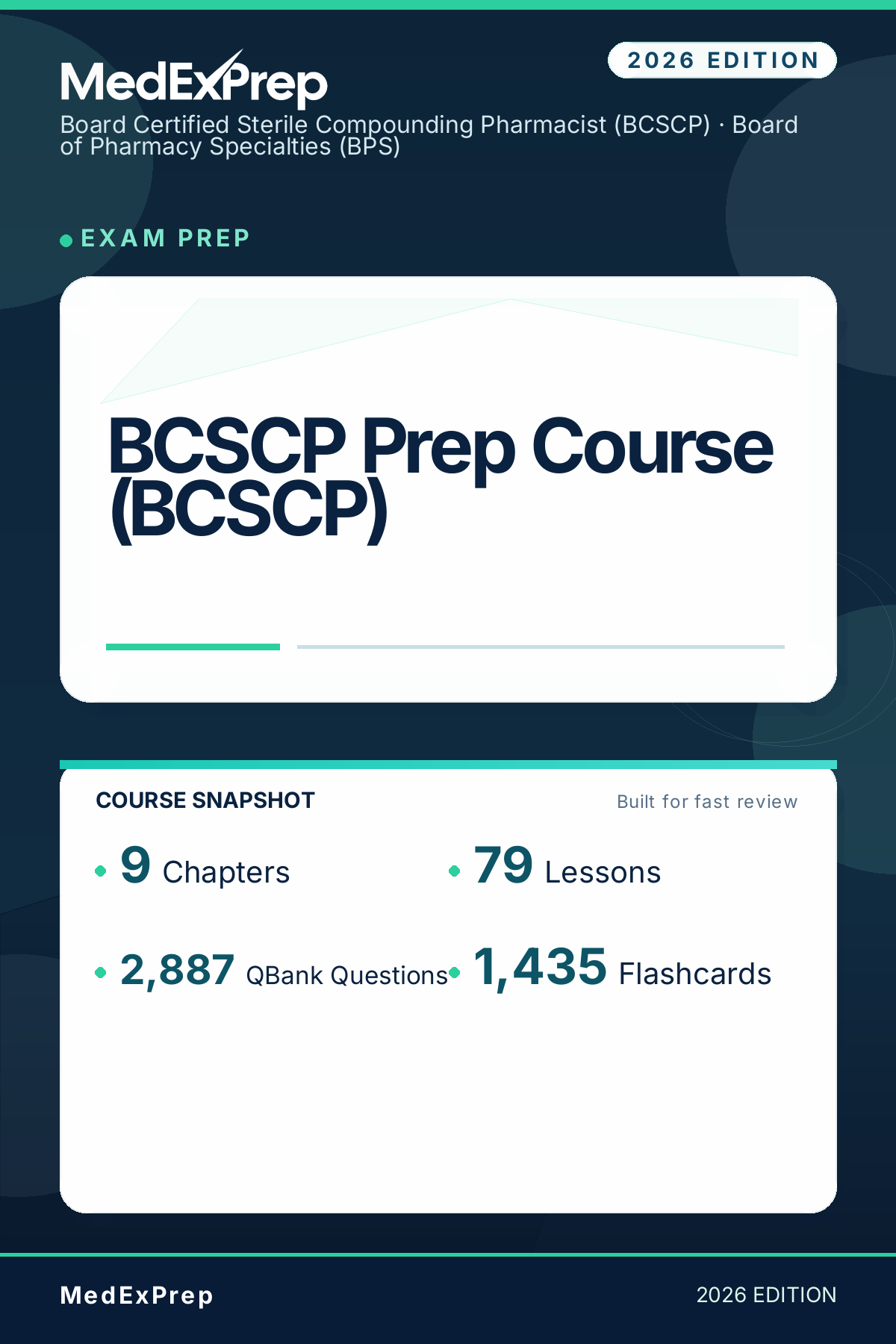
BCSCP Prep Course (BCSCP)
Pharmacists preparing for the Board of Pharmacy Specialties (BPS) Board Certified Sterile Compounding Pharmacist (BCSCP) examination, including candidates seeking initial certification and practitioners strengthening sterile compounding knowledge for exam performance. Key goals: By the end of this course, learners will be able to:; Explain the BCSCP exam focus areas and organize study using blueprint-aligned sterile compounding domains and teachable subskills; do not assume unpublished weighting if not provided..
Exam: Board Certified Sterile Compounding Pharmacist (BCSCP) · Organization: Board of Pharmacy Specialties (BPS)
Includes: Lessons + Flashcards + QBank
Audience: Pharmacists preparing for the Board of Pharmacy Specialties (BPS) Board Certified Sterile Compounding Pharmacist (BCSCP) examination, including candidates seeking initial certification and practitioners strengthening sterile compounding knowledge for exam performance.
Goals:
- By the end of this course, learners will be able to:
- Explain the BCSCP exam focus areas and organize study using blueprint-aligned sterile compounding domains and teachable subskills; do not assume unpublished weighting if not provided.
- Master high-yield sterile compounding concepts, definitions, standards-based principles, and safety rules across environmental quality, engineering controls, aseptic process design, hazardous drug handling, quality management, calculations, documentation, competency, and deviation response.
- Apply current compendial, regulatory, and institutional principles to realistic pharmacist-level sterile compounding scenarios, choosing the safest compliant action that best protects sterility, product quality, worker safety, and patient safety.
- Solve sterile compounding calculations accurately, including dose, concentration, dilution, reconstitution, volume, rate, quantity, yield, and unit-conversion problems; show setup, units, and verification steps.
- Distinguish commonly tested distractors and boundary cases, especially sterility vs stability vs compatibility, hazardous vs nonhazardous workflow requirements, environmental control decisions, garbing/aseptic technique errors, documentation gaps, and deviation-investigation priorities.
- Use a consistent pharmacist problem-solving framework: identify the task → extract key facts → determine the governing standard/principle → execute the safest compliant action → verify against sterility, quality, containment, and patient-safety priorities.
- Build retrieval-ready memory using concise tables, checklists, algorithms, process comparisons, environmental/workflow diagrams, and spaced review summaries.
- Demonstrate readiness through self-check questions and mini-assessments mapped to each domain/subskill.
- Coverage & Blueprint Mapping Requirements:
- Every chapter/section/subsection/topic must map to at least one BCSCP-relevant domain/objective or teachable subskill using a consistent tag format such as: DOMAIN: Objective → Subskill.
- If official blueprint language is broad or unavailable, translate it into learner-facing sterile compounding subskills without claiming unpublished wording or percentages.
- Ensure complete coverage: no major BCSCP-relevant domain is left unmapped, including standards interpretation, environmental quality and engineering controls, aseptic technique, hazardous sterile compounding, quality assurance/management, calculations, product evaluation/BUD and stability reasoning, investigational troubleshooting/deviation response, and documentation/training/competency.
- When requirements vary by institution, regulation, or evolving standards, write learner-safe guidance such as: "Follow current compendial, regulatory, and institutional requirements; local policies may vary." Do not guess unsupported specifics.
- Keep all teaching within pharmacist candidate scope and emphasize standards-informed judgment rather than unpublished exam trivia.
Access is granted immediately after purchase.