Description
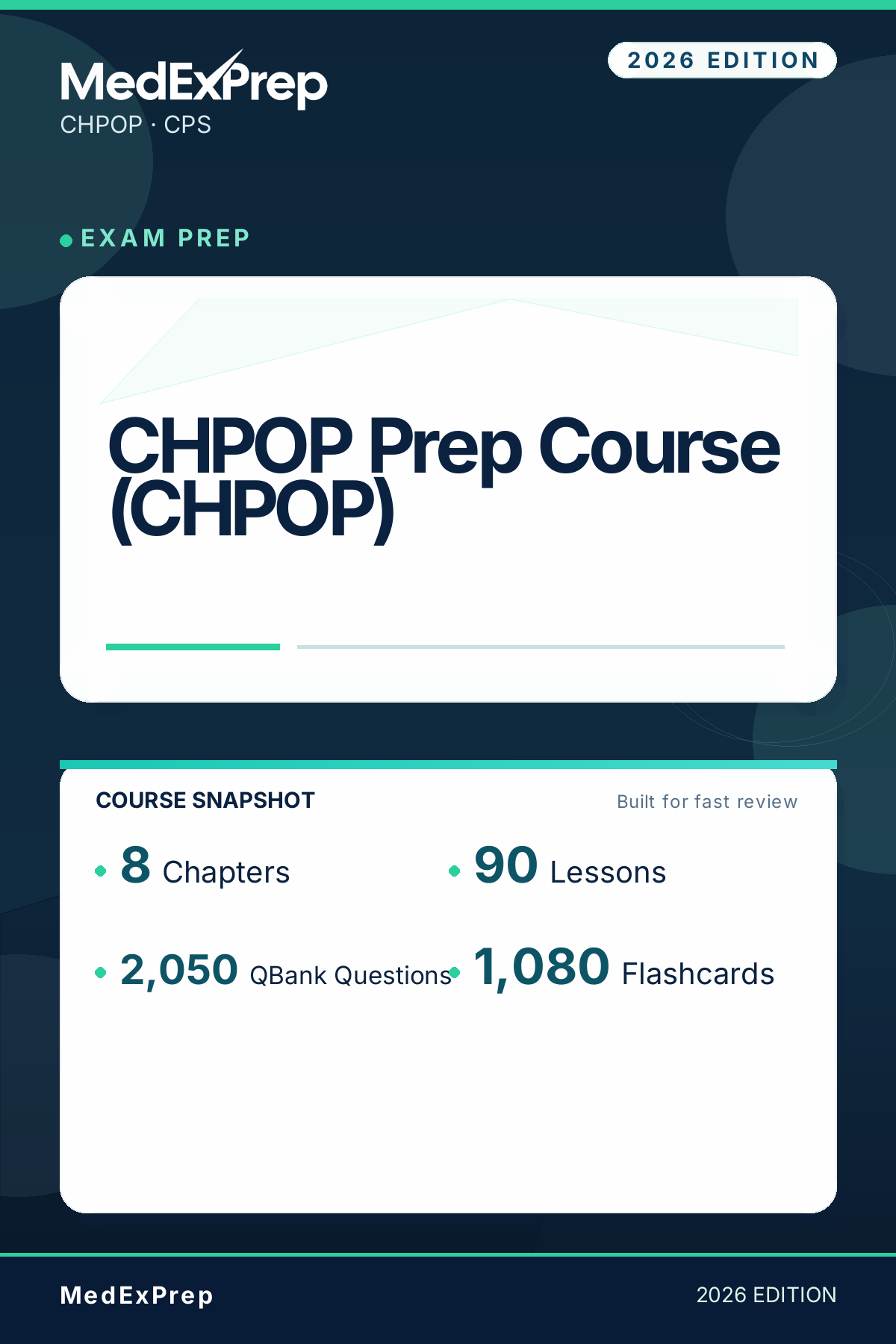
CHPOP Prep Course (CHPOP)
CHPOP candidates preparing for certification or exam assessment under CPS standards, including entry-to-practice or role-appropriate professionals seeking exam-focused mastery of CHPOP concepts, terminology, applied judgment, documentation, ethics, safety, and scope-aware decision-making. Key goals: By the end of this course, learners will be able to:; Explain the CHPOP exam blueprint, competency domains, and any stated or inferable topic weighting, and organize study using a domain-by-domain map..
Exam: CHPOP · Organization: CPS
Includes: Lessons + Flashcards + QBank
Audience: CHPOP candidates preparing for certification or exam assessment under CPS standards, including entry-to-practice or role-appropriate professionals seeking exam-focused mastery of CHPOP concepts, terminology, applied judgment, documentation, ethics, safety, and scope-aware decision-making.
Goals:
- By the end of this course, learners will be able to:
- Explain the CHPOP exam blueprint, competency domains, and any stated or inferable topic weighting, and organize study using a domain-by-domain map.
- Master the high-yield concepts, definitions, terminology, principles, and role boundaries most likely to be tested across CPS-aligned CHPOP content.
- Apply CHPOP concepts in realistic exam-style scenarios that require procedural reasoning, prioritization, judgment, documentation choices, ethics, confidentiality, safety awareness, and escalation when appropriate.
- Solve calculation, logic, sequencing, classification, or interpretation tasks accurately when applicable, showing transparent stepwise reasoning rather than hidden shortcuts.
- Distinguish common distractors, near-match concepts, misconceptions, and boundary cases, especially items that test scope limits, policy awareness, and the difference between appropriate action, referral, and escalation.
- Use a consistent problem-solving framework: identify the task -> extract key facts -> identify the governing rule, principle, or policy-aware constraint -> choose the best role-appropriate action -> verify safety, documentation, and scope alignment.
- Build retrieval-ready memory using concise tables, checklists, comparison charts, decision pathways, and spaced review summaries.
- Demonstrate readiness through self-checks and mini-assessments mapped to each CHPOP blueprint area or, when the blueprint is broad, to clearly labeled teachable subskills.
- Coverage and blueprint mapping requirements:
- Every chapter, section, subsection, and topic must map to at least one CHPOP blueprint domain, objective, or inferable CPS-aligned competency area.
- If official blueprint wording is limited or broad, translate it into teachable subskills and label each consistently as DOMAIN: Objective -> Subskill.
- Ensure complete coverage across all stated or inferable CHPOP domains; no domain/objective should be left unmapped.
- Emphasize candidate-role reasoning: what the CHPOP candidate should do, recognize, document, prioritize, or escalate within scope.
- When details depend on local institution, jurisdiction, employer policy, or unpublished CPS workflow, provide learner-safe guidance such as: local protocols vary; confirm with your institution.
- Do not invent official blueprint details, proprietary scoring rules, or responsibilities not clearly supported by CPS/CHPOP candidate-facing materials.
- Keep all teaching anchored to role-appropriate competence, including safety, ethics, confidentiality, accurate documentation, communication, and recognition of when consultation, referral, or escalation is required.
Access is granted immediately after purchase.