Description
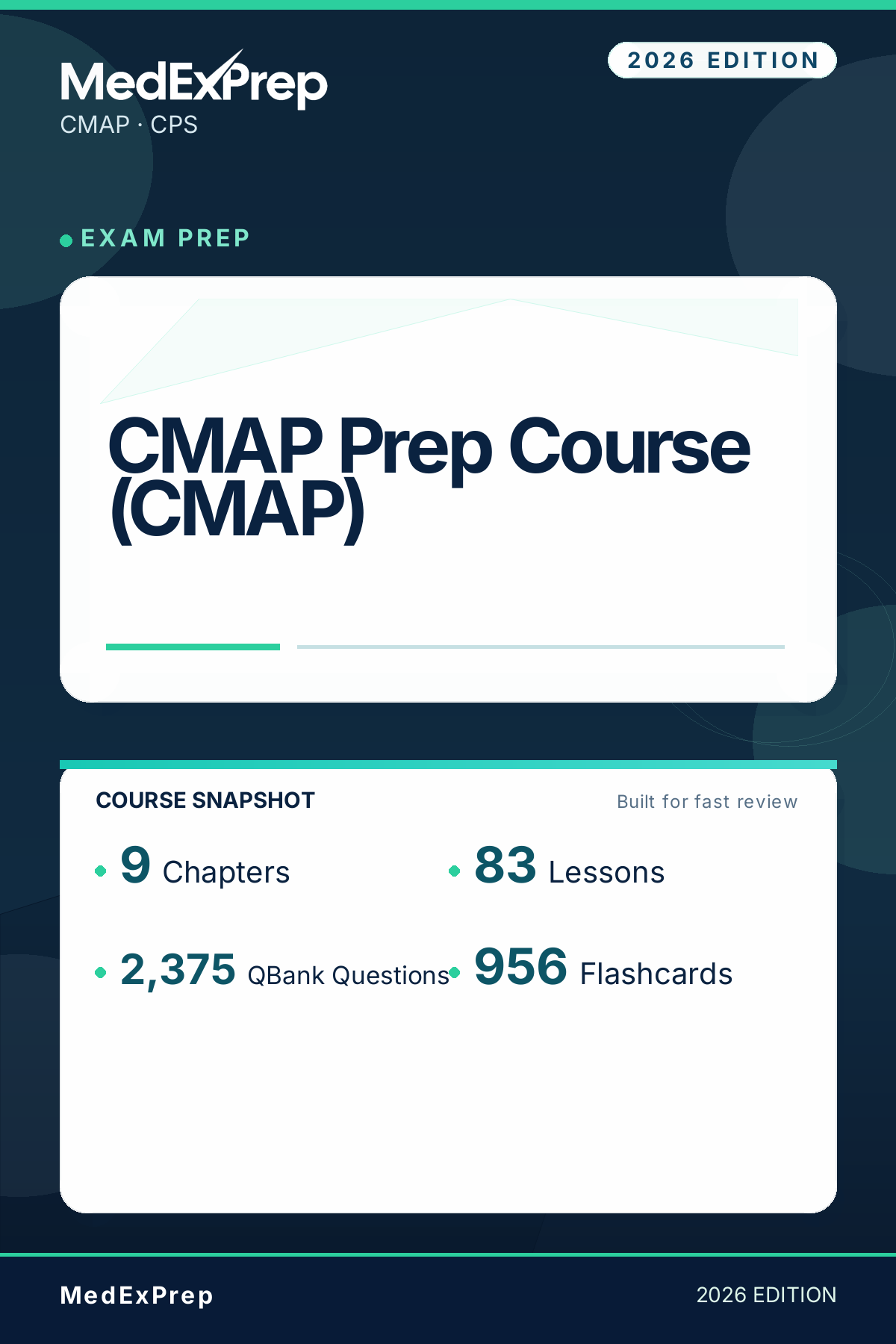
CMAP Prep Course (CMAP)
CMAP candidates preparing for a certification-style medication administration exam. Teach from the perspective of a role-limited medication administration candidate focused on safe task performance, verification, observation, documentation, communication, and escalation according to policy. Use learner-safe, role-appropriate framing and do not assume independent prescribing, diagnosis, order changes, or other duties beyond candidate scope. Key goals: By the end of this course, learners will be able to:; Explain the operational exam blueprint for CMAP preparation and how lessons map to each domain/objective, using provided weighting if available..
Exam: CMAP · Organization: CPS
Includes: Lessons + Flashcards + QBank
Audience: CMAP candidates preparing for a certification-style medication administration exam. Teach from the perspective of a role-limited medication administration candidate focused on safe task performance, verification, observation, documentation, communication, and escalation according to policy. Use learner-safe, role-appropriate framing and do not assume independent prescribing, diagnosis, order changes, or other duties beyond candidate scope.
Goals:
- By the end of this course, learners will be able to:
- Explain the operational exam blueprint for CMAP preparation and how lessons map to each domain/objective, using provided weighting if available.
- Master the high-yield concepts, terminology, safety rules, and role boundaries relevant to medication administration candidate responsibilities.
- Interpret medication-related orders, labels, schedules, and documentation requirements; identify discrepancies, missing information, and unsafe conditions for proceeding.
- Apply concepts in realistic exam-style scenarios involving verification, sequencing, issue recognition, best next action, documentation, communication, and escalation within scope.
- Solve basic medication-related calculations, timing, and label-reading tasks accurately when applicable, showing steps clearly and avoiding hidden shortcuts.
- Distinguish common distractors, misconceptions, unsafe shortcuts, and out-of-scope actions frequently tested on certification-style exams.
- Use a consistent problem-solving framework: identify the task -> extract key facts -> select the governing rule/policy -> execute the safest in-scope action -> verify and document/escalate appropriately.
- Build retrieval-ready memory using concise tables, checklists, comparison charts, algorithms, and spaced review summaries.
- Demonstrate readiness through self-check questions, mini-assessments, cumulative reviews, and scenario sets mapped to each domain.
- Operational blueprint for course coverage and mapping:
- D1: Exam Blueprint and Test Strategy
- D2: Foundations of Medication Administration
- D3: Candidate Role, Scope, and Responsibility
- D4: Orders, Labels, and Verification
- D5: Safe Administration Process and Sequencing
- D6: Observation, Issues, and Escalation
- D7: Documentation and Communication
- D8: Calculations, Timing, and Protocol Application
- D9: Error Prevention, Quality, and Review
- Coverage and blueprint mapping requirements:
- Every chapter, section, subsection, and topic must map to at least one blueprint domain/objective.
- Use a consistent tag format: DOMAIN: Objective -> Subskill.
- Translate broad blueprint language into teachable subskills without inventing official board details.
- Ensure no domain/objective is left unmapped.
- When exam specifics, local rules, or jurisdictional details are unclear, give learner-safe guidance such as following employer policy, institutional procedure, training standards, and applicable law/regulation rather than guessing.
- Keep all teaching and assessment strictly within CMAP candidate scope; when a scenario exceeds authority, the expected action is to stop, secure safety, and notify the appropriate licensed supervisor or follow policy.
Access is granted immediately after purchase.